
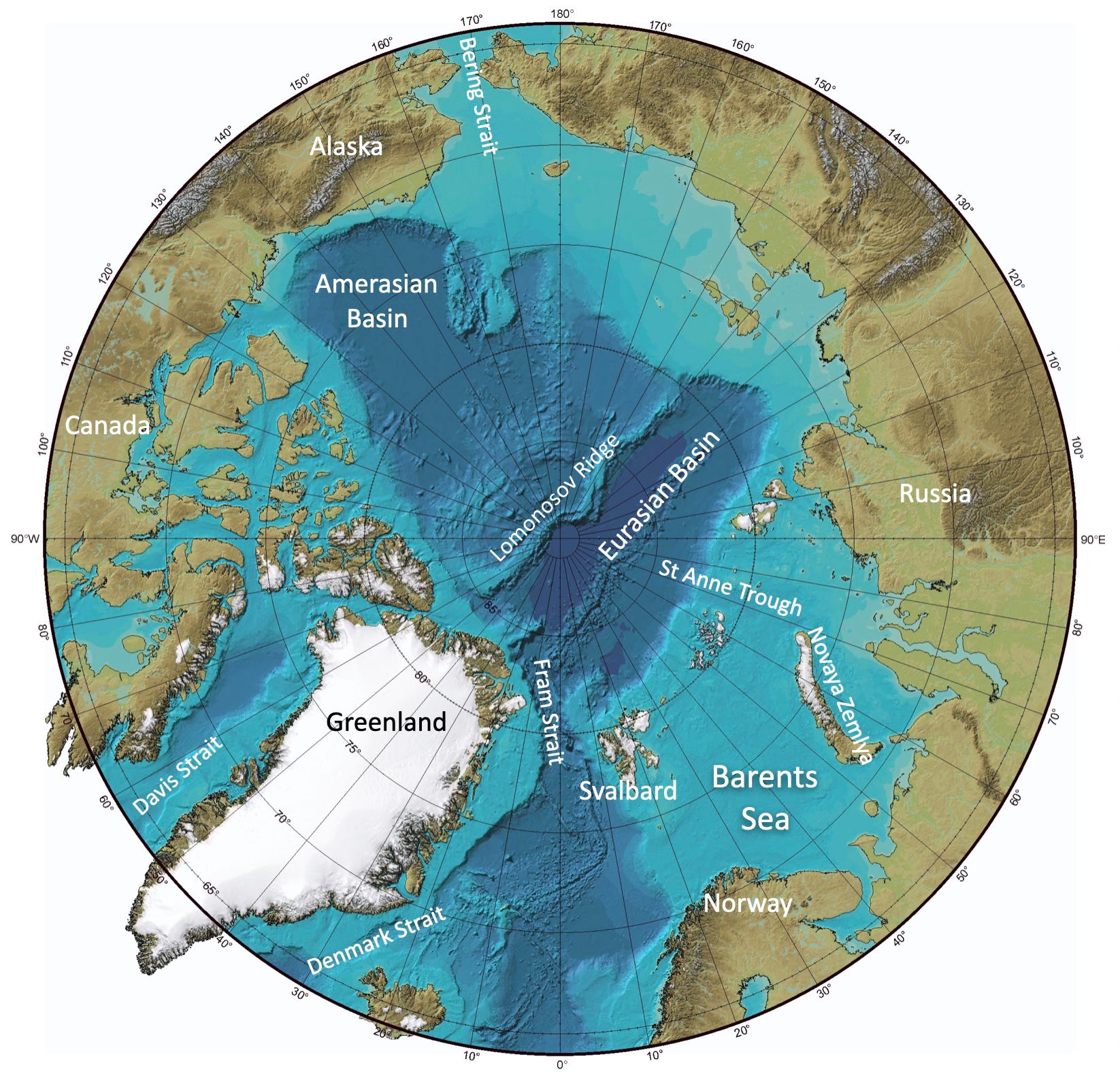
The Barents Seaway is an area of relatively shallow sea between Svalbard, Scandinavia and Novaya Zemlya with access to both the North Atlantic and Arctic Oceans. It has not always been so accessible though, according to a new paper by Kwangchul Jang et al.1 To explain the implications, we need to go back over two and a half million years.
The start of the Quaternary 2.58m years ago saw the start of the current ice age period. Since then, ice sheets have spread and contracted across the northern hemisphere according to the orbital wobbles of the Earth about the Sun. There are three such wobbles known as Eccentricity (the shape of Earths orbit from slightly elliptical to roughly circular), Obliquity (the angle of the Earth’s tilt setting the extent of the tropics) and Precession (the direction of earth’s axis of rotation).
The Eccentricity cycles over about 100,000 years, we are currently living in a time approaching its most circular. Obliquity cycles over about 41,000 years and we are currently about halfway between the minimum and maximum with the tropical lines at 23.4°. The Precession cycles over 25,800 years with the current location of the axis pointing towards the North Star.
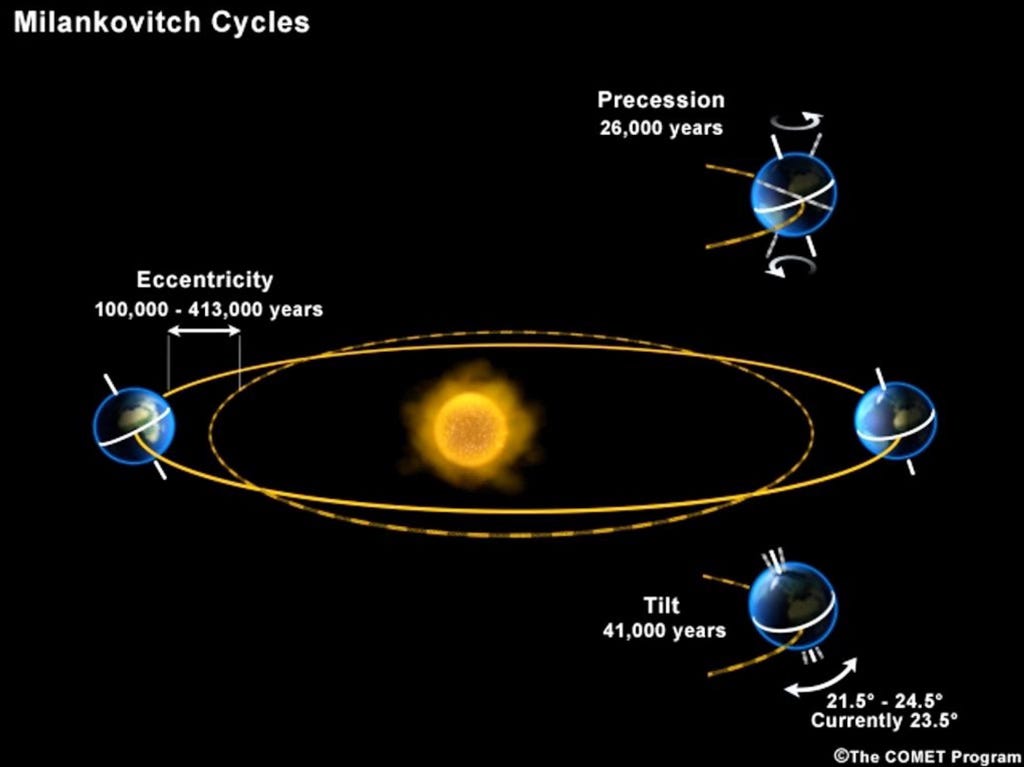
These wobbles are more commonly known as Milankovitch Cycles (figure 2). They are important because they control the hemispheric heat input from the sun as the planet moves seasonally farther and closer, facing the sun from subtly different angles. These changes in turn warm and cool the poles, controlling the timing of the glaciations and interglacials of the ice age. Incidentally these cycles have always affected the Earth’s short term climate variations. In warmer states, with higher levels of atmospheric CO₂, the cycles still adjusted how the planet behaved. It was just not cold enough to create a glaciation event.
In previous ice age periods, such as the Carboniferous (359-299Ma) the same glacial, interglacial pattern occurred. In fact the coal seams in the UK’s Forest of Dean, where I live, are layered with shallow marine limestone deposits as the then tropical landscape was alternately a low land forest (where the coal comes from) and a shallow marine basin depositing fossil bivalve rich limestone. During glaciations when the sea level was low, the forest thrived, during the interglacial warm periods the sea levels were higher, inundating the forest and marine deposits took over, burying the woody deposits where they would slowly bake to become coal.
For the first 2 million years of the current Quaternary period the glaciations occurred on a ~41,000 cycle, synchronised to the obliquity of the Earth’s orbit. Then during a period called the Mid-Pleistocene Transition (MPT) between ~1.25 and 0.7 million years ago, this pattern shifted to a ~100,000 year cycle. The causes of this change have been a hot research topic for decades (sorry).
Certainly geological evidence and ice core analysis confirms that the northern ice sheets grew substantially larger and atmospheric CO₂ levels dropped within the glaciated periods to lower levels than they had prior to the MPT, but the reasons for these changes remain debated.
The new study shows that the Barents Sea was much shallower prior to the start of the ice age, but became progressively deeper as successive ice sheets eroded it away, pushing and washing the sediment into deeper waters. Eventually a tipping point was reached where the seaway was open enough to allow a second opening of the Atlantic into the Arctic alongside the Fram Strait to the west of Svalbard.
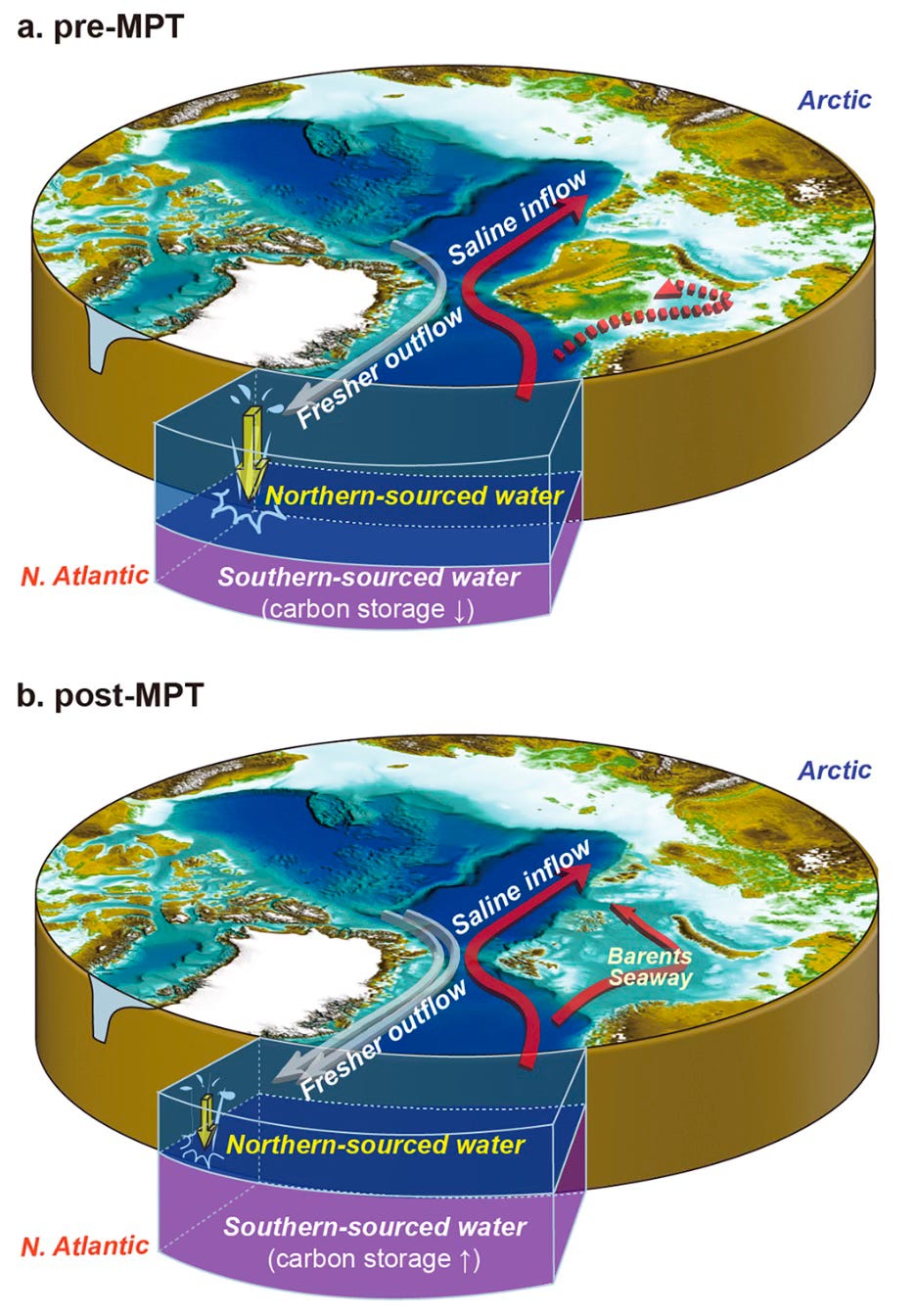
The paper suggests that this increased Arctic-Atlantic connectivity reorganised global ocean circulation. In doing so it enhanced deep-ocean carbon storage and increased moisture supply to the Arctic. These two outcomes drew down the atmospheric CO₂ levels and allowed more rain and snow to accumulate on the growing ice sheets. In a classic feedback loop, the larger ice sheets reflected more sunlight back into space, increasing the planet’s albedo, causing the energy imbalance to go negative driving further deeper cooling and triggering altitude feedbacks as the ice sheets gained height. This locked in the glaciations through the 41 kyr boundary allowing them to remain until the 100 kyr eccentricity cycle allowed sufficient sunlight to reach the northern high latitudes to trigger a deglaciation and the start of an interglacial period.
The enhanced carbon storage occurred as more carbon rich water from the south was able to enter the Arctic Ocean where it could be overturned as the waters cooled, taking the carbon to the abyss, locking it away from the atmosphere.
In combination, these feedbacks were enough to tip the planet out of the 41 kyr cycle onto the 100 kyr cycle governed by the orbital eccentricity, that has run until today.
The second recent study from Jakob Dörr et al.2 explains the importance of the Barents Sea to regional climate and its role as the northern most loop of the Atlantic Meridional Overturning Circulation (AMOC).
The deep water formed in the Arctic Ocean is the densest of the southerly flowing deep water produced by the AMOC system. Looking at the map in Figure 1, you might be excused for thinking that the Fram Strait was the key player in the story. It is, but for the deep water flow only, not for surface flow or overturning. The incoming northerly flow and the salty water that overturns to form the deep water flows mainly through the Barents Seaway.
The flat shallow sea allows the winds to very efficiently strip the remaining heat from the southerly sourced water as it flows north, creating dense salty water that then enters the Eurasian Basin, following the St Anna Trough down to the deepest parts of the Arctic. There it joins and re-mixes with the remaining flow from the Fram Strait in a loop following the Lomonosov Ridge south and out of the Fram Strait to join the Atlantic Bottom Water flowing south.
Some of the Barents water skirts past the Ridge and instead takes a long (500 year) circuit around the whole Arctic Ocean mixing with Pacific water from the Bering Strait before eventually flowing out of the Fram Strait as part of the Atlantic Bottom Water.
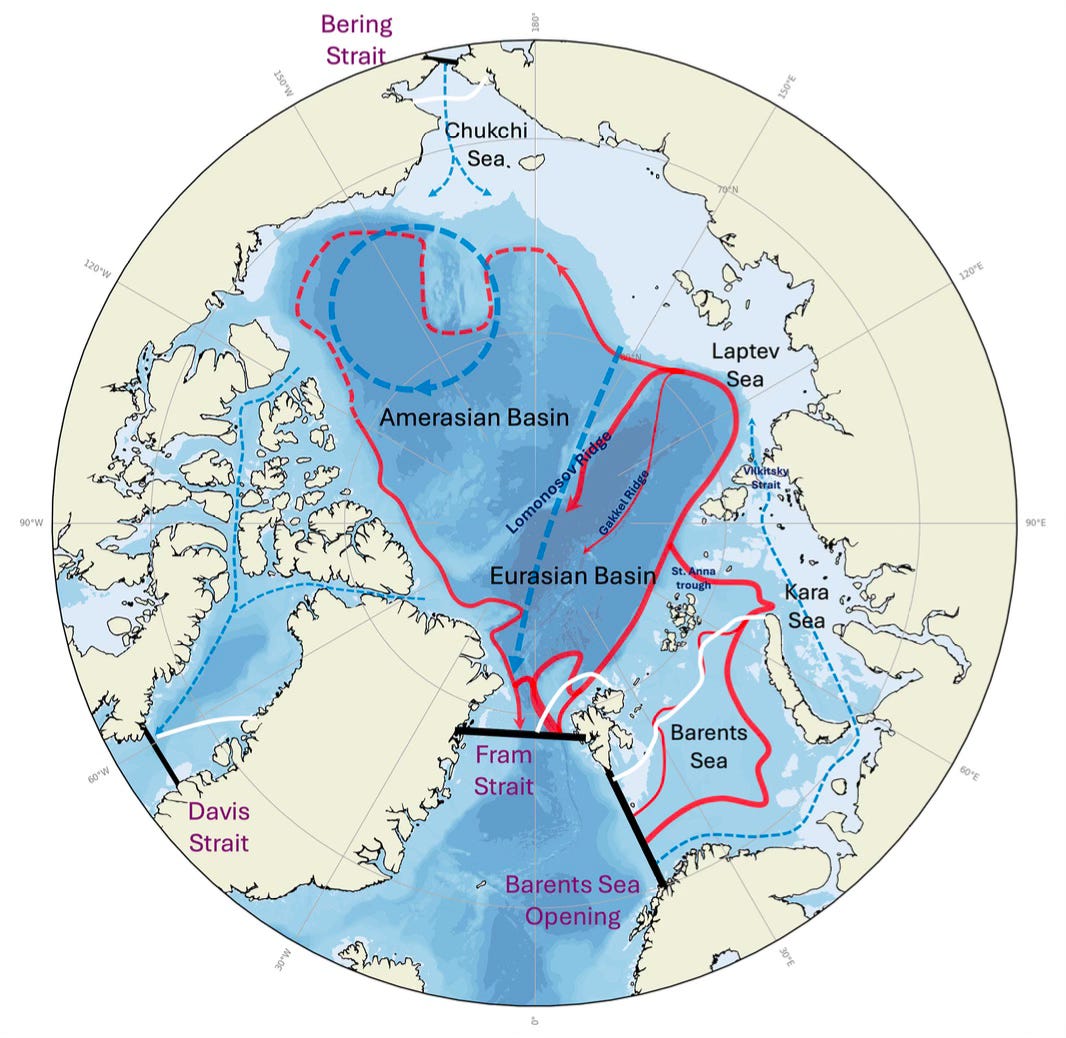
At various points on both journey routes, the water is freshened as it mixes with fresh river and ice melt supplied water and also made more salty through sea ice formation. The end result is that Atlantic Water is transformed into dense waters at a rate of 3.1Sv and into Polar Water at a rate of 1Sv. Given that the total mean AMOC flow was between 15-17 Sv annually from 2011 to 2020 (down from 18-19 Sv over 2004-08), the Arctic contribution is meaningful at ~20% of the AMOC’s total bottom water formation.
The Barents Sea role not only dominates the deep water formation thought temperature loss, it’s dense waters provide the mixing potential for the Fram Strait waters to also form deep water. 85% of the Fram Strait deep water is formed this way.
In a warming climate, the overturning circulation in the North Atlantic (i.e. the AMOC) is projected to decline as the necessary dense water formation is inhibited by warmer and fresher surface waters. In contrast, in the Arctic Ocean, sea-ice loss might lead to a stronger surface exposure of Atlantic water and hence increased dense water formation, potentially partially stabilising the northern overturning circulation, or at least providing some form of back-stop. This is likely to be well below the typical 5Sv threshold used to indicate a complete collapse of the AMOC, but could still be advantageous during the summer months when the Barents Sea is not covered in sea ice. In previous AMOC collapses during the last glaciation, much of the Barents Sea would still have been ice covered so would not have been able to provide this back-stop.
This is just one example of a relatively innocuous stretch of water on the edge of an ocean basin wielding huge power, not just in the distant past, but in shaping our whole world. How would humans have developed and spread if throughout their entire evolution since before Homo Habilis, there had been no 100,000 year glaciations, just smaller 41,000 year cycles? How might the sea protect northern Europe from a complete AMOC collapse in the decades and centuries to come? What other seemingly unimportant parts of the world affect us in ways we have not even looked into yet?
What an amazing, complex and fascinating world we live in. Pity we don’t respect it more…
If you found this article interesting or useful, please tick the ❤️ button as it helps the algorithm point more people in this direction and gives us feedback on what subjects are most useful. Thank you!
To find out more about the AMOC, you might like this article:
Dörr, J., Mans, C., Årthun, M., Döös, K., Evans, D. G., and He, Y.: The Arctic overturning circulation: transformations, pathways and timescales, Ocean Sci., 22, 565–585, https://doi.org/10.5194/os-22-565-2026, 2026.
Comments
Nothing yet. Say the first thing.
Sign in to join the conversation.