
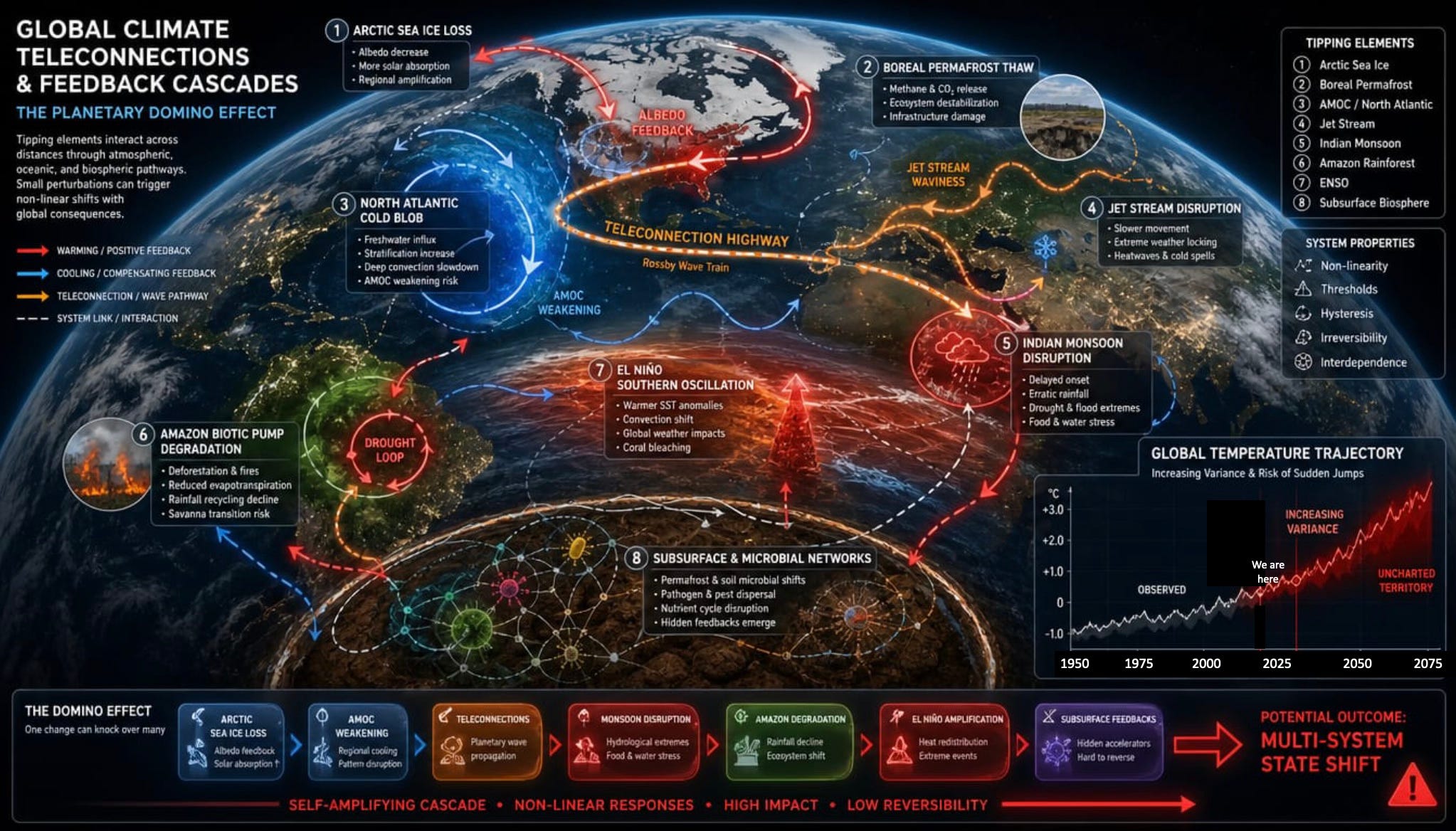
A “cold blob” has developed in the North Atlantic over recent decades, standing out as the only region of the world’s oceans that has stubbornly refused to warm. At the same time, monsoon patterns thousands of miles away have shifted dramatically across India. Northwest India now receives substantially more rain than it once did, while a coincident lack of moisture sends the fertile Indo-Gangetic Plain spiralling toward chronic drought.
Historically, these two phenomena were treated as isolated anomalies. The cold blob is linked to the Atlantic Meridional Overturning Circulation (AMOC) slowing down as less warm water is transported there and melting ice freshens the North Atlantic. The monsoon disruption is tied to shifts in the jet stream, driven by Arctic amplification narrowing the temperature gradient between the tropics and the pole.
However, a groundbreaking study has revealed that these two phenomena are not just parallel symptoms of climate change—the monsoon shift is a direct result of the Atlantic cold blob.1 Linked by a massive atmospheric teleconnection, a wind reconfiguration known as a barotropic governor mechanism strengthens the jet stream’s core while weakening adjacent regions, ultimately redistributing India’s rainfall. As we discover more about the planet’s inner workings, it is becoming clear that our shift from environmental normality is highly interconnected. These networks can provide temporary stability through dampening feedbacks, but they also possess the terrifying capacity to trigger domino-like cascading effects, leading to non-linear accelerations of global impacts.
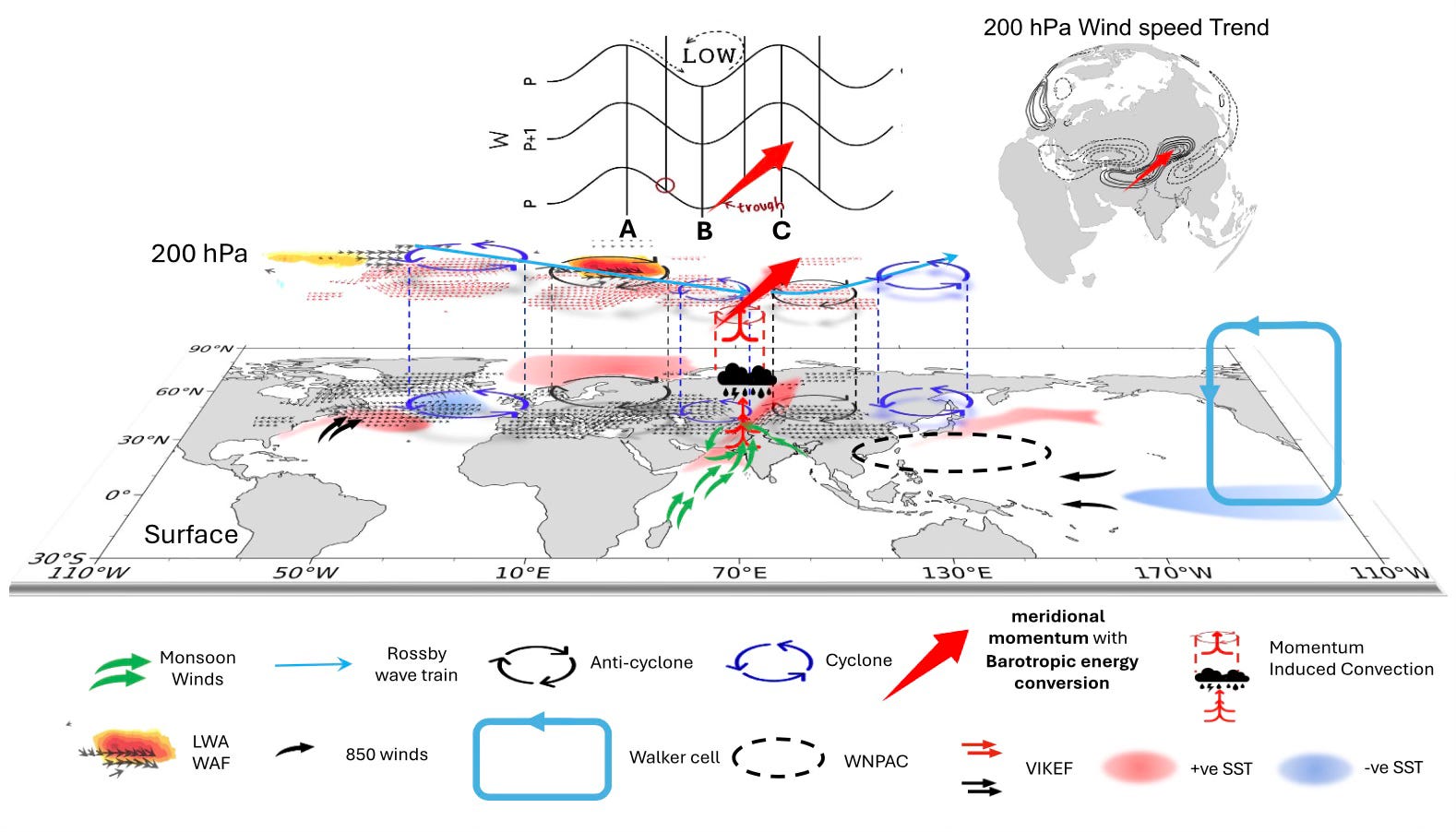
Jan has a deeper explanation of this paper here.
Whilst we recognised that global warming was intensifying extreme events. We overlooked the main principle behind the amplification of these extremes. It’s intensifying upstream events that enable downstream events to reach new, never seen before intensities. It’s a feedback cascade that operates via the dynamical parts of the system, mutually amplifying and reinforcing downstream events in time and space.2 This chain reaction is behind the recent emergence of awe-inspiring incidents that have started to pop up all over the world. Even more worrisome we are now starting to realise that Earth is an oscillatory system in which oscillations can be forced to synchronise.3
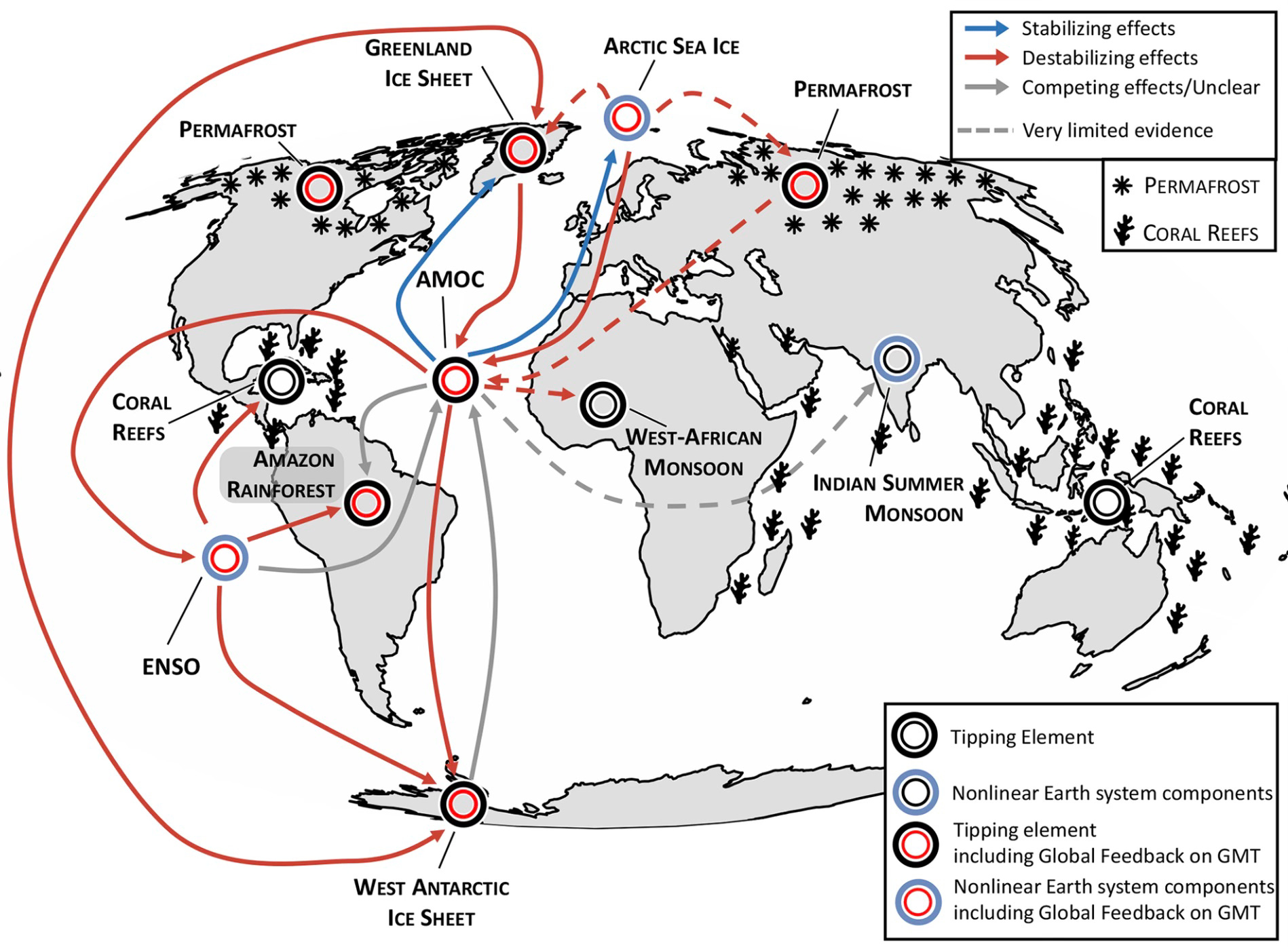
Earth is stabilised by life support systems which appear in various forms. These systems all have important functions that help to keep our climate stable. If these systems tip into another regime they can switch their function from stabilising to destabilising the Earth system. Unfortunately, if one system tips it can bring other systems closer or even past their tipping point. Such cascading tipping behaviour operates via teleconnections that exist between many of the world’s major tipping elements.
This makes the overall system potentially highly unstable, since if one passes it’s point of no return, there is a domino effect that can travel around the world, changing the status of other elements, both positively and negatively.
Figure 2 from Wunderling et al. shows the links between the major tipping elements, red lines indicating destabilising connections and blue indicating stabilising connections.4 (This is from a 2024 paper, so the link between AMOC and Indian monsoon is shown as having limited evidence, this may now be strengthening as discussed above.)
Science is slowly revealing that the Earth is a interlinked system in which changes on one side of the planet can have an effect all the way on the other side. Sea ice retreat interacts with circulation changes around Antarctica that can alter sea surface temperature patterns further north. These emerging ocean-atmosphere patterns then impact the tropical circulation, which can then impact circulation patterns over the Northern Hemisphere, all the way to the Arctic.
Rising and sinking motions in the atmosphere inside rotating atmospheric pressure systems connect with upper and lower air flows that are then able to undergo mutual amplification, being further reinforced by evolving surface extremes (e.g. warmer oceans can couple more strongly with the atmosphere or drying out soils, driving further temperature increases). Hence, circulation changes in one part of the system can affect, for example, surface temperature extremes in the oceans, over the land masses or the ice sheets over large distances, triggering further knock-on effects.
All the discussed tipping elements have one thing in common - that extreme weather events can trigger long lasting impacts on their behaviour. This includes marine heatwaves, or sudden alterations of ocean currents. A striking new signal at the forefront of Earth system change is the emergence of new classes of extreme events, far beyond our historical experience, or model prediction. It’s these exceptional extremes triggered by chain reactions between extreme subsystem states that are now becoming the driving force behind state shifts of important systems, such as Greenland ice mass loss, sea ice declines or the rainforests.5678
While major tipping elements like the Greenland ice sheet, the AMOC, and the Amazon rainforest are well known, emerging research continues to uncover hidden vulnerabilities within the biosphere.
A recent 2026 study exposed how retreating Arctic sea ice is triggering an ecological regime shift.9 While increased sunlight was expected to boost marine primary production, scientists discovered that nitrogen availability acts as a strict limiting factor. As vast, shallow continental shelves are exposed to sunlight, it accelerates a process called benthic denitrification, which strips essential nutrients from the seawater. By analysing two decades of data, researchers identified a distinct tipping point passed in 2009: as sea ice collapsed, nitrite levels plummeted in perfect synchrony, triggering a localised ecosystem collapse where fish populations virtually disappeared. As a knock-on, low primary production leads to low aerosol release which then affects cloud formation down-stream, and so on.
In another study just published, the tipping point of the Tibetan Plateau permafrost has been narrowed down to between 2° and 4°C.10 The region is warming 2.5 times faster than the global average, so this is getting close. The problem centers on a delicate balance between two competing processes. Plants initially thrive with a slight increase in temperature resulting in them pulling more CO₂ from the atmosphere through photosynthesis. But it simultaneously accelerates microbial decomposition in the soil, releasing carbon back into the atmosphere. The tipping point exists when the balance breaks irreversibly, with a decline in photosynthesis but an acceleration of soil decomposition. The whole cascade amplifies if fires increase non-linearly across the permafrost regions, for example if driven by soil-moisture-atmosphere feedbacks or sudden summer sea ice losses which greatly enhance their carbon emissions.11 Actually, new assessments predict values that would be near runway warming.12 The region containing 47 billion tonnes of carbon then becomes an massive unstoppable carbon source, accelerating warming in a feedback.
When one system is forced past its point of no return, it sends shockwaves through these interconnected networks, threatening a global domino effect. The danger of accelerating warming is that tipping points of important subsystems could occur within shorter time intervals. Disturbances could therefore greatly increase their interaction with other systems that lose their resilience at the same time, all operating via intensifying “weather” events synchronising at a global scale.131415
The continents form a major domain of this interconnected network. The world’s forests act as a vital global carbon sink, sequestering roughly 18% of anthropogenic CO₂ emissions annually. Beyond carbon storage, they dictate global climate states through the regional hydrology of the “biotic pump”. Undisturbed forest canopies evaporate water pumped up by deep roots, fuelling moist convection that draws in moist trade winds from the ocean to sustain rainfall far inland.
Severe, recurrent droughts have outpaced the adaptive capacity of the Amazon, leaving over 75% of the ecosystem systematically losing its baseline resilience since the early 2000s.1617 When drought limits root water access, the Soil Moisture-Temperature Cascade engages: latent heat fluxes drop, sensible heat fluxes rise, the air dries, and solar radiation heats the land surface directly.
This elevates the localised Vapour Pressure Deficit (VPD)—the dry air acts like a sponge, demanding exponentially more water to cool down. This prolongs the dry season, breaches the physiological limits of trees, and triggers mass mortality. As the forest dries, intense wildfires spread, and the resulting smoke alters cloud droplet nucleation, further suppressing rainfall.18 Crucially, the breakdown of Amazonian convection stops pulling in Atlantic trade winds. The resulting wind slowdown reduces latent heat loss over the North Tropical Atlantic, causing sea surface temperatures (SSTs) to spike—a condition that naturally induces further drought over South America, locking the Amazon into a self-amplifying loop toward a savanna state.
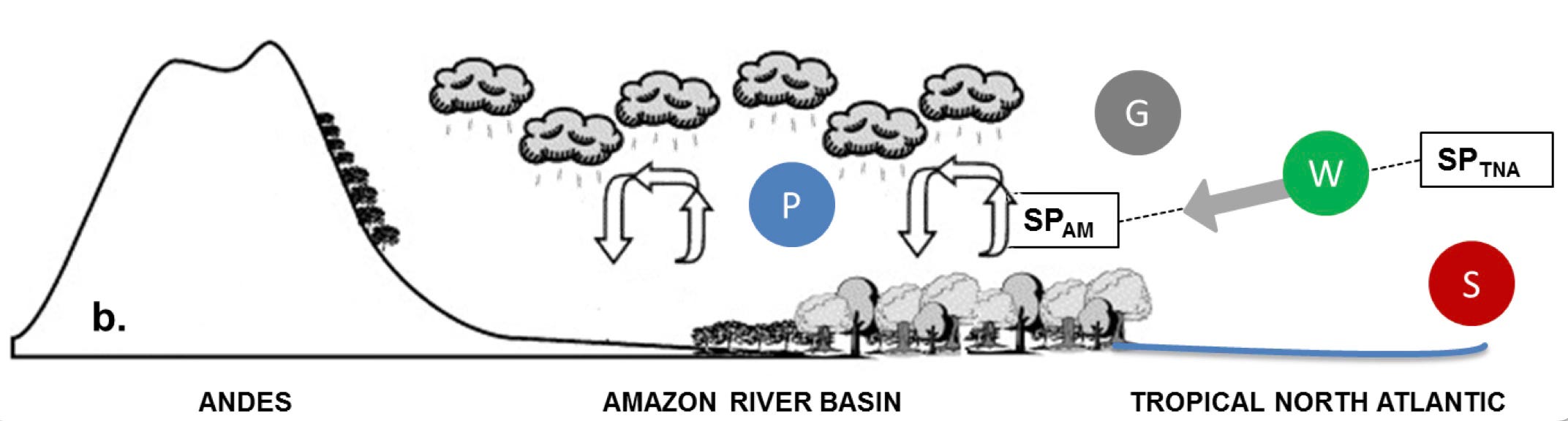
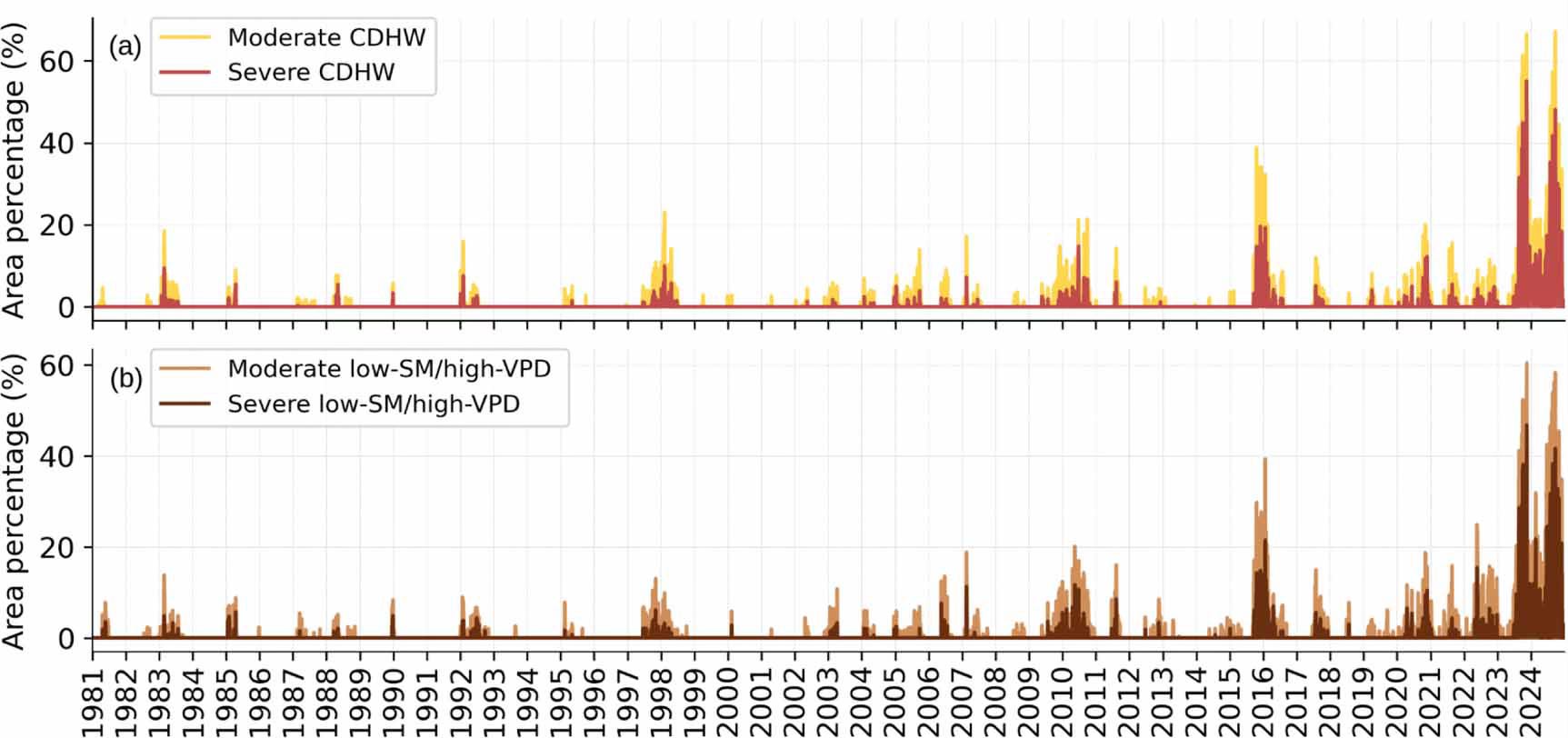
This situation is expected to tip at around 4°C of global warming, but the impact of deforestation and degradation has lowered this to below 2°C of warming if deforestation reaches 22-28% - today we have already reached 18%.19 Then in 2023/24 an highly exceptional drought, far exceeding previous levels, hit the region. It affected most of the Amazon. The main causes were hot and dry compound events (figure 4).20 You can clearly spot the El Niño years - what will a ‘super’ strong 2026 event bring?This is another example of how extreme weather is starting to become the leading cause of subsystem shifts.
This canopy level biological instability is mirrored underground. Healthy, biodiverse soil ecosystems exhibit a natural control function known as the dilution effect, where diverse microbial and fungal communities naturally suppress the transmission and proliferation of opportunistic pathogens. However, industrial agricultural runoff, pesticide overuse, and micro-plastic pollution are acidifying and contaminating global topsoils, decimating specialised microbial biodiversity.21
When these symbiotic mycorrhizal fungal and bacterial networks collapse, the structural stability of the soil fails, and net primary productivity drops. Combined with compound drought-heatwaves—which raise soil temperatures significantly faster than equivalent air temperatures—the Earth’s microbiome is losing its capacity to regulate biogeochemical flows. The resulting dry, barren topsoil is easily eroded into massive dust storms that transport airborne, heat-adapted pathogens across vast geographic distances, spreading disease to already stressed ecosystems downwind.
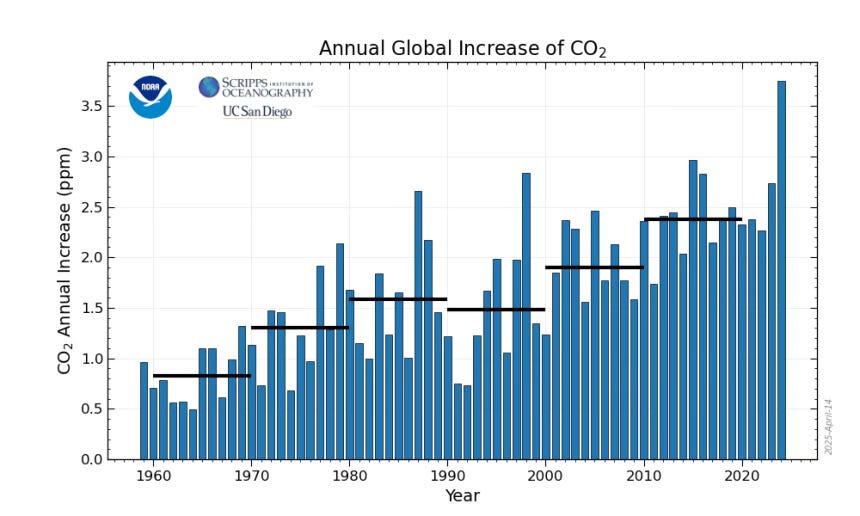
The surprise jump in atmospheric CO₂ levels in 2024 by ~3.7ppm (figure 5), could have been driven by a surprise peak in microbial organic matter decomposition (microbial respiration). One study found that hot and moist conditions drove emissions from microbial respiration to new heights, ~4.3 Gt of Carbon (although this needs further confirmation). Such a peak would be near to half our direct CO₂ emissions. They found that grass and shrub lands had been important sources.22 A second study also identified microbial respiration as the main driver. But this time under hot and dry conditions.23 Unfortunately, both studies could have a point as under both, hot/dry and hot/wet conditions, microbial respiration can increase substantially. The emerging common driver could be high temperatures, be it directly24 or indirectly.25 A recent analysis revealed that sudden shifts between wet and dry conditions drive microbial respiration as well.26 Current models could dramatically underestimate warming driven soil carbon losses,272829 as emissions are driven by hydrological extreme events of both flavours.
Temperature related hydrological extreme events driving microbial respiration to new peak heights is another striking example of weather extremes that are now starting to drive important feedback’s. Since the 2000s we have observed how hot and dry compound extremes have increased non-linearly.3031 We see similar developments occurring with extreme precipitation events that also seem to be increasing non-linearly.3233 Furthermore, weather whiplash events - fast transitions from one hydroclimatic extreme into another - show a non-linear trend as well,34 while the abrupt shifts also intensify non-linearly.35 On the planetary scale we are observing how dry and hot3637 and large scale flooding events can become globally synchronised.3839 These synchronisations become strongest during El Niño and La Niña events.40 A recent estimate saw a shift to higher rates of microbial respiration starting in the 80s by 2% per decade. It projects an increase of 40% by the end of the century in a high emission scenario, mostly driven by the Arctic,41 while in reality we could already see it accelerate through lower latitude regional drivers. Hence, if we do indeed here a strong microbial feedback in the making, the 2024 signal will repeat itself as global warming continues to accelerate, driven by the temperature jumps triggered by strong El Niño events.
The Earth’s polar cryosphere acts as our primary planetary cooling mechanism, yet a rapid feedback cascade is actively linking the degradation of both poles. Arctic Ocean sea ice volume has declined by up to 50%. Under current trajectories, exceptional extreme weather events could cause the Arctic Ocean to experience its first ice-free summer day (dropping below 1 million km2) as early as 2030, or potentially even sooner.42 In a similar way to other significant events, it is likely that the first ice-free Arctic summer will be linked to other extreme weather events elsewhere.
This rapid melting initiates powerful internal feedbacks:
The Albedo Effect: As reflective multiyear ice is replaced by open water, the exposed ocean absorbs shortwave radiation, warming the water to undermine the remaining surface ice from below.
Wildfire Feedback: Diminishing sea ice alters atmospheric pressure, creating persistent blocking configurations that drive severe mid-latitude heatwaves and massive wildfires across the Western US, Canada and Siberia. The resulting wildfire smoke deposits soot directly onto the Arctic ice sheet, darkening its surface and compounding melt rates.
Cyclonic Destabilisation: Thinner ice lacks mechanical resilience. Open water increases latent heat and moisture transport into the atmosphere, spinning up intense Arctic cyclones that mechanically fracture fragile ice flows.
The thermal feedback: Sea ice acts like a thermal barrier for downwelling long wave (LR) radiation from the atmosphere and upwelling LR from the oceans. If sea ice thins this barrier weakens. Downward LR can then warm the oceans as well as upward LR is remitted through the ice to the atmosphere driving further ice loses.
Ice-fire feedback: With declining sea ice area during the summer, water vapour production increases, supporting lighting storms over drying out and warming tundras triggering non-linear increases in fire activity. The emitted soot then deposits over the sea ice, darkening it and fuelling ice algal blooms which further drive sea ice losses, feeding back on the Arctic landscapes increasing fire potential.
A further surprise is that Northern Hemisphere sea ice loss is rapidly synchronising with the Southern Hemisphere sea ice. During 2005 and 2015 warmer, saltier water moved closer to the surface in the Southern Ocean. This shift preconditioned the upper ocean so that in 2015, just one extreme storm season was enough to trigger a regime shift. Storms mixed warmer and saltier water into the upper mixed layer. This then drove surface density looses driving further upward mixing of warm and saline waters melting the sea ice.43
This degradation has rapidly synchronised with the Southern Hemisphere. Since 2016, Antarctica has experienced unprecedented summer sea ice declines, reaching a record low in February 2023 that was 38% below the long-term average due to non-linear ocean-atmosphere coupling.44
Simultaneous ice loss at both poles intensifies the planet’s primary mode of natural variability: the El Niño-Southern Oscillation (ENSO).4546 Dynamic climate modelling reveals that combined polar ice loss induces an El Niño-like warming pattern over the tropical Pacific, driving more frequent and intense El Niño events. In a dangerous closing of the loop, these stronger El Niño regimes transfer heat back toward the poles, accelerating further ice shelf decay and trapping the high-latitude cooling systems in a global death spiral with changes at both poles playing ping pong, disturbing circulation patterns well into the other Hemisphere with each one feeding the other.
We have known all along that Earth is a highly non-linear system in which abrupt changes are not the exception but the norm. If warming rate thresholds are breached, sudden shifts not only occur more often but also intensify. It’s the rate of warming which pushes Earth’s subsystems ever faster away from the climate state they could exist in while more stable. The growing disequilibrium then forces subsystems to shift more abruptly. This principle could be at the core of the non-linearity that is now intensifying rapidly throughout the dynamical subsystems of the Earth, shifting their function from climate stabilisation to destabilisation in multiple domains. The non-linear chain reaction is now working its way upward to the planetary level.
A striking example can be seen in Sea Surface Temperatures (SST), which play a large role in regulating Earth’s climate. They are the interface between the oceans and the atmosphere and regulate the energy fluxes, both into and out of the oceans (e.g. high SSTs reduce cloud cover and fuel storms that undergo rapid intensification). The recent jump in SSTs in 2023 by more than 0.3°C had been driven by a sudden jump in area, intensity, and persistence of Marine Heatwaves (MHW). This jump had been preconditioned by an energy accumulation across the upper oceans in previous years, cloud reductions, and atmospheric circulation patterns triggering MHWs over wide parts of the oceans in 2023.47 This signal persisted into 2024 with two ocean basins - the Atlantic and Indian Ocean running simultaneously hot for some months. From July 2023 to June 2024 surface temperatures spiked at +1.58°C with a record 12 month increase of +0.36°C driven by SSTs going wild.48
All warning signs point to the fact that the oceans are overheating. In 2025 oceans accumulated a record 24 ZJ of energy. This is an eight fold increase above the 1958-1981 average of 2.9 ZJ and equivalent to 200 times the total global human energy generation for the year. The non-linear expansion, intensification, and persistence of MHWs are a warning sign to humanity that we are warming the oceans far too fast.
The warming is concentrating in the upper layers, driving faster stratification, thereby decoupling the upper from the deeper ocean layers, transforming the upper ocean into a highly efficient heat depot which the atmosphere can tap into to drive extreme weather events. MHWs are now becoming prevalent in both Hemispheres with the largest and most intense ones persisting the longest, driven by non-linear upper ocean-atmosphere interactions.49 We reached already at mean warming levels of 1.4°C climatic boundary conditions that just abnormal weak winds are now enough that whole oceans basins and marginal seas alike run hot.5051
Concurrently, we are seeing more extreme events that do not merely break previous records, but utterly smash them. The recent May heatwave in northern Europe and the UK is a stark example: reaching 35.1°C in London did not just creep past the old record; it shattered it by 2.3°C52 (As this article is posted, London is bracing for 40°C heat for the second time in 5 years, something that the Met Office said in 2020 was a 1-in-100 to 300 year event). Rainfall, heat, drought, and fire intensity are all behaving this way with sudden peaks now emerging all over the Earth system with upper ocean heat, extreme SST anomalies, and intensifying SST gradients becoming ever more often the trigger point for feedback cascades of non-linear surface-atmosphere interactions, driving these sudden peaks. These acute spikes are uniquely dangerous because they can instantly nudge a fragile planetary feedback loop beyond a threshold that a steady, linear rate of warming may not have breached until decades later. At the forefront of these are short term variations going off the charts within the time scales that weather operates within.
Predicting the exact moment an interconnected system will tip remains beyond the reach of current historical climate modelling due to complex, non-linear cross-correlations. However, complex systems theory provides distinct mathematical indicators—known as critical slowing down—that can warn that a major state shift is imminent.53
Global empirical observations suggest we are actively approaching this critical threshold. While the long-term climatological average has not yet permanently stabilised above the 1.5°C threshold, the physical Earth system breached this boundary on an annual basis in 2024, with temperatures approaching a 1.6°C warming anomaly relative to pre-industrial baselines. As of the end of May, the average global surface air temperature for the last 42 month period has been above 1.5°C.
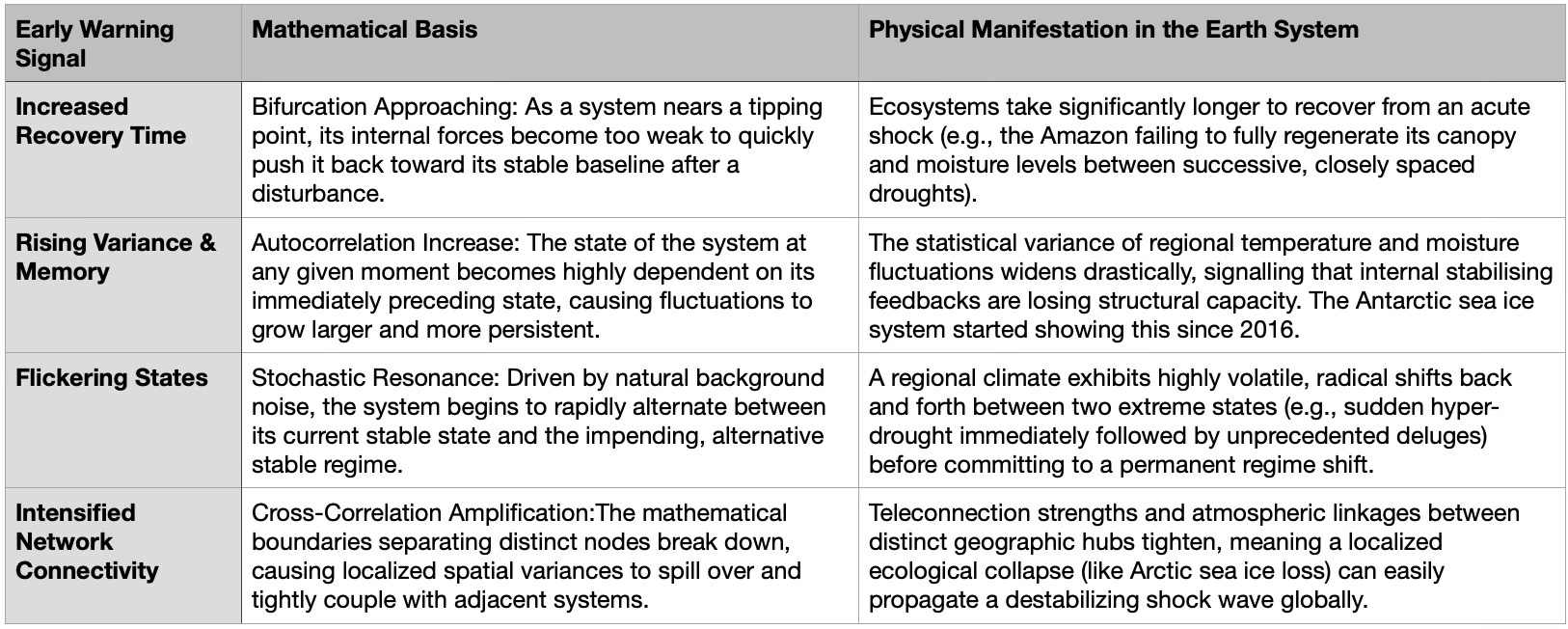
As regional tipping elements lose their individual resilience, their internal dynamics begin to align. When local environmental fluctuations synchronise into global mass and energy transfers, the entire biosphere risks shifting from a collection of isolated regional ecosystems into a self-amplifying, domino-like chain reaction.
In 2016, following the warming spike of a very strong El Niño event, global temperatures failed to return to the baseline trend during the subsequent La Niña. This was the first clear sign of an Earth system that is no longer buffering heat, but amplifying it with each El Niño spike, forcing the planetary engine into a permanently higher gear.
The exact same phenomenon occurred following the 2023 El Niño. As expected, 2024 was the hottest year on record, but temperatures in 2025 did not drop back to the prior trend line, despite a relatively weak La Niña phase that has run into 2026. The three-year average for 2023–2025 stood over 1.5°C, and 2025 itself was more than 0.25°C warmer than the five years leading up to the 2023 spike.54555657
The world is now bracing itself for another likely very strong El Niño event expected to intensify through the latter months of 2026 and persist into 2027.58 As it develops, we are not just looking at a warm 24-month cycle; we are looking at the discharge of a “loaded” planetary battery. The immense heat accumulated in the Pacific will be released into the atmosphere, driving another permanent jump in global temperatures. A new record of 1.7°C could be reached in 2027—and once again, it may never be recovered from.59
Observational data suggests that the coming 2026 El Niño is poised to bring another structural jump in global temperatures, alongside the devastating regional droughts, floods, and storms normally associated with the phenomenon. If temperatures remain permanently elevated afterward—as they did following recent strong events—the world will never again drop below 1.5°C of warming. We will be firmly on the path to 2°C, accelerating the looming cascade of feedbacks and tipping elements that move the planet away from the suitable zone for human civilisation.
Crossing 1.5° and entering what has become known as Overshoot, risks not just extreme events, but engaging feedbacks that push tipping elements over their thresholds, triggering cascades of changes that are unrecoverable on any sensible human time horizon. We also risk triggering natural emissions, such as permafrost, forest die back and ice sheet collapse that render our capabilities of carbon reduction almost meaningless. In short we risk an extinction event tipping threshold that not even we can survive.
The critical functioning of biodiversity across both macro and micro-biomes serves an emergent control function for the planetary climate system. Key recycler species and microbial networks decompose matter, suppress opportunistic pathogens, and regulate soil-moisture-atmosphere coupling. When climate shocks alter these relationships, critical slowing down occurs, increasing network cross-correlations and paving the way for synchronised tipping cascades across the continents, the cryosphere, and the oceans.
The 2023 State of the Climate Report issued a warning in the face of the unfolding catastrophe: “we are entering uncharted territory.”60 The following year’s report stated that we are “on the brink of an irreversible climate disaster.”61 In the 2025 report they added “We are hurtling toward climate chaos. The planet’s vital signs are flashing red. The consequences of human-driven alterations of the climate are no longer future threats but are here now.”62 It was these cascading risks they had in mind when they wrote those words.
If you found this article interesting and useful, please tick the ❤️ button as it helps the algorithm point more people in this direction and gives us feedback on what subjects are most useful. Thank you!
Mahendra, N., Chilukoti, N., Liu, X., Chowdary, J. S., Wang, L., & Huber, M. (2026). Missing summer westerly jet barotropic governor effect explains climate models—observation discrepancies in the Indian monsoon trends. AGU Advances, 7, e2025AV002173. https://doi.org/10.1029/2025AV002173
Vannitsem, S., Liang, X. S., and Pires, C. A.: Nonlinear causal dependencies as a signature of the complexity of the climate dynamics, Earth Syst. Dynam., 16, 703–719, https://doi.org/10.5194/esd-16-703-2025, 2025.
Stuecker MF, Zhao S, Timmermann A, Ghosh R, Semmler T, Lee SS, Moon JY, Jin FF, Jung T. Global climate mode resonance due to rapidly intensifying El Niño-Southern Oscillation. Nat Commun. 2025 Oct 16;16(1):9013. doi: 10.1038/s41467-025-64619-0. PMID: 41102187; PMCID: PMC12531379.
Espinoza, JC., Jimenez, J.C., Marengo, J.A. et al. The new record of drought and warmth in the Amazon in 2023 related to regional and global climatic features. Sci Rep 14, 8107 (2024). https://doi.org/10.1038/s41598-024-58782-5
Zhang J., R. Lindsay, A. Schweiger, and M. Steele (2013), The impact of an intense summer cyclone on 2012 Arctic sea ice retreat, Geophys. Res. Lett., 40, 720–726, doi:10.1002/grl.50190.
Schädel, C., Gasser, T., Rogers, B.M. et al. Permafrost and wildfire carbon emissions indicate need for additional action to keep Paris Agreement temperature goals within reach. Commun Earth Environ 7, 306 (2026). https://doi.org/10.1038/s43247-026-03189-5
Rateb, A., Scanlon, B. R., Pokhrel, Y., & Sun, A. (2025). Dynamics and couplings of terrestrial water storage extremes from GRACE and GRACE-FO missions during 2002–2024. AGU Advances, 6, e2025AV001684. https://doi.org/10.1029/2025AV001684
Zhao, H., Gao, J., Klotzbach, P.J. et al. Global warming intensifies pantropical coupling and its control on northern hemisphere tropical cyclones. npj Clim Atmos Sci 9, 136 (2026). https://doi.org/10.1038/s41612-026-01412-w
Saari, C., J. Kurths, G. Villarini, and B. Ghanbarian. 2026. “Synchronisation of Extreme Precipitation and Sea Surface Temperature Events in the Northern Hemisphere: A Complex Network Approach.” International Journal of Climatology46, no. 3: e70218. https://doi.org/10.1002/joc.70218
Ritchie, P.D.L., Parry, I., Clarke, J.J. et al. Increases in the temperature seasonal cycle indicate long-term drying trends in Amazonia. Commun Earth Environ 3, 199 (2022). https://doi.org/10.1038/s43247-022-00528-0
David A. Wilkinson, Jonathan C. Marshall, Nigel P. French, David T. S. Hayman; Habitat fragmentation, biodiversity loss and the risk of novel infectious disease emergence. J R Soc Interface 1 December 2018; 15 (149): 20180403. https://doi.org/10.1098/rsif.2018.0403
Dang, C., Z.Shi, J.Peñuelas, et al. 2026. “Respiration-Induced Weakening of Land Sink Contributed to the Largest CO2 Increase in 2024.” Global Change Biology32, no. 4: e70831. https://doi.org/10.1111/gcb.70831
Zhu K, Jia W, Mei Y, Wu S and Huang P (2023) Shift from flooding to drying enhances the respiration of soil aggregates by changing microbial community composition and keystone taxa. Front. Microbiol. 14:1167353. doi: 10.3389/fmicb.2023.1167353
Chen, W., Huo, X., Su, Y. et al. Low soil moisture suppresses microbial thermal compensatory response under drought and rewetting. Soil Ecol. Lett. 8, 260434 (2026). https://doi.org/10.1007/s42832-026-0434-3
Zhu K, Jia W, Mei Y, Wu S and Huang P (2023) Shift from flooding to drying enhances the respiration of soil aggregates by changing microbial community composition and keystone taxa. Front. Microbiol. 14:1167353. doi: 10.3389/fmicb.2023.1167353
You, C., Chen, S., Zhou, J., Bian, C., Wan, F., Wei, N., et al. (2025). Predicting ecosystem respiration under climate extremes requires varying parameters. Journal of Advances in Modeling Earth Systems, 17, e2025MS005220. https://doi.org/10.1029/2025MS005220
NGUYEN, N.B., MIGLIAVACCA, M., BASSIOUNI, M., BALDOCCHI, D., GHERARDI, L. et al., Widespread underestimation of rain-induced soil carbon emissions from global drylands, NATURE GEOSCIENCE, 18, 9, 2025, p. 869-876, NATURE PORTFOLIO, https://data.europa.eu/doi/10.1038/s41561-025-01754-9, JRC139756.
Gabriel Y.K. Moinet, Karen Morán-Rivera, Antoine Moinet, Alexandre M.J.-C. Wadoux, Large underestimations of warming-induced soil carbon emissions from oversimplistic Q10 indicator, Soil Biology and Biochemistry, Volume 207, 2025, 109839, ISSN 0038-0717, https://doi.org/10.1016/j.soilbio.2025.109839.
Yong-Jun Kim et al., Nonlinear increase of compound drought-heatwave events since the early 2000s.Sci. Adv.12,eaea3038(2026).DOI:10.1126/sciadv.aea3038
Tian, Yinglin ; Liu, Jiangong ; Huang, Yu ; Gentine, Pierre ; Kornhuber, Kai, Nonlinear interactions amplify the most extreme midlatitude heatwaves, European Geosciences Union General Assembly 2025 (EGU25), held 27 April-2 May, 2025 in Vienna, Austria. Online at https://www.egu25.eu/, id. EGU25-1850, DOI: https://ui.adsabs.harvard.edu/link_gateway/2025EGUGA..27.1850T/doi:10.5194/egusphere-egu25-1850
Rasmus E. Benestad et al., Global record-breaking recurrence rates indicate more widespread and intense surface air temperature and precipitation extremes.Sci. Adv.10,eado3712(2024). DOI:10.1126/sciadv.ado3712
K. Kornhuber, S. Bartusek, R. Seager, H.J. Schellnhuber, & M. Ting, Global emergence of regional heatwave hotspots outpaces climate model simulations, Proc. Natl. Acad. Sci. U.S.A. 121 (49) e2411258121, https://doi.org/10.1073/pnas.2411258121 (2024).
Kevin K.W. Cheung, Ugur Ozturk, Nishant Malik, Ankit Agarwal, Raghavan Krishnan, Balaji Rajagopalan, A review of synchronization of extreme precipitation events in monsoons from complex network perspective, Journal of Hydrology, Volume 651, 2025, 132604, ISSN 0022-1694, https://doi.org/10.1016/j.jhydrol.2024.132604
Rateb, A., Scanlon, B. R., Pokhrel, Y., & Sun, A. (2025). Dynamics and couplings of terrestrial water storage extremes from GRACE and GRACE-FO missions during 2002–2024. AGU Advances, 6, e2025AV001684. https://doi.org/10.1029/2025AV001684
Tianyun Dong et al., Record-breaking 2023 marine heatwaves.Science389,369-374(2025).DOI:10.1126/science.adr0910
Carton, J. A., Chepurin, G. A., Hackert, E. C., & Huang, B. (2025). Remarkable 2023 North Atlantic Ocean warming. Geophysical Research Letters, 52, e2024GL112551. https://doi.org/10.1029/2024GL112551
Li, S., J. Yang, I. Richter, Y. Liu, Y. Zhang, Z. Li, and X. Lin, 2026: Extreme Marine Heat Waves in the Tropical Atlantic during Boreal Early Spring 2024: Major Role of Shortwave Radiation and Mixed Layer Depth. J. Climate, 39, 1643–1655, https://doi.org/10.1175/JCLI-D-25-0383.1.
Jiang, N., Zhu, C., McPhaden, M.J. et al. Atypical warming pattern of strong 2023-24 El Niño boosts global temperatures to new 1.5 °C record. Commun Earth Environ 6, 1012 (2025). https://doi.org/10.1038/s43247-025-02971-1
Napolitano E, Carillo A, Iacono R, Struglia MV, dell’Aquila A, Palma M, Marullo S, De Sabata E, Bordone A and Borzelli GE (2025) Unprecedented Mediterranean Sea warming in 2024: analysis of the driving mechanisms. Front. Mar. Sci. 12:1668204. doi: 10.3389/fmars.2025.1668204
Jones, R.N.; Ricketts, J.H. Regime Change in Top of the Atmosphere Radiation Fluxes: Implications for Understanding Earth’s Energy Imbalance. Climate 2025, 13, 107. https://doi.org/10.3390/cli13060107
Zhang C, Li S, Luo F, Huang Z. The global warming hiatus has faded away: An analysis of 2014–2016 global surface air temperatures. Int J Climatol. 2019;39:4853–4868. https://doi.org/10.1002/joc.6114
Not Just Another “Super” El Niño Article
·
Jun 17

The El Niño Southern Oscillation (ENSO) is one of the most impactful climate phenomena on Earth due to its capacity to alter global atmospheric circulation. This, in turn, dictates temperature, precipitation, and extreme weather patterns across the world.
William J Ripple, Christopher Wolf, Jillian W Gregg, Johan Rockström, Thomas M Newsome, Beverly E Law, Luiz Marques, Timothy M Lenton, Chi Xu, Saleemul Huq, Leon Simons, Sir David Anthony King, The 2023 state of the climate report: Entering uncharted territory, BioScience, Volume 73, Issue 12, December 2023, Pages 841–850, https://doi.org/10.1093/biosci/biad080
William J Ripple, Christopher Wolf, Jillian W Gregg, Johan Rockström, Michael E Mann, Naomi Oreskes, Timothy M Lenton, Stefan Rahmstorf, Thomas M Newsome, Chi Xu, Jens-Christian Svenning, Cássio Cardoso Pereira, Beverly E Law, Thomas W Crowther, The 2024 state of the climate report: Perilous times on planet Earth, BioScience, Volume 74, Issue 12, December 2024, Pages 812–824, https://doi.org/10.1093/biosci/biae087
William J Ripple, Christopher Wolf, Michael E Mann, Johan Rockström, Jillian W Gregg, Chi Xu, Nico Wunderling, Sarah E Perkins-Kirkpatrick, Roberto Schaeffer, Wendy J Broadgate, Thomas M Newsome, Emily Shuckburgh, Peter H Gleick, The 2025 state of the climate report: a planet on the brink, BioScience, Volume 75, Issue 12, December 2025, Pages 1016–1027, https://doi.org/10.1093/biosci/biaf149
Comments
Nothing yet. Say the first thing.
Sign in to join the conversation.