
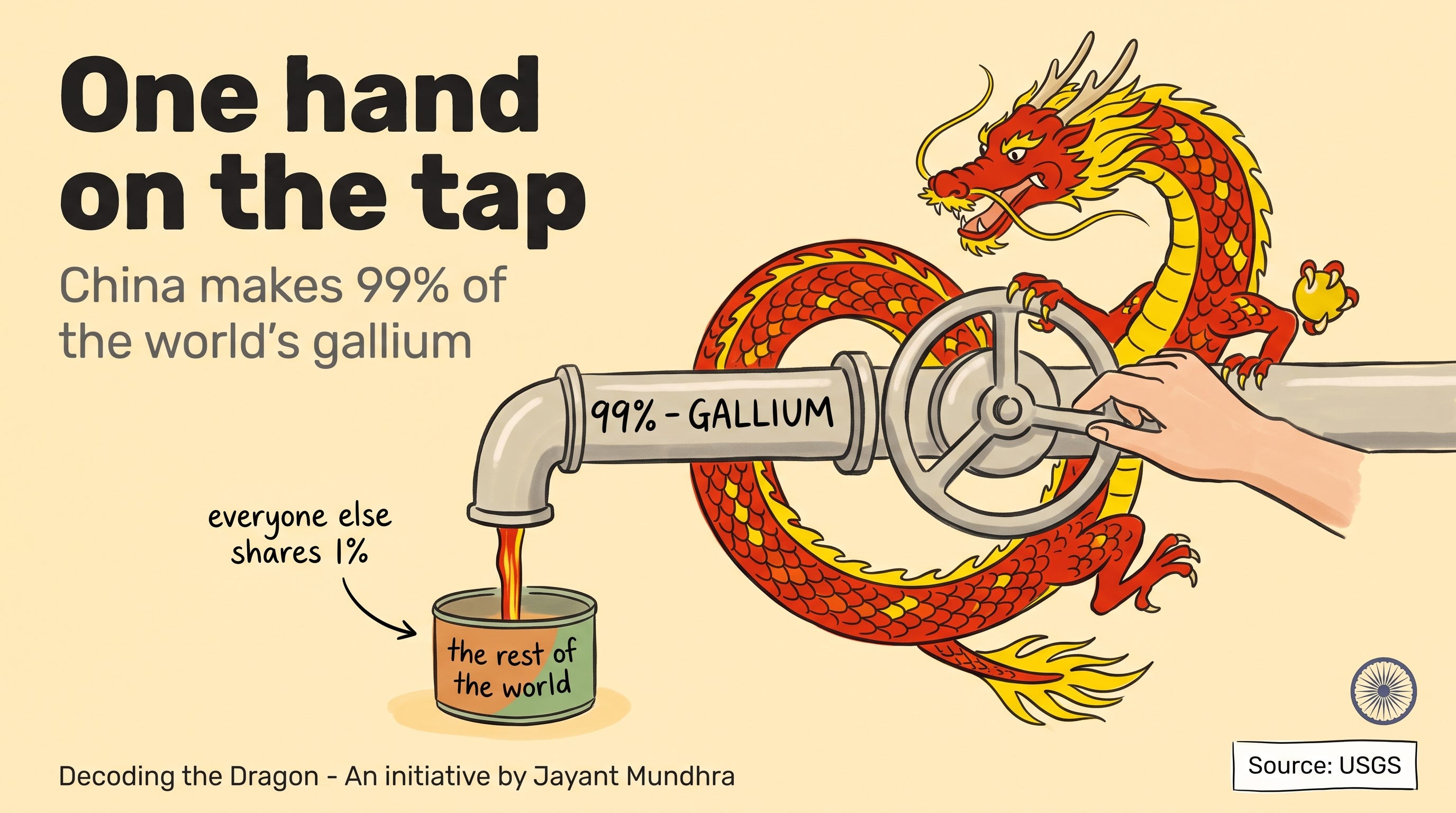
Here is a number that should unsettle anyone building a chip industry from scratch. China makes about 99% of the world's raw gallium.1 Not most of it. Nearly all of it.
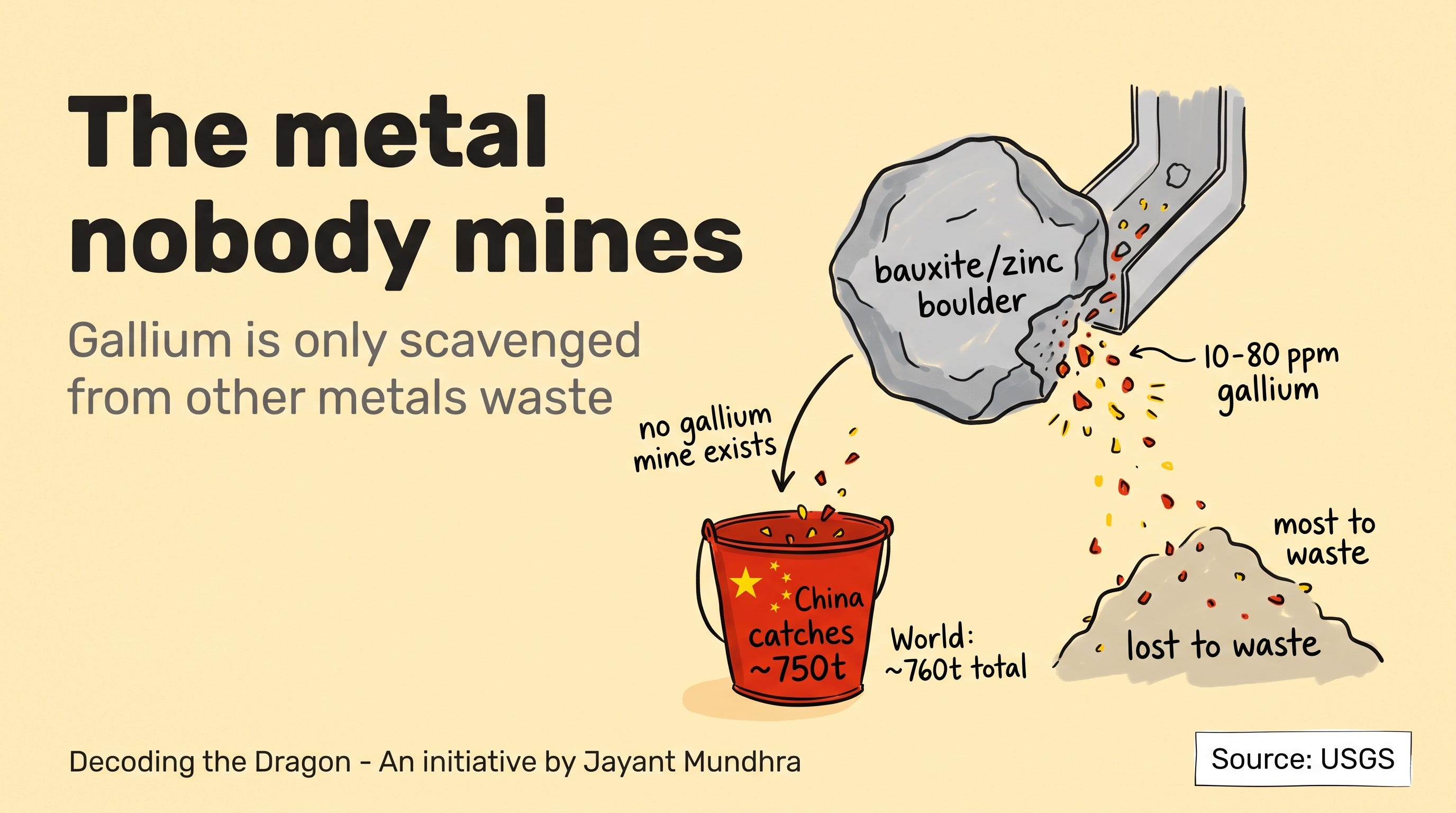
Gallium is not exotic. There is more of it in the earth's crust than there is lead. Yet the entire planet produced only around 760t of it in 2024, and roughly 750 of those tonnes came from China.1 The rest of the world, all of it put together, made about ten tonnes.
Now hold that next to what gallium actually does. It is the base metal for gallium nitride, the compound that powers 5G base stations, electric-vehicle inverters, satellite solar cells, and the radars inside modern fighter jets. A material almost no one outside a lab has heard of sits underneath the most advanced hardware we build.
And one country controls the tap. In December 2024 China turned that tap off for the United States entirely. This edition is about how a waste product became a weapon, and why India cannot afford to keep buying it.
Let me set the scene, because the mechanism is the whole story.
Gallium and germanium are not mined. That single fact explains everything that follows. You do not dig a gallium mine. Both metals exist only as trace passengers inside the ores of other metals: gallium hides in the bauxite that becomes aluminium, and germanium in zinc ores and in coal ash.
So the only way to get them is to run a giant aluminium or zinc smelter and then bolt on an extra, expensive circuit to scavenge the traces before they wash away into the waste. It is dirty, power-hungry, low-margin work.
For decades the West decided it was not worth the bother. Environmental rules tightened, margins were thin, and the smelting drifted to China. Beijing took the pollution and the power bills, and in return it quietly took the metals too.
The result is a monopoly built not on geology but on willingness:
China makes about 99% of the world's primary gallium.1
China refines roughly 60% of the world's germanium.2
The United States has not produced a gram of primary gallium since 1987, and imports every bit it uses.1
India is 100% import-dependent for both metals, two of the ten critical minerals it makes none of.3
That last line is the one I want you to sit with. India is spending tens of thousands of crores to build semiconductor plants. The raw feed for the most strategic of those chips comes entirely from a country it fought a border clash with six years ago.
The clever part of China's play is that it never looked like a strategy. It looked like cheap supply.
Between roughly 2005 and 2015, Beijing pushed its aluminium refiners to install gallium-capture circuits across the country. Output multiplied more than twentyfold in a decade.4 That flood of subsidised metal crashed the global price, and the handful of independent producers left in Britain, Germany, Hungary and Kazakhstan simply went bankrupt. Why keep a loss-making gallium line running when China is selling below your cost?
By the time anyone noticed, there was nothing left to notice with. The West had no producers, no processing know-how, and no reason to rebuild any of it. This is the trap of treating a strategic input as a commodity. You optimise for price right up until the moment price stops being the point.
This byproduct economics, where the cheapest supplier quietly becomes the only supplier, is exactly the kind of hidden mechanism I love pulling apart, and it is what we chew over most mornings in the Decoding the Dragon WhatsApp community, where I share a smaller China deep-dive like this one with thousands of readers every day (t.ly/t7uhs).
Join the Decoding the Dragon community
Then the point changed. Beijing stopped treating these metals as commodities and started treating them as levers:
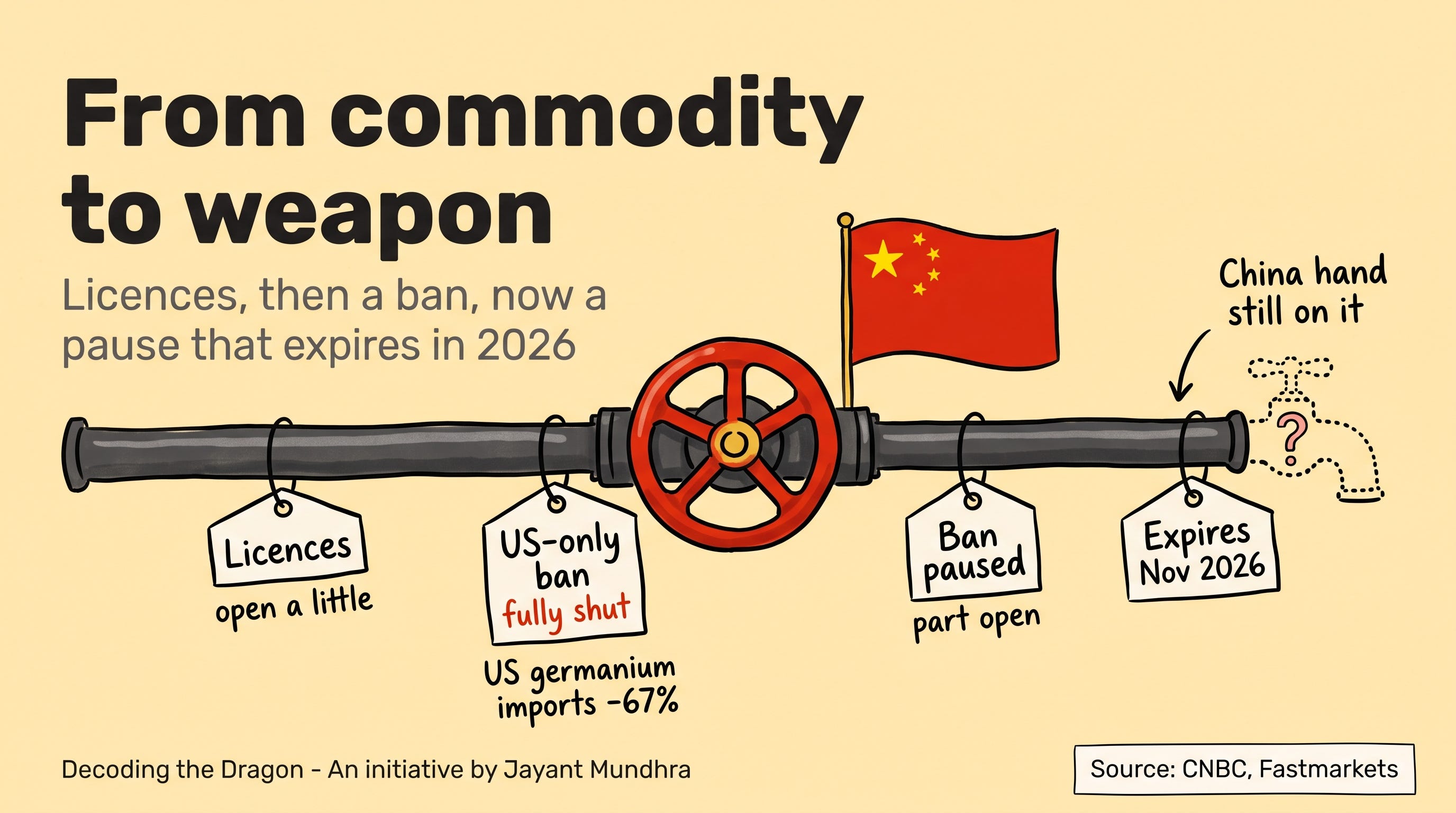
July 2023: China's commerce ministry introduces export licensing on gallium and germanium, citing "national security", the exact phrase Washington had used for its chip-equipment curbs.5
December 2024: after the US blacklists 140 Chinese chip firms, Beijing bans gallium, germanium and antimony exports to America outright. The first time a critical-mineral restriction was aimed at a single country.5
2025: US germanium imports collapse 67% to about 7t for the whole year.2
That ban is the thing everyone remembers. But here is the update that matters, and it is why I am writing this now.
The ban is not in force today. In November 2025, days after Xi Jinping and Donald Trump met and agreed a one-year tariff truce, China suspended the export ban on gallium, germanium and antimony to the United States.5 Exports resumed, but under licence, and the suspension has a hard expiry date: 27 November 2026.6
Read the fine print and the leash is obvious:
Exports are allowed again, but only with a Beijing-issued licence for each shipment.6
The clause banning sales to military end-users stays in place.6
The whole arrangement lapses in November 2026, and Beijing can snap the ban back at will.6
So the "resolution" is really a pause button that China holds. American and allied buyers get metal for a few months, on Beijing's terms, knowing the tap can close again the week the truce sours. Prices tell the story. Gallium trades around $290 a kilo inside China but nearer $400 for export,7 and that gap is not production cost. It is the price of the licence.
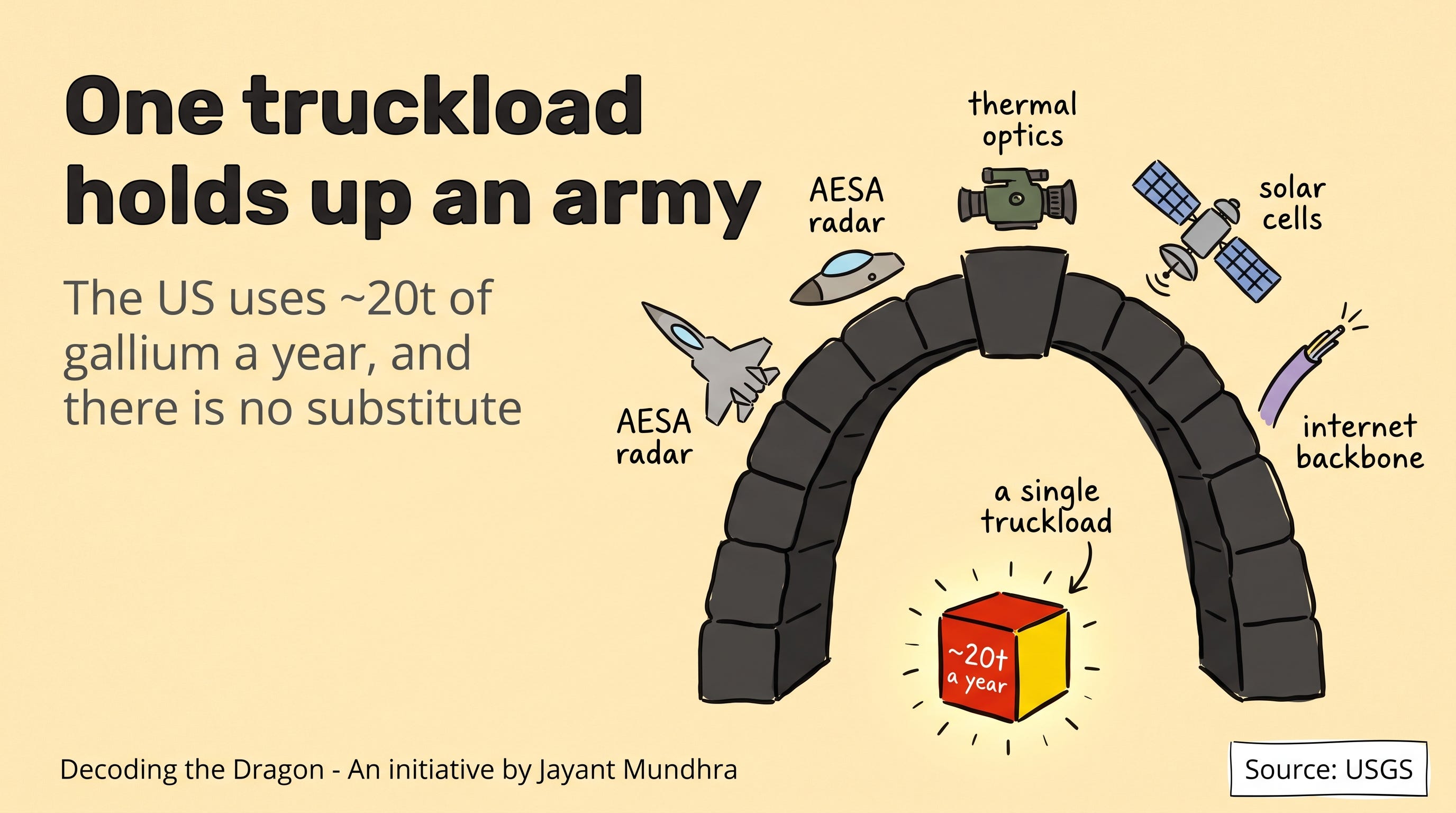
Because the leverage is absurdly asymmetric. The United States uses only about 20t of gallium a year, a single truckload, yet that truckload sits underneath:
Gallium-nitride AESA radars that spot stealth aircraft, small enough to fit in a jet's nose cone.
Germanium lenses in almost every thermal night-vision sight and targeting pod.
Germanium-doped glass in the fibre-optic cables that carry the internet.
Multijunction solar cells, grown on germanium, that power satellites.
There is no clean substitute. Silicon carbide is often floated as a stand-in for gallium nitride, but it behaves differently and would mean redesigning finished weapons from scratch. When a material is this deeply embedded and this concentrated, a few hundred tonnes stops being a rounding error and becomes a chokepoint.
The good news, if you are not China, is that the panic has at last produced money and movement:
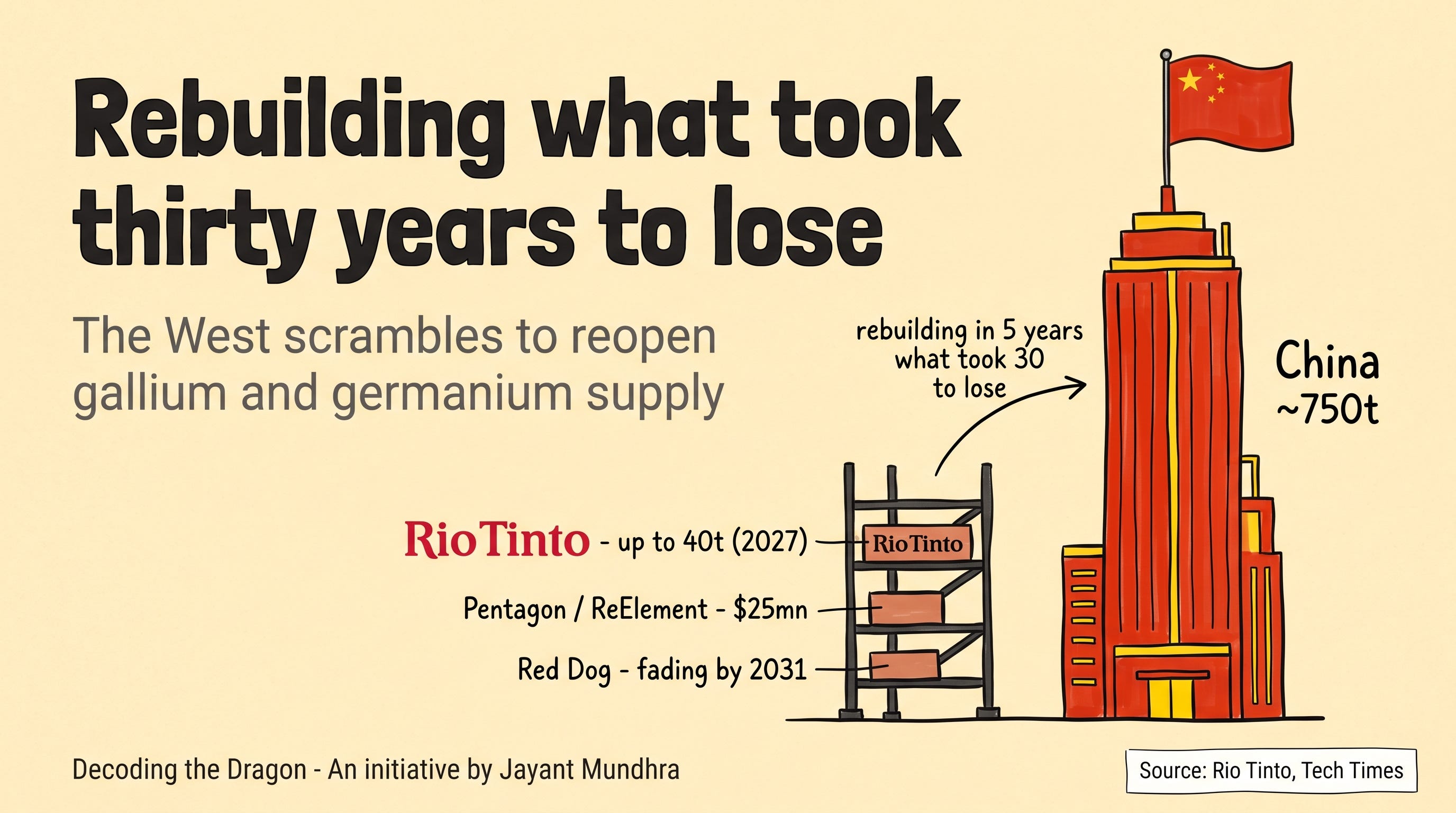
The Pentagon, now renamed the Department of War, put $25mn into ReElement Technologies in Indiana in July 2026 to refine gallium and germanium from recycled electronics.8
Rio Tinto pulled the first primary gallium out of its Vaudreuil refinery in Quebec in 2025, and is building a pilot plant for 2027 that could scale to 40t a year, or 5% to 10% of world supply.9
Red Dog in Alaska, the world's biggest zinc mine and a germanium source, made 462,700t of zinc in 2025 but is fading, with its ore running out around 2031.10
None of this is fast. A smelter and its capture circuit take years to build and longer to make economic. The West is trying to rebuild in five years what it spent thirty years dismantling.
This is where it gets uncomfortable for us, and also where the opportunity is.
India has made the semiconductor bet properly. In the last year the Cabinet cleared a ~₹27,000 crore Tata OSAT plant in Assam, with chip packaging due to start in 2026,11 and approved Crystal Matrix's ~₹3,100 crore compound-semiconductor fab in Dholera, which will run a gallium-nitride foundry on 6-inch wafers.12
Now put the two facts side by side. India is building a gallium-nitride foundry while making zero gallium of its own.12 That is a plant whose core feedstock comes entirely from the one country most likely to withhold it. It is exactly the vulnerability China spent twenty years engineering.
If the midstream is where this whole fight is really decided, it is also the thread I keep tugging at in these pages, and I go deeper on India's processing gap almost every day with the readers in the Decoding the Dragon WhatsApp group (t.ly/t7uhs).
Join the Decoding the Dragon community
The fix is not to find a gallium mine, because there isn't one. It is to do the dirty midstream work India has always skipped, and India already owns the smelters to do it:
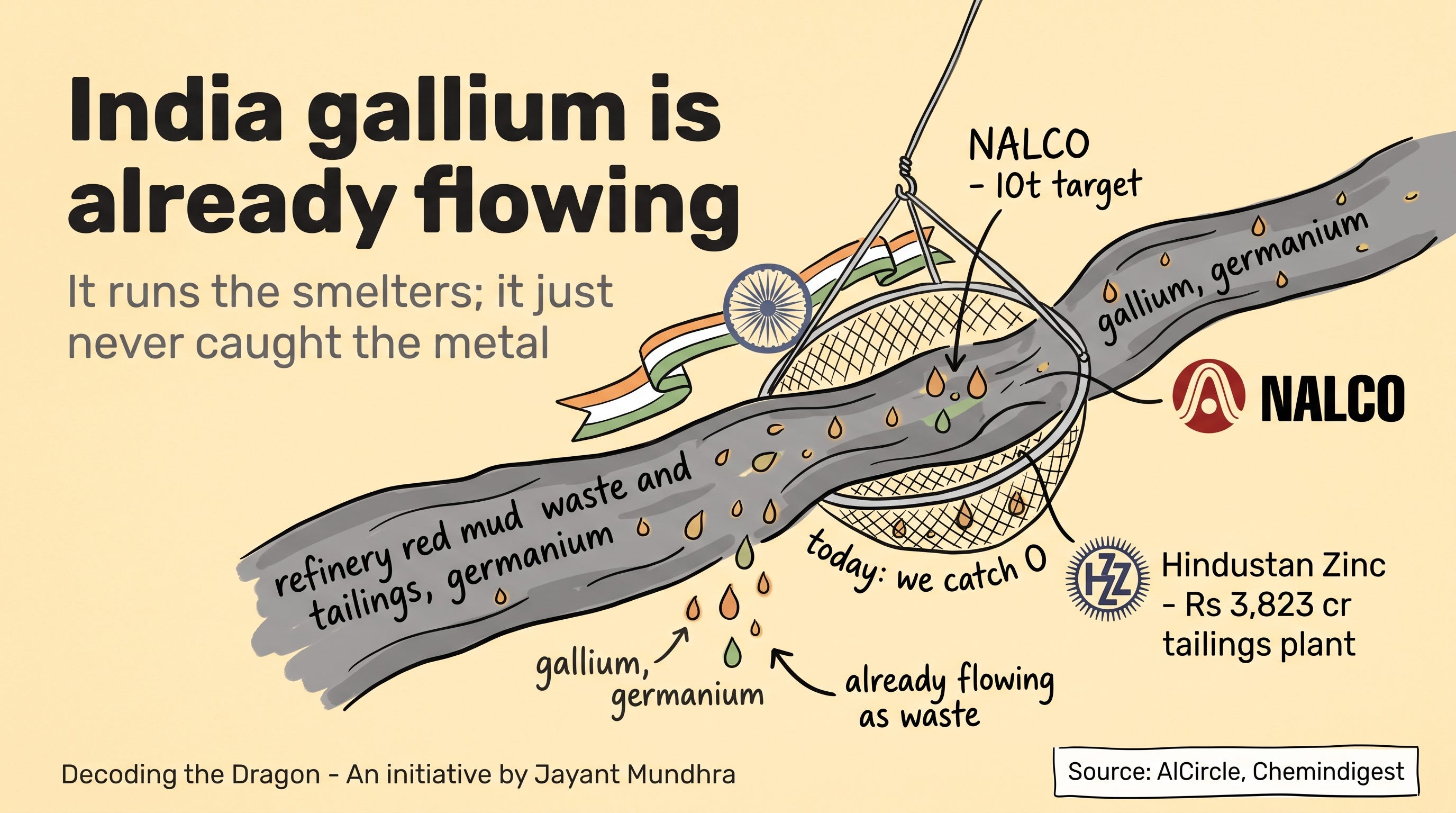
NALCO inaugurated a "Metal-G" gallium pilot at its Damanjodi alumina refinery in Odisha in late 2025, targeting 10t a year, with commercial output promised in about two years.13
Hindustan Zinc has put ₹3,823 crore into a tailings-reprocessing plant at Rampura Agucha to pull metals out of old waste, and is pushing hard into critical minerals and rare earths.14
The National Critical Mineral Mission, a ₹34,300 crore, seven-year programme, is funding exploration and, for the first time, a strategic stockpile of at least five critical minerals.15
The raw material is literally already flowing through Indian refineries as waste. The whole game is choosing to catch it before it washes away.
Step back, and gallium is not really about gallium. It is the clearest example yet of China's core industrial doctrine: dominate the unglamorous middle of the supply chain, the processing and refining that everyone else finds too dirty to want, and let that quiet control become leverage over everyone downstream.
It is the same playbook as rare earths, where China refines roughly 90% of the world's supply,17 and the same as the battery chemicals it controls. The West chased the finished product and the fat margins. China took the messy middle. Then it discovered the messy middle was the choke point.
India, to its credit, seems to have read the lesson correctly. The words that keep appearing in Indian policy now are not "mining" but "processing" and "midstream":
The India-US critical minerals framework signed in May 2026.16
The shift from the old Minerals Security Partnership to the more muscular FORGE grouping, which is even discussing price floors to blunt Chinese dumping.17
A deepening minerals partnership with Australia across two dozen shared minerals, including gallium.17
All of these aim at the same gap: refining, not digging. That is the right target. But alliances buy time, they do not build capacity. The 80% to 90% of the value that sits in the midstream still has to be earned the hard way, plant by plant, on Indian soil. No summit does that for you.
The uncomfortable truth is that China's monopoly was never really a mineral advantage. It was a willingness advantage. It was willing to eat the costs, the pollution and the thin margins for two decades while everyone else optimised for something easier.
Four concrete things over the coming months:
Whether China lets the export suspension lapse on 27 November 2026 or extends it. If it lapses, gallium and germanium prices spike again, and India's exposure gets very real, very fast.
Whether NALCO's Damanjodi pilot actually produces commercial gallium on its two-year promise, or slips again as it did for nearly a decade after the 2016 BARC tie-up.
Whether the National Critical Mineral Stockpile actually buys and holds gallium and germanium, not just rare earths.
Whether Rio Tinto's Quebec pilot and the Pentagon's ReElement bet deliver real allied tonnes by 2027, or stay as press releases.
China's grip on gallium was never about what lies in the ground. It was about who was willing to do the dirty work, and for twenty years no one else was.
And well that is it for today's edition. That said, do check out my core WhatsApp community Biz News+ where I share 4-5 deepdives from the world of business, economics & public economics daily: https://t.ly/h2jq1
And, do check out my work on the following platforms as well: Instagram, LinkedIn and Youtube
Best,
Jayant
1. USGS, Mineral Commodity Summaries 2026, Gallium: https://pubs.usgs.gov/periodicals/mcs2026/mcs2026-gallium.pdf
2. USGS, Mineral Commodity Summaries 2026, Germanium: https://pubs.usgs.gov/periodicals/mcs2026/mcs2026-germanium.pdf
3. IEEFA, India's critical mineral imports in 2025: ieefa.org
4. Rare Earth Exchanges, Why China still owns gallium and germanium: rareearthexchanges.com
5. CNBC, China suspends ban on exports of gallium, germanium, antimony to US: cnbc.com
6. Fastmarkets, China suspends export prohibition on gallium, germanium, antimony, superhard materials to US: fastmarkets.com
7. Critical Minerals HQ, Gallium market 2026, prices and export controls: criticalmineralshq.com
8. Tech Times, Pentagon backs Indiana refiner with $25M to break China's gallium chokehold: techtimes.com
9. Rio Tinto, Advancing gallium metal R&D project with the Government of Canada: riotinto.com
10. North of 60 Mining News, Mixed news for Red Dog zinc production: miningnewsnorth.com
11. Communications Today, Tata Electronics to launch chip packaging at Assam OSAT in 2026: communicationstoday.co.in
12. PM India, Cabinet approves two more semiconductor units (Crystal Matrix, Dholera): pmindia.gov.in
13. AlCircle, NALCO set to pioneer gallium production, the first in India: alcircle.com
14. Chemindigest, Hindustan Zinc expands into critical minerals: chemindigest.com
15. Business Standard, Cabinet approves Rs 34,300 crore for National Critical Mineral Mission: business-standard.com
16. Al Jazeera, India, US strike critical minerals deal: aljazeera.com
17. ORF, Securing critical minerals at scale, multilateral solutions: orfonline.org
Comments
Nothing yet. Say the first thing.
Sign in to join the conversation.