
I have spent a fair bit of time on China's grip over rare earths, lithium and solar. But the metal that unsettles me most right now is one almost nobody talks about: magnesium.
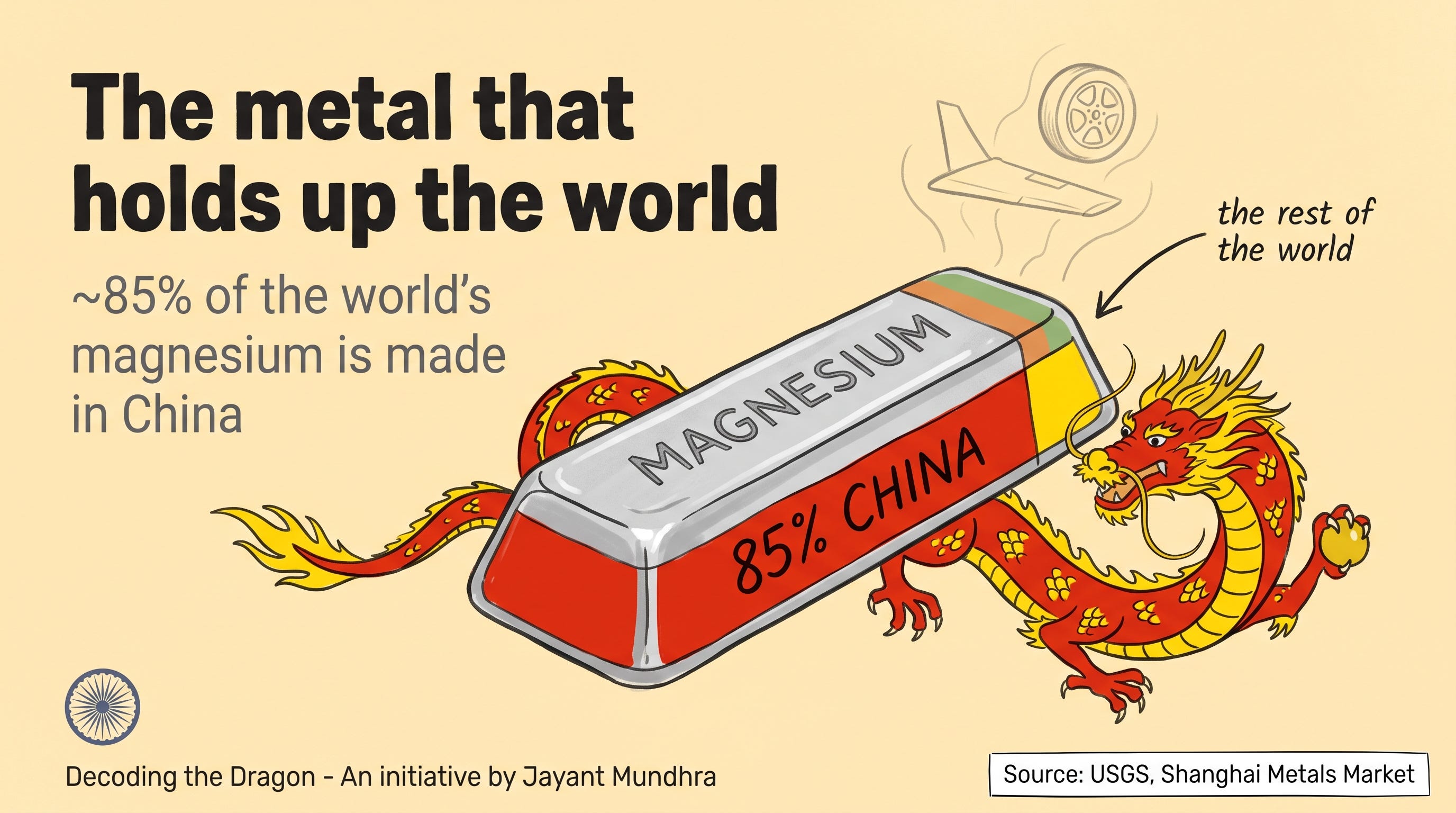
Here is the thing. You cannot build a modern car or a modern aircraft without it. Magnesium is the alloying agent that strengthens and lightens aluminium. No primary magnesium, no aluminium sheet, no die-cast body parts, no gearbox casings, no structural aerospace components. And China now makes roughly 85% of the world's primary magnesium.1, 2
In 2025 China produced about 1.01mn tonnes of it, up nearly 7% on the year before.1 The rest of the planet, combined, makes a rounding error by comparison. That is not a supply chain. That is a single point of failure with a flag on it.
And most of it does not even come from all of China. It comes from one province, and really from one county inside it.
Let me narrow it down for you, because the concentration is almost comical once you see it.
China makes ~85% of the world's primary magnesium.2, 5
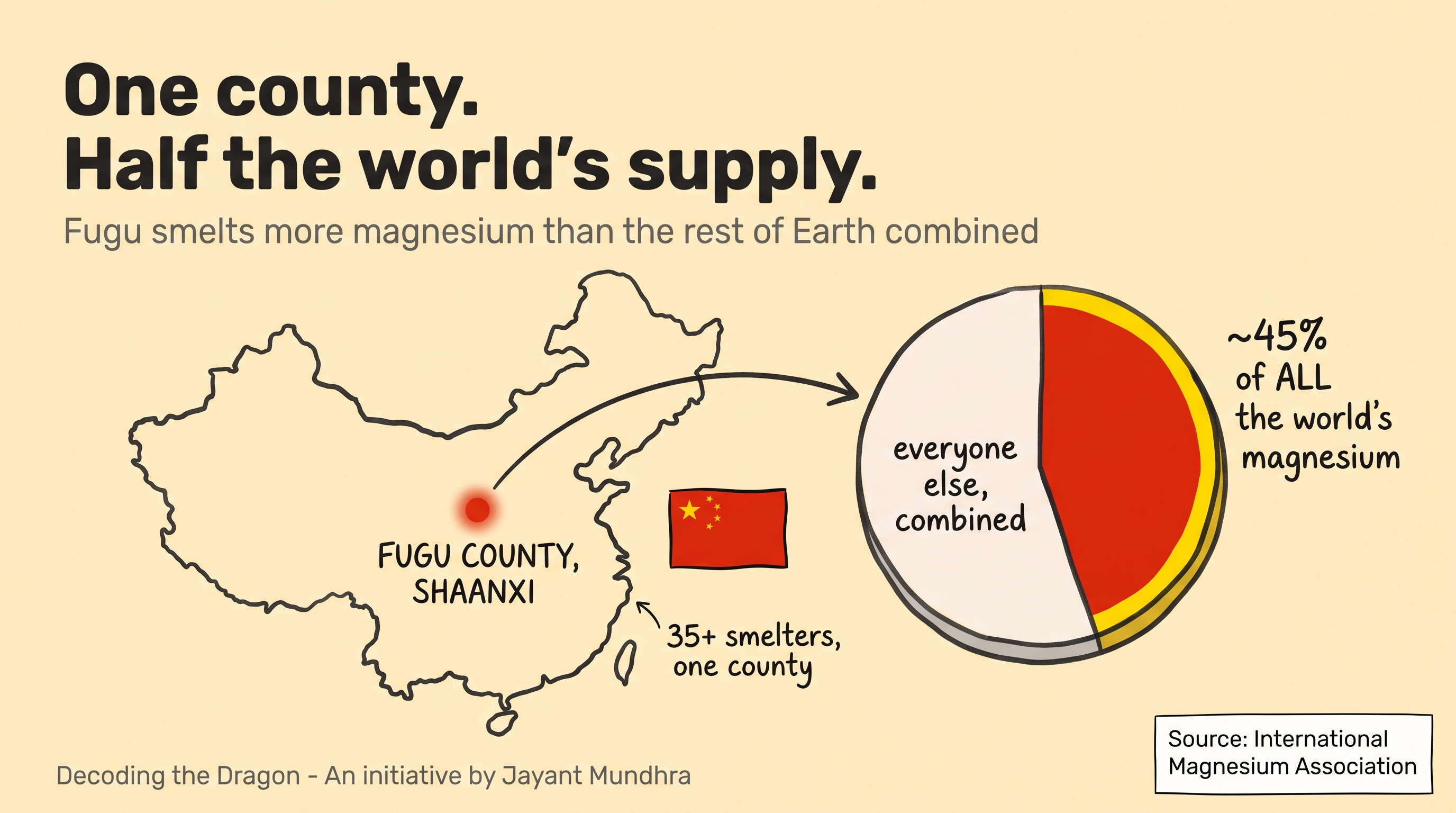
Shaanxi province alone accounted for about 64% of China's output in 2025.4
Inside Shaanxi, Fugu county is the epicentre: more than 35 smelters, over 700,000 tonnes of capacity, more than half of China's total.4
So when you stack it up, a single county in northern China smelts something close to 45% of the magnesium the entire world uses. Your German saloon, your Boeing, your Tejas fighter's gearbox casing, all of it traces back to a place most people could not find on a map.
Why there? Because the way China makes magnesium is brutally energy-hungry, and Fugu sits on cheap coal.
The dominant method is the Pidgeon process, a thermal reduction technique that roasts dolomite with ferrosilicon in steel retorts at around 1,200°C.5 It is simple, cheap to build, and it drinks energy. Fugu solved the energy problem with a closed loop that is genuinely clever: it turns coal into semi-coke, captures the waste "tail gas" that would otherwise be flared, and uses that free heat to run the magnesium furnaces.4 The marginal energy cost falls to almost nothing.
Western electrolytic producers, paying full commercial power prices and real environmental compliance costs, simply could not compete. Over two decades, they were bankrupted or sidelined one by one. What looks like a monopoly of geology is really a monopoly of subsidised energy and tolerated pollution.
We have seen what happens when this single point fails, and it was terrifying.
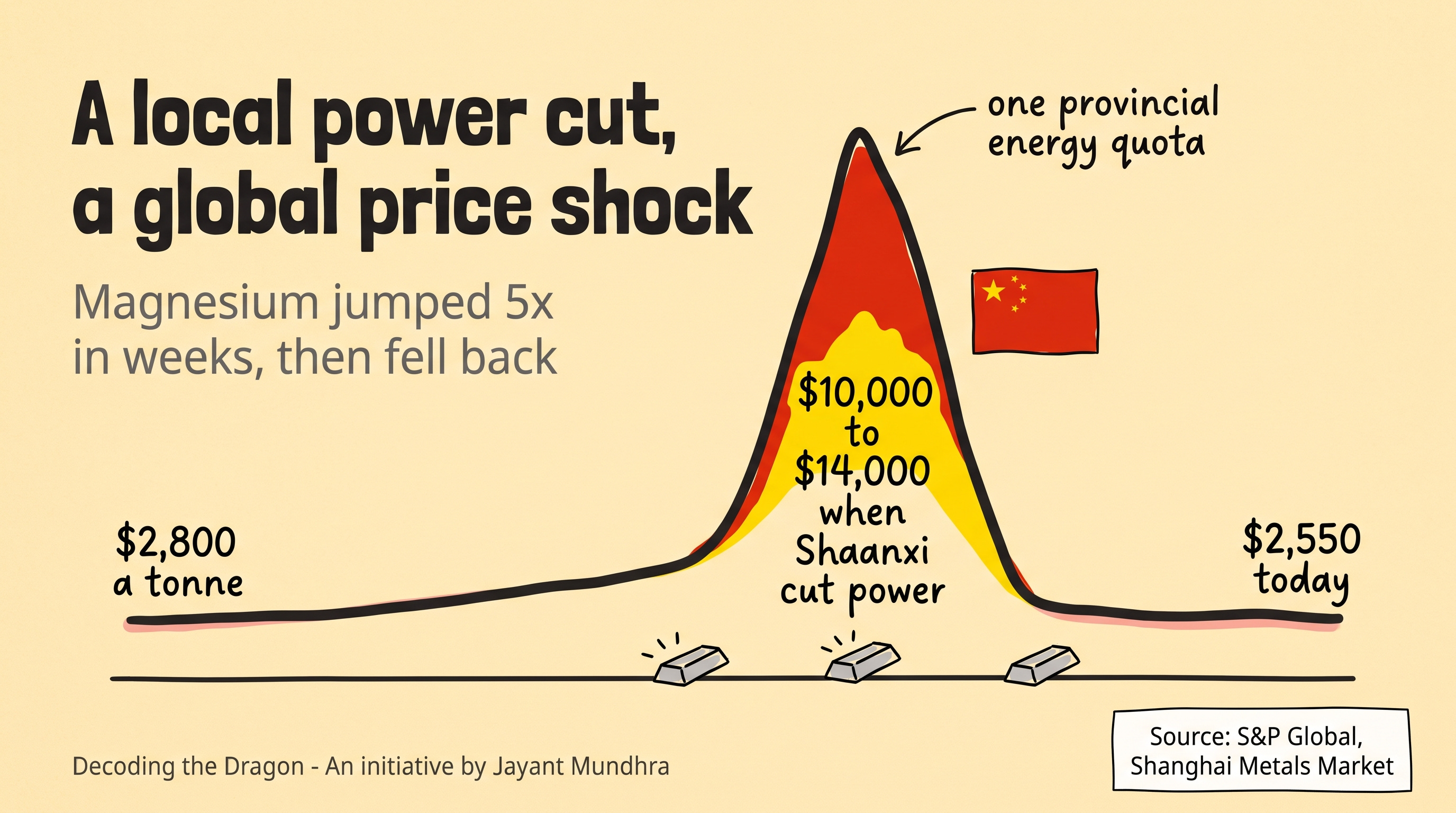
In September 2021, Yulin prefecture in Shaanxi ordered heavy industry to cut power use to meet Beijing's energy-intensity targets.6 This was not aimed at the West. It was a local bureaucrat trying to hit a quota. Around 35 magnesium smelters were curbed or shut, and output collapsed.
The prices tell the story:
Primary magnesium had been sitting near $2,800 a tonne.6
Within weeks, the little supply left was trading at $10,000 to $14,000 a tonne.6
Europe, which sources 95% of its magnesium from China, warned its stocks would run dry by late November.13
Europe's biggest industry bodies issued joint emergency alerts. The message was blunt: while a car can be built and parked waiting for a semiconductor, it cannot even be cast without magnesium alloy. This licence-quota mechanism, where a provincial energy target can freeze global carmaking, is exactly the kind of quiet lever I find myself picking apart most mornings in the Decoding the Dragon WhatsApp community, where thousands of us go a level deeper on this stuff every day (t.ly/t7uhs).
Join the Decoding the Dragon community
Prices eventually normalised, and by July 2026 magnesium is back to roughly $2,550 a tonne.3 But the lesson did not normalise. The vulnerability is still fully loaded.
The obvious answer is: build a strategic reserve, like an oil stockpile. It does not work, and the reason is chemistry.
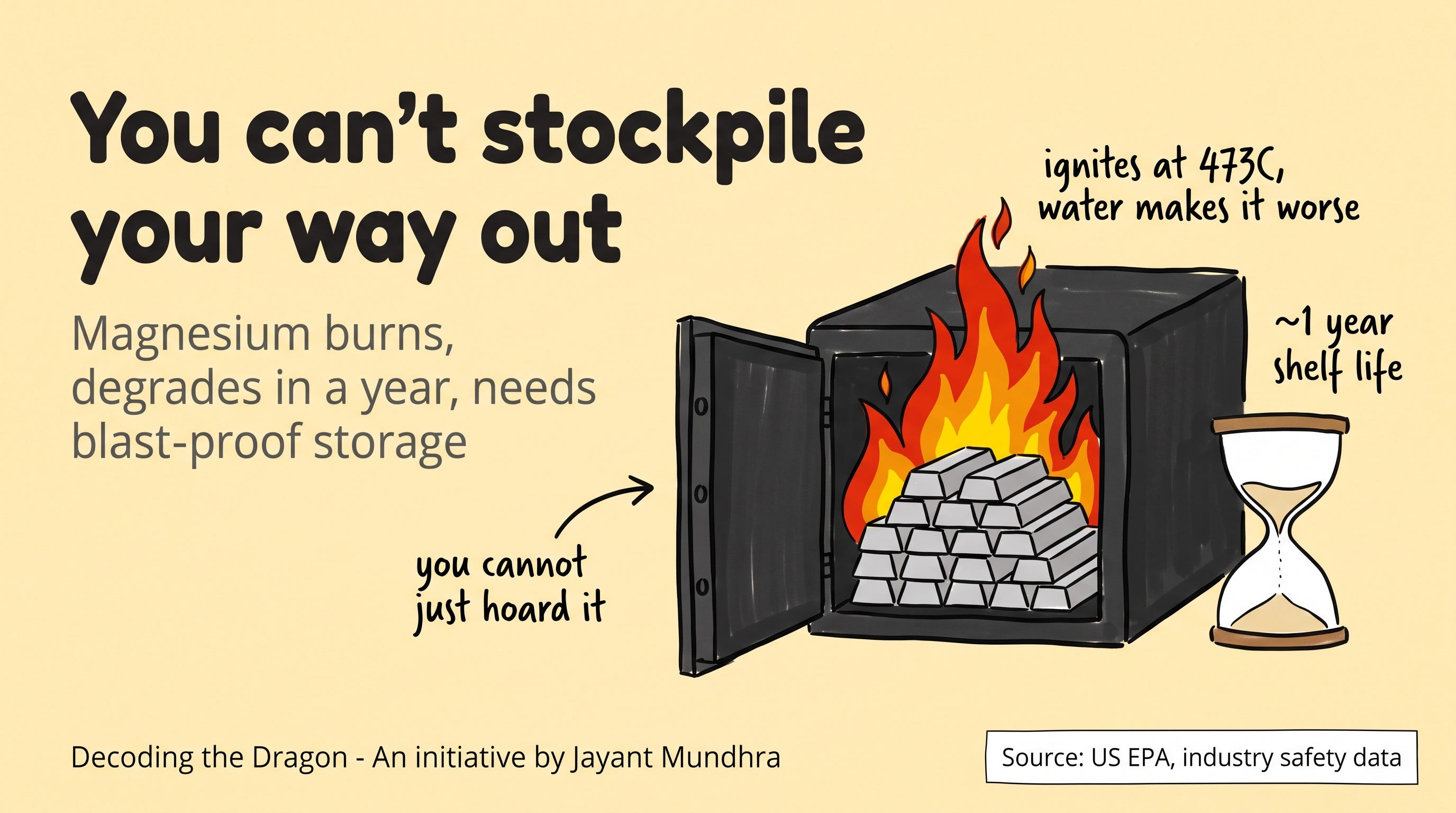
Magnesium is a reactive metal. Solid ingots need dry, climate-controlled, ventilated storage, and even then their high-grade shelf life is only about a year before quality degrades.
In powder or turning form it is a serious fire and explosion hazard, with an autoignition point around 473°C. Water makes a magnesium fire worse, not better, because it releases hydrogen.
Regulators classify magnesium scrap and powder as hazardous waste, which means a national reserve needs blast-proof, climate-controlled warehousing costing a fortune.
But the deeper flaw is strategic, not physical. Stockpiling fails when it is divorced from processing. If you hoard raw magnesium but have no domestic alloying, die-casting and thixomolding industry to turn it into parts, you are just storing a reactive metal at great cost. Real security is an integrated industrial base, not a warehouse. That is a lesson India needs to internalise before it spends money in the wrong place.
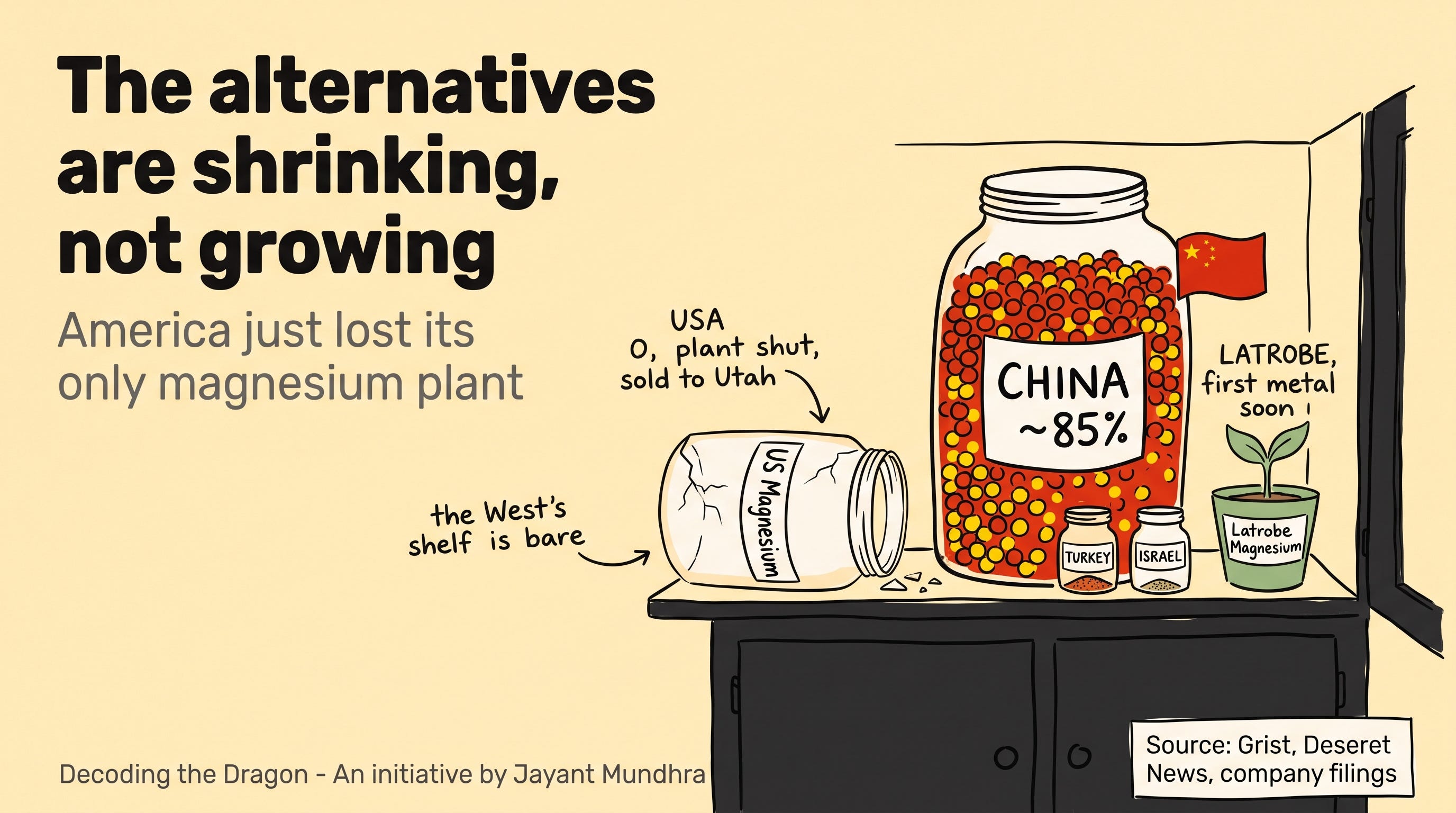
Here is what should worry every Western planner: the alternatives to China are collapsing, not rising.
The United States just lost its only primary producer. US Magnesium in Rowley, Utah, drew magnesium from Great Salt Lake brine. After years of equipment failure and a shrinking lake, it filed for bankruptcy in September 2025, and in January 2026 the state of Utah bought its land and water rights for $30mn to help restore the lake.9, 10 Restarting the plant would cost around $40mn.9 In effect, America now has zero primary magnesium capacity.
The other non-Chinese producers are tiny. Turkey's Kar Mineral runs a 15,000-tonne plant. Israel's Dead Sea Magnesium makes clean, low-carbon metal but at modest scale. Together they are a rounding error against China's million-plus tonnes.
Europe is legislating hard. Its Critical Raw Materials Act, in force since 2024, sets 2030 targets: extract 10% of consumption at home, process 40%, recycle 25%, and let no single country supply more than 65%.13 In December 2025 the Commission's RESourceEU plan committed up to €3bn over a year.14 Yet across all its designated strategic projects, exactly one is for magnesium, Verde Magnesium in Romania.13 One project, against a 95% Chinese dependence. The ambition and the reality are not on speaking terms.
The one genuine disruptor is Australia's Latrobe Magnesium. It extracts magnesium from brown-coal fly ash, a toxic waste product, at far lower emissions than the Pidgeon process. It has produced its first high-grade magnesium oxide, is targeting first metal in the second half of 2026, and has a US distribution deal with Metal Exchange, which prepaid $2mn.11, 12 Its first commercial plant is a modest 10,000 tonnes a year, now slated for 2027. Promising, but a decade of scale-up away from mattering.
Now let me bring this home, because India is walking into this bottleneck with its eyes closed.
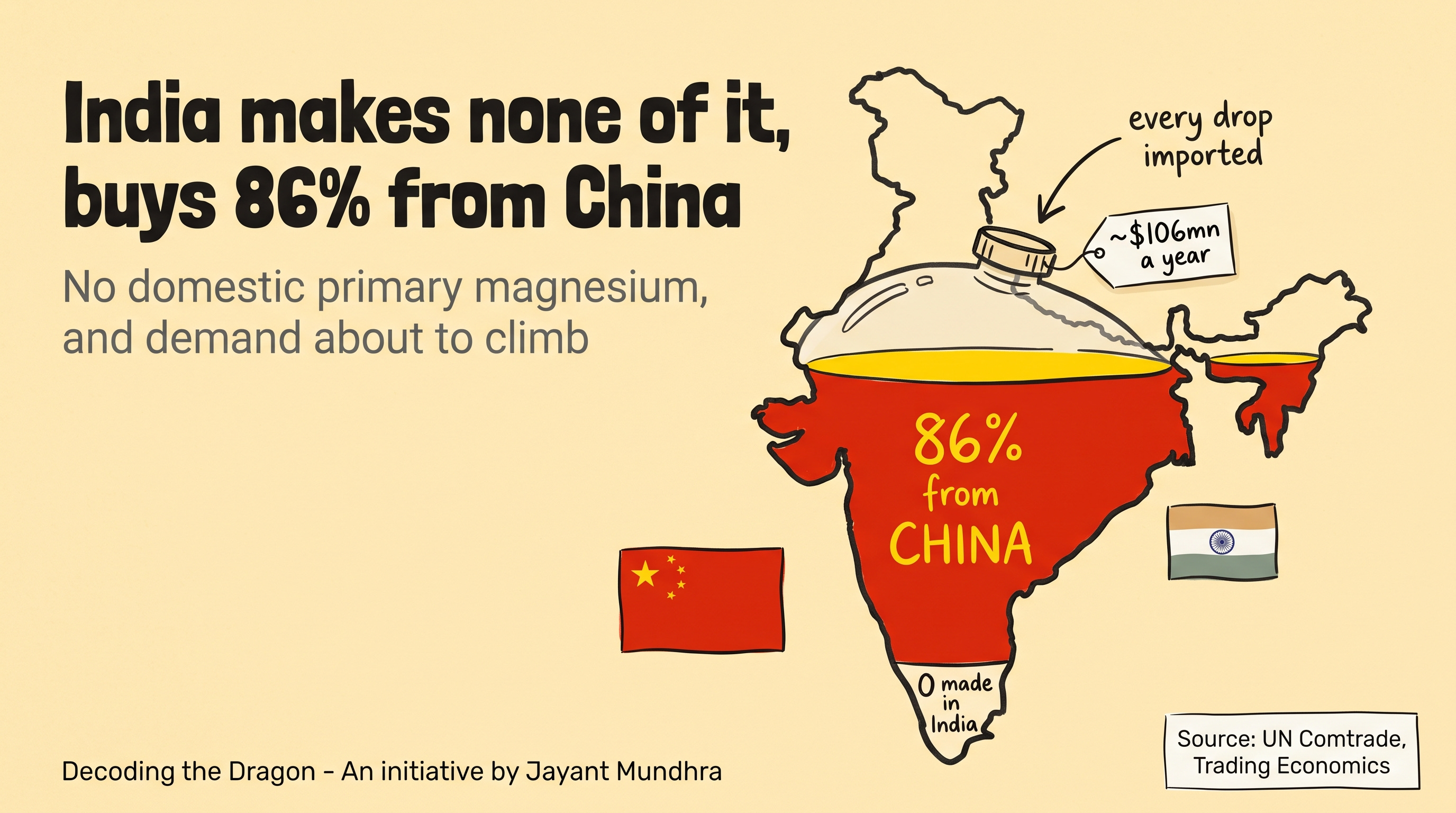
India has no primary magnesium industry at all. Zero. We import essentially everything.
In 2024 India imported about $106mn of magnesium, and 86% of it came from China.7
India's magnesium market was worth roughly $622mn in 2025 and is growing steadily.8
We also lack the recycling infrastructure to reclaim magnesium from end-of-life parts, so there is no domestic buffer at all.
For years this did not matter, because India used magnesium only in small, low-tech ways. That era is ending fast, and the culprit is the EV.
The physics of electric vehicles makes magnesium strategic rather than optional. Every extra kilogram of body weight needs a bigger, heavier, costlier battery to hold the same range, which adds still more weight. Magnesium is 30% to 35% lighter than aluminium, dampens vibration, dissipates heat, and shields electronics. China's own roadmap targets 45kg of magnesium per vehicle by 2030, up from around 20kg in premium models today.16
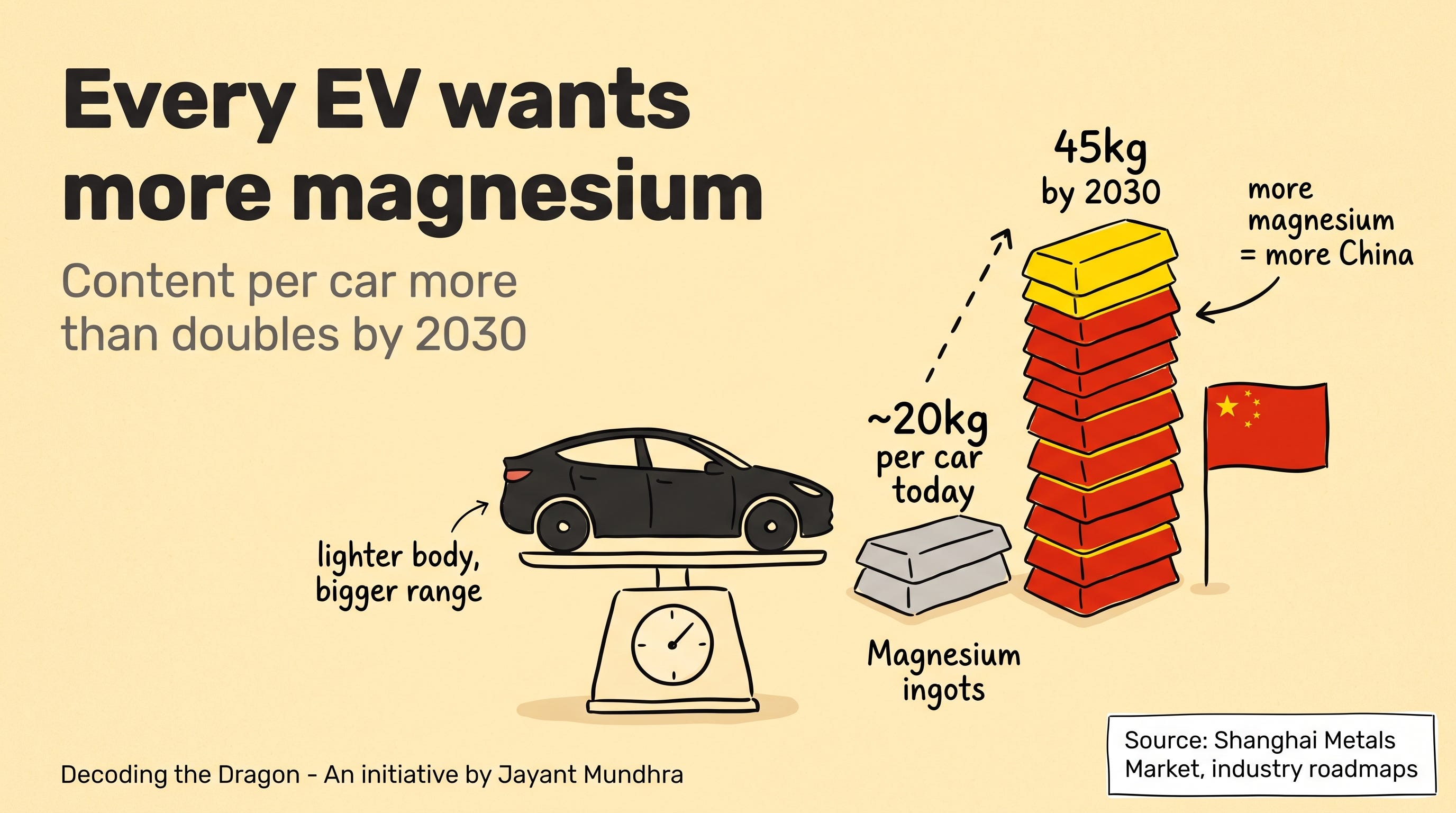
So as India electrifies, its magnesium demand is about to climb sharply, and every extra kilogram is a kilogram of dependence on Shaanxi. We risk swapping our old addiction to imported crude oil for a new, equally rigid addiction to imported Chinese metal. This is the sort of second-order trap I keep coming back to with readers in the Decoding the Dragon community, where I share a smaller China deep-dive like this one every morning (t.ly/t7uhs).
Join the Decoding the Dragon community
There is a sensible way in, and it is worth naming, because the demand is coming whether we are ready or not.
Magnesium alloy wheels are the low-risk first step. Alloy wheels already sit on 38% to 40% of Indian passenger cars, and a magnesium wheel is about 30% lighter than the aluminium one it replaces, saving battery cost on every EV.
Electric motorcycles are the clean-slate opportunity. Their heavy battery packs wreck handling, so designing frames, swing-arms and motor housings in magnesium from scratch buys back range that Indian riders actually care about.
Both routes lean on thixomolding, a semi-solid casting method that runs cooler and finishes thinner than old die-casting, and the presses are affordable enough to pencil out for Indian manufacturers.
The catch is the same one every time: the wheels and frames can be cast here, but the metal to cast them still lands from Shaanxi.
The defence angle is sharper still. Hindustan Aeronautics Limited has been researching the Mg-RZ5 alloy for aircraft gearbox casings and structural housings, using an advanced pressing technique that shrinks the grain size from 164 microns to 12 and lifts hardness by almost 17%.15 Brilliant metallurgy. But the raw RZ5 ingots still originate from the Chinese supply chain. Our sovereign defence platforms are being lightened with metal we cannot make ourselves.
Step back and the shape of it is clear. The green transition, EVs and aerospace lightweighting, is driving demand for a metal whose supply is wedded to one of the dirtiest processes on earth, concentrated in one Chinese county.
The Pidgeon process emits around 21.8kg of CO2 for every kilogram of magnesium, nearly double primary aluminium. So every clean electric car built on Chinese magnesium carries a heavy carbon debt made in Fugu. And because Beijing keeps tightening its own decarbonisation quotas, the risk of another Yulin-style shutdown never really goes away. The West spent two decades offshoring its dirty metallurgy to China for cheapness, and China now holds the switch.
Whether Beijing tightens energy-intensity quotas on Shaanxi again in the current Five Year Plan cycle, the trigger for any repeat of 2021.
Latrobe Magnesium's first magnesium metal in the second half of 2026, the first real test of a non-Chinese, low-carbon route.
Whether India's critical minerals mission names magnesium specifically, or keeps focusing only on lithium and rare earths.
Any move by an Indian auto or defence group to sign an offtake deal with Latrobe or a Gulf producer, the first sign we are taking this seriously.
The next magnesium shock will not be announced. It will arrive as a memo from a provincial energy bureau in Shaanxi, and the world's carmakers will find out when the alloy stops coming.
And well that is it for today's edition. That said, do check out my core WhatsApp community Biz News+ where I share 4-5 deepdives from the world of business, economics & public economics daily: https://t.ly/h2jq1
And, do check out my work on the following platforms as well: Instagram, LinkedIn and Youtube
Best,
Jayant
1. Shanghai Metals Market, "The Magnesium Market in 2025": news.metal.com/newscontent/103700819
2. Light Metal Age, "Global Magnesium Market: Supply, Demand, and Future Outlook": lightmetalage.com
3. Shanghai Metals Market, magnesium price data: metal.com/magnesium
4. International Magnesium Association, "New progress of China's magnesium industry and market": intlmag.org
5. USGS, Mineral Commodity Summaries 2026: pubs.usgs.gov
6. S&P Global Commodity Insights, "Chinese magnesium squeeze persists": spglobal.com
7. Trading Economics (UN Comtrade), "India Imports from China of Magnesium": tradingeconomics.com
8. 6Wresearch, "India Magnesium Market Outlook": 6wresearch.com
9. Deseret News, "Why Utah spent $30 million on buying US Magnesium": deseret.com
10. Grist, "The country's largest magnesium supplier shut down. Now what?": grist.org
11. Shanghai Metals Market, "Latrobe Magnesium Secures $2M Prepayment": news.metal.com
12. Discovery Alert, "Latrobe Magnesium Produces 20 Tonnes High-Grade Magnesium Oxide": discoveryalert.com.au
13. European Commission, "Selected strategic projects under CRMA": single-market-economy.ec.europa.eu
14. Oxford Institute for Energy Studies, "Europe's new critical minerals plan": oxfordenergy.org
15. MDPI / PMC, "Severe Plastic Deformation Effects on Magnesium RZ5 Alloy Sheets": pmc.ncbi.nlm.nih.gov
16. Shanghai Metals Market, "A Key Material for Automotive Lightweighting: Magnesium Alloys": metal.com
Comments
Nothing yet. Say the first thing.
Sign in to join the conversation.