
Here is a number that should unsettle every planner in Delhi. India buys more than nine out of every ten kilos of tungsten it uses from abroad2, and the single largest seller is the one country our tanks are literally built to fight.
I have been circling this metal for weeks now, and the more I read, the more I think tungsten is the most underpriced strategic risk on the board. Everyone talks about lithium, cobalt and rare earths. Almost nobody talks about the metal that makes the machines that make everything else.
Tungsten does not go into your phone or your car in any amount you would notice. It goes into the cutting tools that shape the phone and the car. It is the upstream of the upstream. And China controls it almost from end to end.
Start with what tungsten actually is, because it explains why it matters so much.
It has the highest melting point of any metal, a scarcely believable 3,422°C, and a density close to gold.
Carbonised into cemented tungsten carbide, it becomes the hardest working material in industry, and carbide alone soaks up roughly 60% to 65% of all tungsten used3.
Every CNC machine that shapes a turbine blade, an engine block, a medical implant or a fighter jet does it with carbide cutting tools. Take away the tools, and the factory stops.
Now the asymmetry. A carbide cutting insert costs a rounding error next to the jet it helps build. Yet without that insert, the line halts the same day. That is what makes tungsten such a quiet, brutal lever. Control the metal, and you control the means of manufacturing itself.
And control is exactly the word. Look at where it comes from3:
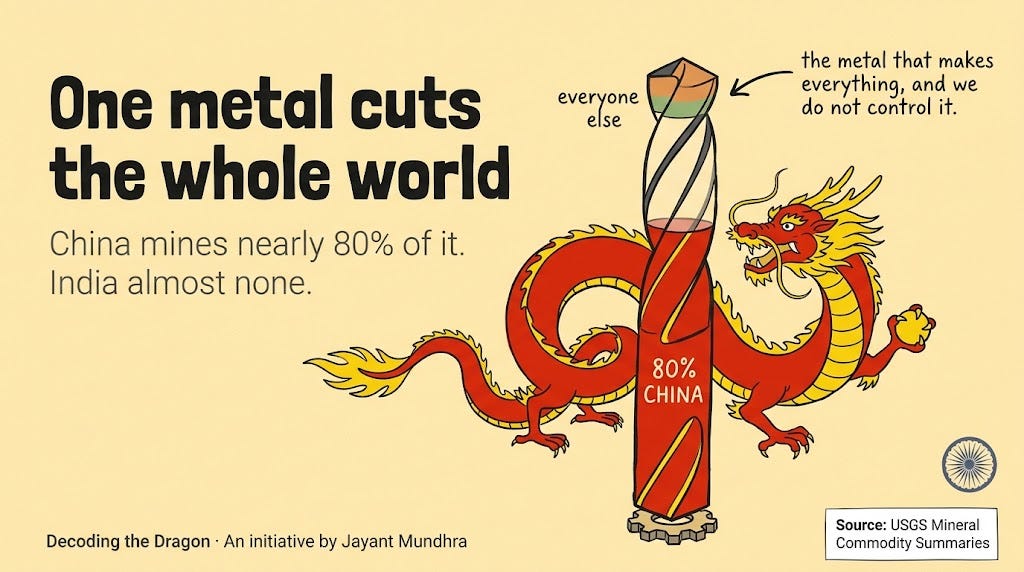
China mined about 67,000 tonnes of tungsten in 2025, out of a world total near 85,000 tonnes. That is close to 80% of everything dug up on the planet1.
The next biggest producers, Vietnam and Russia, are rounding errors by comparison, a few per cent each.
China also sits on roughly 52% of the world's known reserves1.
But the mine is not even the real moat. The moat is the chemistry.
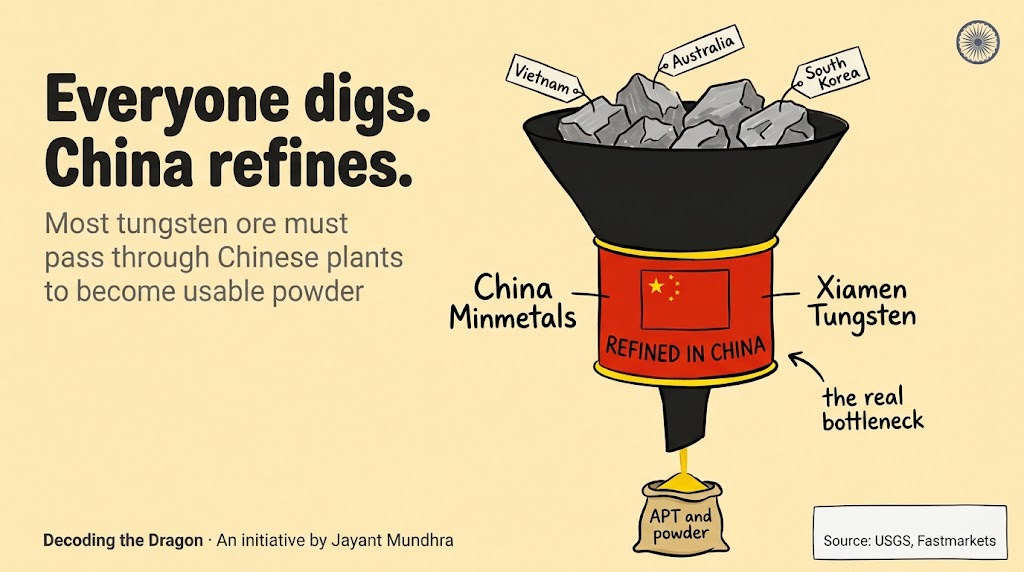
Turning raw ore into ammonium paratungstate, or APT, and then into high-purity powder is a filthy, capital-heavy, deeply specialised process. China owns the overwhelming majority of that refining capacity worldwide.
This is the part people miss. Even when tungsten is mined outside China, in Vietnam, Australia or South Korea, there is often nowhere else to process it at scale. The concentrate frequently has to be shipped back to Chinese plants to become usable powder. You can dig the ore up in a friendly country and still be handing it to Beijing to finish.
The whole chain is run by a handful of state-backed champions:
China Minmetals, through its listed arm China Tungsten and Hightech, holds around 17% of the global market and is one of the largest APT producers alive.
Xiamen Tungsten controls roughly another 16%, integrated from captive mines all the way to finished cutting tools.
Behind them sit Jiangxi Tungsten, Chongyi Zhangyuan and others, coordinating quotas, refining and exports as one machine.
Western toolmakers like Sandvik, Kennametal and Ceratizit are formidable, but they mostly play downstream, turning powder into tools and leaning hard on recycling. The virgin powder underneath still comes, in large part, from China. This is the sort of quiet, structural chokepoint I find myself pulling apart most mornings, and it is exactly the kind of thread we chase together in the Decoding the Dragon WhatsApp community, where I share a smaller China deep-dive like this every day (t.ly/t7uhs).
Join the Decoding the Dragon community
For years China managed all this with a domestic tool that looked purely internal: mining quotas. Officially they exist to protect resources and clean up a messy industry. In practice they have become a global supply dial, and Beijing has been turning it down.
China has cut its domestic mining quota for three straight years, at roughly 6% a year.
For 2025 the first batch of mining permits was set at 58,000 tonnes, 4,000 tonnes below 2024, a deliberate 6.45% cut4.
The permits are funnelled to a few big provinces, Jiangxi and Hunan chief among them, tightening state control further.
The official reasons are environmental clean-ups and falling ore grades, and both are genuinely true. But they are also a very convenient screen. Less tungsten leaving the mines, more of it reserved for China's own aerospace, EV and chip ambitions, and a smaller and smaller surplus left over for everyone else.
Then, in early 2025, the squeeze stopped being quiet.
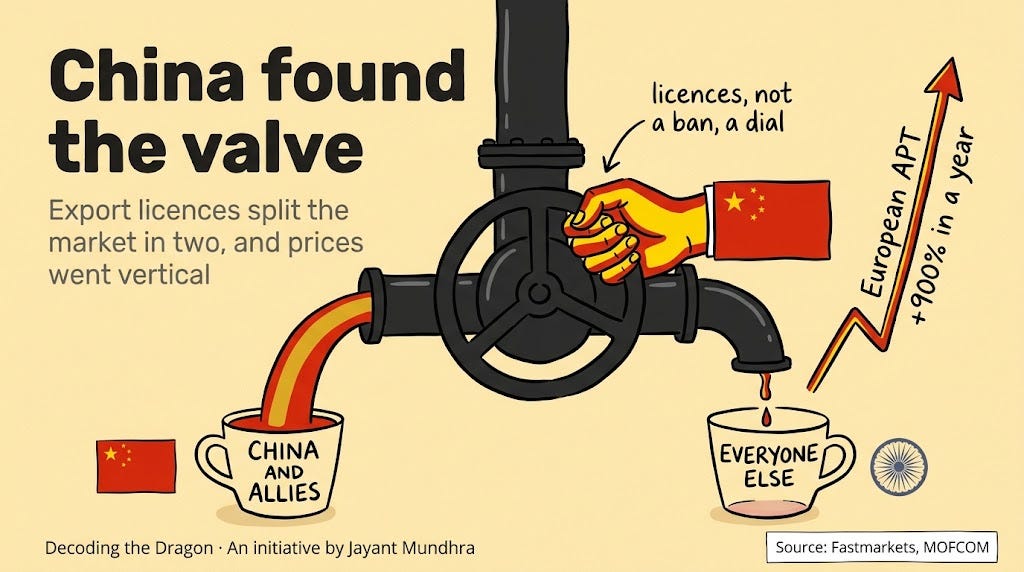
In February 2025, China put tungsten under formal export licensing, alongside tellurium, bismuth, molybdenum and indium, five metals at once5.
This built on a 2020 Export Control Law that, crucially, reaches across borders: Beijing claims the right to control foreign-made goods that contain Chinese-origin material.
It was the same playbook already run on gallium, germanium, graphite and antimony, tested metal by metal.
These are not blanket bans. They are worse, in a way, because they are a dial. Every buyer now needs a licence, an end-user declaration, a paper trail. Beijing can grant, slow-walk or quietly deny each one, and use that friction as leverage in any negotiation it likes. Supply becomes a bargaining chip.
The result is a market split cleanly in two: Chinese and allied buyers on the inside, at stable prices, and everyone else scrambling for scarce non-Chinese metal on the outside. Prices have gone vertical. European APT has blown past $3,100 per metric tonne unit, up around 900% over twelve months6. Tungsten is trading at levels not seen in over a decade.
If you want to see how sharp this lever really is, look at what just happened to the semiconductor world. It is the cleanest case study I have seen of a supply chain breaking at a point almost nobody was watching.
The pinch point is an obscure gas called tungsten hexafluoride, WF6.
It is the only material used at scale to deposit the tiny tungsten "plugs" that wire the transistors inside a modern chip together.
It is indispensable for sub-7nm logic, for the high-bandwidth memory that feeds AI servers, and for 3D NAND flash that now stacks more than 200 layers.
There is no drop-in replacement. Molybdenum is studied, but nothing matches WF6 at production yield and purity, where the standard is 99.9999% and impurities are counted in parts per billion.
Here is where China's tungsten grip reached all the way into the chip fab. In January 2026, Beijing's export announcement effectively choked off high-purity tungsten powder to Japan, and that powder is 60% to 70% of the cost of making WF67. Japan mines almost no tungsten of its own.
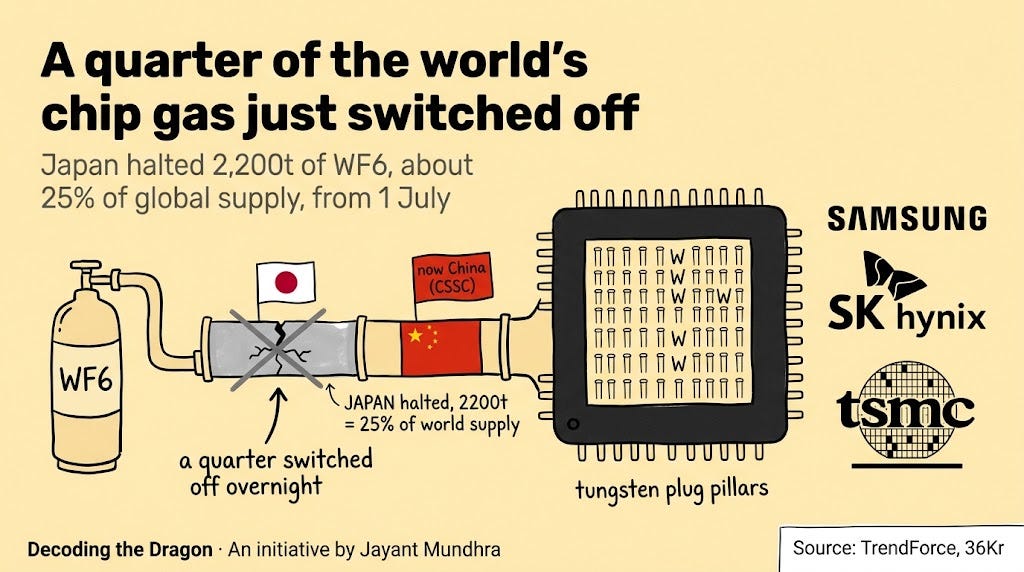
The knock-on was brutal. Two Japanese giants, Kanto Denka and Central Glass, together about a quarter of world WF6 supply, gave their customers a final ship date and said they would halt production for good from 1 July 20267. In one stroke, roughly 2,200 tonnes of annual capacity, about 25% of world supply, simply vanished, right as AI demand was pushing memory fabs flat out.
Prices did what you would expect. China's average WF6 export price hit about $150 per kg in April 2026, up more than 200% in a single month8.
And the customers on the wrong end of this are the biggest names in tech:
Samsung and SK Hynix leaned on Japanese suppliers for around 80% of their WF69.
Certifying a new supplier for advanced chips normally takes 18 to 24 months. They no longer have that time, so they are rushing it.
SK Hynix, which had diversified earlier, pivoted fast to Korean suppliers like SK Specialty and Foosung. Samsung, more exposed, is scrambling harder. TSMC needs WF6 for its 2nm and 3nm lines and cannot afford a gap.
And who is stepping calmly into the void? China's own CSSC Special Gas, which already runs the world's largest WF6 plant at 2,000 tonnes a year and is building more9. The chokepoint has not been removed. It has just been moved from Japan to China. Korean suppliers who still import Chinese powder under temporary exemptions have warned customers of WF6 price rises of up to 90%9.
Step back and this stops looking like a commodity story and starts looking like a doctrine.
For thirty years the world optimised supply chains for cost. Just-in-time, lowest-bidder, single-source, all of it beautifully efficient and completely blind to resilience. China read that same map and saw a weapon.
The strategy is patient and complete. Consolidate the mines. Corner the refining. Move up into powders, tools and finished gas. Then, once the world is fully dependent, wrap the whole thing in export licences and dual-use rules and start controlling the flow. It is industrial statecraft, and tungsten is one of its purest expressions.
This is the broader arc of everything Decoding the Dragon tracks: not just what China makes, but how it turns making into leverage. It is the thread I pull almost every day for the thousands of readers in the WhatsApp community, and tungsten is a near-perfect illustration of it (t.ly/t7uhs).
Join the Decoding the Dragon community
Now bring it home, because for India this is not an abstract supply-chain worry. It is a hole in the armour, quite literally.
Tungsten is the heart of modern anti-tank ammunition. The APFSDS round, the long, dense dart a main battle tank fires to kill another tank, is made from tungsten heavy alloy. It defeats armour not with explosives but with raw kinetic energy, punching a hyper-dense rod through steel and ceramic at over a mile a second.
India's armoured corps runs on this:
The T-90S, T-72 and the indigenous Arjun Mk1A all rely on APFSDS ammunition to fight.
The Arjun's Mk2 round, developed by DRDO's ARDE and DMRL, uses an advanced tungsten-alloy penetrator.
These rounds are made mainly at the High Energy Projectile Factory in Tiruchirappalli, the old Heavy Alloy Penetrator Project, now under Munitions India Limited10.
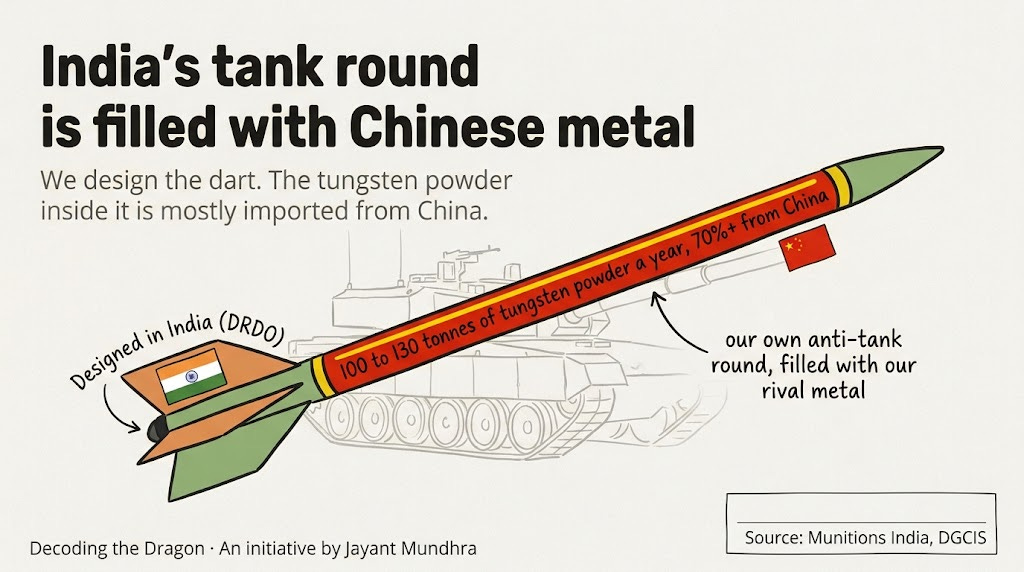
And here is the trap. That factory needs somewhere between 100 and 130 tonnes of pure tungsten powder every year, and India barely mines any tungsten of its own10. So the powder is imported, and the biggest source is China. Some Indian tool firms report that over 70% of their tungsten imports come straight from China.
Read that back slowly. India's ability to mass-produce the ammunition it would need in a war with China currently depends on buying the raw material from China. If Beijing ever pointed its licensing regime at military-grade tungsten headed to India, the way it just did at Japan's chip supply, the lines at Trichy could choke within months.
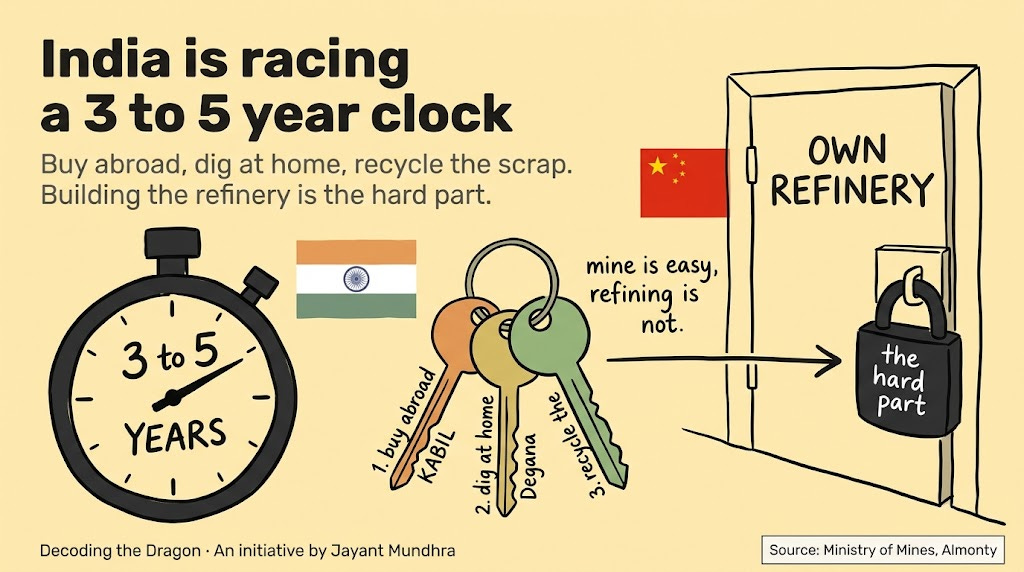
To Delhi's credit, the recalibration has started, and it is moving on three fronts at once.
Buying abroad. KABIL, the state joint venture set up to secure minerals overseas, has widened its mandate to around 30 critical minerals including tungsten, and signed exploration and supply deals across Argentina, Australia, Chile and the UAE.
Digging at home. The historic Degana block in Rajasthan was put back up for auction in September 2025 under the National Critical Mineral Mission12. The catch is that appetite is thin, and the government had to scrap nine critical-mineral blocks in mid-2026 after too few bidders turned up12.
Recycling the scrap. Munitions India is now tendering to recover pure tungsten powder from the offcuts of its own APFSDS production. Indian defence scientists have shown that recovered powder can be re-sintered into working penetrators, a small but sovereign loop.
The honest problem is time. Even Almonty's Sangdong mine in South Korea, one of the largest non-Chinese tungsten projects on earth, only reached commercial production in mid-2026 after a thirty-year gap, and converting ore to weapons-grade powder is a long road beyond that11. Industry veterans put the wait for real, high-volume non-Chinese supply at three to five years. That is the length of India's exposure.
Whether MOFCOM ever names India specifically in a tungsten or dual-use licensing action, the way it squeezed Japan. That is the tripwire.
The next batch of China's 2026 mining quotas, and whether the annual 6% cut continues or deepens.
Whether the Degana re-auction and the next critical-mineral tranche actually attract qualified bidders this time, or fail again.
Almonty's Sangdong ramp-up and any move to build APT and powder refining outside China, because the mine is the easy part and the refinery is the real bottleneck.
The uncomfortable truth is simple. India can design a world-class tank round and still not be able to build enough of them, because the powder inside it starts its life in a Chinese mine. Tungsten is not a metal India can afford to keep importing on trust.
And well that is it for today's edition. That said, do check out my core WhatsApp community Biz News+ where I share 4-5 deepdives from the world of business, economics & public economics daily: https://t.ly/h2jq1
And, do check out my work on the following platforms as well: Instagram, LinkedIn and Youtube
Best,
Jayant
1. USGS, Mineral Commodity Summaries 2026, Tungsten. pubs.usgs.gov
2. India Herald / SSBCrack, India's tungsten import dependence and defence exposure. ssbcrack.com
3. MINING.COM, Tungsten prices hit 12-year high as China tightens export controls. mining.com
4. China Tungsten Industry Association, Total Control Index of Tungsten Mining in 2025 (First Batch). ctia.com.cn
5. Global Times, MOFCOM, GAC announce export controls on tungsten and other items, effective February 4. globaltimes.cn
6. Fastmarkets, Tungsten 2026: Geopolitics sets global tone. fastmarkets.com
7. TrendForce, Potential Supply Disruptions of Tungsten Hexafluoride from Japan. trendforce.com
8. 36Kr, Tungsten Hexafluoride Supply Cut-off: Choking the Throat of Global Chips. 36kr.com
9. BigGo Finance, South Korea's Semiconductor Sector Hit by Double Supply Shock. biggo.com
10. Wikipedia, Munitions India (High Energy Projectile Factory / Heavy Alloy Penetrator Project). wikipedia.org
11. NAI500, Almonty's Sangdong Tungsten Mine Begins Commercial Production. nai500.com
12. Business Standard, Govt scraps 9 critical mineral blocks auction citing poor investor response. business-standard.com
Comments
Nothing yet. Say the first thing.
Sign in to join the conversation.