
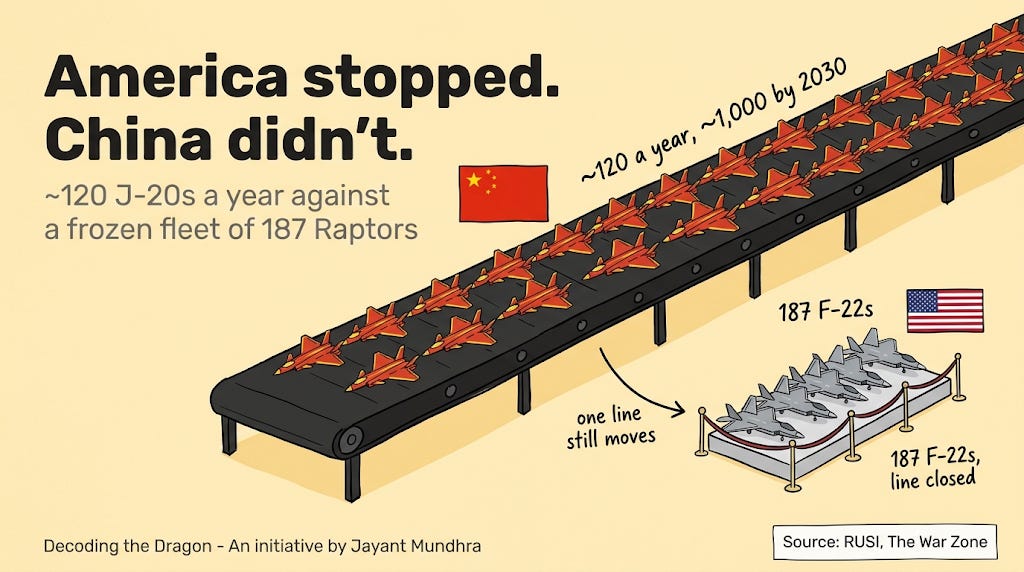
Here is a number that stopped me cold. By late 2025, China was building its J-20 stealth fighter at a rate of around 120 aircraft a year1. The United States built 187 F-22 Raptors in total, ever, then shut that line in 20114. China now rolls out most of a Raptor fleet every eighteen months.
And the thing that unlocked this was not a wing, or a radar, or a clever bit of stealth shaping. It was an engine.
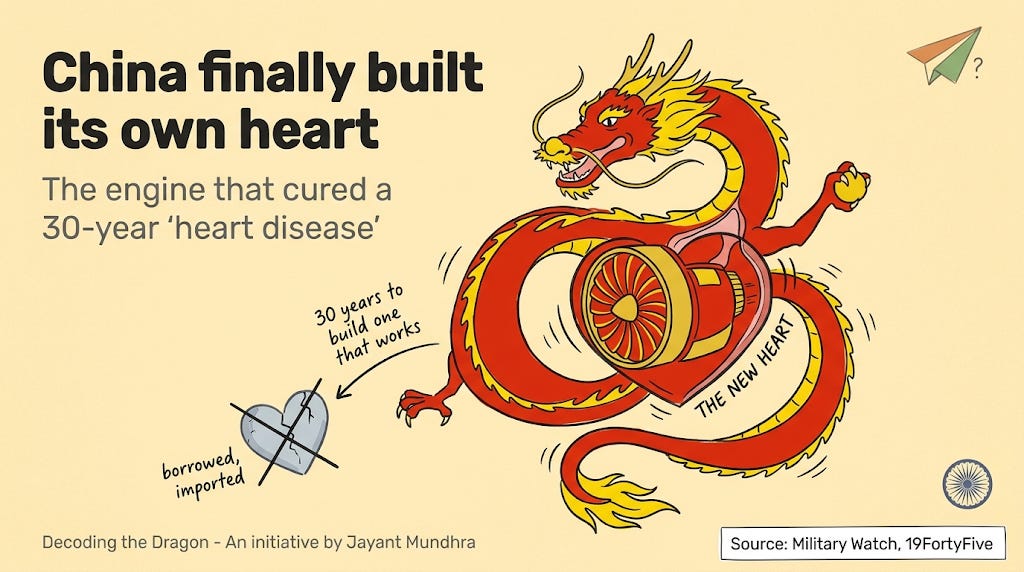
For thirty years, the one component China could not build was the one that mattered most. Chinese engineers had a name for it: xinzangbing, or "heart disease". The airframes were world class. The hearts inside them were borrowed, Russian, and unreliable.
That era is now over. And I think it is one of the most underrated industrial stories of the decade.
The J-20 "Mighty Dragon" flew for years on someone else's engines. First the Russian Saturn AL-31, then China's own stopgap, the WS-10 "Taihang". Both did the job. Neither had the raw power the aircraft was designed around.
The problem was never the plane. It was that a fifth-generation jet engine is arguably the single hardest thing a modern industrial economy can be asked to build.
A nuclear device needs a burst of extreme physics, once.
A fighter engine needs sustained mastery of extreme thermodynamics for hundreds of hours, without blowing up.
It runs on turbine blades that sit in gas hotter than the melting point of the metal they are made from.
Get any of it slightly wrong and the engine does not underperform. It disintegrates. That is why, for decades, China could copy almost anything in aerospace except this.
The dependence was not just technical, it was a leash. During the J-20's early years, Russian exporters reportedly refused to hand over better AL-31 variants unless Beijing also bought complete Sukhoi Su-35 airframes it did not really want. Your supplier setting your shopping list is the definition of a strategic vulnerability.
This is the part I find most instructive, and it is the part India should read twice.
For years, China treated aero-engines as accessories. An engine programme was tied to a specific aircraft. If the aircraft got delayed or cancelled, the engine research died with it. That is a fine way to build gearboxes. It is a hopeless way to build something that takes 25 years of continuous, failure-tolerant iteration.
So in 2016, Beijing changed the structure, not just the budget.
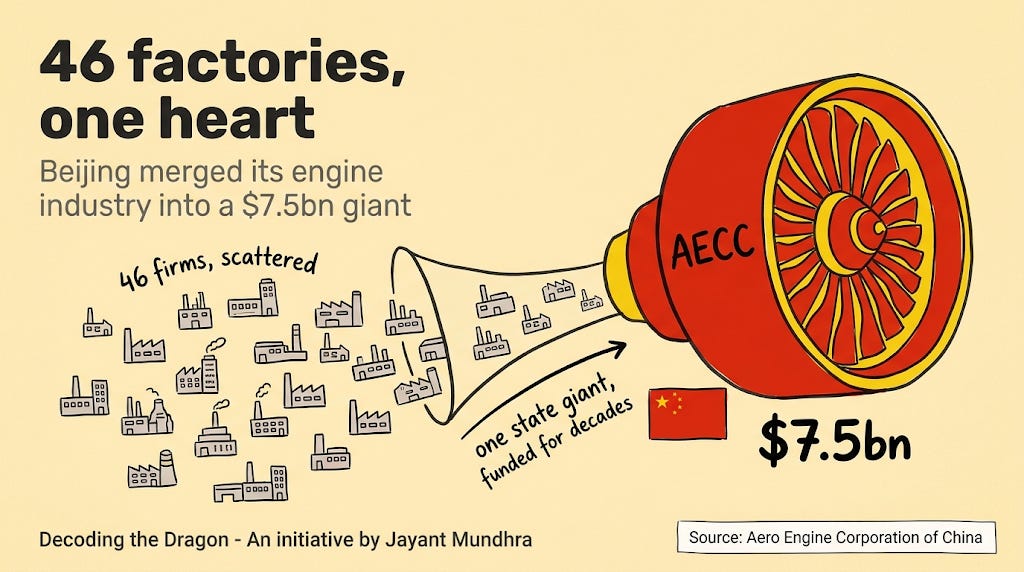
On 28 August 2016, it merged dozens of scattered factories and research institutes into a single giant: the Aero Engine Corporation of China (AECC)7.
AECC launched with registered capital of about $7.5bn and pulled 46 separate companies under one roof7.
Aero-engines were elevated to a "National Science and Technology Major Project", which meant state money flowed to the engine directly, decoupled from any single jet.
The effect was to let engineers fail safely. In the West, a Pratt & Whitney or a GE has to justify engine R&D against quarterly numbers and win procurement bids. AECC just had to deliver, eventually, with the state absorbing decades of expensive destructive testing.
This is exactly the kind of quiet structural mechanism I end up picking apart most mornings, and it is what we go back and forth on in the Decoding the Dragon WhatsApp community, where I share a smaller China deep-dive like this with thousands of readers every day (t.ly/t7uhs).
Join the Decoding the Dragon community
The breakthrough that finally worked lives in the turbine blades, and it is worth understanding because it is the same wall India keeps hitting.
Ordinary metal is made of countless microscopic crystals, or grains. Spin that metal at tens of thousands of RPM inside gas at over 1,800 K and the grain boundaries become fault lines. The blade slowly stretches, a process called creep, until it grinds into the engine casing and the whole thing lets go.
China's answer, developed largely at the Beijing Institute of Aeronautical Materials, was to grow each blade as one single continuous crystal, with no grain boundaries at all, enriched with rare elements like rhenium for heat resistance.
Single-crystal blades that resist creep at extreme heat.
Compressor discs made by powder metallurgy, pressed from atomised superalloy powder rather than cast, for far fewer internal flaws.
A core that reportedly tolerates turbine-inlet temperatures near 1,850 K.
Higher heat tolerance is the whole game, because in a jet engine, hotter gas means more thrust for the same fuel. Master the metal and everything downstream improves at once.
The result is the Shenyang WS-15, codenamed "Emei". It is now in serial production and flying on the upgraded J-20A3.
The exact figures are unofficial, and I want to be honest that these are estimates rather than published specs. But the credible range is striking:
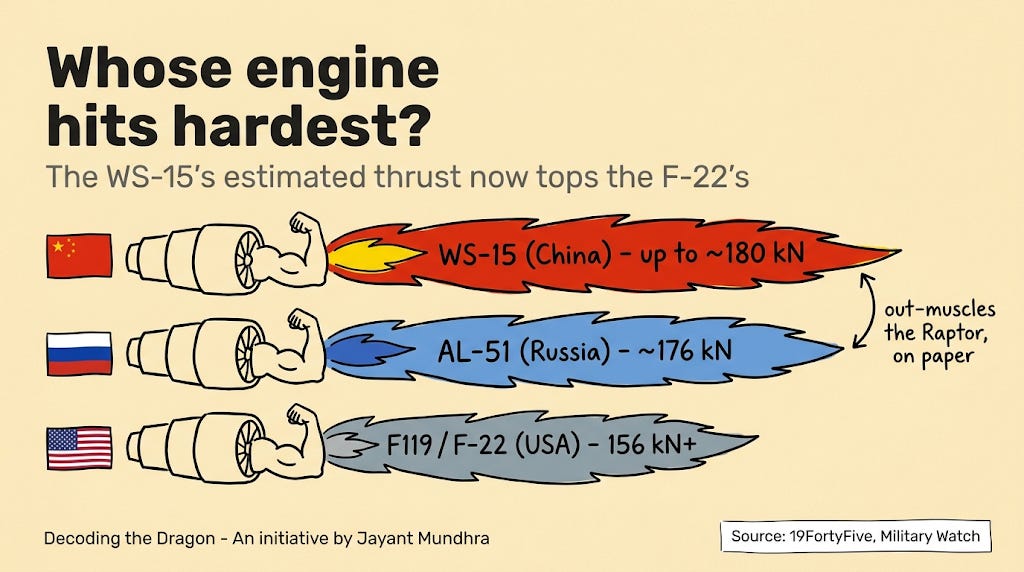
WS-15 thrust of roughly 160 to 180 kN with afterburner, with Chinese state TV claiming 18.5 tonnes of force, near the top of that band2.
A thrust-to-weight ratio credited at around 10:1 to 11:12.
For comparison, the Pratt & Whitney F119 that powers the F-22 produces more than 156 kN4.
On paper, then, China has built an engine that out-muscles the one inside America's premier air-superiority fighter2. It also draws roughly level with Russia's newest Su-57 engine, the AL-51, rated near 176 kN in afterburner14.
I stress "on paper". Out-powering the F119 in a spec sheet is not the same as matching its reliability, which took the US decades to earn2. But the direction of travel is unmistakable.
The real prize is supercruise: sustained supersonic flight without afterburners. A fourth-generation jet can only go supersonic by dumping raw fuel into its exhaust, which it can sustain for minutes. Supercruise makes it the cruise setting, not the sprint. That does three things for the J-20:
It cuts the infrared bloom, because afterburners are what light a jet up for heat-seeking sensors and early-warning satellites.
It hands launched missiles like the PL-15 more kinetic energy at release, extending their no-escape range.
It stretches combat radius across the South China Sea without burning fuel in reheat, so the jet can loiter longer or fly deeper.
Put simply, the engine is what turns an expensive stealth shape into an actual weapon. Until 2023 the J-20 was a fifth-generation body with a fourth-generation heart. The WS-15 is what closed that gap.
The WS-15 does something less obvious too: it generates electrical power, a lot of it. And that feeds the J-20's other 2025 upgrade.
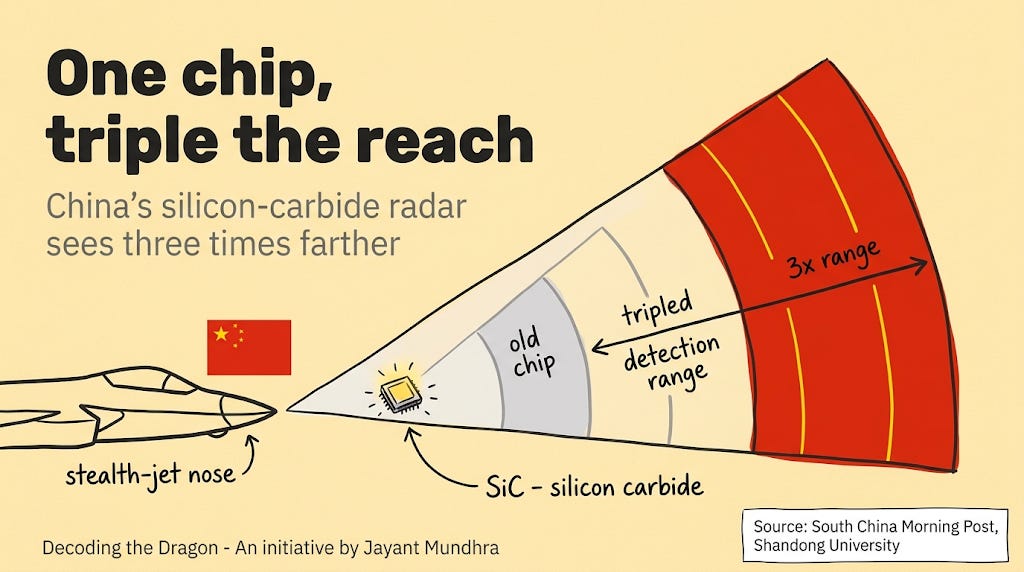
Chinese researchers at Shandong University, led by semiconductor scientist Xu Xiangang, say a home-grown silicon carbide (SiC) material has tripled the detection range of the jet's phased-array radar5. SiC handles heat and voltage far better than the older gallium-based chips, so the same radar runs hotter and harder.
The claim, made public in May 2025, is a threefold jump in range, credited to two decades of SiC work5.
The same material is being pitched for missile seekers and laser weapons5.
Then there is the J-20S, a two-seat variant now entering service, built so a back-seat officer can command swarms of stealthy GJ-11 "loyal wingman" drones6. A powerful engine, an elite radar, and a drone quarterback in one airframe. That is a genuine system, not a show jet.
Step back and this stops being a story about one engine. It is the capstone of China's tech self-reliance drive.
With the WS-15 in production, alongside the mature WS-10 for its other fighters and the WS-20 for its heavy transports, China has, for the first time, a home-grown engine for essentially every class of military aircraft it flies.
The Russian leash is cut. No more buying Su-35s to unlock spare parts. Estimates from RUSI suggest China could field close to 1,000 J-20s by 20301, a fleet backed by satellite-confirmed factory expansion9. The United States, by contrast, is frozen at its 187 Raptors4.
An adversary you could once throttle by withholding engines is now one that builds its own, at scale, on its own timetable. That is a different kind of competitor.
Here is where it gets uncomfortable, because India is living China's old story in real time.
We have our own xinzangbing, and it is acute right now.
As of mid-2026, roughly 30 brand-new Tejas Mk1A fighters sit built but grounded, because their American GE F404 engines have not arrived10.
India ordered 99 of those engines back in 2021 for about $716mn; by late 2025 only a handful had been delivered, years late10.
HAL has resorted to bolting test engines onto finished jets just to keep flying10. GE has only recently restarted deliveries after a two-year delay13.
The parallel to China circa 2010 is almost eerie. World-class airframe, no reliable heart, a foreign supplier setting the pace.
And our indigenous answer has struggled the same way China's early engines did. The Kaveri engine never powered a fighter. It was so behind that the government formally relaunched it as "Kaveri 2.0" in February 2026, with a fresh 2030 deadline11.
Even our future is outsourced at the core. For the AMCA, India's own fifth-generation stealth fighter, the plan is a clean-sheet engine co-developed with France's Safran, because we cannot yet do it alone12. And the AMCA itself is not expected to fly before 2028-29, with service closer to 203510.
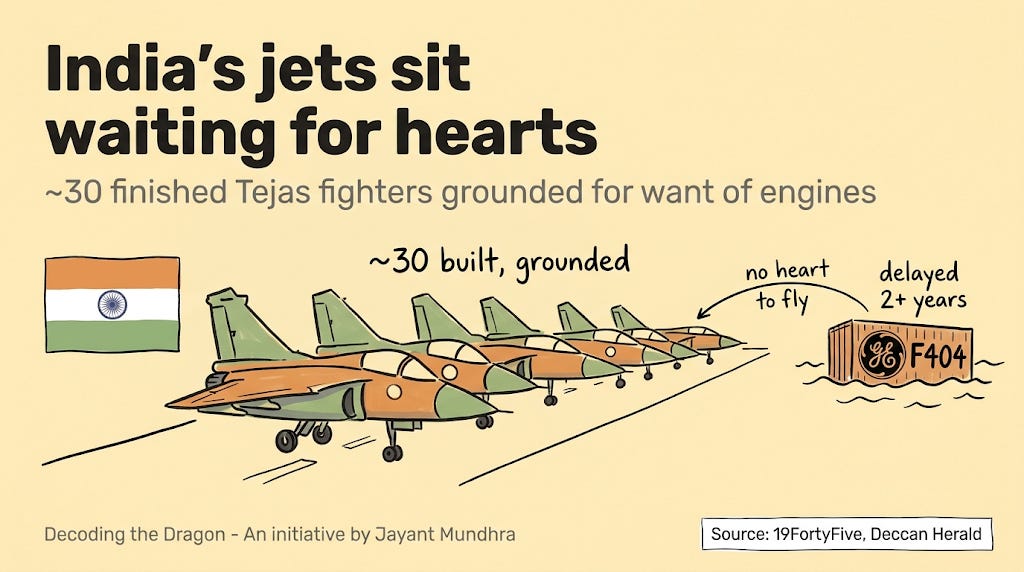
There is a scale point too, and it is brutal. China is delivering J-20s by the dozen every few months, with more than 200 believed handed to the PLA in just the first half of 20268. India, in the same window, could not deliver a single finished Tejas because the engines were not there10. One country is arguing about whether it builds 120 or 250 fighters a year. The other is arguing about whether it can power 30.
The lesson from AECC is not "spend more". India already spends. The lesson is structural: China won by decoupling engine funding from any single aircraft and protecting it for 25 years. India still ties its engine fate to whichever jet is in the headlines. That is the difference between a Kaveri that stalls and a WS-15 that flies. This gap, between how China and India fund the unglamorous core of hard tech, is the thread I keep pulling in the Decoding the Dragon community, where a version of this debate runs every single day (t.ly/t7uhs).
Join the Decoding the Dragon community
Whether the WS-15 clears the real test, not thrust but time-between-overhaul hours, which is where China's engines have always fallen short.
Whether the J-20A's WS-15 finally gets thrust-vectoring nozzles, which current prototypes still lack.
GE's F404 delivery pace to HAL through 2026-27, and whether Kaveri 2.0 shows any bench progress before its 2030 date.
The AMCA engine deal's final Cabinet clearance, and what share of the core India actually gets to build.
China spent a generation, and a restructured industry, to stop importing hearts for its jets. India is only now admitting it has the same disease. The engine, not the airframe, is where air power is really decided, and that is the lesson we can least afford to keep relearning.
And well that is it for today's edition. That said, do check out my core WhatsApp community Biz News+ where I share 4-5 deepdives from the world of business, economics & public economics daily: https://t.ly/h2jq1
And, do check out my work on the following platforms as well: Instagram, LinkedIn and Youtube
Best,
Jayant
1. The War Zone, "How Many J-20 Mighty Dragon Fighters Does China Actually Have?", twz.com
2. 19FortyFive, "Now China Has Built One That Out-Powers The F-22 Raptor's", 19fortyfive.com
3. Military Watch Magazine, "China's New WS-15 Jet Engine Finally Enters Serial Production", militarywatchmagazine.com
4. Wikipedia, "Pratt & Whitney F119", en.wikipedia.org
5. South China Morning Post, "China's J-20 stealth fighter's radar leap credited to semiconductors expert Xu Xiangang", scmp.com
6. Military Watch Magazine, "China's New '5+ Generation' J-20S Fighter Built For Airborne Command and Control", militarywatchmagazine.com
7. Wikipedia, "Aero Engine Corporation of China", en.wikipedia.org
8. Meta-Defense, "Chengdu is believed to have delivered over 200 J-20s to the PLA in the first half of 2026", meta-defense.fr
9. Defence Security Asia, "China Mass-Produces J-20 & J-35 Stealth Fighters, 1,000 Fifth-Gen Jets by 2030", defencesecurityasia.com
10. 19FortyFive, "India Has 30 Brand-New Fighters It Can't Fly", 19fortyfive.com
11. Meta-Defense, "India relaunches Kaveri 2.0 development for Tejas Mk1A amid delays to the US F404", meta-defense.fr
12. Aerospace Global News, "Safran & India to co-develop clean sheet fighter jet engine for AMCA", aerospaceglobalnews.com
13. Deccan Herald, "GE Aerospace starts delivery of F404 engines for Tejas Mk1A jets after two years of delay", deccanherald.com
14. Wikipedia, "Saturn AL-51", en.wikipedia.org
Comments
Nothing yet. Say the first thing.
Sign in to join the conversation.