
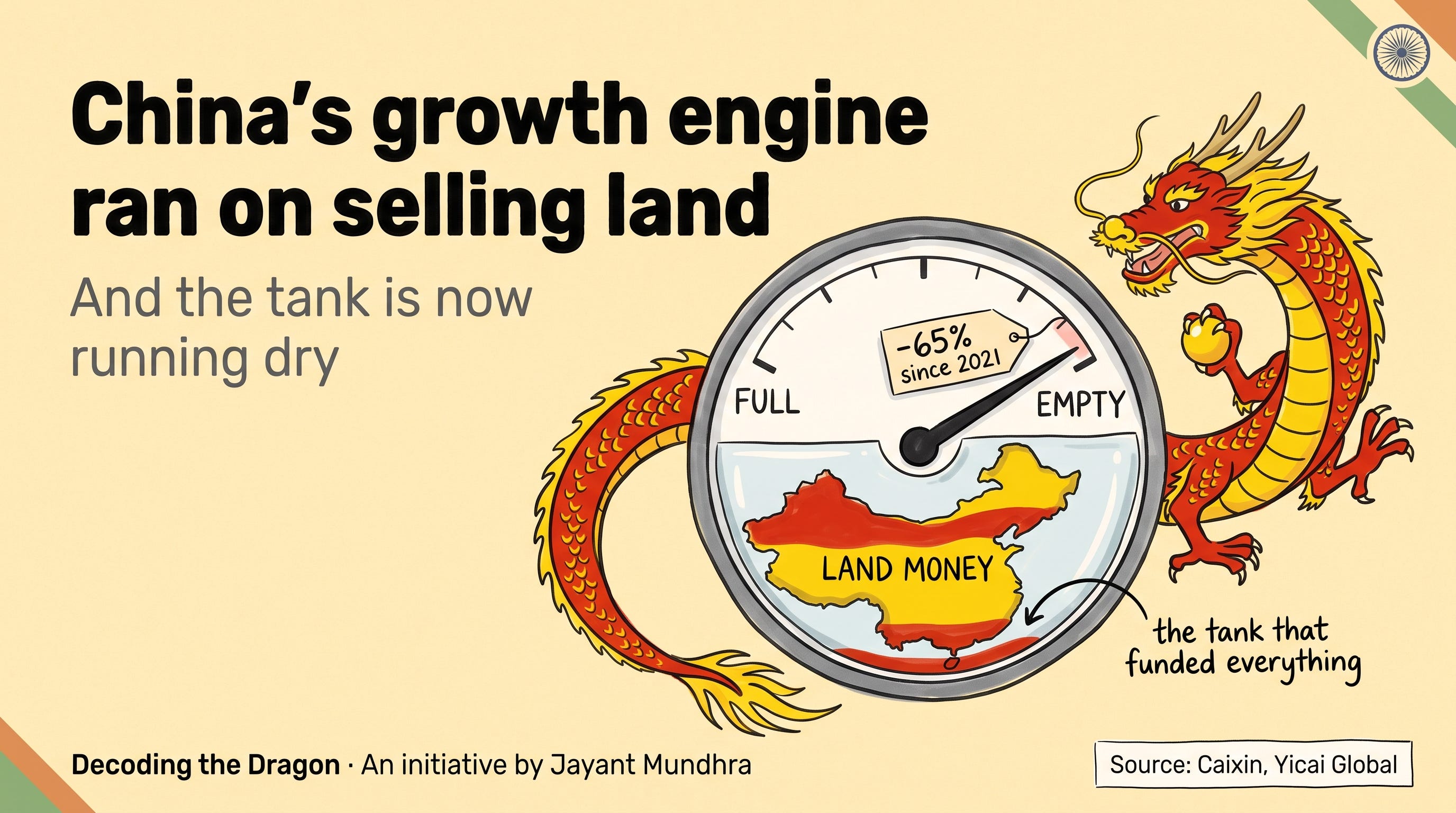
Here is a number that quietly reframes the entire China story for me. In 2025, Chinese local governments earned about $597bn from selling land, down 14.7% in a single year and roughly 65% below the 2021 peak.1 2
Most of us read the China property crash as a housing story. Over-borrowed developers, empty flats, Evergrande in a Hong Kong courtroom. That is the symptom. The disease sits one level up, and almost nobody outside China is naming it.
For nearly thirty years, selling land was not one revenue line for a Chinese city. It was the revenue line. So when land stops selling, this is not a sector cooling off. It is the funding engine of the world's second-largest economy losing its fuel.
To see why, you have to go back to 1994. That year China ran a tax-sharing reform that handed Beijing the best revenue streams, chiefly VAT and corporate income tax, and cut local governments' share of taxes from roughly 80% to around 45% almost overnight.3
But it did not cut their jobs. Chinese cities still had to fund schools, hospitals, pensions, roads, and later high-speed rail and industrial parks. By 2008 local governments were doing nearly 80% of all public spending while keeping under half the revenue.3
They were also banned from borrowing directly and could not levy their own property tax. So they did the one thing they could. They sold land.
All urban land in China is owned by the state, and cities hold a legal monopoly on the primary market.
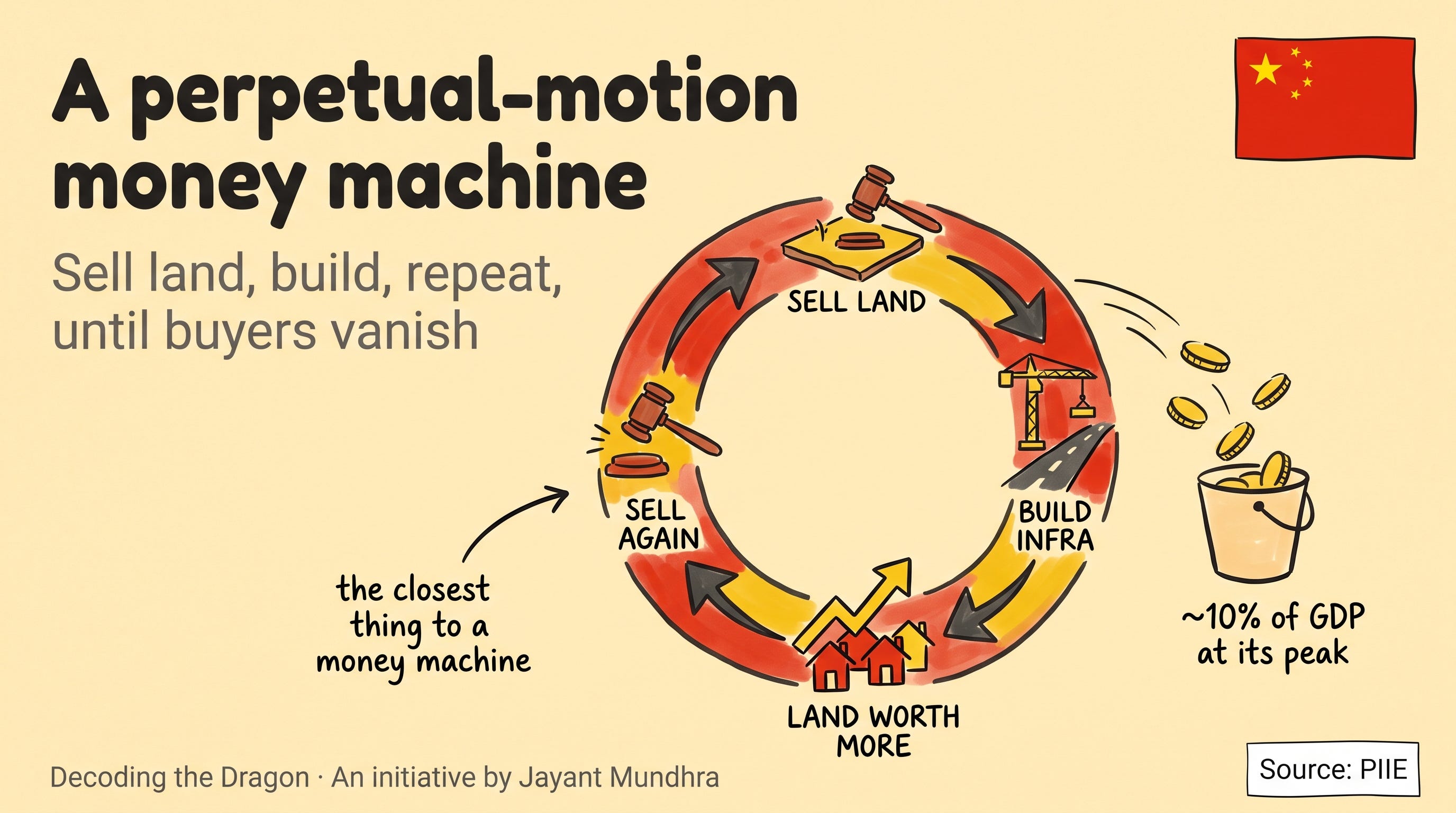
Local governments buy farmland from villages cheaply, rezone it, and auction 70-year usage rights to developers for huge upfront fees.
That cash funds infrastructure, which lifts the value of the next plot, which is then auctioned even higher.
This is "land finance", tudi caizheng, and it is the closest thing modern economics has to a perpetual-motion machine. At its height, land sales and land-backed borrowing threw off close to 10% of GDP for the state.4 This is the mechanism I keep coming back to in the Decoding the Dragon WhatsApp group, where I share a smaller China deep-dive like this with thousands of readers every morning (t.ly/t7uhs), because once you see it, you cannot unsee it in any China headline.
Join the Decoding the Dragon community
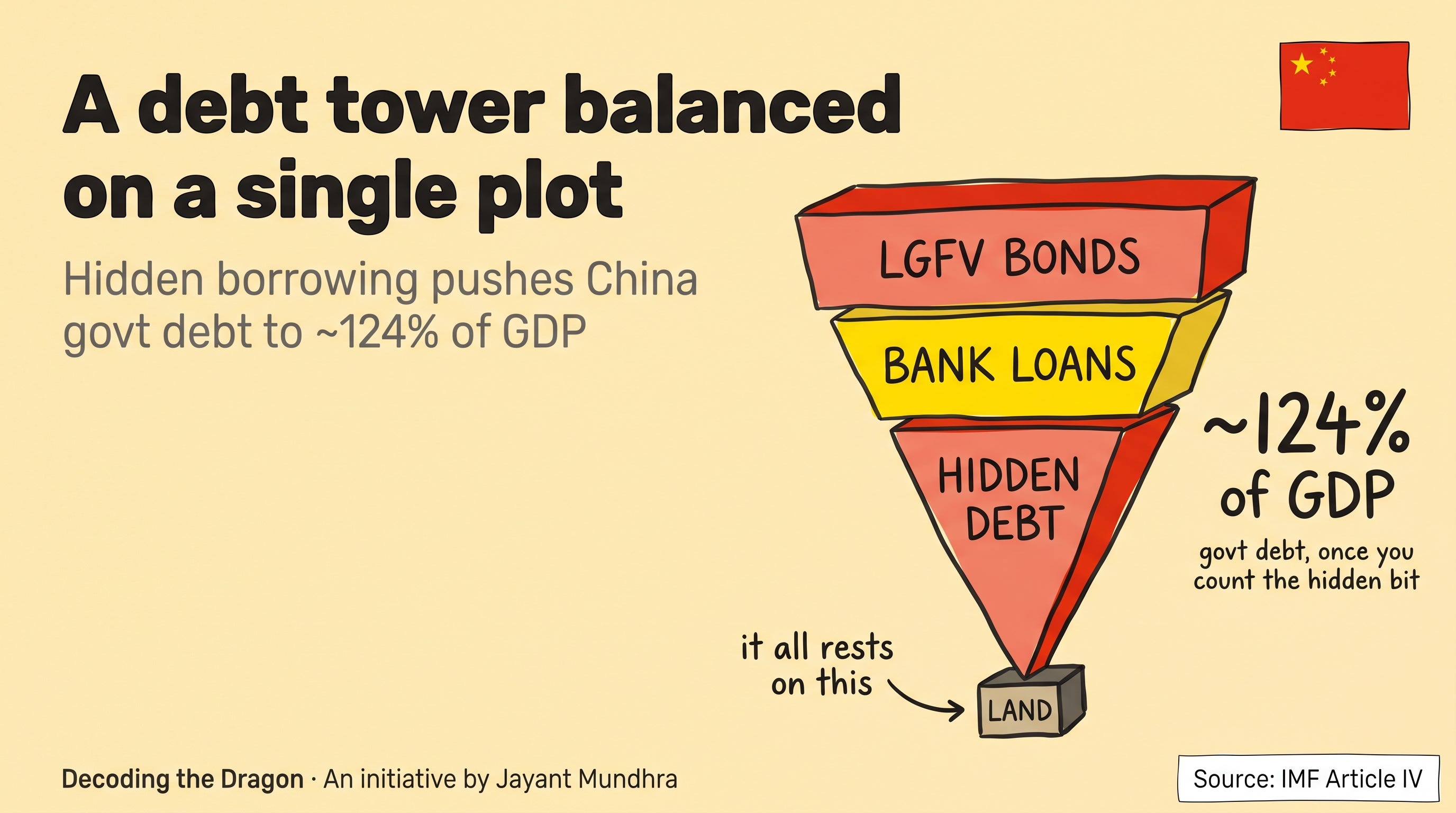
Upfront land sales were never going to be enough for China's building ambitions, so cities built a workaround called the Local Government Financing Vehicle, or LGFV. Think of it as a city's off-books borrowing arm.
The trick is elegant and dangerous in equal measure:
The city injects state land into an LGFV as capital.
The LGFV uses that land as collateral to borrow from state banks and issue bonds.
It builds infrastructure, which raises nearby land values, which the city then sells to service the debt.
The whole structure runs on one assumption. Land prices only ever go up. Stack enough of these vehicles on top of each other and you get a debt pile that dwarfs China's official government borrowing.
The IMF now puts China's "augmented" government debt, the measure that finally counts this hidden borrowing, at around 124% of GDP, up from 86% in 2019.5 Outstanding LGFV operating debt alone was about $2.1tn at the end of 2024.6
And these vehicles do not really make money. They build public goods that benefit the region but earn the LGFV almost nothing, while paying 5% or more in interest. Most cannot cover their own interest bill without fresh land money from the city. It is negative carry, financed forever, on the promise of ever-rising land.
Then Beijing pulled the thread. The "three red lines" policy of 2020 cut off credit to over-leveraged developers to curb speculation. Demand fell, construction stalled, and the developers who defined the boom went down.
Evergrande, once the most indebted developer on earth with over $300bn owed, was ordered into liquidation and delisted from Hong Kong in August 2025.7
Country Garden, formerly China's largest builder, defaulted and remains stuck in winding-up proceedings.7
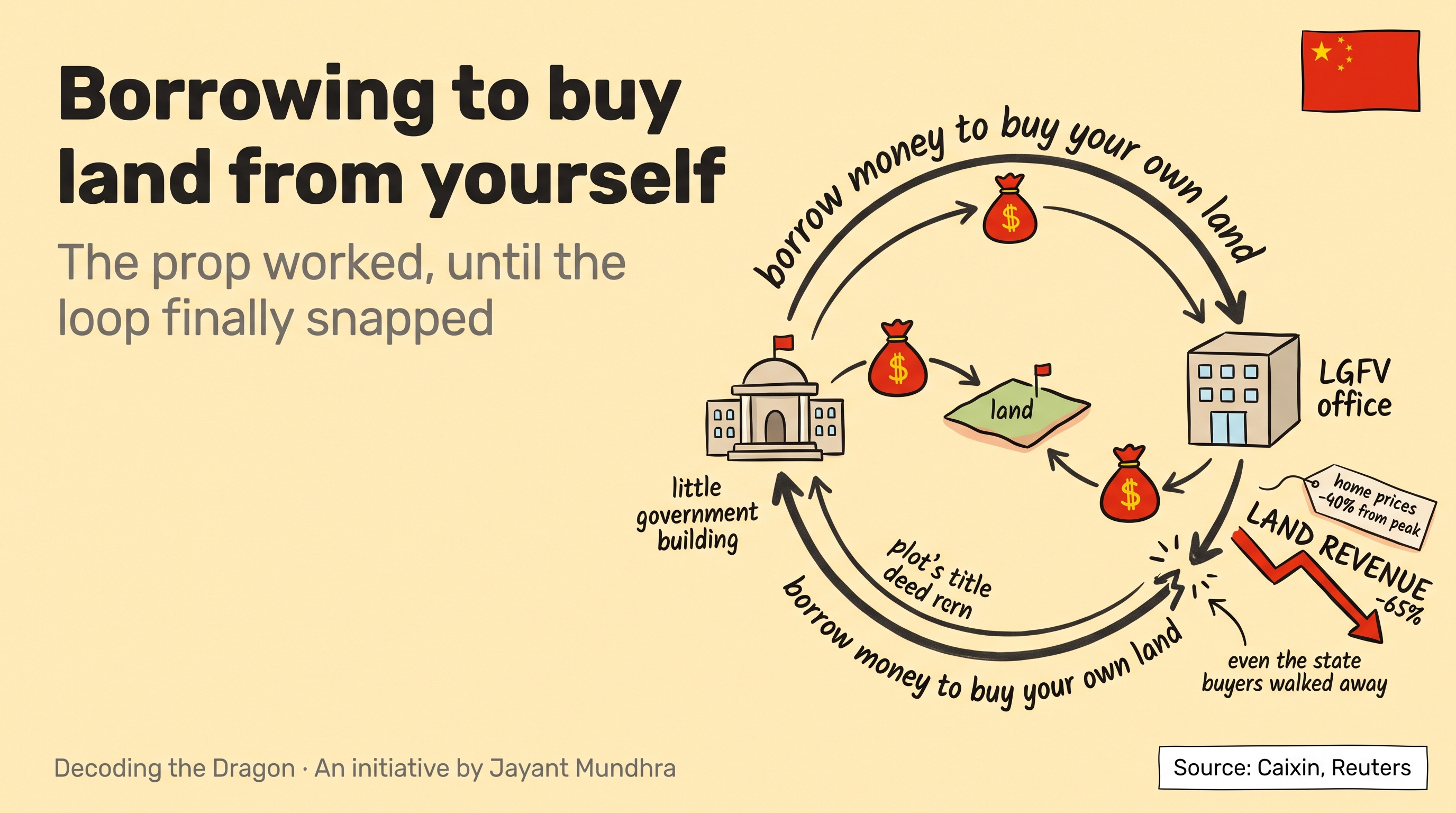
Here is the strange part. As sales volumes collapsed, land prices did not fall the way a textbook says they should. Because if land values dropped, every LGFV's collateral would be worth less, banks would face write-downs, and the whole credit chain would freeze.
So cities did something remarkable. They ordered their own LGFVs to buy the land, propping up the auctions to keep prices, and collateral, artificially high. For a while it worked. A government was effectively borrowing money to buy land from itself.
But that game has now run out. The 65% collapse in land revenue is happening precisely because even the state-backed buyers have retreated.1 The propping has stopped, and gravity has taken over. Home prices are down around 40% from their 2021 peak, and a Reuters poll of analysts expects a further 4% fall in 2026 before any stabilisation in 2027.8 In the first five months of 2026, only 4 of 70 major cities saw new-home prices rise year-on-year.8 This is the point I find most worth chewing on, and it is exactly the kind of second-order mechanism we pull apart in the Decoding the Dragon community every day (t.ly/t7uhs).
Join the Decoding the Dragon community
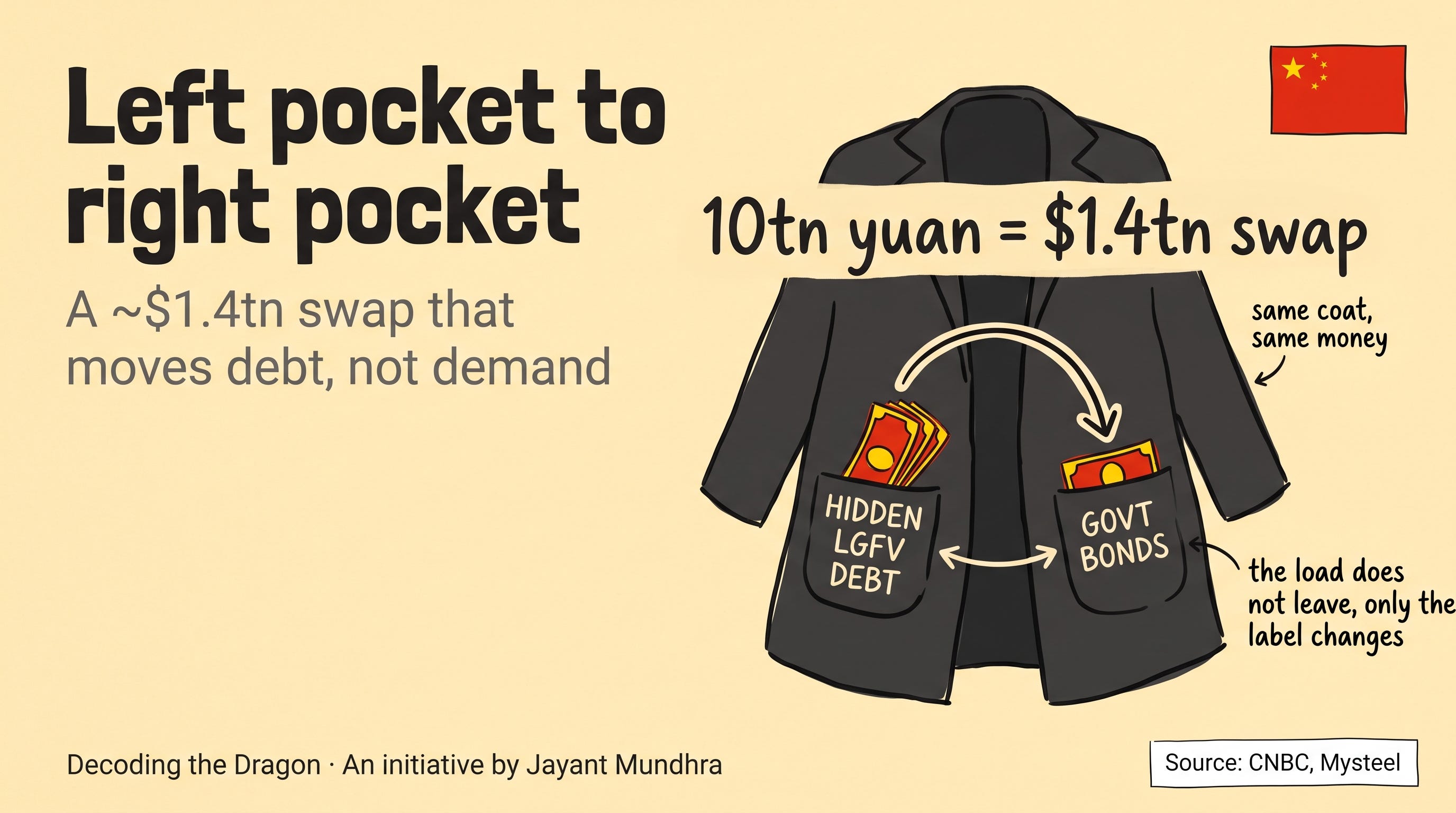
Beijing's answer, announced in late 2024, is a 10tn yuan (about $1.4tn) debt programme running to 2028. It swaps expensive, hidden LGFV debt for cheaper, transparent local-government bonds.9
On the numbers, it is working narrowly. Hidden debt fell to 10.5tn yuan by the end of 2024, and the central bank says the count of LGFVs and their outstanding financial debt dropped 71% and 62% between March 2023 and September 2025.9 10 In 2025, LGFV net bond financing turned negative for the first time as new borrowing was throttled.11
Lower interest bills, longer maturities, and more visible books. Real, and useful.
But it injects no new demand into the economy. It shifts debt from the left pocket to the right pocket.
That is the core problem. China's slowdown is a demand problem, and a swap is not stimulus. Worse, this was Beijing's historic tool for stimulus. When growth sagged, the centre told local governments to build, funded by land. That transmission belt is now broken. The land-finance model didn't just fund the boom, it was the counter-cyclical lever, and China has misplaced it at the exact moment it needs it most.
With about 70% of Chinese household wealth tied up in property, and the downturn shaving an estimated 2 percentage points off GDP growth a year, this is not a niche fiscal story.12 It is the whole ballgame.
Here is where it gets genuinely interesting for us. China is dying of too much land monetisation. India is quietly starving from too little.
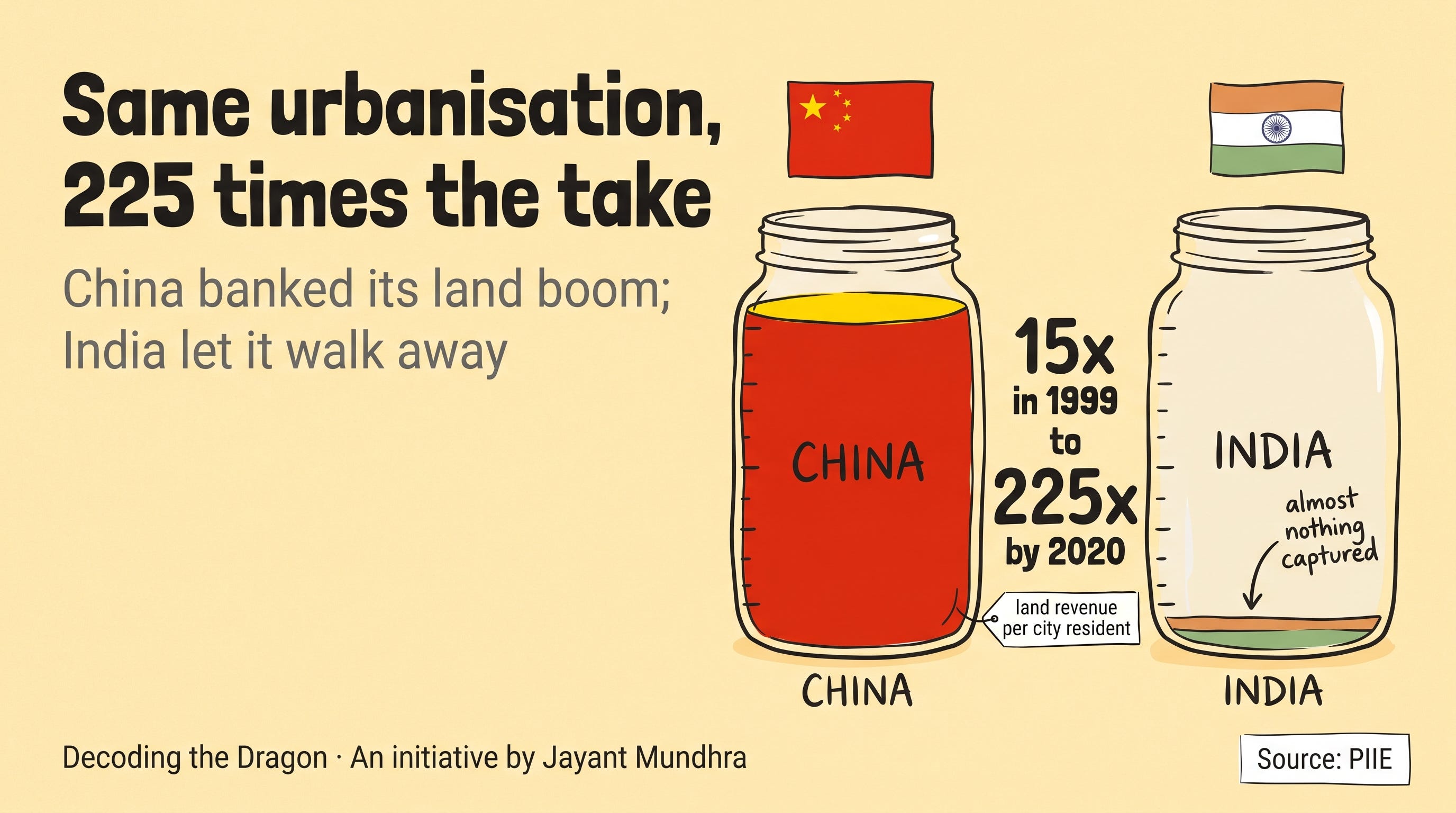
Urbanisation makes land more valuable everywhere. China captured that surplus aggressively and scaled land revenue to roughly a tenth of GDP. India let almost the entire windfall walk out the door.
The gap is almost hard to believe. Chinese local land revenue per urban resident was about 15 times India's in 1999. By 2020 it was nearly 225 times.4 Same wave of urbanisation, two completely different states standing in front of it.
India's cities are structurally powerless in a way China's are not:
Indian municipal corporations raise just 0.6% of GDP in revenue, against 9.2% for the centre and 14.6% for states.13
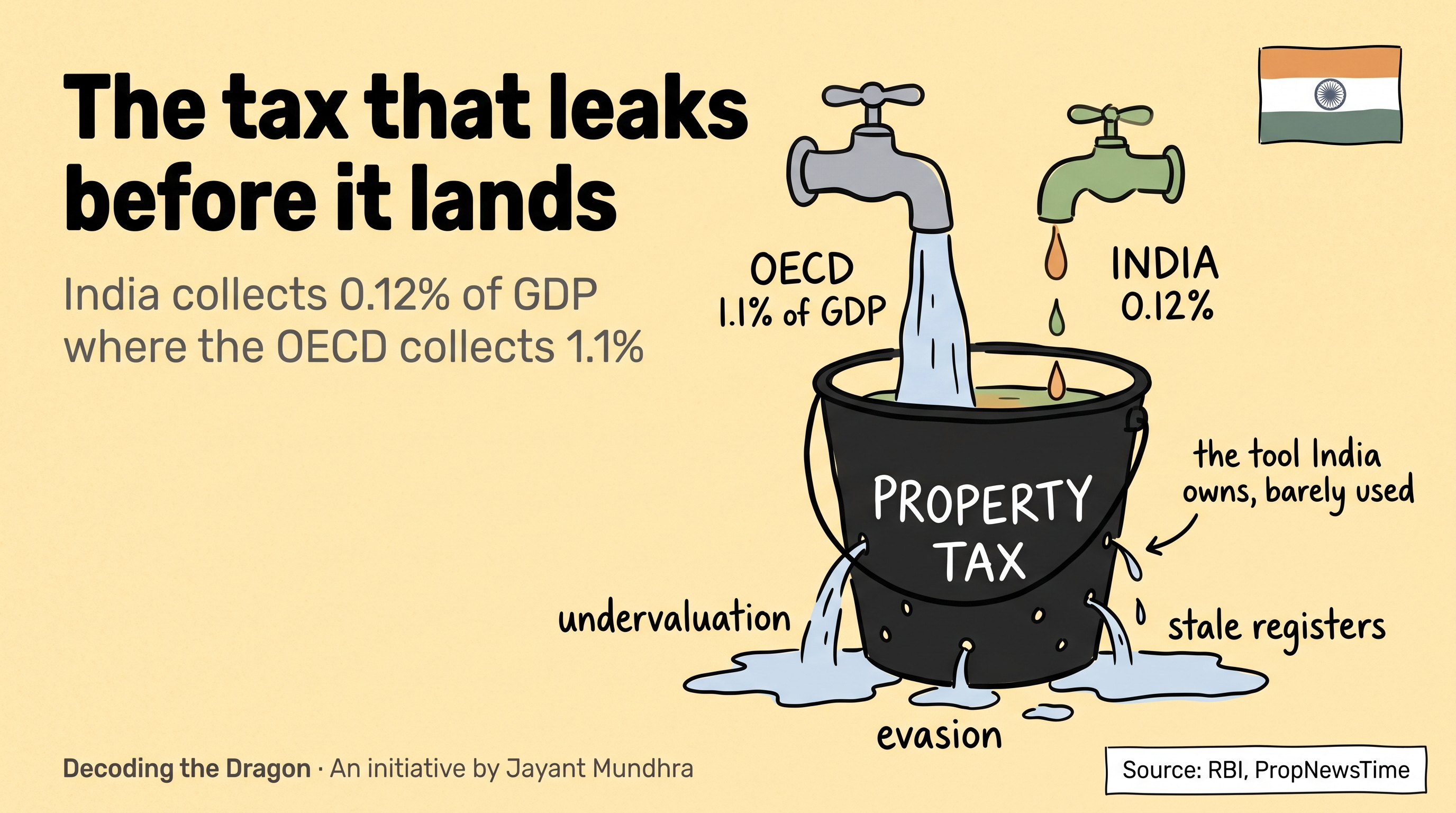
Property tax, the one recurring tool they own, brings in only 0.12% to 0.15% of GDP, versus a developing-country average of 0.7% and an OECD average of 1.1%, nearly ten times India's rate.13 14
In 2023-24, all of India's municipal corporations collected about ₹32.5k crore in property tax out of ₹1.7 lakh crore of total municipal revenue, and their borrowings, thin as they are, more than quadrupled from ₹2.9k crore to ₹13.4k crore over five years.14
It is not a shortage of valuable land. It is a failure of machinery.
Legacy laws like the 1976 Urban Land Ceiling Act froze prime city land in decades of litigation and fragmented titles.
Registers are manual and outdated, valuations are years behind the market, and evasion is rampant. GIS mapping pilots in Bengaluru and Jaipur found cities were collecting a small fraction of what they were actually owed.
Vast tracts sit with railways, ports, defence and PSUs, unmonetised.
India is trying to build the machine China is now dismantling. The National Land Monetisation Corporation, set up in 2022 with ₹5k crore of authorised capital, is meant to unlock surplus public land, and Budget 2025-26 flagged a wider ₹10 lakh crore asset-monetisation roadmap to FY30.15 It is taking charge of surplus parcels from Air India, MTNL and other disinvested firms.
But an NLMC with no land monopoly, tangled titles and no coercive power is a pale shadow of a Chinese city that could simply take farmland and auction it. The ambition is right. The tools are weak.
The temptation is to conclude China did it wrong and India should avoid the whole thing. I think that reading is lazy.
China's mistake was not capturing land value. It was funding a permanent state on a volatile, one-off revenue source, with no recurring property tax underneath as ballast. When the one-off dried up, everything cracked.
India's mistake is the mirror image: it captures so little that its cities cannot function, cannot borrow, and cannot build. Municipal bonds barely exist here because the underlying revenue is too thin to service them.
The honest lesson sits in the middle. The stable answer both giants keep avoiding is the same, a properly assessed, technologically enforced, recurring property tax. China won't introduce one during a housing crash for fear of triggering panic selling. India can't collect the one it already has. Both are running from the boring, durable solution toward exciting, fragile ones.
Whether China's 2026 land-sale revenue posts a fifth straight double-digit fall, or finally flattens as the whitelist loan support feeds through.
Any signal from Beijing on reviving the property-tax legislation that was dropped from the legislative agenda in 2023.
Whether the debt swap moves from refinancing old LGFV bonds to actually restructuring the operating debt underneath, the harder half.
On the India side, NLMC's first genuinely large monetisation close, and whether any state finally digitises and revalues its property-tax base at scale.
China spent thirty years turning land into a fiscal engine, and is now learning that an engine built on a one-off sale eventually runs out of road; India never built the engine, and is learning that too can leave a country stranded.
And well that is it for today's edition. That said, do check out my core WhatsApp community Biz News+ where I share 4-5 deepdives from the world of business, economics & public economics daily: https://t.ly/h2jq1
And, do check out my work on the following platforms as well: Instagram, LinkedIn and Youtube
Best,
Jayant
2. Yicai Global, "Chinese Local Gov'ts Log Double-Digit Drop in Income From Land Sales in 2025"
3. NPC Observer, "Finance Minister's Explanation of China's Local Debt Swap Plan"
4. PIIE, "Chinese local governments' reliance on land revenue drops"
6. IMF, "People's Republic of China: 2025 Article IV Staff Report"
7. CNN Business, "China's property crisis icon Evergrande will delist"
8. Reuters, "China's home prices set to stabilise by 2026 after slower falls"
9. CNBC, "China announces $1.4 trillion package to tackle local governments' hidden debt"
10. Mysteel, "China's 10 Trillion Yuan Local Debt Swap Program"
13. Reserve Bank of India, "Report on Municipal Finances 2024"
14. PropNewsTime, "Property tax collections in 2023-24 across India"
Comments
Nothing yet. Say the first thing.
Sign in to join the conversation.