
I think the tunnel boring machine is the most underrated instrument of Chinese power, and almost nobody in India is talking about it.
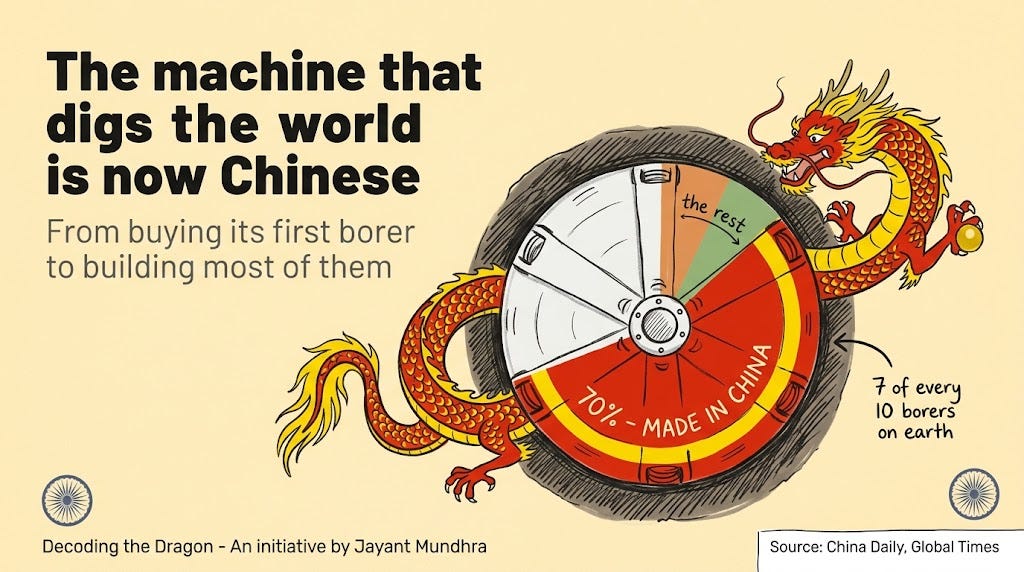
Here is the fact that stopped me. Seven out of every ten tunnel boring machines used anywhere on earth today are made in China.1 Two decades ago China could not build a single one with its own technology. Today it builds most of the world's.2
And here is why it should matter to us. India is the second-largest market for these machines on the planet, and we make exactly zero of them.3
The two giant borers for the Mumbai-Ahmedabad bullet train finally docked in Mumbai in March 2026, more than a year late.4 Getting them out of China took the commerce ministry, the PMO, and eventually Narendra Modi raising it with Xi Jinping at the Tianjin SCO summit.3
A machine, held up for a year. That is the story of this edition.
A tunnel boring machine, or TBM, is not really a machine. It is a moving underground factory.
A super-large one runs well over a hundred metres long, weighs several thousand tonnes, and carries more than 20,000 precision parts.3
It grinds through rock and soft ground with a giant spinning cutterhead at the front, while bolting concrete tunnel rings into place behind it as it advances.
Engineers call it the "king of construction machinery" for a reason. Almost every metro line, road tunnel and undersea crossing built this century runs through a hole a TBM dug.
For decades the technology sat with a tight Western club: Germany's Herrenknecht and Wirth, and America's Robbins. China bought from them and depended on them completely.
Now look at where China sits today.2
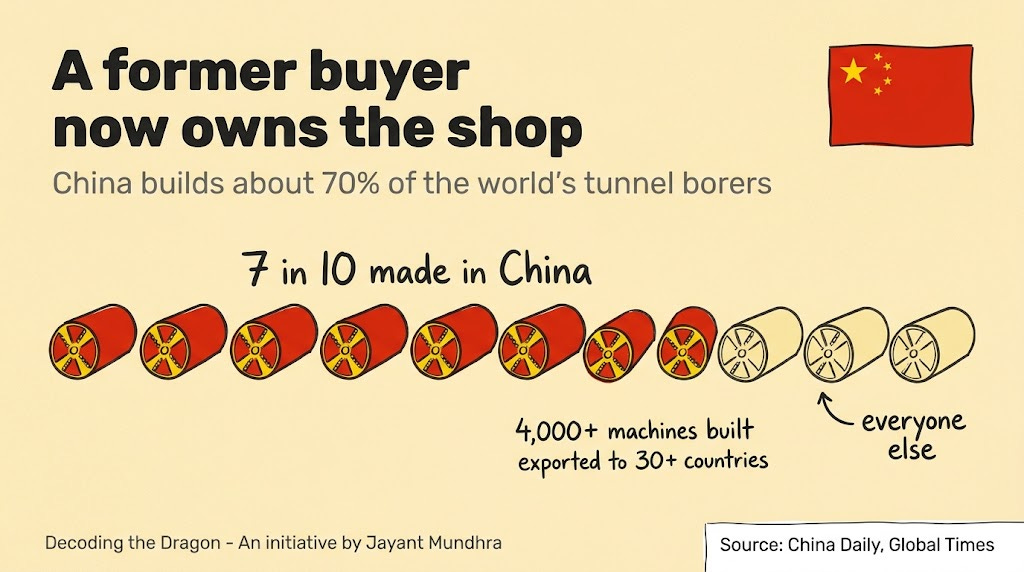
Chinese firms hold roughly 70% of the global market and have built more than 4,000 machines.1
The lead maker, state-owned CREG, has ranked first in the world for output eight years running, and its machines have bored past 5,000km of tunnel.1
95% of the TBMs working inside China are now home-made.2
CREG alone exports to more than 30 countries, including Denmark, France, Italy, Canada, Brazil, Singapore, Malaysia and the UAE.1
This is not imitation catching up. This is a former buyer that now owns the shop.
The obsession has a clear origin, and it is a story of humiliation, not ambition.
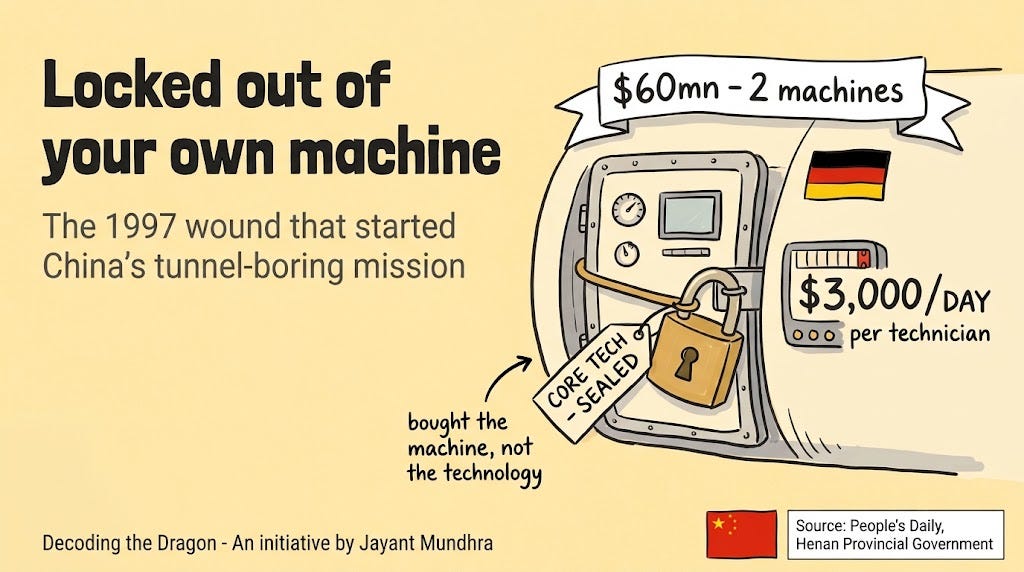
The Qinling wound (1997). To build the 18.5km Qinling railway tunnel, China's railway ministry paid Germany's Wirth about $60mn for two machines.6 When the borers hit trouble in the mountain's rockburst zones, Chinese engineers were contractually locked out of their own equipment.
They could not open the core components. They had bought the machine but not the technology.
German technicians were flown in at rates cited in industry retrospectives at upwards of $3,000 per person per day, and the mega-project stopped whenever they downed tools.6
In the end a long central stretch had to be dug the old way, by drill and blast, just to keep the schedule.
That single experience convinced Beijing that dependence on a foreign machine was a national security problem. What followed is the Chinese playbook in its purest form.
Step one: fund it as a state mission. In 2001, shield machine development was written into the "863 Programme", China's flagship high-tech push, and later the "973 Programme" for the underlying basic science.6
This took the crushing cost of research off company balance sheets and onto the state.
State banks like China Development Bank supplied near-unlimited credit. CREG assembled a "dream team" of eighteen engineers told to build a machine from scratch.6
Step two: lock industry, universities and labs together. The famous "Industry-University-Research" model meant a formula worked out in a university lab was fabricated in a state steel mill and tested on a live tunnel within the same chain. Zhejiang University worked on the control systems and the AI, Tongji on the geotechnics, and the Chinese Academy of Sciences on the metallurgy.
Step three: prove it at home. In 2008 CREG rolled out "China Railway No. 1", the first domestic machine with its own intellectual property. On Tianjin Metro Line 3 a year later, it held ground settlement to within 3mm and passed every inspection.6 The domestic machine worked.
This licence-to-build-then-test-at-home design is exactly the sort of quiet industrial mechanism I find myself picking apart most mornings, and it is the kind of thread we pull further in the Decoding the Dragon WhatsApp community, where I share a smaller China deep-dive like this with thousands of readers every day (t.ly/t7uhs).
Join the Decoding the Dragon community
Here is the part I find most telling, because it shows how deep "self-reliance" had to go.
China localised almost the whole machine but stayed stuck on one component for over fifteen years: the main bearing. It is the heart of the TBM, the giant ring where the spinning cutterhead meets the still body.
A super-large main bearing has to take thrust loads of more than 10,000 tonnes while shutting out abrasive slurry.5
Forging a steel ring several metres across to microscopic tolerance is brutally hard, and for years China imported every one from Sweden's SKF, Germany's Schaeffler and America's Timken.
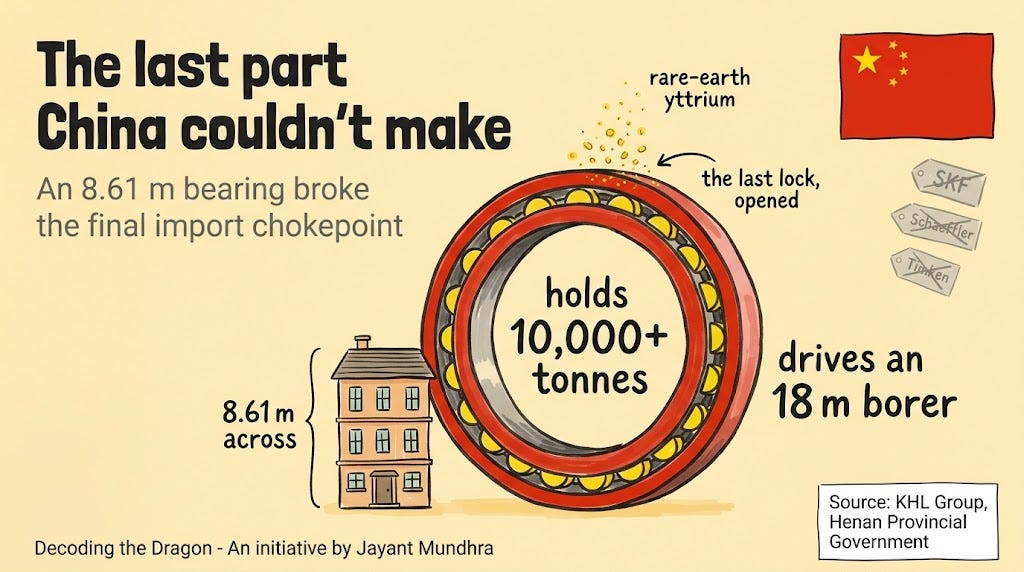
The fix came from metallurgy, and from the one resource China owns outright: rare earths. Researchers at the Academy of Sciences added the rare-earth element yttrium to the bearing steel, which reshaped the microstructure and cut localised corrosion loss by nearly half.6
Then the milestone. On 12 October 2023, CRCHI rolled an 8.61-metre main bearing off its line in Changsha, big enough to drive an 18-metre TBM, and claimed the largest in the world.5
That was described inside the industry as the "final piece of the puzzle".
China now controls the entire TBM chain, from the steel to the software, with no foreign chokepoint left.6
Notice the shape of it. The thing that finally freed China from imported bearings was a rare-earth trick, in a supply chain China already dominates. The dependencies compound.
You cannot perfect a tunnel borer in a lab. You need earth, endless, varied, punishing earth, and China's building boom handed its makers a testbed no rival could match.
More than 90% of China's metro tunnels, across over 40 cities, were dug with domestic machines.2
The vast field data fed straight back into the AI control models the universities were building, so each machine got smarter than the last.
The proof came at the Shantou Bay undersea tunnel, where a domestic borer on the harder west line outpaced a German Herrenknecht on the easier east line, and finished first.
Now China is building at a scale that was pure fantasy a decade ago.
The Haitai Yangtze River Tunnel is set to be the world's longest underwater highway tunnel: a 39km route with a 9.3km shield section, six lanes at 100km/h, under the mouth of the Yangtze.8
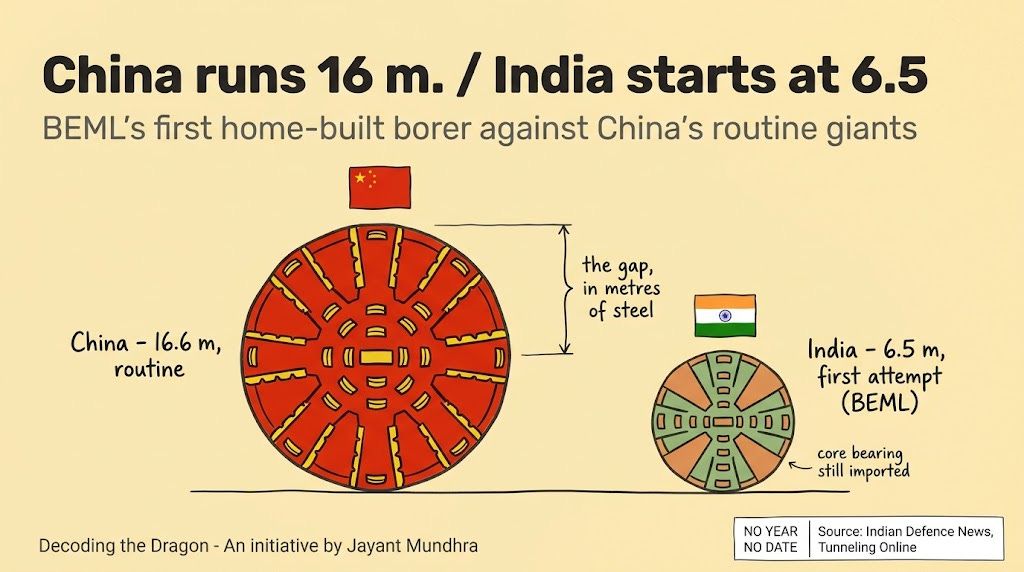
It is being bored by home-grown machines around 16.6 metres across, among the largest ever built, and drilling is already under way.9 10
China has since floated even bigger classes, a 17.5-metre, 5,200-tonne borer among them.2
Step back and the TBM story stops being about tunnels.
It is the exact template China has run in solar panels, electric vehicles, high-speed rail and rare-earth processing:
Pick a bottleneck the West controls and declare it a national mission.
Absorb the R&D risk through state programmes and patient state credit, free of quarterly earnings pressure.
Use the captive home market as a giant, subsidised testbed to iterate faster than anyone.
Unleash a private supplier swarm around the state champions to crush the cost.
Then export, often bundled with Belt and Road financing and round-the-clock service the old Western sellers never offered.
That last move is why Chinese borers are now under Paris, Naples and a Polish strait, not just Jakarta. When you can finance the loan, build the tunnel and service the machine as one package, a German firm selling only hardware cannot compete on the whole deal.
This is the pattern I keep coming back to in the Decoding the Dragon community, because once you see it in TBMs you start seeing it everywhere, and it is worth watching where it points next for India (t.ly/t7uhs).
Join the Decoding the Dragon community
This is where it gets uncomfortable for us, and I want to be honest about both sides.
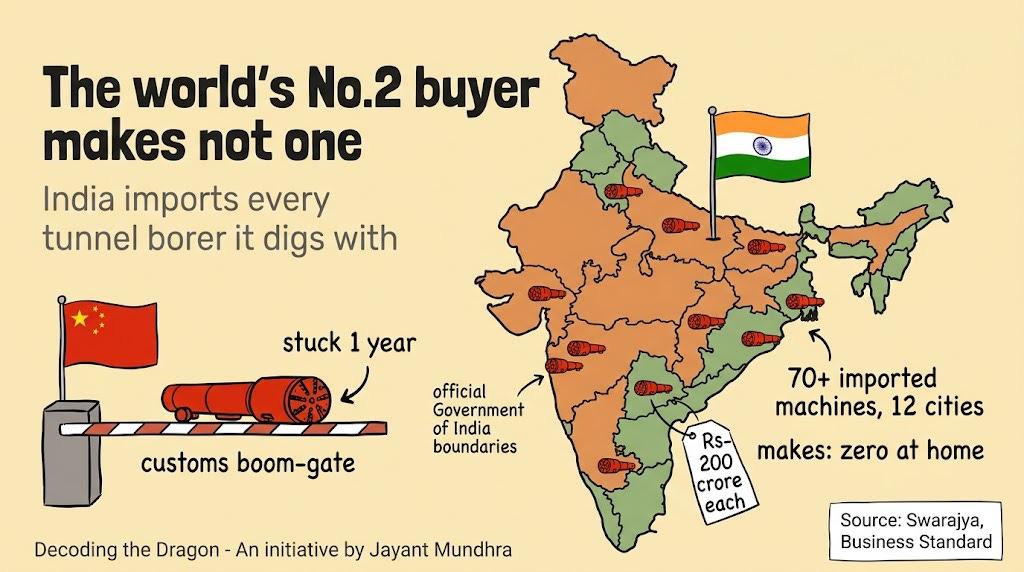
India is not a bystander here. We are the second-largest TBM market in the world, and we still manufacture not a single one.3
More than 70 imported machines are working across roughly 12 Indian cities right now.3
India has an estimated ₹2.5-3 lakh crore of tunnelling work lined up over the next decade, for metros, roads, hydro and water.3
Each large-diameter machine costs somewhere between ₹80 crore and ₹200 crore, and every unit is a strategic import.3
And the dependency is not theoretical. After the 2020 Galwan clash, China quietly stretched customs clearance for India-bound equipment, and the bullet train's two Herrenknecht borers sat stuck for over a year before reaching Mumbai in March 2026.3 4
Here is the twist that should really worry Delhi: even the "German" machines are largely built in Herrenknecht's Guangzhou plant, so China sits on the chokepoint regardless of the badge on the box.3
To India's credit, the penny has dropped.
In September 2025, state-owned BEML announced it will build TBMs at home, starting with a 6.5-metre prototype and a design range up to 16.5 metres, backed by the defence and urban housing ministries under Atmanirbhar Bharat.7
It has floated a tender for design partners from Austria and Japan.7
But be clear-eyed. This is a start, not a solution.
BEML tried this before, with France's NFM in 2009, and that partnership collapsed by 2018.3
The hardest bit, the main bearing, India cannot make at all. Even Herrenknecht's Chennai facility only assembles machines and still imports the core parts.3
We are starting at 6.5 metres while China routinely runs machines at 16.6. That is the gap, measured in metres of steel.
Whether BEML's 6.5-metre EoI actually lands a design partner and a firm delivery date within the year, or quietly slips like the NFM tie-up did.
Whether the remaining metro and high-speed-rail TBM deliveries clear Chinese customs cleanly, or get held up again the next time relations sour.
Whether India moves to localise the main bearing and cutter steel, the true chokepoints, rather than settling for final assembly at Chennai.
Whether China's Haitai Yangtze machines hit their boring milestones, which would confirm the 16-metre-plus class is now routine, not a stunt.
China did not out-invent the West on TBMs. It out-planned it, then used its own vast dug earth to out-practise it, and India is now paying the import bill for a machine we should have been building ourselves a decade ago.
And well that is it for today's edition. That said, do check out my core WhatsApp community Biz News+ where I share 4-5 deepdives from the world of business, economics & public economics daily: https://t.ly/h2jq1
And, do check out my work on the following platforms as well: Instagram, LinkedIn and Youtube
Best,
Jayant
China Daily, Tunneling machine highlights rise of Chinese manufacturing, global.chinadaily.com.cn
Global Times, China's tunnel boring machine sector leaps ahead, manufacturing 7 out of 10 TBMs used globally, globaltimes.cn
Swarajya, India's Bullet Train Needed A TBM. Getting It Here Took the PMO, The MEA, And A Scene On A Metro, swarajyamag.com
Business Standard, Tunnel Boring Machines for bullet train project to arrive in Mumbai, business-standard.com
KHL Group, China's CRCC claims to have manufactured world's biggest TBM main bearing, khl.com
People's Government of Henan Province, China's tunnel boring machine industry achieves leapfrog development, english.henan.gov.cn
Indian Defence News, BEML Has Plans To Make Tunnel Boring Machines To Cut Dependence On China, indiandefensenews.in
Tunneling Online, Construction Begins on World's Longest Underwater Highway Tunnel, tunnelingonline.com
Xinhua, China launches giant tunnel boring machine for Yangtze River project, english.news.cn
SASAC, China's Largest-Diameter TBM Begins Drilling Yangtze River Tunnel, en.sasac.gov.cn
Comments
Nothing yet. Say the first thing.
Sign in to join the conversation.