
A couple of weeks ago I went to the Angela Marmot centre at the Natural History Museum to look at a specimen of the Museum beetle. So named due to his propensity for specimen munching, I was shocked by his minute size. A quarter of the size of my pinky nail, brown, and pretty plain, this was the guy who infiltrated museum collections worldwide and caused irreparable damage. Bar the polar regions, there’s not an inch of land mass Anthrenus museorum can’t make his roost.
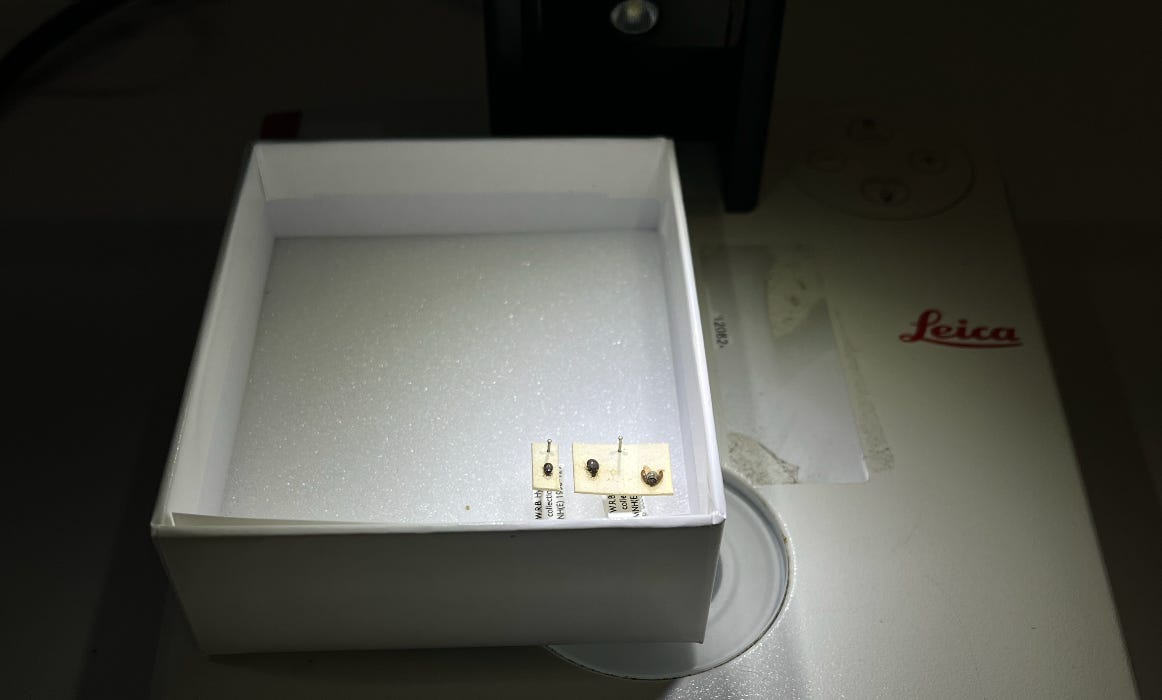
I was showed the specimens and helped to take photographs of them by Florin Feneru, the Identification and Advisory Officer, who also told me that all of the destruction is caused whilst the beetle is still a larva. As a baby, it needs to eat lots and lots in order to facilitate a dramatic transformation. It’s strange to think of a specimen fuelled metamorphosis - I imagined a fat white grub, wriggling and wiggling, melting its insides into a primordial stew and rebuilding a body out of 300 year old harpy eagle and plants that no longer grow, or crafting a wing from dead dart frog. The more I read about the species, the more shrouded and eldritch it seemed. Anthrenus m. was a spectre, haunting collections across the world. An article I read said it was “often quoted as a ‘frequent and feared pest in museum collections’ by eminent entomologists, a belief that has spread via electronic media.” I thought of a chain of digital whispers, tales of his belligerence lurking on forums and email threads.
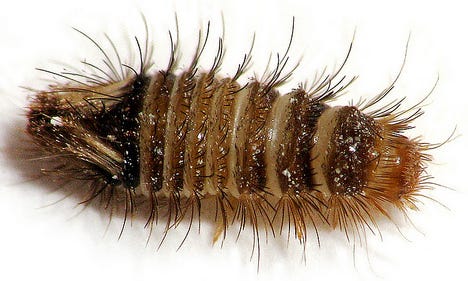


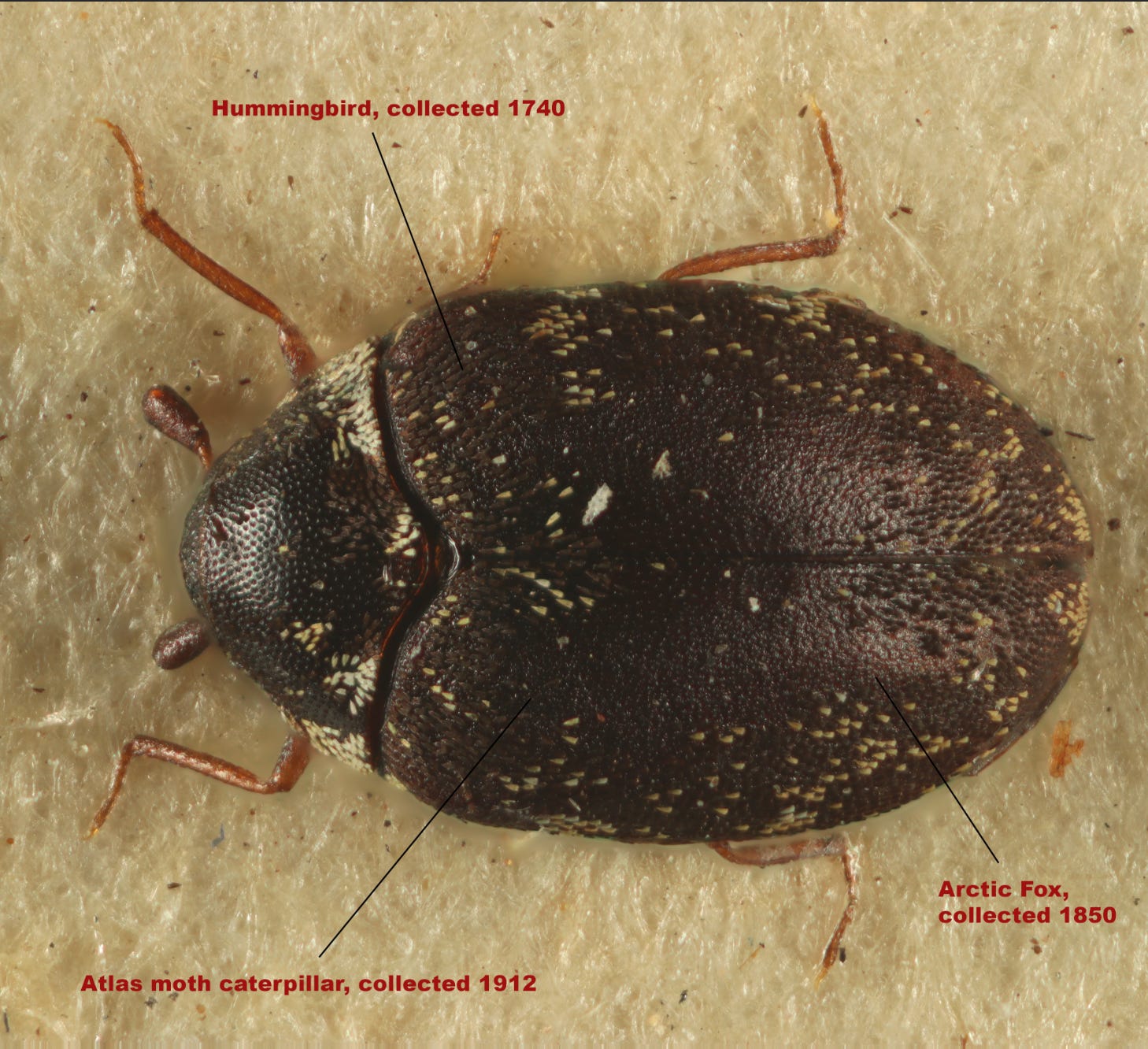
I remember the first time I saw his handiwork at the Booth museum. They had displayed a drawer of caterpillars which looked like they were riddled with miniature bullet holes. Anthrenus had tunneled his hairy, larval body in and out of the long dead creatures, nibbling their insides as he went. It’s a weird specialism, but one he’s practiced since at least the 18th century. The species was first described by Linnaeus himself in 1761, a time when natural history museums were fairly far and few. The beetle must have gained notoriety by feasting on the offerings of the cabinets of curiosities in the castles of kings.
After a fine dinner, the beetle, like most of us, fancies a fuck. Do they do it on the back of an old heron, creating life whilst frozen in time in a glass diorama? What about in the wild? It turns out we know very little about the breeding habits of Anthrenus M., especially in nature. In fact, we know very little about them as a species outside of human habitats. It is possible that they live as larvae under loose bark on old trees feeding on carcasses of insects caught by spiders. My understanding of them as cryptids gets stronger the more I learn.
As I’m scrolling through various articles, I come across a pair of photos which gives me pause. Uploaded by Richard Jones to his entomology blog, the following images show all that is left of the butterfly specimens once lovingly collected by an entomologist. The imprints of their wings, like chalk outlines at a crime scene, feel eerie. This is the work of Anthrenus m., or if not him personally, a member of his family. The dreaded pest is the cousin of a whole clade of beetles of which ‘museum workers should remain vigilant.’ They are notorious criminals who leave very little evidence, just dusty shadows in a box sealed for centuries.
One of the members of this destructive clan is Anthrenus flavipes, who lacks the climatic range of A. museorum, but shares his destructive tendencies. He is found in warmer places, like Greece, but as the meteorological pendulum swings, the beetle’s range widens. An example of his doings are shown below:
This display case was supposedly firmly sealed, so these guys did a bit of an Oceans 11 act to ravage the wild goat skull. I realise I’ve begun to personify this group of beetles as a mafia family in my own head. A. museorum is the Don Corleone, the big daddy, but ageing and losing territory. There’s A. verbasci, not a born museum specialist, often known as the carpet beetle, but now found more frequently in museums than our Corleone. Verbasci and Flavipes are like two sons vying for power, anticipating the demise of Museorum. He’s been at it since the 18th century, maybe it’s time to give the bambinos a chance?
On Richard Jones’ blog I mentioned earlier, he says that no one likes the Anthrenus family - that there’s someone who loves every bug, but no one loves these. I’d like to say I’ve grown quite fond of them as I’ve written this. My apologies to curators, taxidermists, and researchers everywhere, but there’s something brilliant about an insect who has steadfastly specialised in carrying out decomposition in the spaces which fight tooth and nail to keep it at bay. Nature devours all her creatures, these beetles are sneaky agents in her arsenal, thwarting our attempts to preserve and categorise her.
Comments
Nothing yet. Say the first thing.
Sign in to join the conversation.