
It was my birthday on Monday, and I went to the zoo for the first time. I realised that I spend week in and week out looking at animals that have been dead for hundreds of years behind glass, but I’ve never seen most of them alive. So I went to see them alive, and it was a like something out of a fever dream. The first animal I saw was a bald headed ibis behind a fine vertical wire fence. The wind ruffling his feathers, his third eyelid blinking, the tilt of his beak, all made him almost unbearably real. I marvelled at the finesse of his plumage, the way it caught sun and glinted. Seeing the squirrel monkeys was a similarly ridiculous experience - the fur on their turmeric stained bellies appeared hyper-real in its softness, their ears twitched with the gentleness of a butterfly’s wing. For the first hour I was bewitched as I wrestled with the cognitive dissonance of breathing and moving animals from around the world so close to me, in a London park.
As we went from enclosure to enclosure, something odd started to happen. The animals were so real, were made with such fine handiwork, that I slowly became desensitised to them. I stopped understanding them, and it felt like a mental short circuiting. This was exacerbated by the themed enclosures which were so ardently fake they felt like theme parks. The worst for it was the lion’s, which was themed like an Indian street market, complete with fake shop fronts selling bangles and altars to Hindu gods covered in plastic flowers. It was awful. In the middle of this gaudy extravaganza the king of the jungle lay slumbering. He batted a paw lazily at a robin who had made its way into his enclosure. I was fighting a strange and uncomfortable battle between seeing the lion - really seeing him - and falling into the lull of spectacle. I kept looking back at how big his paws were, and every time I compared them to the size of a dandelion nearby it sent an electric shock through me. It wan’t what I expected to happen. I had expected to be sad, maybe to shed some tears because of the caged creatures. I hadn’t been prepared for the whirlwind sensation of the crumbling real, for the questioning of which was actual - animal or zoo? I had to fight to tether myself to the understanding that the animals were really there. Really real. I noticed that some of the people around me had clearly lost this fight and were sort of glazed over, watching the show.
And then I saw the Okapi. I walked into an empty, dark room that reeked of shit. In the gloom I saw a beast grazing on a pumpkin which dangled from the ceiling on a black chain. It was completely silent. Slowly, she turned to look at me. Her huge eyes blinked once, then turned away. She moved slowly in the small concrete room, walls painted with worn out blue foliage. I felt like I was seeing something I shouldn’t. It was like peering into a forgotten corner of time, where someone had managed to keep alive an animal that should have died out before the last ice age. There was a prehistoric sagacity in the Okapi’s eyes that made me deeply uncomfortable. I stared at her for a long time, wrapped in a spell, unable to shake the idea that what I was seeing was somehow taboo.
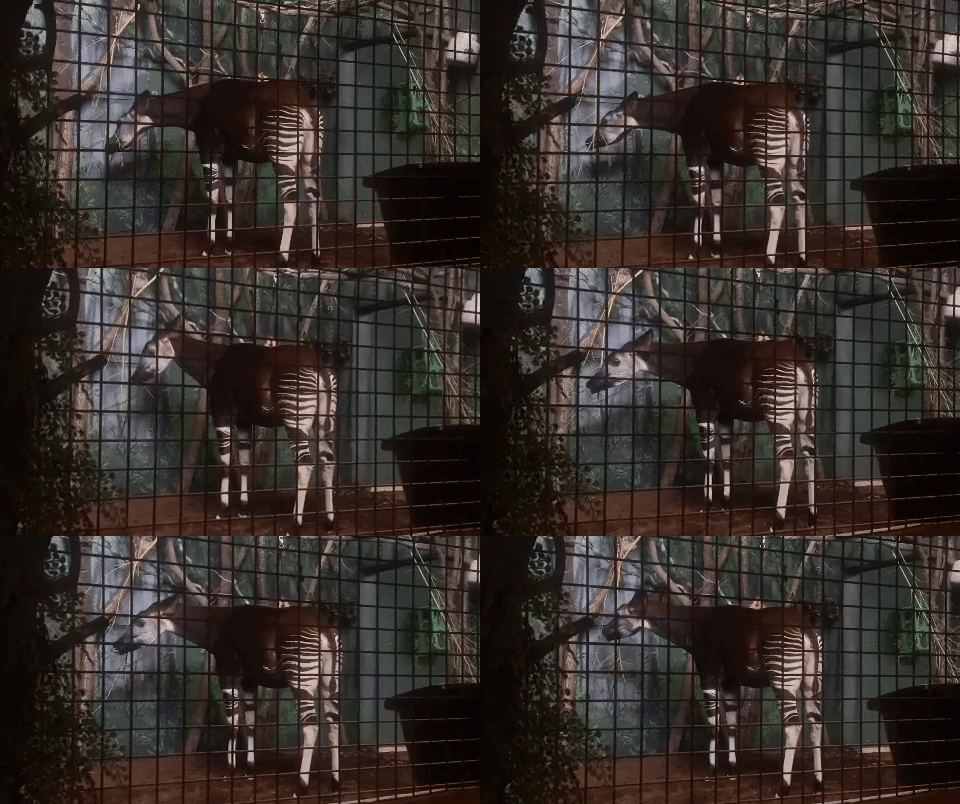
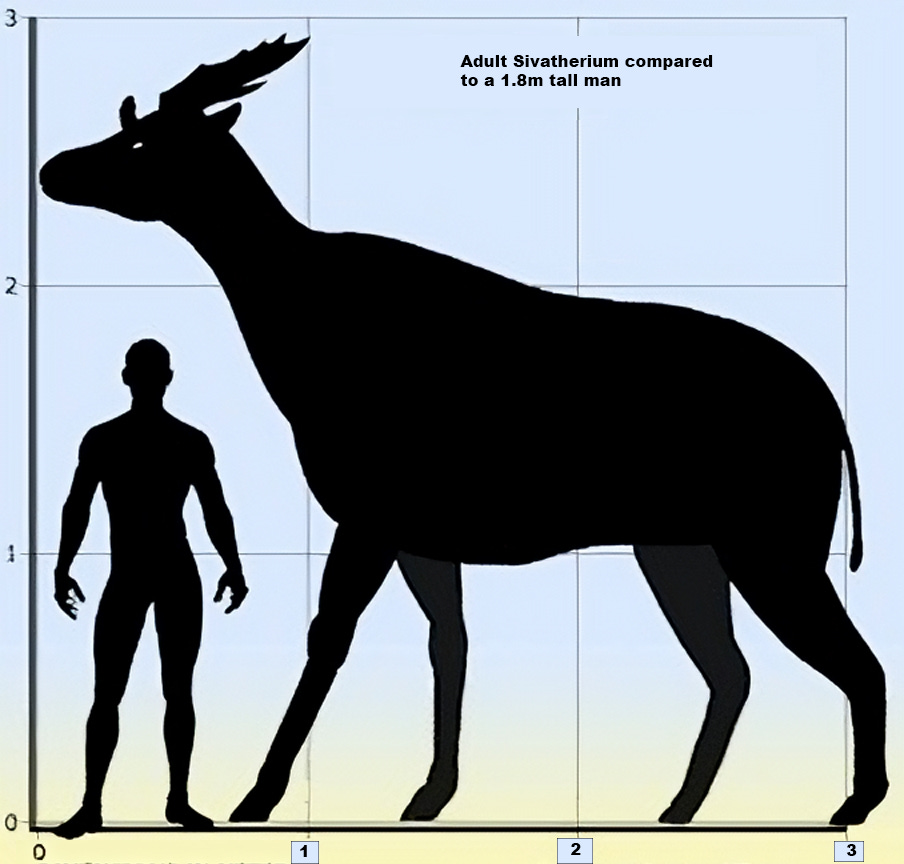
The species was unknown to western science until 1901, although it has existed for some 11 million years, hiding in the lush rainforest of the Congo. The Okapi are solitary and territorial, and emit a sticky, tar-like substance from their feet to mark their boundaries. They eat clay from riverbeds, and their offspring have a gestation period of 16 months. It joins my clade of living cryptids alongside the museum beetle. I started to research the Okapi’s genealogy and came across its extinct ancestor, Sivatherium. Even more eldritch, it stood at nearly 10 foot tall until 2 million years ago, and was one of the largest ruminants ever known.
There was something so uncanny about discovering an animal I didn’t know existed -not through the internet or a museum - but by seeing it alive and eating, breathing, blinking, shitting. It gave me a shiver unlike anything I had experienced before - and this was in a zoo, in London, in 2024. It inspired a deep reverence in me, and I imagined what it was like for the Victorian men who shot and killed most of the animals I see in vitrines today. What would it have been like in the heady heat and dense foliage of a rainforest, seeing everything for the first time, every bit of undergrowth and forest glade spilling over with the new and the terrific? The whole thing must have been trance like - reality becoming a hallucination of itself - pulsating with the shock of the new. What bombastic ego it must have taken to shatter that spell with the shot from a rifle, imposing one’s own agency on a foreign reality. I think it was done out of fear more than wonder - out of discomfort in the presence of the awesome - out of terror masquerading as science.
That discomfort was to be quelled, to be stuffed and parcelled up, bred under heat lamps in tiled rooms. A century later, from behind glass, sticky fingered children can safely admire it. The lion has become ‘like the one in the film’, to be roared at and photographed. The penguin has become something to hoot and cheer at as it swims for dead fish tossed out of a plastic bucket. As we become familiar with images of nature rather than nature herself, fear is smoothed out, prepared for. We are so shrouded, wrapped in things like nature documentaries, animal figurines from childhood, national geographic subscriptions, that we’ve come to think of ourselves as jaded. This flattening of fear and awe is what paves the way for possession and dispossession, for exploitation, and it’s precisely the future that Victorian men, who were so afraid they set gunpowder alight, dreamt of.
I wonder what the Okapi in the London Zoo dreams of. Does she imagine running through a forest of painted leaves with concrete walls? Instead of vines unfurling from a height, is there a woodland of turnips and pumpkins dangling from chains? Does she dream of the forest of 11 million years ago - somehow stored in her cellular makeup? Does she know she isn’t where it should be? Does she dream of a world 11 million years from now, with holographic leaves and mechanical flies? Does she know she has brothers?
Nature has always been the monster under man’s bed, but we’ve slowly set her ablaze, driven her out with a staunch belief in the new real. I am trying to un-jade myself. There were moments at the zoo, like the encounter with the Okapi, or the sight of the squirrel monkey’s yellow fur, that really rattled me. Even from behind bars, nature reached down my throat and rummaged around inside me, scared me, tantalised me, made me feel sick in a thrilling and new way. I want to experience reality with that kind of edge to it, to unpick some of the work done to flatten it. I think there’s a lot made of the overstimulating powers of digital media, and it’s cast intense sensorial arousal in a negative light. I think, in a perverse way, there’s a human need for overstimulation - it’s something nature has pummelled us with since the dawn of time. Now that we live under the illusion that we’ve tamed her, we create a simulacra to replace her headiness and power, but its a poor copy - a mere simulation of stimulation.
Thank you for reading. Feel free to share this post if you found it interesting, or boring, or anything at all. Lovingly welcoming feedback and critique.
Links:
Cover image taken from the London Zoo Okapi webpage: https://www.londonzoo.org/whats-here/animals/okapi
Height chart taken fromPrehistoric Wildlife’s page on the Sivatherium: https://www.prehistoric-wildlife.com/species/s/sivatherium.html
Okapi trivia taken from Live Science: https://www.livescience.com/56233-okapi-facts.html#:~:text=After%20Canthumeryx%2C%20the%20family%20tree,okapi%20side%20developed%20shorter%20necks.
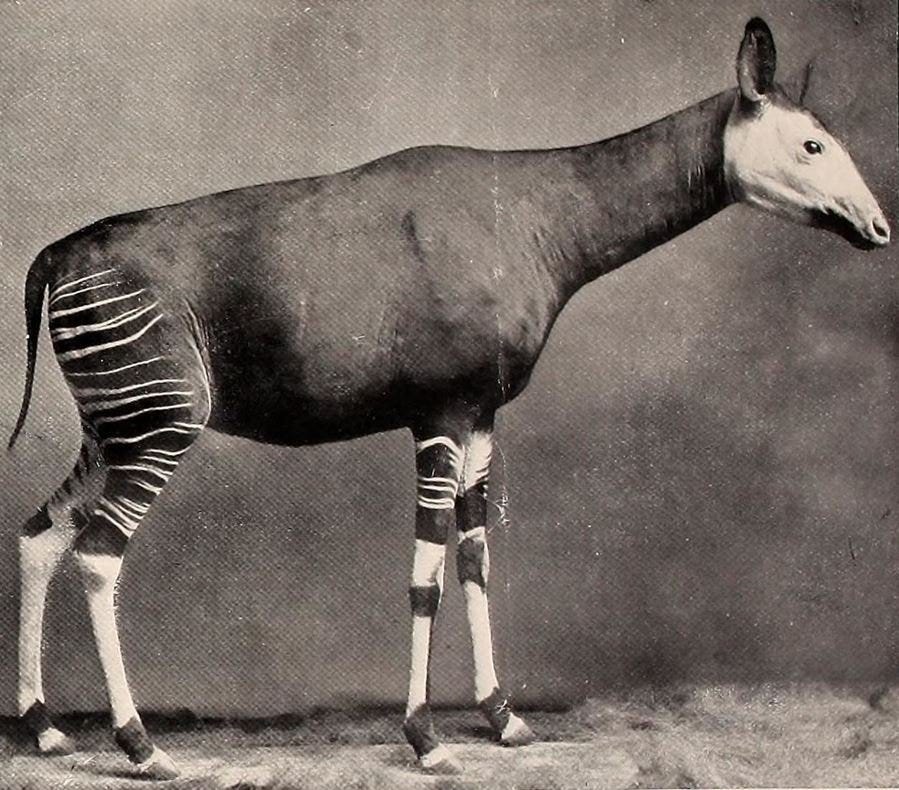
Bonus: This is the first ever taxidermy mount of an Okapi, obtained by Sir Harry Johnston, photographed in the British Museum (now the Natural History Museum)
Comments
Nothing yet. Say the first thing.
Sign in to join the conversation.