
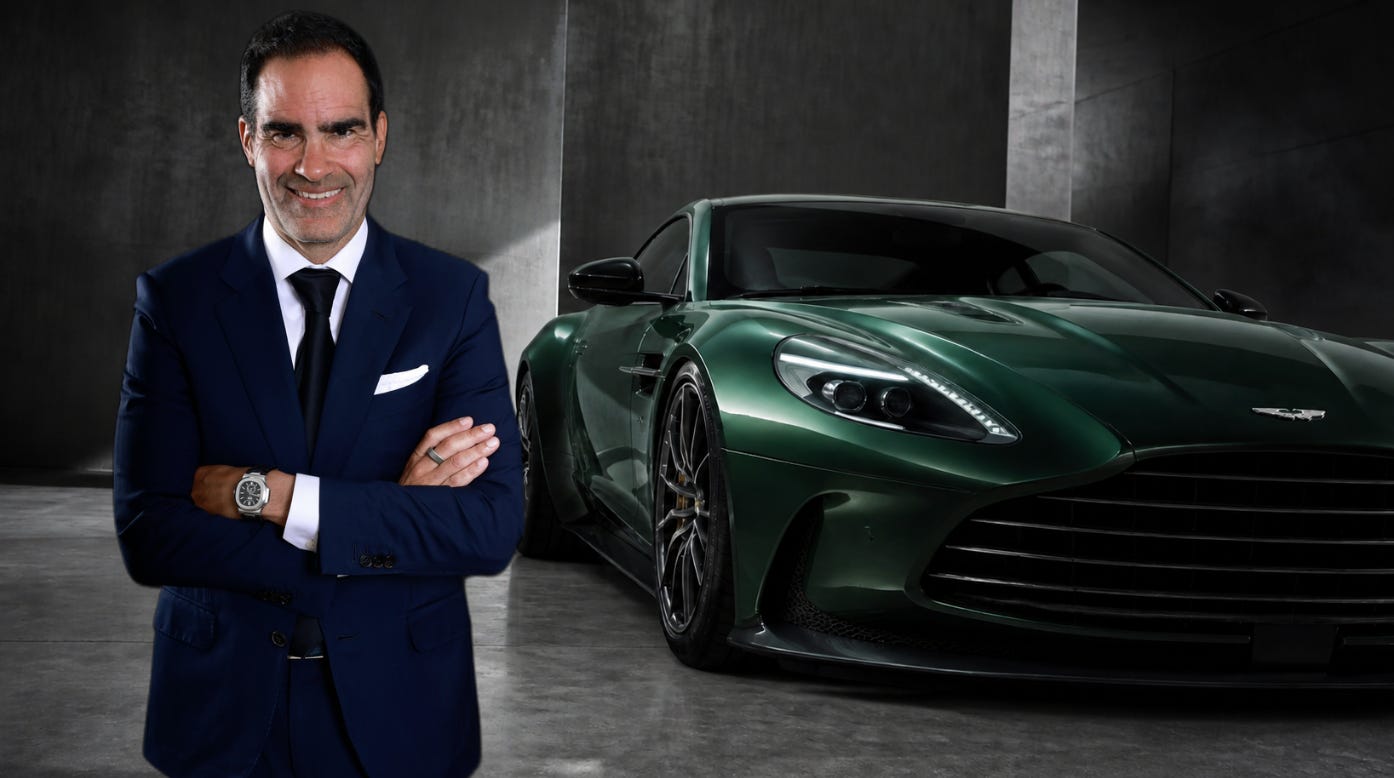
Some mistakes in luxury announce themselves right away. A misjudged campaign draws its backlash within hours. The costliest mistakes work differently. They look like solutions on the day they are announced, and their price only becomes visible years later, after it has compounded past the point of reversal. Aston Martin may have just made one of those. I want to walk you through why, starting with the numbers that forced the decision.
A few weeks ago I published an analysis in Jing Daily arguing that Aston Martin runs on borrowed everything. The cultural capital came from a Bond franchise that has gone dormant. The engines come from Mercedes-AMG, and the liquidity has been borrowed again and again, most recently from anyone still willing to lend. My conclusion was that borrowed equity carries an expiration date. A brand that never builds independent equity underneath its borrowed assets eventually faces a reckoning.
I did not expect the reckoning to arrive this fast. Or this literally.
Aston Martin has agreed to transfer 50.1 percent of its non-automotive intellectual property to Authentic Brands Group, the American licensing platform behind Reebok and Brooks Brothers. The transfer forms part of a £550 million debt package led by HPS Investment Partners, the private credit firm owned by BlackRock. The rights were reportedly moved into a newly incorporated Cayman Islands subsidiary before being pledged, and access to a £100 million tranche of the financing is conditional on the branding transfer completing. Look closer and the arrangement gets more entangled. HPS is simultaneously the lead lender and an investor in Authentic Brands. An HPS co-founder sits on the boards of both companies. Bondholders owed £1.3 billion have sent a formal legal warning to the board, arguing that prime collateral moved beyond their reach.
Strip away the financing architecture and one fact remains. Outside its cars and Formula One, Aston Martin now owns less than half of “Aston Martin.” Everything else the name touches, from a jacket to a residential tower, is majority controlled by a company whose business model is monetizing famous names at scale.
To understand why a 113-year-old luxury house would agree to this, you need to sit with the numbers.
The paradox: the cars sell better, the losses grow
On the surface, the first half of 2026 looks like the turnaround management promised. Revenue rose 38 percent to £628.6 million. Gross profit climbed 68 percent to £212.5 million, with gross margin expanding to 34 percent from 28 percent, helped by more than 220 deliveries of the Valhalla at hypercar economics. Second quarter wholesale volumes grew 43 percent year on year. Adjusted EBITDA swung from a small loss to £62.7 million positive.
A business improving on almost every operational measure. And yet the pre-tax loss widened to £154.2 million from £140.8 million, while free cash outflow reached £198 million in six months. How does a company sell more cars at better margins and lose more money?
The answer sits in two lines that most coverage skips past.
The first is depreciation and amortization. Between the positive adjusted EBITDA and the bottom line sits roughly £170 million of first-half charges, much of it the amortization of capitalized development spending on the very products now driving the revenue growth. Adjusted operating loss still came in at £109 million. The improvement at the gross line is genuine progress, and it is not yet large enough to carry the cost of building the products that produced it.
The second line is the decisive one. Net adjusted financing costs rose to £99 million from £9 million a year earlier. Part of that swing is non-cash, a currency revaluation on dollar-denominated debt that flattered the prior year and punished this one. But even setting the currency effect aside, the underlying interest burden on £1.5 billion of net debt is eating the business alive. Adjusted net leverage stands at 8.9 times. A healthy luxury company operates below 1.5. Ferrari, for comparison, faces effectively no leverage constraint on its brand decisions at all.
Now run the simple bridge. Gross profit improved by roughly £86 million year on year. Financing costs increased by roughly £90 million. Every additional Valhalla delivered, every point of margin recovered, absorbed by the cost of capital before a single pound reached the bottom line. The workforce reduction of 600 people, a fifth of the company, saves an estimated £40 million per year. The financing line alone grew by more than twice that in six months.
And the new money is expensive. The £550 million package is priced at 6.75 percent above SONIA, which puts the cost of borrowing above 10 percent. Lenders price risk with precision. That number is their verdict. This is the arithmetic of a company that has crossed a specific threshold, the point where debt service grows faster than operational improvement can offset. Once a business crosses that line, its most valuable unpledged asset goes on the table. For a luxury house, that asset is the name.
From borrowed story to sold story
Here the financial analysis and the brand analysis become the same analysis.
In the Jing Daily piece I laid out the dependency chain. Bond gave Aston Martin a cultural relevance it never generated on its own, and that engine has been switched off since 2021 with no restart in sight. The powertrains come from Stuttgart, which means the mechanical soul of a Vantage is authored by someone else. Meanwhile the secondary market renders its verdict daily. A DBX loses close to half its value in five years. Ferrari’s core models hold, and certain Lamborghinis barely depreciate at all. Residual value is the market’s real-time measurement of desire, and by that measurement Aston Martin’s desire has been eroding for years.
My team and I identified brand storytelling as one of the decisive value drivers of the coming decade in the Équité Luxury Report 2026 to 2030, The Cost of Waiting. The report quantified something most boards underestimate: the cost of deferring brand-building compounds. A brand that waits does not stay in place. It falls behind at an accelerating rate, because desire is dynamic and competitors keep investing while you defer.
Aston Martin is now among the sharpest illustrations of that compounding cost I have seen. For decades the company deferred building an independent story because the borrowed one worked well enough. Then the borrowed story faded, financial pressure arrived, and financial pressure forces exactly the decisions that weaken story further. Selling the permanent F1 naming rights raised £50 million. Licensing the name to residential towers from Miami to Tokyo raised fees, and pledging majority control of the lifestyle name unlocked another £100 million of conditional financing. Each transaction bought time. Each also converted a piece of the story into cash, which means every new round of borrowing must be secured against a weaker asset than the last. That is the death spiral mechanism. A weak story produces weak economics, and weak economics force the monetization that weakens the story further.
Why this particular deal is dangerous
I want to be precise about the risks, because they go well beyond overexposure.
The first risk is incentive misalignment. Authentic Brands is very good at what it does, and what it does is extract licensing volume from names. Its economics improve with distribution breadth. Luxury economics reward the opposite. The value of the Aston Martin name rests on how rarely and how deliberately it appears in the world, and the entity now holding majority control has a commercial reason to increase its appearances. Aston Martin will retain approval rights, and management will negotiate hard. But influence differs from control. Over a decade, the volume incentive compounds quietly, one reasonable-sounding license at a time.
The second risk is incoherence, and the residential towers show why this matters even more than exposure. I recently delivered a keynote to developers of branded residences, and my warning to them was direct. The playbook of attaching a famous name to a building has been executed so many times that it now produces a sea of sameness. In the short term a prestigious name on a tower signals distinction. Repeated across dozens of skylines, it signals the opposite. The name becomes decoration, interchangeable with the next name on the next tower, and decoration is the definition of commoditization. A brand with a powerful independent story can survive some of this, because the story disciplines what the name can credibly touch. A brand without one has nothing to be incoherent against. If Aston Martin does not stand for something specific, every extension becomes equally plausible, which means every extension dilutes equally. And if a luxury marque ever becomes associated with commoditization in the mind of its clients, recovery is close to impossible. Clients will never read the shareholder agreement. They will simply encounter the name in more places, and they will quietly recalibrate what it is worth.
The third risk is the signal itself. The balance sheet is part of the brand. Clients at this level read financing structures the way they read campaigns, and the sequence of the past year tells them a coherent story: this company monetizes its name because its products cannot yet fund the business. Desire funds independence. When desire weakens, capital fills the gap, and capital always takes something in return.
What matters now
The people running Aston Martin are not naive. Adrian Hallmark led one of the more impressive brand elevations in the industry at Bentley, and the operational progress in these results is his work showing. Viewed purely as treasury management, the financing was arguably the only move available. The question is what the company does inside the structure it has now accepted. My analysis points to four priorities.
First, treat the licensing governance as the most important brand negotiation in the company’s recent history. The approval mechanisms and category exclusions written into the Authentic Brands relationship will shape the marque for twenty years, and they deserve the same intensity as any product program.
Second, define the independent story before the market defines it by default. The raw material exists. There is handcraft in Gaydon and a century of racing history behind it. What has never existed is a sharp answer to the question of what Aston Martin means without Bond. The Valhalla proves the company can still build objects of desire. Objects alone do not constitute a narrative.
Third, make residual value a board-level metric. It is among the most honest measures of desire available, and right now it is the market’s loudest signal that the story is not landing.
Fourth, resist the volume temptation the new capital structure will create. Every pressure in this arrangement pushes toward more licenses. The brands that survive distress are the ones that shrink the name’s footprint while rebuilding its meaning.
This is why I call this deal potentially one of the costliest mistakes in luxury. The £550 million is precisely measurable. The cost sits on the other side of the ledger, where nothing gets measured quarterly. Majority control of the name now answers to volume incentives, and a story that was already borrowed is partially owned by someone else. Liquidity problems are survivable. Brands recover from them regularly. A name that stops meaning something specific is a different category of loss, and no refinancing brings it back.
The so what for every brand reading this extends far beyond Gaydon. Three questions worth sitting with. What does your brand mean without its strongest external association, in one sentence? Which appearances of your name would a client actually miss if they disappeared tomorrow? And what does your capital structure say about you, read as a brand signal rather than a financing decision? Aston Martin’s situation gives these questions their urgency. The moment to protect a name is years before anyone asks for it as collateral.
Thanks for reading! This post is public so feel free to share it.
Langer on Luxury is a weekly in-depth analysis by Dr. Daniel Langer, published every Friday. He is the CEO of Équité, a global luxury brand strategy firm advising the world's leading luxury brands across jewelry, watches, fashion, automotive, aviation, hospitality, and luxury experiences, and serves as the executive professor of luxury strategy and pricing at Pepperdine University in Malibu and as a professor of luxury at New York University, New York. A best-selling author of luxury management books in English and Chinese, he is recognized as a global top-five luxury key opinion leader, named an authority in luxury by the Economist, and awarded Top Keynote Speaker in Luxury by the WLCC for two consecutive years. He is featured as a luxury expert in The Wall Street Journal, Financial Times, The New York Times, Forbes, Vogue, and Robb Report, and is the author of the Équité Luxury Report 2026-2030, "The Cost of Waiting," a five-year outlook for the industry. Follow him on LinkedIn and Instagram, listen to his podcast, The Future of Luxury, and explore Équité Intelligence, the on-demand digital platform for luxury learning.
No posts
Comments
Nothing yet. Say the first thing.
Sign in to join the conversation.