
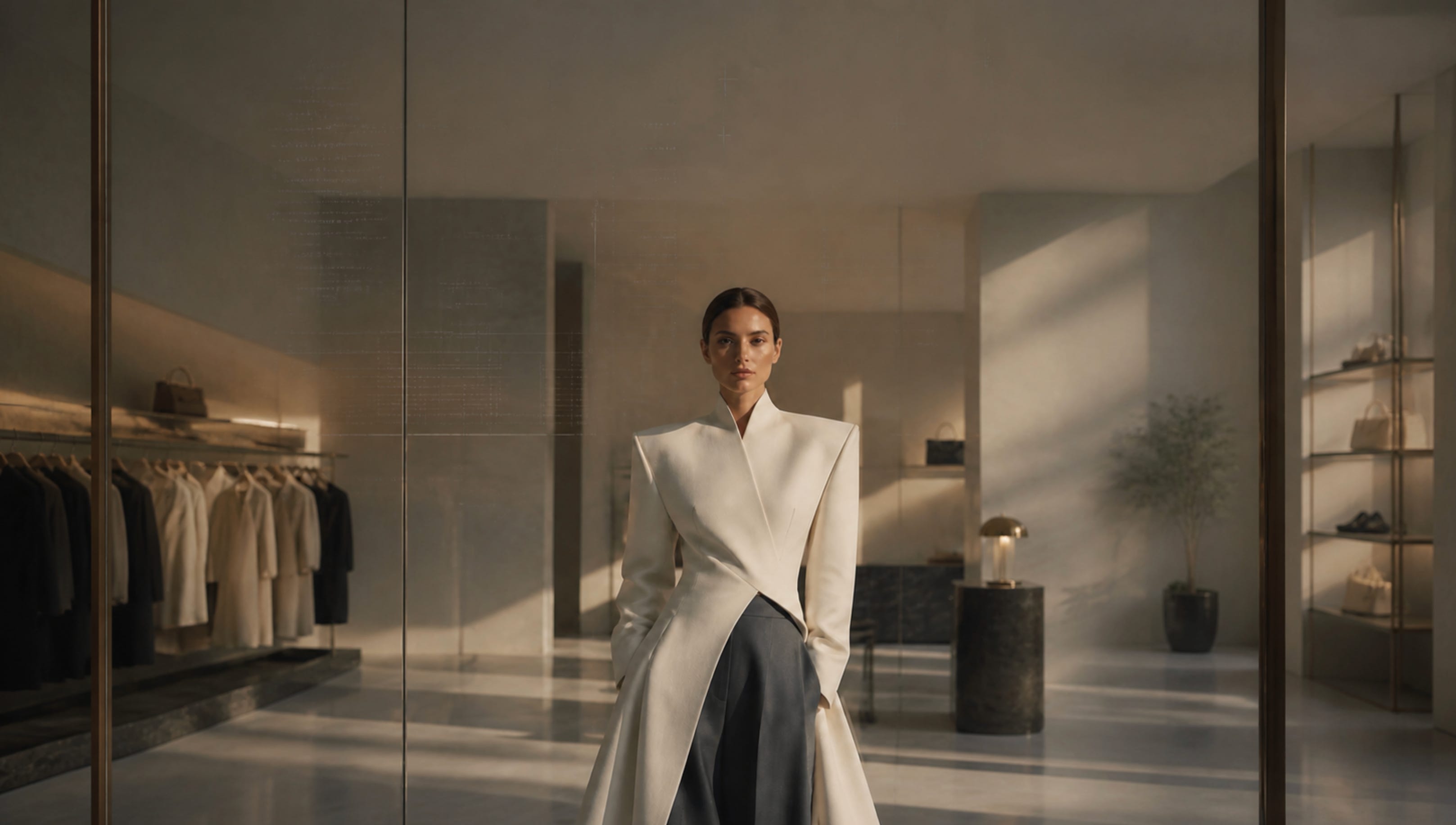
For more than a century, luxury brands have designed the first encounter with clients. Windows of luxury brands on Place Vendôme in Paris, Nanjing West Road in Shanghai, or Fifth Avenue in New York are composed like a stage. Campaigns are photographed with careful curation and placed with precision. Advisors greet their best clients by name. Every element of the introduction is considered because luxury leaders understand that desire often begins with the first impression.
That sequence is now changing. Before a client enters a boutique, a hotel, or a restaurant, visits a website, or speaks with an advisor, an algorithm may already have made the introduction. The client asks an AI assistant which watch deserves consideration for a milestone birthday, which maison has the strongest position in high jewelry, or whether a particular bag justifies its price.
The machine responds. It selects a competitive set, summarizes the options, and frames a recommendation. Sometimes it constructs a narrative. Often it compares materials, prices, specifications, reviews, availability, and alternatives.
The brand may still own the product and the environment. It no longer automatically owns the first interpretation or the recommendation.
The adoption data should end complacency
The latest BCG and Altagamma True-Luxury Global Consumer Insights research gives scale to the shift. Eighty-seven percent of luxury consumers surveyed use AI tools weekly, with approximately four in ten using them daily. Around 80 percent already use AI to research luxury, seek recommendations, and compare options. Équité research confirms this in our interviews with HNWIs and UHNWIs. A significant number of them use AI to assist with shopping decisions.
The trust data is even more consequential. AI has achieved a net trust score almost level with word of mouth and approximately twice that of social media and influencers.
One finding deserves particular attention. The brand’s own website remains the most trusted source of luxury information, ranking above search, word of mouth, and AI. Clients continue to place considerable trust in the brand’s universe. Yet many now arrive there after an external system has already organized the category, defined the alternatives, and shaped their expectations.
The brand gets the second word. AI tools increasingly gets the first.
AI is a compression and interpretation engine
Let us take a closer look at what happens when a client asks an AI assistant about a brand.
The AI draws from what it was trained on and, depending on the platform, from sources it can retrieve. Those sources may include brand websites, product pages, campaigns, press coverage, executive interviews, analyst commentary, client reviews, forums, and editorial content.
It then compresses that material into an answer.
AI does more than shorten information. It determines what survives the compression. It selects which attributes appear relevant, which competitors belong in the comparison, and which evidence seems credible enough to surface. That creates a strategic challenge for luxury.
A human can be moved by forces that resist measurement: the beauty of a boutique during a rainy afternoon in Paris, the charisma of an advisor who remembers a client’s daughter, or the pull of an object encountered at precisely the right moment. Luxury has always benefited from emotion, context, memory, and inspiration.
An AI system cannot experience any of this. It can only infer the experience from the traces that brands, journalists, advisors, and clients leave behind.
When a brand’s language consists primarily of category claims, the system has little distinctive material to work with. “Timeless craftsmanship.” “Exceptional savoir-faire.” “An uncompromising commitment to excellence.” “Heritage since...”
Many competitors typically use the same vocabulary. The model may therefore treat much of it as interchangeable noise and focus on what remains easier to compare: price, materials, functions, availability, and social proof.
My academic luxury research across two decades indicates that storytelling typically accounts for more than 90 percent of perceived value in luxury. The exact contribution differs by quality of storytelling and the competitive context, but the pattern has remained remarkably consistent. Functional excellence alone never explains an extreme price premium. In fact, the best brands per category achieve 100x, 1,000x or even 10,000x or more perceived value from the story compared with the value from the functions. It’s the most underappreciated and underdeveloped value component for many brands.
AIs can only retell a story worth retelling. Feed them category language, and they are likely to describe the brand like the category.
What our AI audits reveal
At Équité, AI assessment is always integrated into our broader brand-audit work, hence we have significant data across luxury categories. Our proprietary framework examines how leading AIs interpret, frame, compare, and recommend a brand across relevant client contexts.
The analysis is designed to identify recurring patterns in brand meaning, competitive substitution, semantic convergence, source authority, and recommendation behavior. It allows us to assess whether the intended positioning remains distinctive as it passes through AI mediation, or whether the brand is reduced to the same category language as its competitors.
The findings from our luxury strategy work are often uncomfortable. Within category after category, models describe competitors using nearly identical language. The adjectives change order, yet the substance remains the same. The distinctive positioning that leadership teams often believe they have built does not survive the algorithm.
This pattern corresponds with a broader finding from Équité. Across the brand stories we have evaluated, approximately 95 percent show significant weaknesses in distinctiveness, emotional power, or inspiration. The precise expression varies, but the vulnerability is consistent: many stories explain the category more effectively than they explain the brand.
AI does not create that weakness. It exposes it at scale.
The blind test already happened with humans
A discussion that spread across luxury forums recently offered a tangible preview of this compression in human form. A member presented an expensive designer bag to the community as an inexpensive secondhand find. The community started dissecting it: the leather was judged as ordinary, and the hardware was perceived as cheap. Then the brand was revealed, and the same object suddenly commanded a different conversation.
One forum thread proves nothing on its own. The pattern it exposes is what my team and I have measured across two decades of quantitative research: at luxury price points, the object carries only a fraction of the perceived value. Story, meaning, cultural relevance, and the identity transformation the brand creates carry the rest. When you remove the story context and the meaning the value collapses. It is the mechanism of luxury working exactly in its most logical form.
The strategic exposure sits elsewhere. Brands that justify their prices simply by claiming superior quality are volunteering for a comparison they cannot consistently win, because at this level excellence is expected, present across the entire category, and therefore invisible. When experienced clients can’t feel the difference, algorithms will not even pretend to. They strip context by design, weigh construction against price, and hand the next client the exact verdict that forum reached. The difference is that the forum ran the test once. AIs run it millions of times a day.
The story continues after the transaction
There is another source of exposure that some houses underestimate.
AI systems do not only encounter what brands publish. They also retrieve what clients say happened. When service complaints, repair delays, warranty disputes, dismissive boutique interactions, or failed deliveries appear in public reviews and forums, they become part of the accessible record from which future answers may be constructed.
In our mystery-shopping and brand experience audits across luxury fashion, jewelry, automotive, hospitality, and beyond, my team and I often find the widest gap between brand promise and delivery after the sale.
Brands invest heavily in creating desire before the purchase. Some then transfer the client into processes that feel more appropriate for a mid-market retailer. Campaigns often promise recognition and care, yet the after-sales experience often delivers anonymity and friction.
That gap was always expensive. AI makes it more discoverable and easier to summarize. Every neglected interaction that a client recounts publicly may become part of the introduction made to the next client.
Three strategic imperatives
First, treat the brand story as strategic foundation. In times of algorithmic recommendation, brand storytelling is even more critical than before. And as stated above, most brands have significant deficits. The test for your brand story: What do you really sell and which emotion do you evoke? If these are not formulated well and communicated consistently, then both clients and AIs will not know what the brand is about. You can imagine the dramatic damage that this has on AI recommendations.
Luxury brands need stories that only they can tell, articulated with enough clarity and emotional force that their meaning remains recognizable after compression. This work must come before any campaign, any website copy, any social media post. No media budget can reliably transform an interchangeable story into a distinctive one.
Second, shape the source material deliberately. Brands cannot control every AI answer, nor should they assume that owned content automatically determines the result. They can, however, create a coherent messaging system.
Websites, product descriptions, founder and executive interviews, campaign narratives, press materials, structured information, and authoritative third-party coverage now contribute to how machines interpret the brand. Consistency matters, but repetition alone is insufficient. The narrative must remain brand specific and express the brand story.
The objective is not to write for the algorithm. Doing so may create even more literal, standardized, and generic brand language. Do not simplify the brand for AI. It must be sharpened to escape the sea of sameness.
Third, extend the story beyond the transaction. After-sales service has become a form of brand publishing whenever clients describe their experiences publicly. The repair process, complaint response, delivery, and tone of the human interaction can reinforce or contradict everything the brand claims. And bad news travels fast.
The brands that treat these moments with the same care they bring to a flagship opening will create an advantage that compounds. Their clients provide evidence that the promise is not just an empty statement.
First the introduction, then the transaction
AI is always available, operates at enormous scale, and can frame a client’s understanding of a brand before a human advisor has the opportunity to contribute.
AI already participates significantly in the luxury client journey. Therefore, the urgent question is what it says when it makes the introduction, which parts of the brand story survive its compression, and whether the story gives it anything distinctive to say.
And the introduction is only the first phase. The next one is already taking shape under the name agentic commerce, where AI moves from advising the client to acting for the client. AI assistants interpret a client’s desires, assemble the options, and increasingly complete the transaction on their behalf.
At that point the machine stops being a gatekeeper and becomes the buyer. A brand that today gets flattened into generic category language will tomorrow simply not be selected, because an agent optimizing across comparable attributes has no reason to choose the interchangeable option at the higher price.
The brands with singular meaning will be the ones an agent can justify. Invisibility to the algorithm ends as invisibility to the market.
In our Équité Luxury Report 2026–2030, my team and I called this period “The Cost of Waiting.” The name reflects what we see across our research and client work. As brands delay sharpening their positioning, AI systems are trained more thoroughly on the unsharpened and undifferentiated story.
The starting point is uncomfortable but simple: knowing what AI already says about your brand. From there, the work is to make the brand’s meaning precise and its emotional territory singular. This is where many organizations underestimate what the task requires. Optimizing a brand story demands expertise and utmost precision. It’s a multi-month strategic project, and delegating it to junior teams or treating it as an afterthought practically guarantees a generic result, with everything that implies for how machines will describe the brand. In our own engagements, this work happens at CEO and board level, because defining what the brand fundamentally stands for is among the most strategic decisions a company makes.
AI does not create luxury’s differentiation crisis. It makes that crisis impossible to hide.
Thanks for reading! This post is public so feel free to share it.

Langer on Luxury is a weekly in-depth analysis by Dr. Daniel Langer, published every Friday. He is the CEO of Équité, a global luxury brand strategy firm advising the world's leading luxury brands across jewelry, watches, fashion, automotive, aviation, hospitality, and luxury experiences, and serves as the executive professor of luxury strategy and pricing at Pepperdine University in Malibu and as a professor of luxury at New York University, New York. A best-selling author of luxury management books in English and Chinese, he is recognized as a global top-five luxury key opinion leader, named an authority in luxury by the Economist, and awarded Top Keynote Speaker in Luxury by the WLCC for two consecutive years. He is featured as a luxury expert in The Wall Street Journal, Financial Times, The New York Times, Forbes, Vogue, and Robb Report, and is the author of the Équité Luxury Report 2026-2030, "The Cost of Waiting," a five-year outlook for the industry. Follow him on LinkedIn and Instagram, listen to his podcast, The Future of Luxury, and explore Équité Intelligence, the on-demand digital platform for luxury learning.
About Équité
Équité is a global luxury brand strategy and consulting firm, recognized as one of the leading luxury consultancies worldwide. We advise CEOs and boards across all luxury sectors, including fashion, high jewelry, watches, automotive, private aviation, hospitality, beauty, and lifestyle, on the discipline luxury depends on most: creating desire. Our work rests on decades of proprietary research on UHNW clients and the psychology of luxury, and on a conviction our results keep confirming: desire is created, and most brands leave most of it unbuilt.
Équité’s services include luxury strategy, brand positioning and storytelling optimization, brand audits, pricing architecture, client experience optimization, and luxury masterclasses. Clients include some of the most iconic luxury houses in the world. Los Angeles, Phoenix, Singapore, London.
No posts
Comments
Nothing yet. Say the first thing.
Sign in to join the conversation.