
A polling company released numbers in major American elections this summer. Campaigns cited them. Reporters covered them. The numbers circulated on social media and even generated activity on prediction markets.
But there was a problem: the polling company wasn’t real.
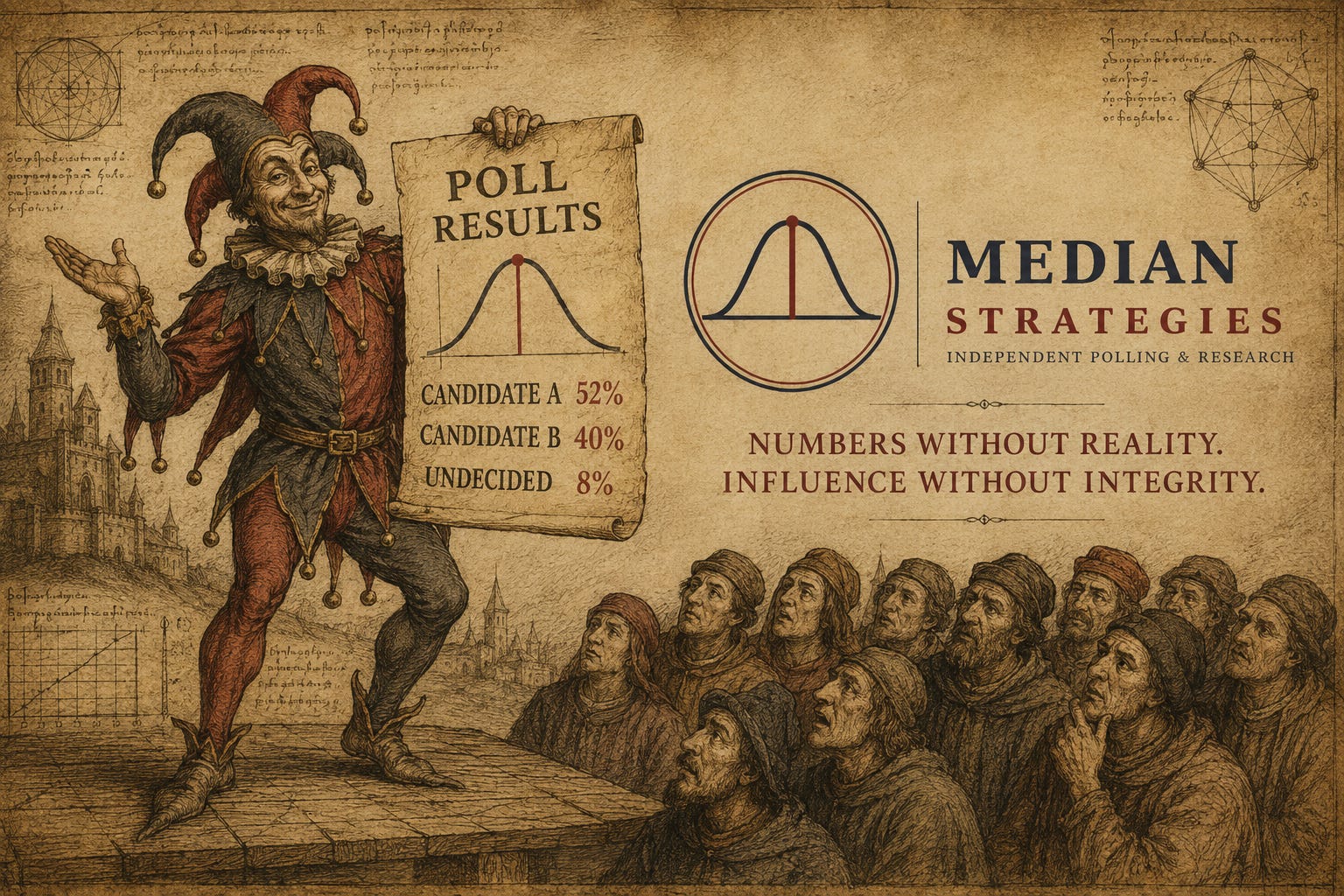
Median Strategies appeared to be a legitimate research firm. It published methodology, field dates, sample sizes and the other things those of us who have spent our careers in polling instinctively look for. One of its surveys showed Los Angeles Mayor Karen Bass leading challenger Nithya Raman by about 12 points. The Bass campaign shared it. Median also published polling in Wisconsin and Nevada.
Then the company disappeared.
Median eventually acknowledged that the polls were fabricated and described the entire operation as a “short-term social experiment” designed to see how unverified polling information could move through the political ecosystem. According to the Associated Press, established aggregators had declined to include the surveys because Median could not provide sufficient information about its methods, but that didn’t prevent the numbers from traveling.
There is a temptation to treat this as a funny story about political Twitter getting fooled. I think that misses the point.
Median Strategies demonstrated how easily a number can acquire authority simply because it looks like real data.
Polling has always depended on trust. Most people who see a poll will never inspect the questionnaire, evaluate the sample design, examine weighting procedures or ask whether the interviews underlying the toplines actually occurred. They rely on institutional credibility.
We learned how badly that system can fail with Research 2000.
In 2010, Daily Kos terminated its relationship with the polling firm after statisticians examining its weekly surveys found patterns they concluded could not plausibly have come from random polling. Daily Kos subsequently said it could no longer trust the data and accused Research 2000 of providing results that were fabricated or manipulated beyond recognition.
Go back another decade and the 2000 South Carolina presidential primary produced a different corruption of the same basic idea. So-called “push polls” were used to deliver political attacks while masquerading as research. As CBS polling director Kathy Frankovic explained at the time, a push poll isn’t a poll at all; it is political telemarketing dressed up to look like research.
Twenty-six years later, we have almost the inverse problem. Instead of persuasion pretending to be research, we now have fabricated data pretending to be evidence.
What makes 2026 different is how inexpensive it has become to manufacture the appearance of credibility. AI can help create the firm, the website, the methodology, the analysis, the charts and the social content around it. None of that makes the underlying numbers real.
It is, in a sense, quantitative slopaganda.
The more interesting lesson from this summer may actually come from Wisconsin.
Marquette Law School is a real polling operation run by people I respect. Its final Democrat gubernatorial primary survey had Francesca Hong at 38 percent and David Crowley at 7 percent, with 34 percent undecided. Crowley ultimately won with 39.8 percent; Hong finished at 39.3 percent.
At first glance, that looks like an enormous polling miss. Look closer and something more interesting happened.
Marquette measured Hong almost perfectly. She polled at 38 percent and received 39.3 percent. What changed was everyone else.
Three candidates left the race during a chaotic final month. Crowley re-entered, consolidated support and captured an extraordinary share of the voters who made their decisions after the poll was completed. Marquette’s Charles Franklin has since pointed out that the overwhelming majority of those late-deciding voters appear to have gone to Crowley.
That isn’t fake polling. It isn’t even necessarily bad polling. It’s a reminder of what a poll is: a measurement taken at a particular moment in time.
And that’s why I think Median and Wisconsin belong in the same conversation, even though they represent completely different problems.
Median gave us a signal that wasn’t real while Marquette gave us a legitimate signal from an electorate that wasn’t stable. Crowley had the momentum. But polling doesn’t measure momentum.
I’ve spent most of my professional life around polling, so I’m not particularly interested in declaring its death. Good polling is still one of the most valuable instruments available to a campaign.
But I increasingly believe the mistake is allowing any single instrument to become the truth.
If a poll suddenly tells me a candidate has moved 15 points, I want to know what else changed. Did sentiment move? Did an issue suddenly become more salient? Did a message begin resonating? Did the coalition become more volatile? Did the narrative environment change? Are voters behaving differently?
If the answer to all of those questions is no, that doesn’t prove the poll is wrong. It does tell me I should start asking questions.
That’s one reason I’ve become such an advocate for looking at campaigns through multiple lenses. Polling tells us what voters say. Predictive analytics helps tell us which voters matter. Continuous behavioral measurement (like EyesOver) lets us observe whether the environment around those voters is actually changing.
The power isn’t in choosing one over the others. It’s in understanding what it means when they agree, and paying particular attention when they don’t.
A race like Wisconsin, for example, might have looked very different through that lens. Hong’s 38 percent wasn’t necessarily the warning sign. The warning sign was an electorate with a third of its voters still undecided, candidates entering and leaving the race, a rapidly changing endorsement environment and enormous uncertainty about where displaced voters would land.
I wouldn’t claim that any data platform could have looked at those conditions and predicted Crowley at precisely 39.8 percent. That’s not how this works.
But a good campaign intelligence system should have been screaming something much more useful: This race is not stable.
That is information a strategist can act on.
The Median Strategies story arrives at an interesting moment. We are entering an information environment in which producing something that looks authoritative is becoming almost frictionless. Polls are one example, but the same problem applies to news, video, research, social conversation and increasingly almost every other source campaigns use to understand the world.
That means verification can no longer mean checking whether something has a professional-looking methodology page. It means looking for corroborating signals.
For most of my career, the argument inside campaigns was about which poll to believe. I think that question is becoming less useful.
The better question is whether the poll agrees with everything else we can observe about the electorate.
Sometimes the number will be legitimate and the electorate will move immediately afterward. Sometimes the methodology will be flawed. And, apparently, sometimes somebody will simply make the whole thing up.
The response to all three situations is essentially the same.
Never trust one instrument when you can see the whole dashboard.
Comments
Nothing yet. Say the first thing.
Sign in to join the conversation.