
Going into Tuesday night’s Oklahoma Republican runoff for governor, I expected AG Gentner Drummond to encounter roughly the same ceiling Mick Cornett hit in 2018. I was wrong.
Cornett received about 45 percent against Kevin Stitt. Drummond received 49.7 percent and came within 2,045 votes of winning the nomination. Drummond’s team deserves a great deal of credit for exceeding expectations and keeping the AG competitive through the final vote.
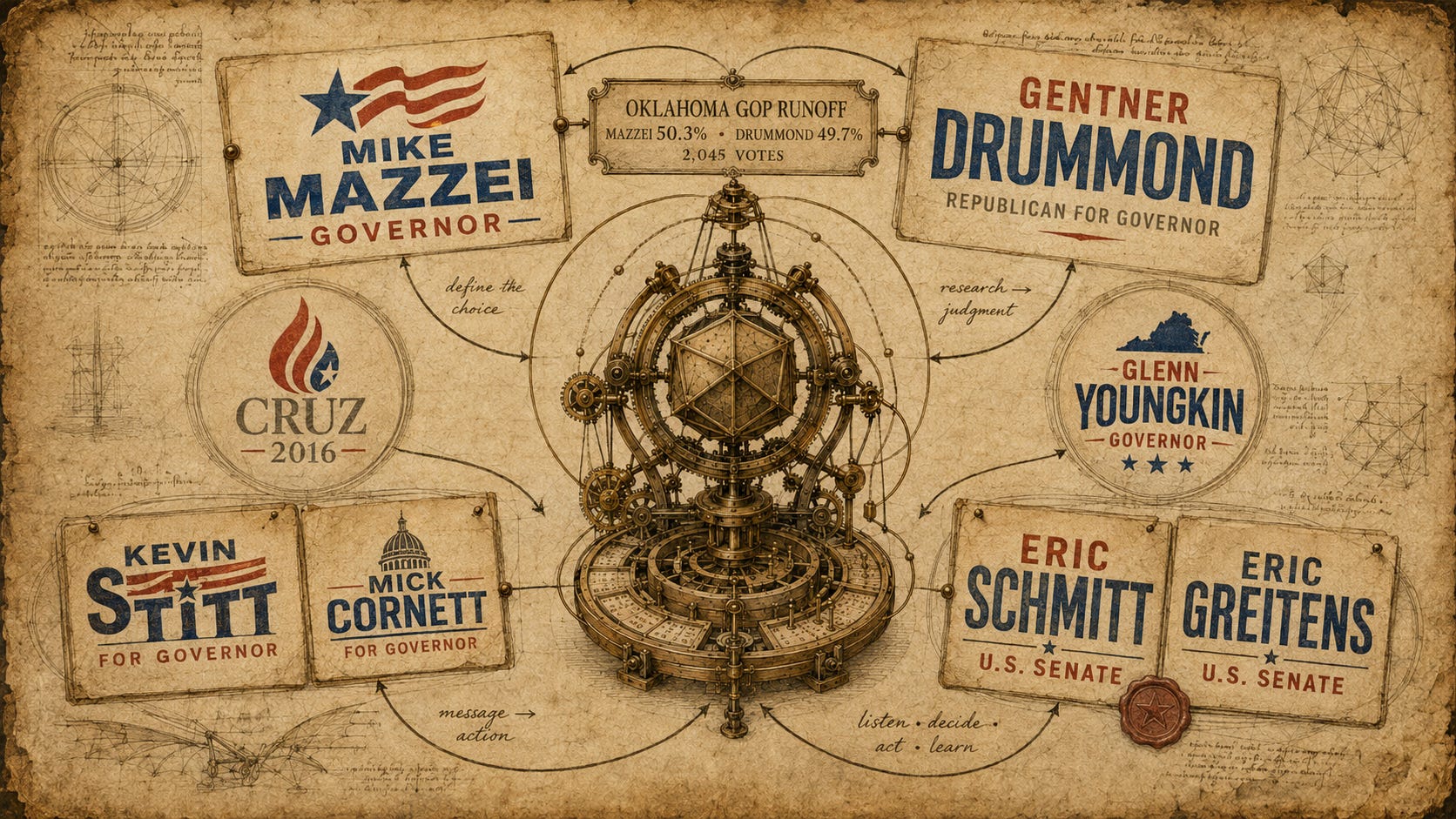
That result brought back memories of 2018 because I worked for Stitt in that campaign. We were able to define the runoff clearly: Stitt was the conservative outsider, while Cornett was the moderate OKC mayor who had supported tax increases. Cornett had plenty of strengths and a strong geographic base, but the choice voters carried into the booth favored us.
The Drummond team kept this year’s race from becoming that kind of ideological contest. I had worked earlier in the primary for another candidate with a proven conservative record, but we failed to make that record the basis on which voters evaluated the field. We had research showing openings and messages that moved the voters we needed. Sadly we never turned those findings into the campaign’s central theme.
I’m probably too close to that loss, and it is still fresh. Still, it illustrates something I have come to believe after a pretty long time in campaigns: possessing the right information and building a campaign around it are very different matters.
Today, campaigns have more data, more sophisticated models and more ways to communicate than ever. Sadly, many still operate through the same basic structure we used decades ago. The pollster presents numbers, the consultants discuss them, each vendor returns to a separate lane, the media team writes scripts, and then the team waits for the next poll to learn whether it worked.
The best campaigns I have worked on operated differently, even before we had language for it.
During the 2016 Iowa caucuses (and even into Super Tuesday), the Cruz campaign effectively connected polling, modeling, field intelligence, digital behavior and message development. Information moved across the campaign and affected real decisions about resources, audiences and communication.
On Election Day, we saw that Google search behavior in many states gave us a better indication of where interest was moving than my tracking polls. That did not make polling obsolete. It showed me how many signals voters were producing outside traditional research and we adapted to that.
I saw another version of this in Missouri in 2022, when I worked for Eric Schmitt in the Republican Senate primary. Former governor Eric Greitens entered with high name recognition and a devoted following. Schmitt’s record as AG gave us a stronger and more current case to make: he was the conservative who had been leading the fight with the Biden administration. The campaign established that contrast and repeated it. Schmitt won the crowded primary with nearly 46%; Greitens finished third with about 19. Even President Trump’s wonderfully ambiguous endorsement of “ERIC” could not disrupt the choice voters had already formed.
Glenn Youngkin’s 2021 victory in Virginia followed the same pattern. Parents were concerned about school closures, curriculum, standards and the feeling that institutions had stopped listening to them. Our campaign recognized the common thread and organized those concerns around the idea that parents should have a voice. That gave a very diverse group of voters a shared reason to support Youngkin in a state Republicans had not won for governor in nearly a decade.
Companies have wrestled with this same challenge. Toyota’s production system became famous because information from the factory floor could change the work while it was underway. Problems did not have to travel through layers of management and wait for the next quarterly review. The system created a habit of listening, deciding, acting and learning.
That is what I mean by a new campaign operating system. Polling, narrative intelligence (like EyesOver), analytics and AI will supply more signals than most campaign teams can absorb on their own. The advantage now goes to campaigns (and consultants) that can quickly ingest those signals, establish a clear strategic choice, give a trusted team authority to act and learn while time still exists to change the outcome.
The victories taught me how powerful that can be. The losses, especially the recent one here at home, have taught me how expensive it is when a campaign never quite gets there.
Comments
Nothing yet. Say the first thing.
Sign in to join the conversation.