
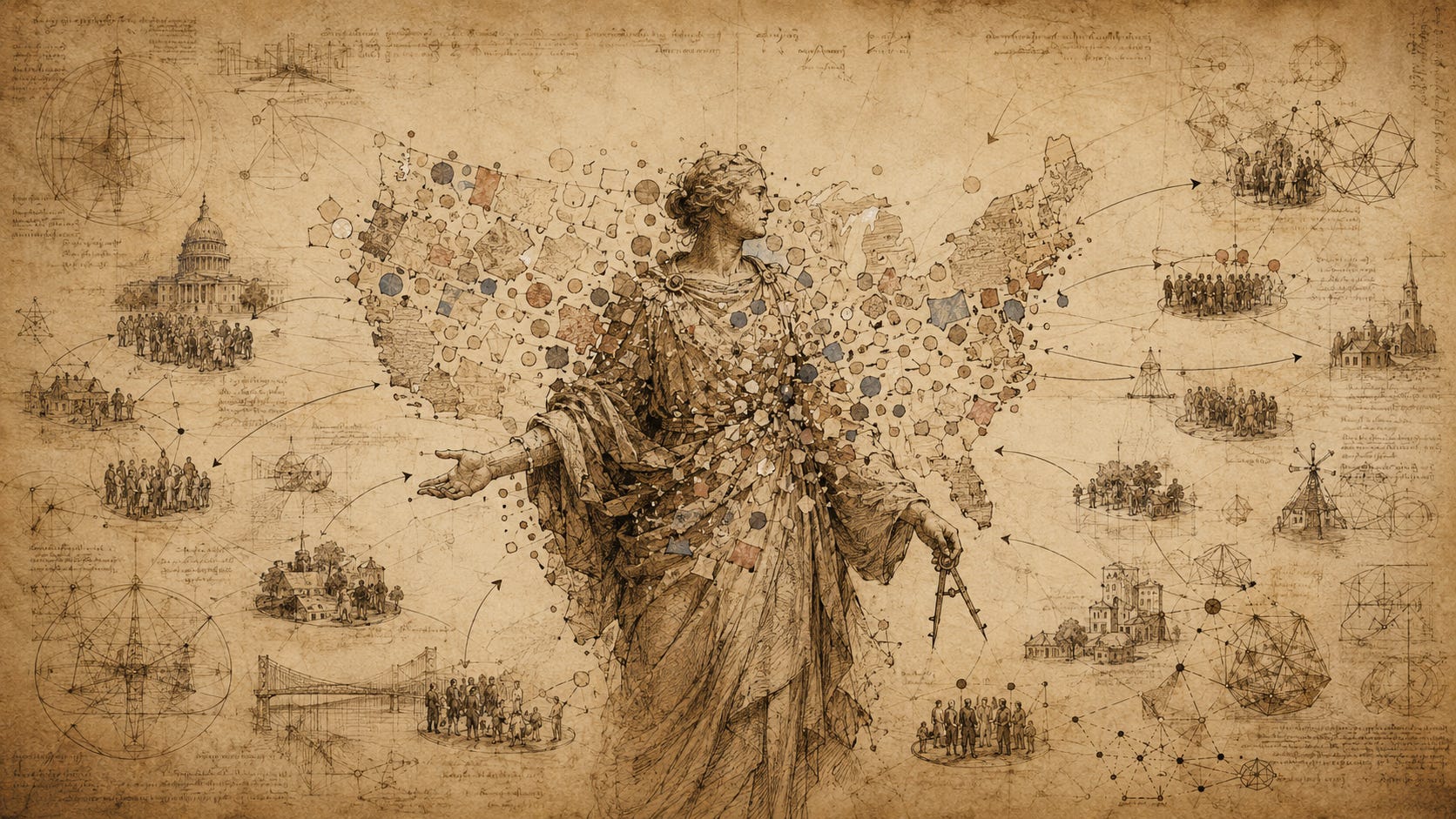
The New York Times published an interesting piece this week arguing that America is no longer adequately described as polarized. Polarization implies two sides moving farther apart. What may be happening now is more complicated: Americans are scattering into smaller communities, each with its own interests, language, sources of information and understanding of the world.
The article calls it atomization. I think that is a useful way to look at what campaigns are confronting, although perhaps not for the reason people might assume.
We still talk about the electorate as if it consists of a few large and relatively stable groups: Republicans, Democrats and independents; suburban women and working-class men; Black, Hispanic and young voters. Those categories are useful. I have relied on them for a pretty long time, and I’m not suggesting we throw them away.
But they increasingly describe only one part of a voter’s identity. A person can be economically populist, culturally conservative, distrustful of large institutions, concerned about the environment and unaffiliated with either political party.
The voter may listen to a podcast that reaches more people than most CNN or MSNBC programs while also participating in an online community that most campaign consultants have ever heard of. Which part of that voter’s identity matters politically can change from week to week.
The electorate is not simply divided. It is constantly reorganizing.
President Trump’s 2024 coalition is a useful example. It included traditional Republicans, working-class voters, young men, technology entrepreneurs, podcast audiences, parents concerned about health and voters motivated primarily by inflation or immigration. Those people did not necessarily share the same ideology, media habits or reasons for voting. For a period of time, however, their frustrations pointed in the same direction.
The corporate world has been dealing with a similar change for years. There was once a mass audience that could be reached through a small number of television networks, magazines and newspapers. That audience splintered across streaming platforms, podcasts, social networks and thousands of online communities. Companies could no longer assume that their customers watched the same programs, trusted the same institutions or even used the same language to describe what they wanted.
Campaigns have adapted tactically to this world, but I’m not sure they have adapted strategically.
We now buy audiences instead of programs. We microtarget digital advertising. We divide voter files into increasingly precise segments. We test more messages against more groups and produce more content for more platforms.
All of that has made campaigns more efficient, but the underlying model has not changed very much. We are still placing voters into predefined categories and looking for the message most likely to move each one.
That can conceal as much as it reveals. Two voters of the same age, race, education level and party registration may inhabit completely different information environments. One may reach a political judgment through local economic concerns, while the other is reacting to a national cultural argument. On a spreadsheet, they look nearly identical. In the real world, they may have very little in common.
The Clinton campaign discovered the limits of demographic confidence in 2016. Its coalition appeared sufficient on paper, and the traditional models suggested that states such as Michigan, Pennsylvania and Wisconsin would hold. What those models did not fully capture was the connection forming among voters who felt ignored economically, culturally and politically.
Brad Parscale understood this. And targetd voters in a way that help Donald Trump perform better across demographic categories. He assembled dissatisfaction across several of them.
Kodak made a comparable mistake in a very different setting. It continued to understand photography through the business of film, even as consumers were changing what photography meant. People no longer wanted only to take and print pictures. They wanted to create, share and organize them instantly. Kodak knew its customers, but it was looking at them through categories formed by an earlier market.
That is the risk for campaigns now. We know a great deal about the voters as they have been classified. We know less about the communities and concerns bringing them together at a particular moment.
Glenn Youngkin’s 2021 campaign in Virginia offers a better model. Concerns about schools, parental authority and institutional responsiveness began connecting suburban parents, traditional Republicans and even minority voters dissatisfied with Democratic governance. Those were not identical constituencies, and not every voter entered the issue from the same direction. The campaign recognized the connection and gave it a simple organizing idea: parents should have a voice.
That was more than targeting. It was coalition construction.
Nike has done something similar in the consumer world by building a community around the idea of being an athlete rather than around a narrow demographic definition of who buys athletic shoes. Its customers include elite competitors, weekend runners and people who may never enter a race. They have different backgrounds and motivations, but the brand gives them a shared identity large enough to hold them together.
This is where newer technology, including artificial intelligence, can help campaigns. It can identify emerging conversations earlier, detect connections among audiences that do not fit the usual categories and follow the movement of narratives in something closer to real time. That is a significant improvement over depending entirely on periodic polling and the instincts of people sitting in a campaign headquarters.
But seeing a coalition is not the same as building one.
A dashboard can show that several groups are expressing versions of the same concern. It cannot decide what a candidate should stand for, which political risks are worth taking or what larger argument can turn those concerns into a governing majority. Those are questions of strategy and judgment.
Barack Obama’s campaign understood this in 2008. It used data and technology more effectively than any presidential campaign before it, but the technology was not the reason millions of people with different backgrounds saw themselves as part of the same movement. “Hope and Change” gave them a common story. The tools helped find, organize and mobilize the coalition. They did not supply its meaning.
Netflix provides the corporate version of the same lesson. It has extraordinary behavioral data and can divide viewers into remarkably specific taste communities. But data can tell Netflix what people watched; it cannot reliably manufacture the next cultural phenomenon. Eventually, someone still has to exercise creative judgment about which story is worth telling.
The dangerous response to atomization would be to conclude that every voter should receive a different message. AI will make that increasingly easy. A campaign could generate thousands of variations, each optimized for a narrow audience or even an individual person.
That might increase engagement, but it could also leave the campaign with no central identity. If every voter is told a different story, what does the candidate actually believe? What would unite the coalition after the election? A campaign cannot assemble a governing majority by becoming as fragmented as the electorate it is trying to reach.
We have seen a version of this in social media. Personalized feeds were remarkably effective at giving individuals more of what held their attention. They were less successful at preserving a shared understanding of events. What worked for engagement did not necessarily work for society.
The best political campaigns have always done something larger. Ronald Reagan’s 1980 coalition included economic conservatives, national-security voters, evangelical Christians, working-class Democrats and Americans who were simply exhausted by a sense of national drift. Those groups did not agree on every issue. Reagan gave them a broader argument about restoring American confidence and strength.
Apple accomplished something comparable with “Think Different.” It did not create separate identities for designers, entrepreneurs, students and technology enthusiasts. It placed all of them inside one larger story about creativity and challenging convention. The audiences were different. The organizing idea was coherent.
That is the opportunity for campaigns in an atomized America. Better technology can help us listen more closely and understand how concerns are moving across communities. It can show us connections that our traditional categories miss. But the purpose cannot be to perfect a separate appeal for every fragment.
The purpose is to find the connective tissue among them.
America may be atomizing, but politics cannot stop at understanding the fragments. The real work of a campaign is assembling them into something capable of winning—and, eventually, governing.
Comments
Nothing yet. Say the first thing.
Sign in to join the conversation.