
Think about the last few times you switched a service. One was probably something you were fleeing. Bad experience, broken trust, a fee that felt like theft. The other was probably something you were chasing. A new product that excited you, a feature that made you rethink what was possible, an experience that felt like the future.
Both are switches. Both require effort. But the energy underneath them is fundamentally different. And if you’re building products or researching customer behavior, confusing one for the other will lead you to the wrong strategy every time.
I conducted a jobs to be done interview with George, a serial entrepreneur based in Arizona. He was on his seventh business at the time of our interview and getting ready to launch his eighth. His current company, Bounty Full Blooms, sells indoor gardening and hydroponics products direct to consumer. He had four employees working in a warehouse, and a physical store was set to open in about three months. The business was almost three years old.
George had all of his accounts, personal and business, with Bank of America. Personal checking, personal savings, a savings account for his son, a joint account with his wife, plus business checking and business savings. He’d opened the business accounts there because he was already a personal customer and needed them quickly. But he knew from the start he wouldn’t stay. “I knew all along that I was gonna transition away from them,” he told us, “because I wasn’t too happy with the experience personally.”
The unhappiness was specific. Bank of America’s overdraft fee policy was, in George’s words, “unscrupulous and should be illegal.” He went a dollar and change into overdraft on his personal account and didn’t catch it. The bank charged him $35 per day, every day. By the time he deposited a check, the fees had accumulated to over $500. “I went and deposited a check into my account, and they took the majority of the check I deposited, and it was gone.”
He’d had overdraft issues before. He’d even set up overdraft protection, and it still happened. Customer service was “atrocious.” He fought to get the fees refunded. The bank’s response was essentially: this is our policy. George closed everything. Personal accounts. His son’s account. His wife’s joint account. Business checking. Business savings. All of them. “I no longer do business with them at all.”
He moved first to Chase, enticed by a $300 promotion for opening a personal checking account with direct deposit. The experience was immediately better. Chase had a one to two day grace period on overdrafts before charging fees, which was all George needed to transfer money from another account. He was happy enough with the personal account that he moved his business checking and savings to Chase as well.
But here’s the important part: George never planned to stay at Chase. “I never had the intention to stay with Chase, either,” he said, “because I’m trying to take all my business, personal and business, away from these large banks.” Chase was a stepping stone. A place to land while he looked for something better.
Then George discovered Yotta. He was watching a video by Graham Stephan, a financial YouTuber he followed and trusted. Stephan was talking about Yotta, an online bank that had gamified savings. George was “blown away that something like that even existed.”
Here’s how Yotta works: for every $25 you hold in your account, you get one ticket. Every day at 7 PM, numbers are released in a lottery style drawing. Your winnings contribute to your APY for the month. George had seen his returns range from around 4% on a bad month to as high as 16%. The bank was FDIC insured up to $250,000 and backed by Ally Bank. George did his due diligence. He looked for social proof online, found review videos, checked Reddit, and spoke to other people who used Yotta for business and personal banking.
Then he ran a test. He deposited $100. Waited a day or two for it to clear. Withdrew it. It came back in less than two days. “That’s just fast enough,” he said. There was also an instant transfer option for a fee that he’d never used, but knowing it existed gave him peace of mind.
George began closing his Chase business savings account within days. He moved the funds to Yotta. And then something changed in how he related to his own money.
“I’m so excited to open my banking app every day,” he told us. “I don’t check my Chase account every day at 7, all excited for the lottery. It just made banking fun.”
Listen to the full Jobs-to-be-Done interview with George to learn how you can tease out negative to zero energy and zero to positive energy:
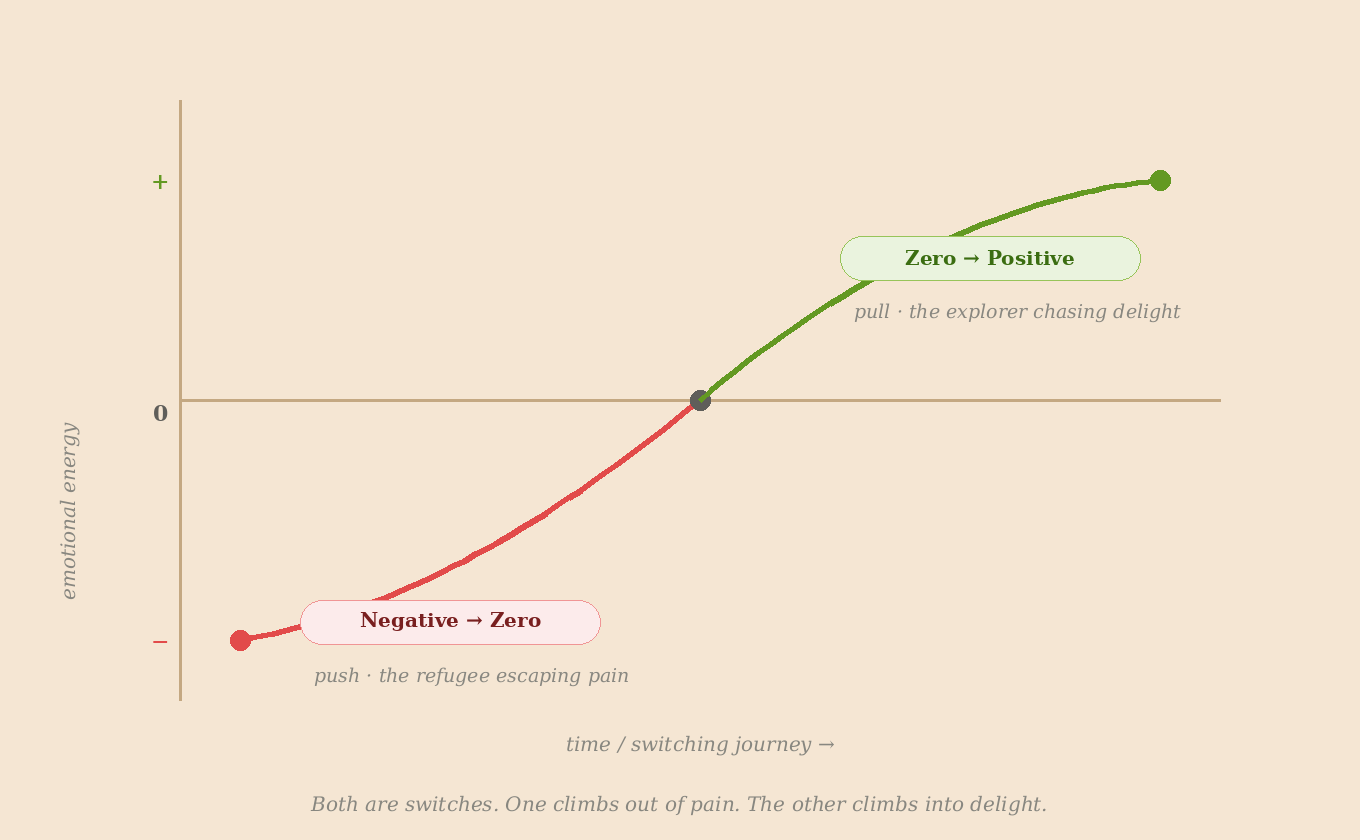
George’s story contains two switches, and they are powered by fundamentally different energy.
The first switch, Bank of America to Chase, was driven by pain.Overdraft fees were draining his accounts. Customer service was dismissive. He felt like the bank was “greedy” and didn’t value his business. The energy of this switch was negative to zero: get me out of this bad situation and into something that doesn’t hurt. Chase didn’t need to be exciting. It just needed to be not Bank of America. The $300 promotion was a nice bonus, but the real driver was escape.
The second switch, Chase to Yotta, was driven by a desire to continue making progress. Chase wasn’t causing George pain. He described having “a good experience” there and called Chase “probably one of the best” of the large banks he’d used. The energy of this switch was zero to positive: I’m not in pain, but I see something that could make my life genuinely better. The gamified savings, the high yield returns, the daily engagement. George wasn’t escaping. He was discovering.
These two types of energy create completely different patterns. The negative to zero switch happened under duress. George closed every single Bank of America account, personal and business, all at once. There was no deliberation about timing or sequencing. The emotion was urgency bordering on anger. The switch happened because the cost of staying became unbearable.
The zero to positive switch happened with curiosity. George watched a video, did research, ran a test transaction, checked Reddit and reviews, and moved his savings over within days. The emotion was excitement. He wanted to tell everyone about it. “It’s a genius idea,” he said. The switch happened because the possibility of something better became irresistible.
And here’s the critical difference for product builders: negative to zero switching doesn’t create loyalty on its own. George moved to Chase with the explicit intention of leaving eventually. He was never invested in Chase. He was just not in pain there. Zero to positive switching creates genuine engagement. George opens his Yotta app every day at 7 PM. He wants to keep money in the account to earn more tickets. He evangelizes the product to anyone who will listen. The relationship is fundamentally different.
Diagnosing the Energy Type
Mapping the Two Types on the Timeline
Implications for Product Strategy
Common Mistakes
Comments
Nothing yet. Say the first thing.
Sign in to join the conversation.