
In 2012, Bob Moesta and I interviewed Brian about a mattress he bought at Costco. We did it live, in front of a workshop audience at the 37signals office in Chicago, with Jason Fried, Ryan Singer, and workshop attendees jumping in. Clay Christensen later featured the story in his book, Competing Against Luck.
The interview became famous because it makes the core point of Jobs-to-be-Done better than any slide deck ever could. On the surface, Brian’s purchase looks like pure impulse: a guy cuts through the wrong aisle at Costco and throws a $699 mattress on a flatbed cart. Underneath, there’s a year of waking up with headaches, 37 weeks in hotel beds that didn’t hurt, a wife slowly converting to his side, a failed warranty claim, and a move to a new house. The “impulse purchase” was five years in the making.
Last week I fed that transcript into something I’ve been building, and I want to show you what came out. The tool is live here if you want to use it on an interview that you’ve conducted: https://ai.jtbdinterviews.com
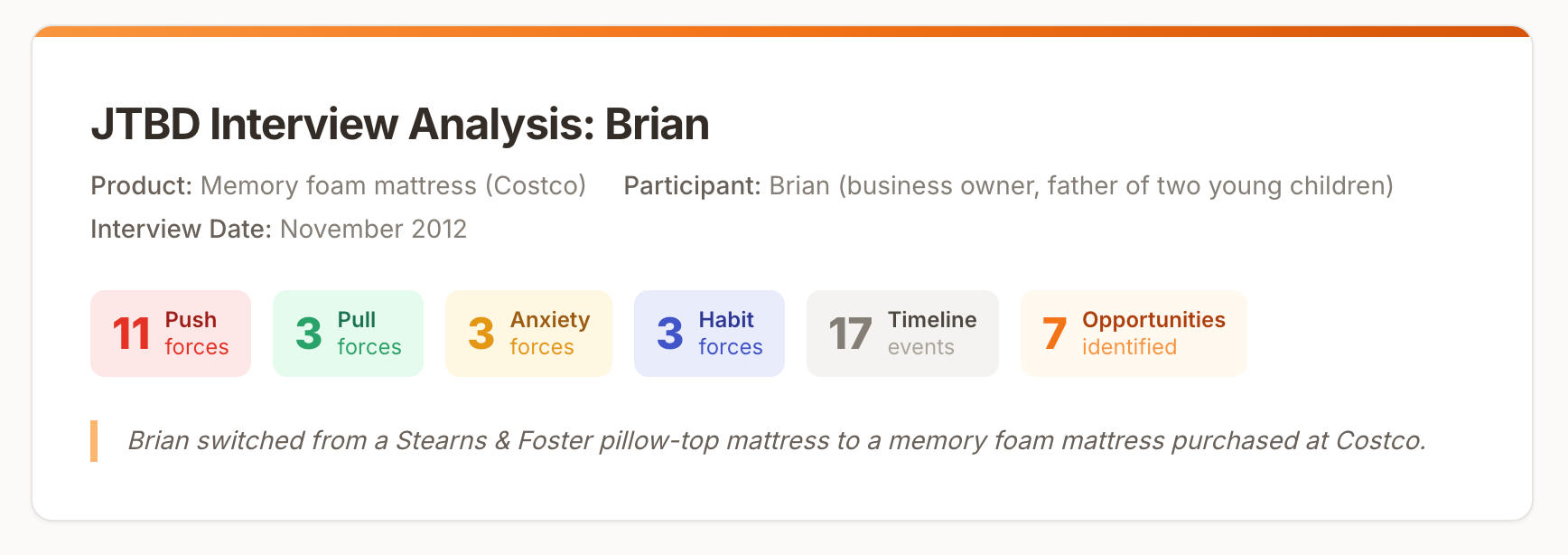
The most expensive part of a JTBD interview was never the hour of conversation. It’s what comes after. Listening back, pulling quotes, building the timeline, separating the forces, turning it into something a team can act on. Done right, that’s hours of work per interview. So teams that should be interviewing customers every week end up doing it once or twice a year. Worse, by the time the analysis is finished, the energy in the organization has moved on. The insight arrives after the decision it should have informed.
I tried. You probably have too. Even with different models and prompts like “use everything you know about Jobs to be Done,” what you get back is a lot of hallucination and nothing usable. Generic AI doesn’t distinguish a push from a pull, doesn’t catch espoused behavior (“I’d never buy from Walgreens”) versus what actually happened, and doesn’t reconstruct the timeline that makes the causality visible.
So I trained a system on the methodology itself. Twenty years of interviews that I analyzed by hand, the frameworks that I teach, and hard rules about what counts as evidence. Then round after round of refinement until the system produced the same analysis I had done by hand.
Then I pointed it at the mattress interview.
It found the forces, with Brian’s own words as evidence. It rebuilt the timeline across five years and seventeen events, from the original Stearns & Foster purchase through the moment at Costco. It pulled out the hiring requirements and the product opportunities. It even assessed the quality of the interview itself (we passed, what a relief).
But here’s the part that got my attention: it caught that the story isn’t over. Forty-five days after buying the new mattress, Brian still had both mattresses in his bedroom. The night before the interview, he slept on the old one and woke up feeling great. The analysis flagged the switch as unresolved, questioned whether the memory foam was actually delivering, and pointed at the product opportunity: catching that kind of quiet buyer’s remorse before it festers. That’s not summarization. That’s the anomaly in the data, and it found it.
It went from raw transcript to all of that in under two minutes.
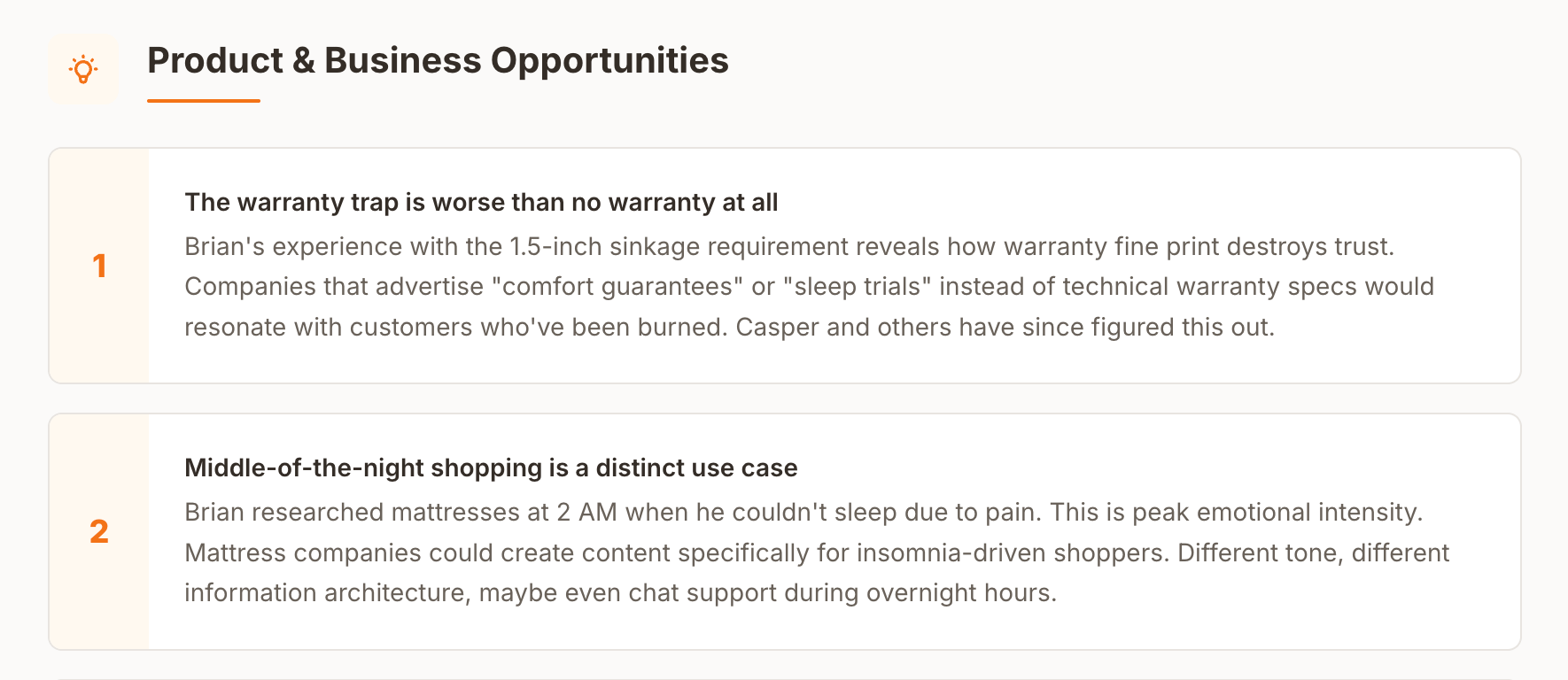
The goal is simple: accelerate innovation by helping teams get from interview to insight faster. When analysis takes minutes instead of days, you interview more often, and you act while the insight is fresh.
Sign up and analyze an interview here: https://ai.jtbdinterviews.com
Your transcript and the analysis stay private. Never shared, never used to train AI models.
No posts
Comments
Nothing yet. Say the first thing.
Sign in to join the conversation.