
The first question isn’t who to talk to. It’s what you’re trying to learn. That sounds obvious, but the answer takes wildly different shapes depending on what’s at stake and what you’re trying to uncover.
Sometimes you just want to unpack one strange thing you saw in the data. A customer is using your product in a way that you didn’t anticipate and you want to get into the details to understand more. A single interview might scratch that itch or lead to a larger set of interviews.
Sometimes you need a set of Jobs solid enough to set your company’s strategy, with a formal approach to recruiting that will stand up to scrutiny, and enough interviews to identify formal clusters of causality (Jobs).
You can set up a series of interviews to satisfy each outcome that you’re looking for, from a single casual conversation all the way to a formal study with the whole leadership team watching.
This piece will walk you through the decisions you get to make and the different paths you can go down, so that by the end you can look at whatever challenge is in front of you and design the right approach for it.
If you’re just learning this, don’t start by designing a project at all. Start by doing single interviews, as many of them as you can get. The reps are what build the skill, and one good conversation will teach you more than a stack of articles.
The whole trick at this stage is picking the right thing to study. You want purchases with weight to them. Weight usually comes with cost, because expensive things get considered, and a considered purchase leaves a story that the purchaser will remember easily.
Avoid the two extremes. Don’t start with something tiny like a pack of gum. There’s real Jobs to be Done in a pack of gum, but there’s so little deliberation in it that it’s a challenging topic to start with. And don’t start with a business to business purchase, where the decision is spread across a committee and the complexity will bury you before you have the basics down.
Start in the sweet spot: a big, considered consumer purchase. Someone who bought a house. Someone who bought a car. Even something like a guitar or a bike at a few hundred or a thousand dollars. By definition those buyers put real thought into it, and they felt something. They can walk you through a timeline, and you’ll be able to see the forces acting on them. Get a handful of those conversations under your belt, and the rest of this piece, the map and the decisions ahead, will make far more sense, because you’ll be designing around something you have actually felt. If you need to get the basics down, watch a few of the interviews on this Substack to get a feel for how it goes. If you’re ready to learn all of the details of the framework and start down the path of mastery, dive into the online Jobs to be Done course.
Struggle: Should I be interviewing, or using another method?
This trips up a lot of people, because the instinct when you’re unsure is to go run interviews. But not every question is an interview question. Interviews are for why. Why someone switched, what they were struggling with, what finally pushed them to act. That’s the stuff a person can only give you by walking through their own story.
If your question is how many, or how much, or which version wins, an interview is the wrong tool. How many people drop at step three, which headline converts. Your analytics, a survey, or an A/B test will answer that faster and more reliably than any conversation. Reach for an interview when you need to understand a decision, not when you need to count one.
You design your approach with two decisions, and one tool to weigh them: the Interview Map.
The vertical axis is how much confidence you need in the answer. At the top, you need something bulletproof, and you’re willing to spend the time to get it. At the bottom, you just need a quick read, something good enough to point you in the right direction. It will impact how many interviews you do.
The horizontal axis is who the answer is for. On the left it’s just for you or your team, and it can stay informal, because the people who will act on it already speak the Jobs to be Done language. On the right it’s going to be shared broadly, with a client, the executive team, or the whole company. It will impact how you schedule things, who needs to be in the room when you interview and debrief, and how you share out your findings.
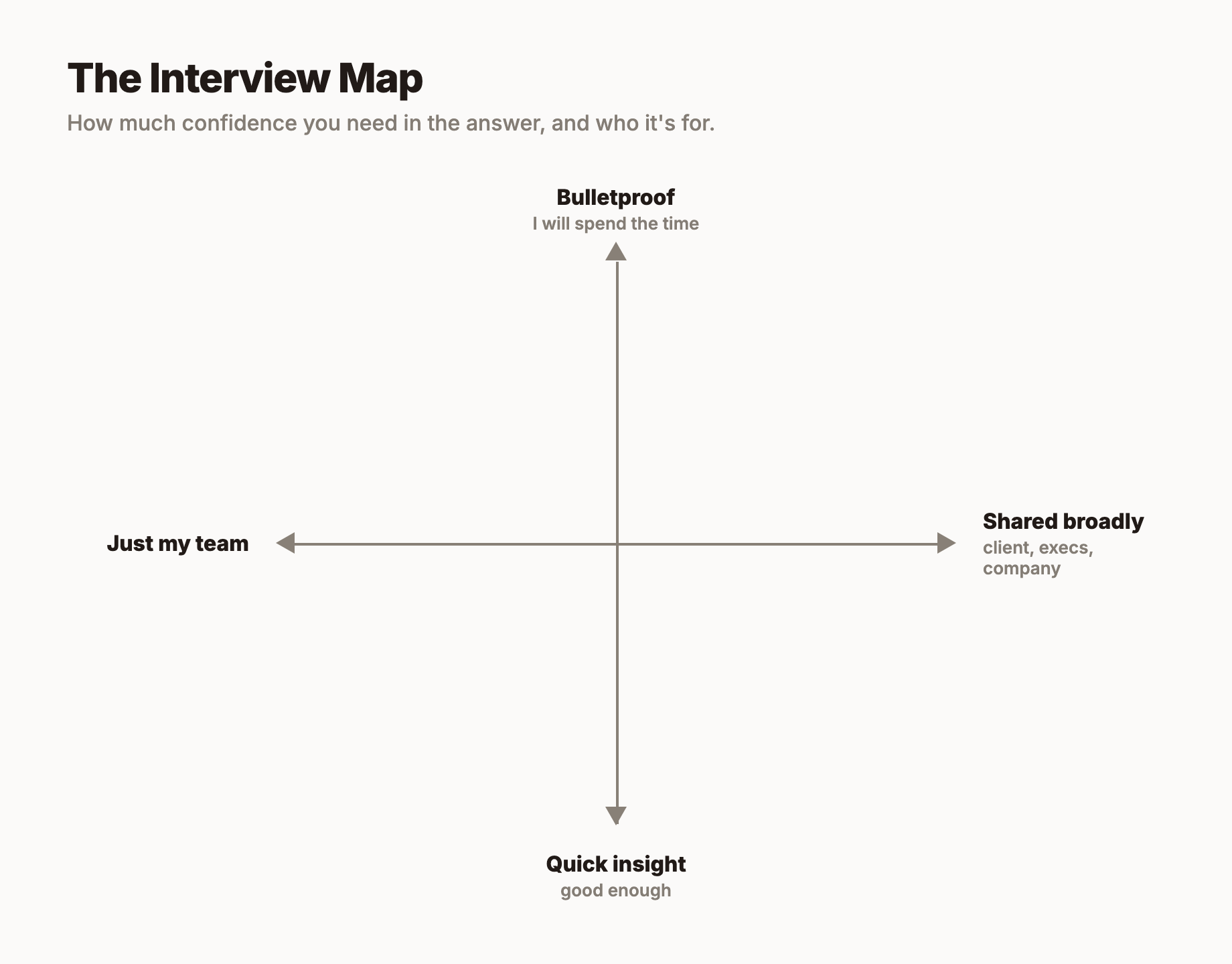
Every kind of project you might run is just a spot on the Interview Map. Each time you get the thought, “I should interview some customers,” come back to the Interview Map as a guide for what to do next.
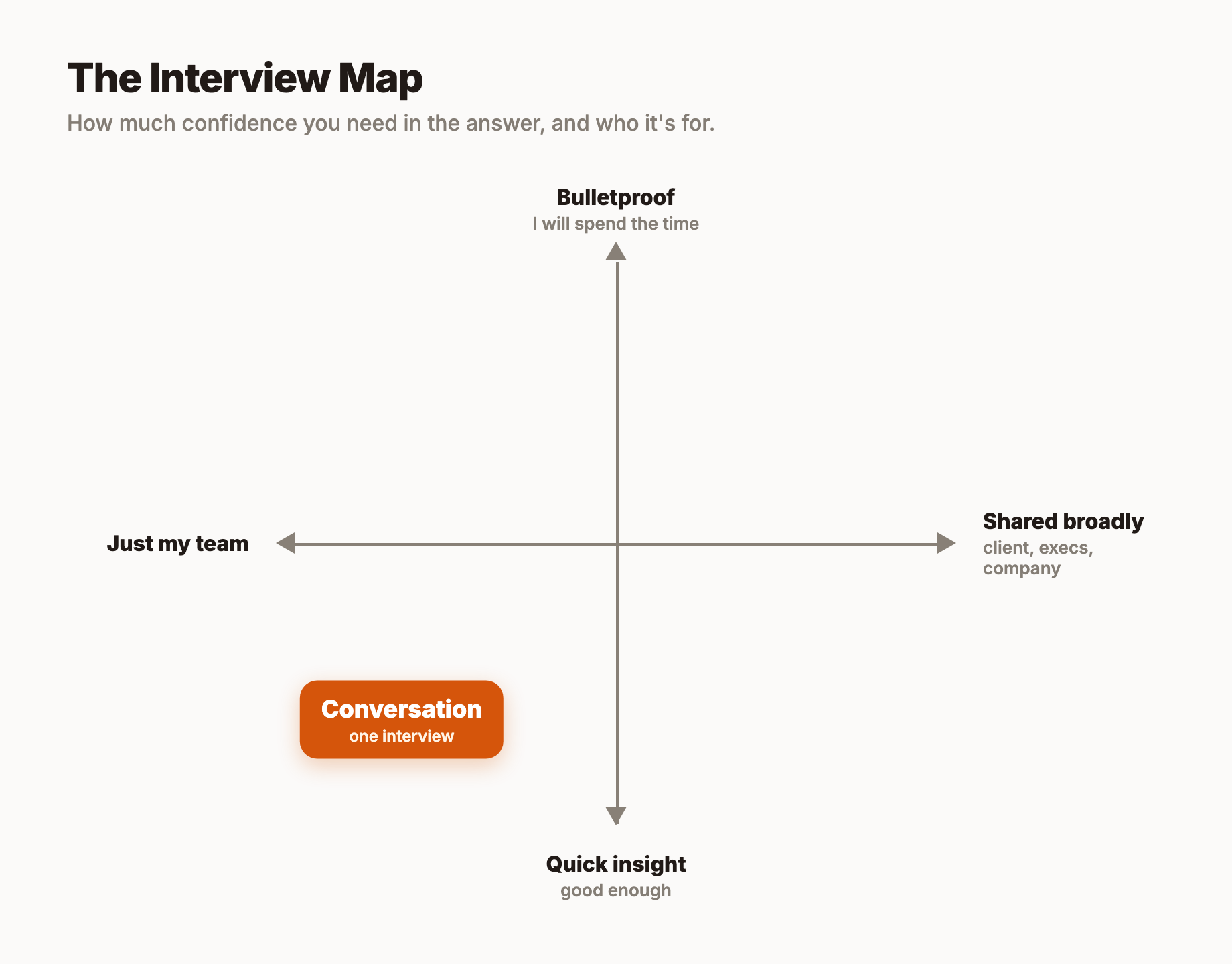
Let's place each different project on the map one at a time and explain them.
The trigger for this is rarely a grand research plan. It’s usually something you can’t explain and want to understand more about. You’re on a product team looking at usage data and a single customer does something interesting. Not the average. The anomaly. The thing that doesn’t fit. The common thread is usually: someone did something you don’t understand, and you want to know what caused it.
When that happens, the simplest move is to talk to that one person. It’s for you, or maybe a couple of people on your team. You don’t need deep rigor or a big sample size of interviews. This approach sits in the bottom left of the map: some quick insights just for me or my team.
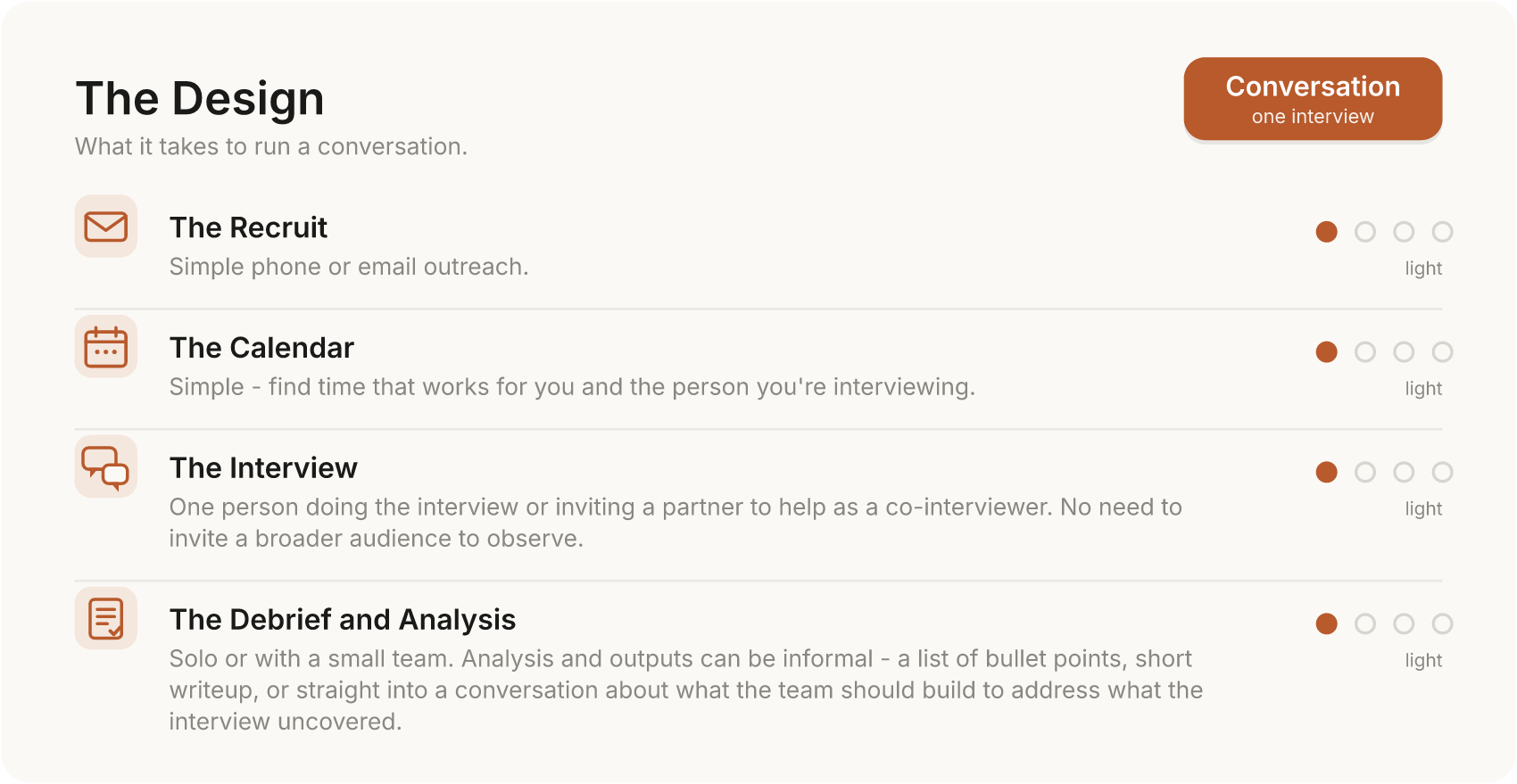
This is the simplest recruit there is. Email or call the customer directly. “I work on this product. I noticed you were using it and I’d love to ask you a few questions about how you use it. If you’re up for a casual conversation, nothing to prepare, I’ll send a $100 to $150 Amazon gift card your way. Are you free in the next couple of days?” That’s the whole thing. It’s just a conversation.
Because it lands in the bottom left of the map, the output can be as simple as a quick write-up with some bullet points for your team along with the recording of the interview and the transcript.
Struggle: Can one conversation teach me anything?
It can, as long as you’re honest about what it gives you. One interview won’t hand you a pattern, and you shouldn’t pretend it does. What it hands you is something a dashboard never will: the real forces behind one real decision, in the customer’s own words. The push that got them looking, the pull of the new thing, what nearly stopped them. That’s often enough to change what you do next, and it always makes you a sharper interviewer for the next interview that you conduct.
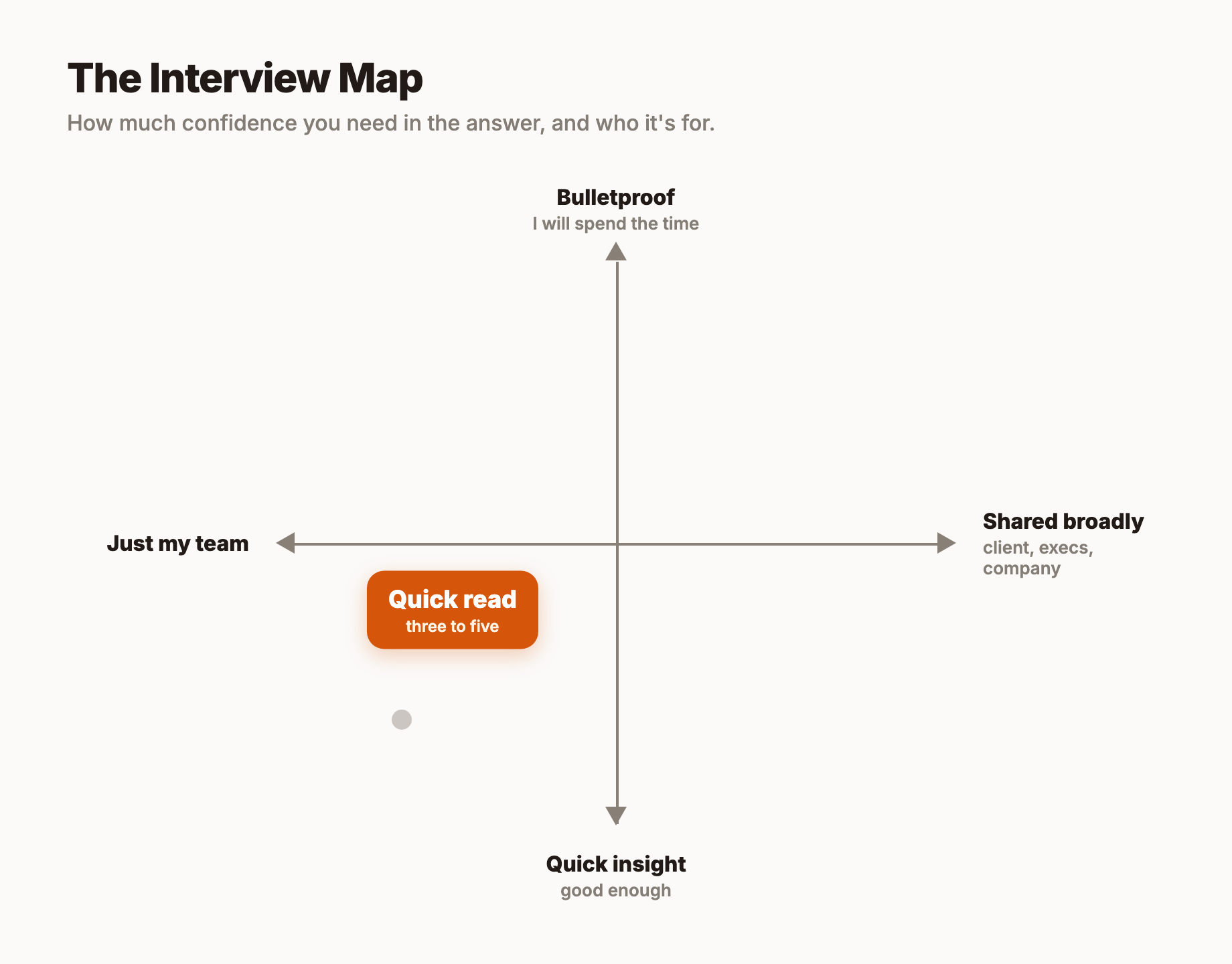
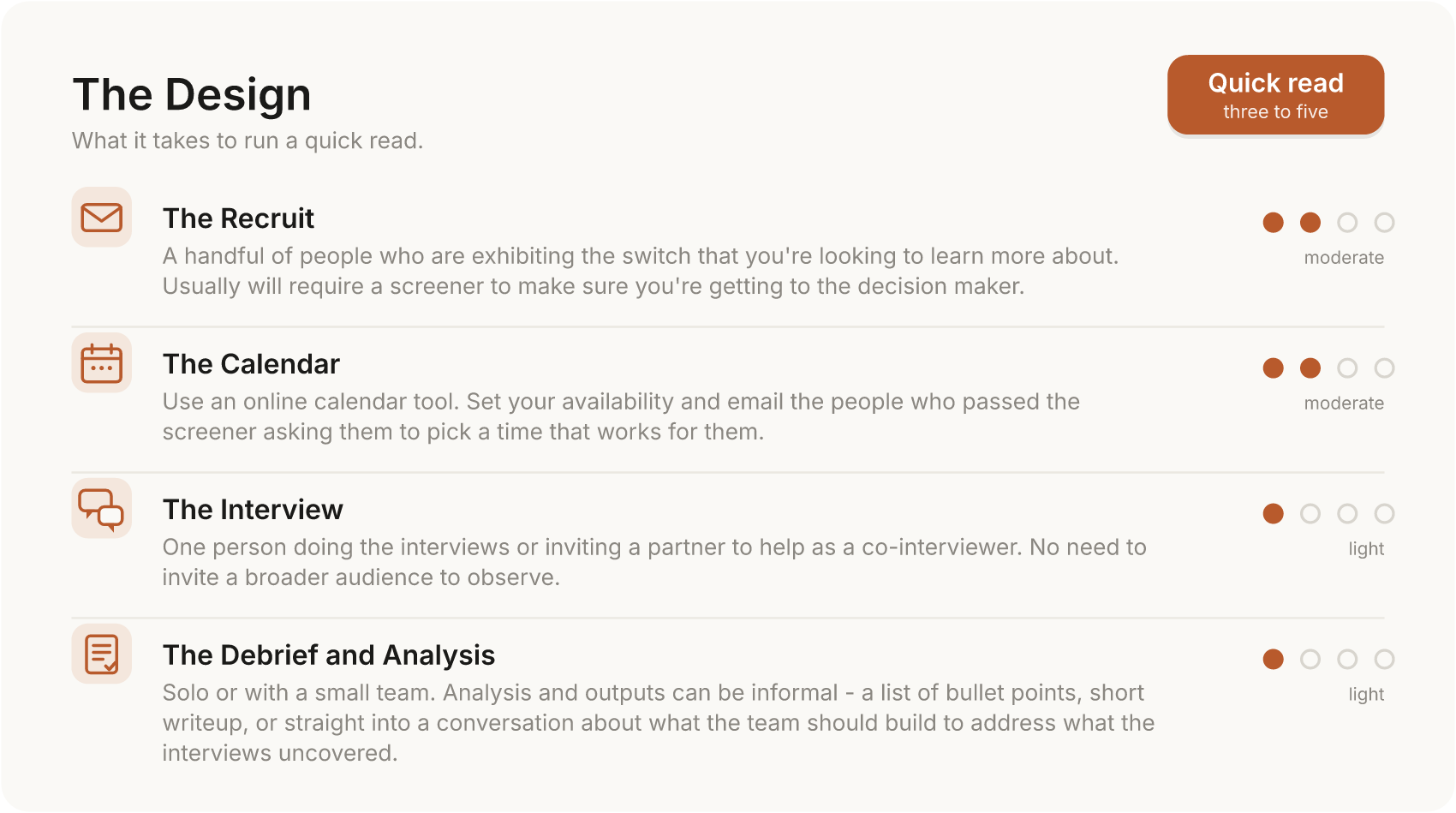
In this case, you want a little more. A handful of interviews, say three to five, to see whether there’s a pattern. It’s still for your team, so the audience stays easy. One person can go off, do the interviews, and report back.
If your team is up to speed on Jobs to be Done, you don’t need everybody in the room for every interview. People aren’t going to instinctively challenge the findings because of a lack of knowledge about the framework (we often solve this by having people in the room when we interview - it’s harder to challenge what you see and hear directly from a customer).
This Quick Read approach moves up the vertical axis. You’re looking for a little more confidence in the findings: insights from a set of customers, just for me or my team.
What comes out the other side can still be informal. Raw transcripts, a few clips, a working conversation about what to change in the product or positioning. You build it around one specific switch: they just adopted your product, adopted a feature, or churned to a competitor. The trade-off is honest. A handful of interviews is a smaller sample than a full study, so you trade some certainty for speed. The benefit is that you still get answers fast, and if there’s a little uncertainty that you need to clear up, or something that jumps out as incredibly interesting, you can always go back and do more interviews.
Struggle: How many interviews is the right number?
You’ll get wildly different answers to this, and that’s the problem. Ask around and you’ll hear five, ten, twelve, thirty, even a hundred, all said with total confidence. The reason they don’t agree is that they’re answering for different boxes on this map. The number isn’t something you pin down up front. It falls out of where you’ve landed. A conversation is one. A quick read is a handful, three to five. A study is ten to twelve, give or take.
Inside a study, you don’t lock the exact count either. You keep going until the interviews stop surprising you. When the third or fourth person in a row tells you a story you’ve basically already heard, you’re there (it usually happens around 10 interviews). And if you blow past a dozen and every conversation still cracks something new open, that’s a signal too: the topic you’re studying is too broad, and you can tighten it.
Sometimes you want real rigor even though the finding will likely never leave your team. You run a full study, ten to twelve interviews, because you want the sample size and the high confidence in the data. The answer needs to be solid, because you’re going to place a big bet based on what you find. The audience is still your own team. This approach sits at the top left of the map: some rock-solid insights for me or my team.
I’ve personally used this during phase-change periods of a business: We’ve spent the last two years finding product-market fit and tackling adoption and growth. Now that we’ve made great progress in those areas we need to turn our focus to churn and retention. Let’s do a study with real rigor with people who have churned from our product and adopted something else.
I’ve also used it during or after acquiring a business: We know the space from a general perspective, but let’s dig in and really nail down the jobs that people hire this product for.
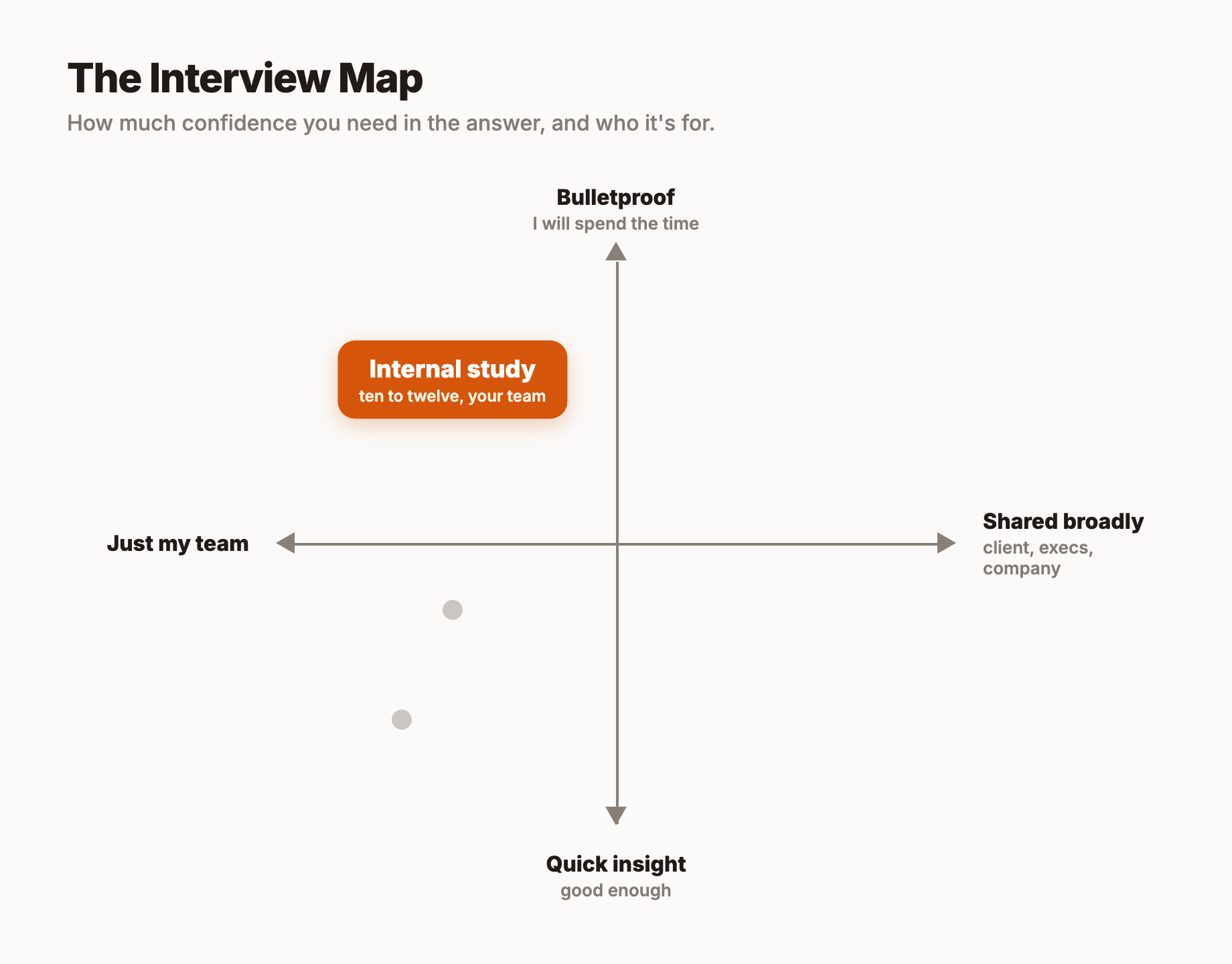
The two axes really are independent, and this internal study is the proof. It’s high on confidence but it stays on the left.
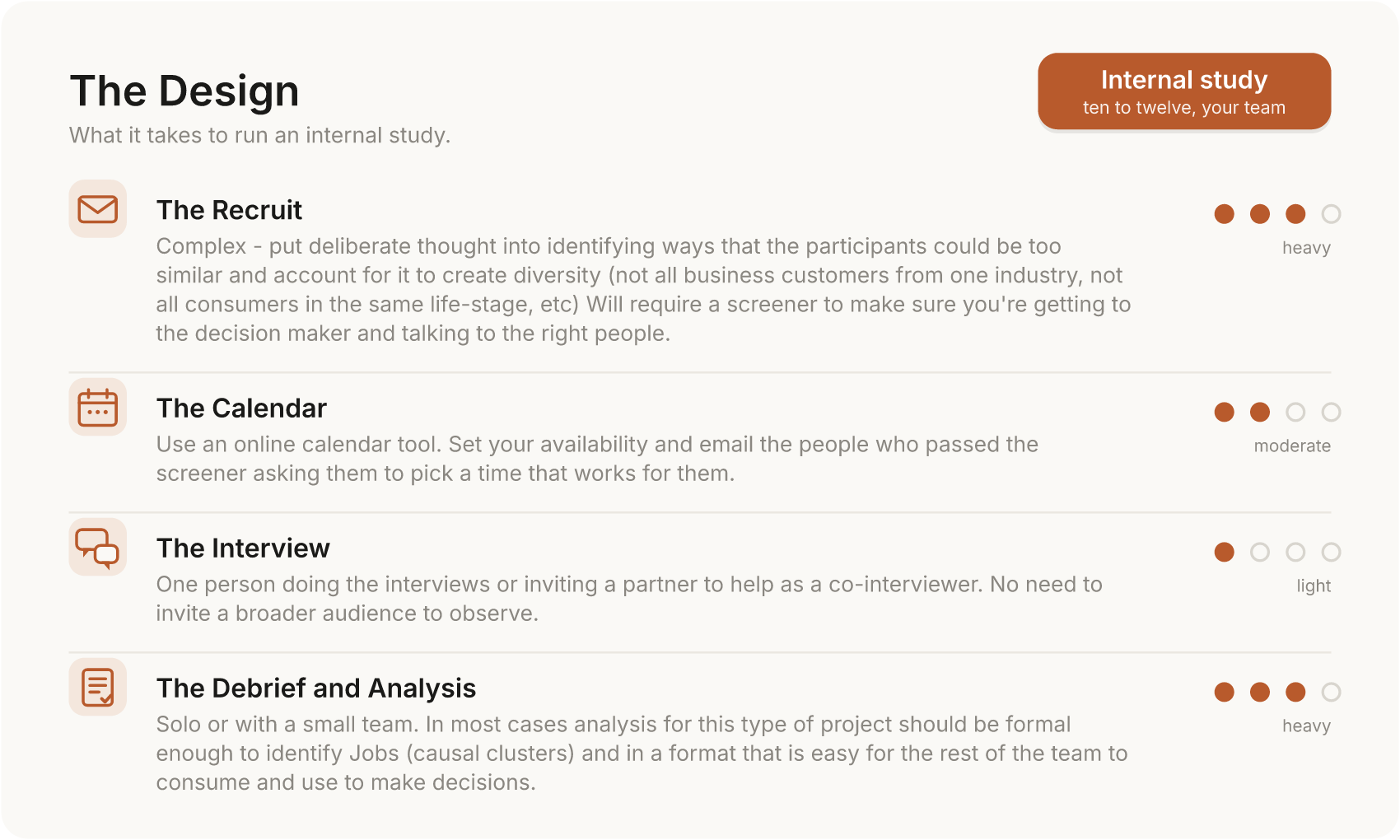
Now we’re in a situation where the findings and insights are going to travel. Marketing will base strategic decisions on them, sales will rewrite their outbound copy and content, the executives will steer the company with them.
You need to make sure you nail two things at once:
Enough rigor to deeply trust in the answer.
Findings that survive contact with people who weren’t in the room.
That’s the top right, and it’s the biggest investment, for reasons we’re about to get into: highly trustworthy insights that everyone is going to consume and use.
Here’s the thing nobody warns you about: Jobs to be Done findings tend to contradict what everyone already believes.
For decades we thought we sold Snickers to moms who wanted a sweet treat for their kids. Then we ran interviews and all of these people told us stories about grabbing a Snickers bar when they want to fuel up instead of a coffee, a protein bar, or a hamburger.
That isn’t an easy thing for a team to swallow. The instinct is to reject it. Scrutinize the recruit, decide you must have talked to the wrong people, and quietly drop the opportunity altogether.
This is why the horizontal axis matters so much. A finding you carry back and that people hear secondhand is easy to dismiss. If I catch you at the water cooler and say “you wouldn’t believe it, this person uses Snickers like an energy drink,” you aren’t going to believe me. But if you were in the room, on the call, watching the customer tell the whole story in all its richness, the options they weighed, why this one was perfect in the moment, how they wouldn’t change a thing, you can’t throw it away so easily. You heard it yourself.
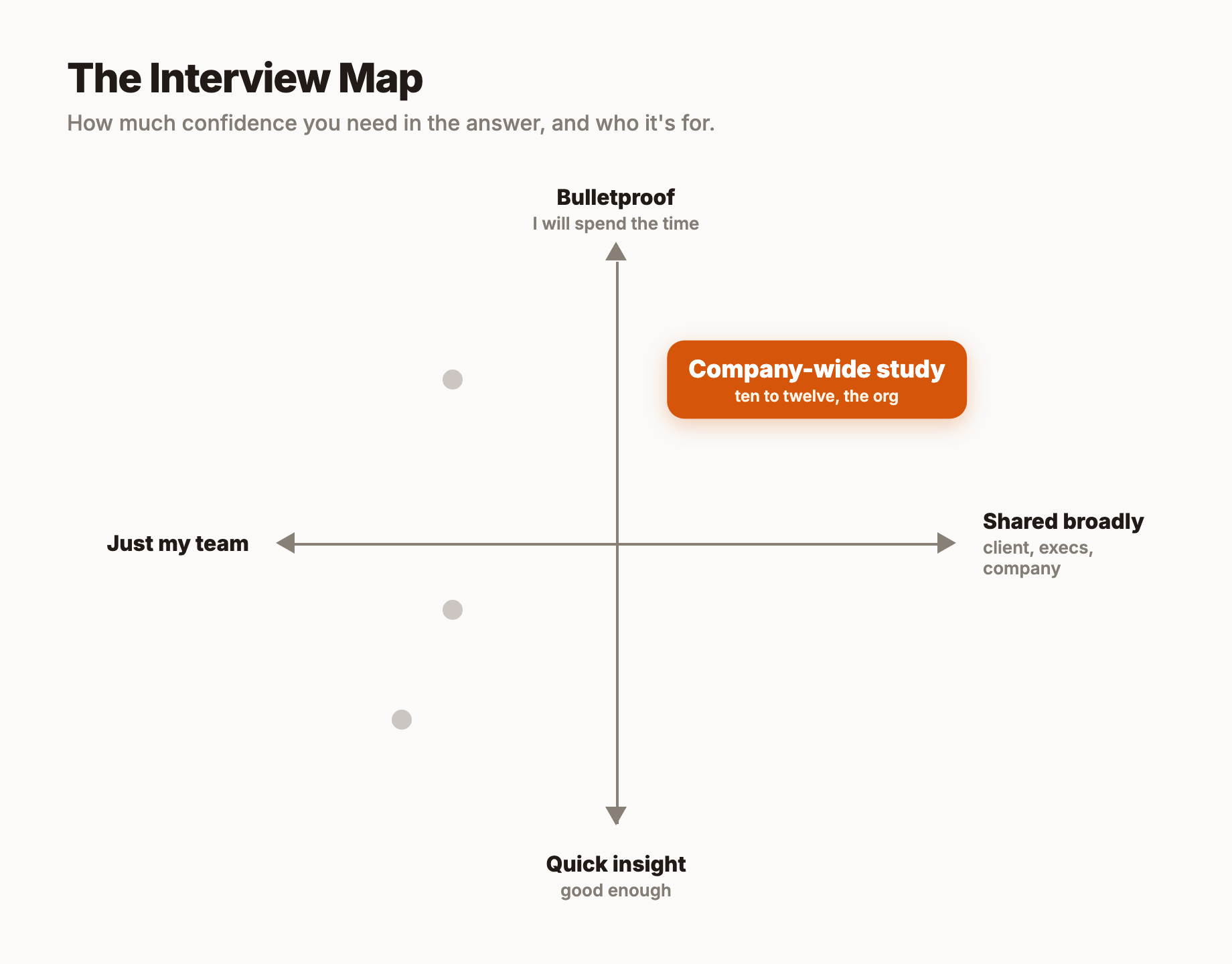
So on the right side of the map, the work is mostly about getting the right people, from the right parts of the org, into the interviews as they happen. That ripples through everything that follows. It changes the recruit, the timing, and the scheduling. You might block off the better part of a week, line the interviews up so the key people can witness them firsthand (and accept that not everyone will make every interview). The payoff is the moment the phone hangs up and everyone looks at each other and nods because they all heard the same thing. Now you’re on the same page, instead of arguing about whether the data is real.
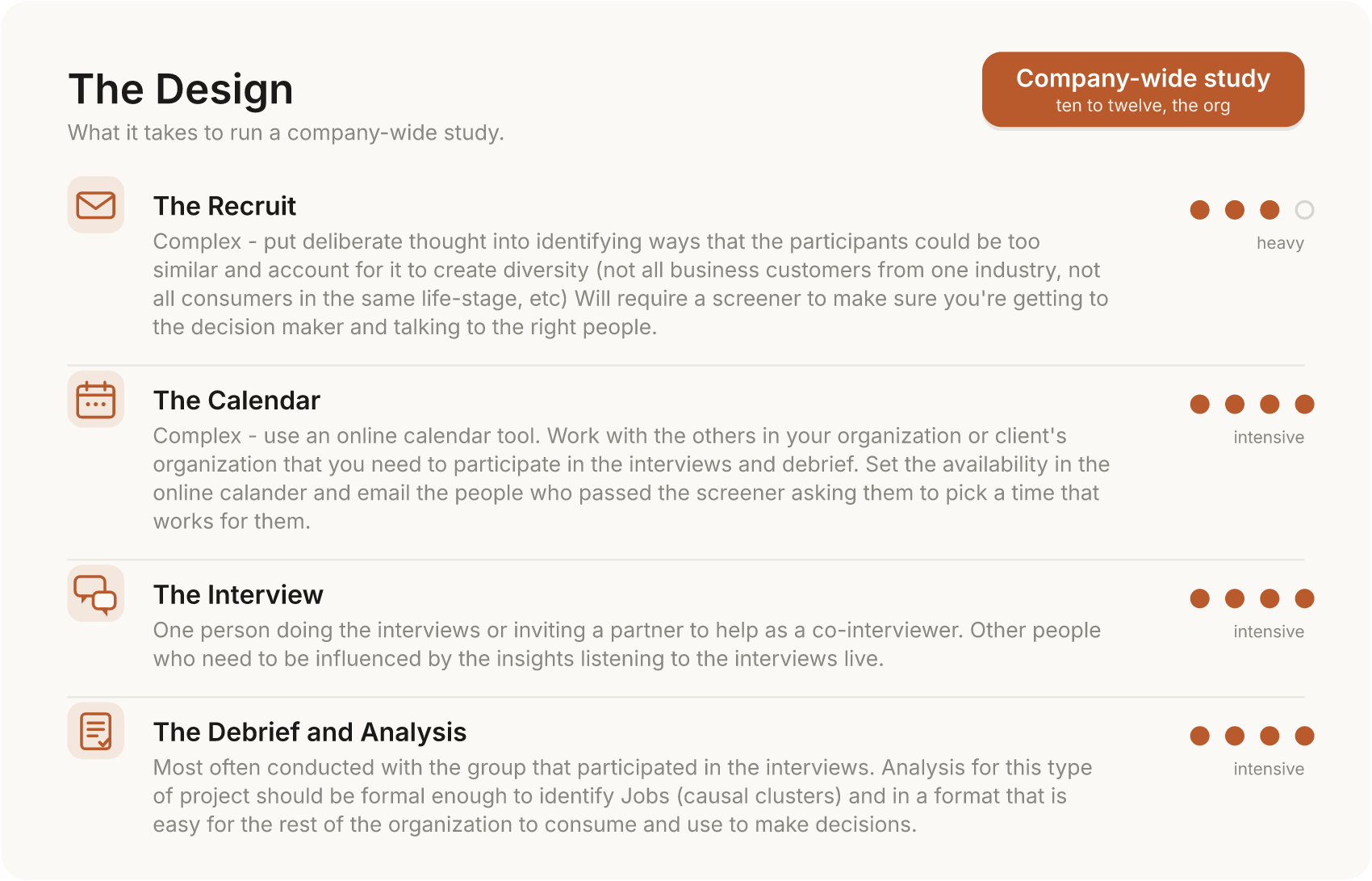
If you’re reading this and using Jobs to be Done for your consulting work, conversion rate optimization projects, or product and strategy consulting, you will probably spend a lot of time at the top right of the map. The deliverable has to be solid enough to defend and formal enough to present, because a client is paying for it and someone above them is reviewing it. You live in the full study by default.
And the witnesses problem is sharpest of all for you. A finding delivered by an outsider is the easiest finding in the world to wave away. The moment your data contradicts what the client already believes, the instinct is to decide you talked to the wrong people. You don’t know their business. Your recruit must have been off.
The single best defense you have is to have the client in the room when the customer told the story. So if you’re a consultant, spend a disproportionate share of your planning energy on getting their team to sit in at least some of the interviews.
Being a consultant also doesn’t mean that you never reach for the other areas of the map. Trying to decide whether to take on a client or unsure if you can provide value in a specific domain? Reach for a Conversation or a Quick Read to get fast answers.
In practice, these don’t stay in their own boxes, and you don’t have to pick just one. Here’s a personal example. I once joined a company as head of product, and I knew from day one that I had to run a formal study within the first few months of taking the job.
I had to set product strategy and help shape the company’s strategy, and I had the first ninety to a hundred and twenty days to get it nailed down. So right away I started designing that Company-Wide Study: how I’d recruit, who I needed to talk to, the different customer profiles, who needed to be in the room when I did interviews, who needed to travel, what everyone’s schedules looked like. All of it.
But I didn’t let that stop me from talking to customers. A study that big takes time to set up, and I didn’t want that time getting in the way of learning. I was new in the role, new to the domain, new to the product. I needed to get my feet under me.
So in parallel, I ran a Quick Read for myself. I went into the database, found some customers, sent a few emails, and did a handful of interviews myself. Just five or six of them. I knew I wasn’t going to share these out to the whole company, which hadn’t really been introduced to Jobs to be Done yet. I just wanted quick learnings, to get my feet on the ground, and to start sharing some early findings with my own team.
From this example I hope you see that these projects often come together, a Quick Read coming right before a Company-Wide Study, a Conversation quickly leading to a Quick Read when an interesting insight emerges.
The lesson is simple: don’t let the formality of the big one block you.
You don’t have to wait for the perfect project to begin. If what you need lives in the bottom or left of the map, a Conversation or a Quick Read, the best thing you can do is close this post and go do some interviews. Find a customer who did something you can’t explain, send the email, and have the chat this week. No screener, no schedule, no permission required. That one rep will teach you more than reading about it ever could.
The higher and further right you go, the more a single decision starts to dominate: who exactly you bring in, and how careful your screener has to be to get them. That’s a craft of its own, and it’s where a lot of promising studies quietly go wrong. It’s also the subject of the next post. Recruiting is coming soon, and it’s the natural next step once you know the scale and audience you’re designing for.
No posts
Comments
Nothing yet. Say the first thing.
Sign in to join the conversation.