
The U.S.–China AI rivalry is often described through a simple contrast.
China advocates openness, cooperation and sharing, while the United States tightens export controls, investment restrictions and other barriers around advanced AI technology.
That description is not entirely wrong.
But when China’s intervention in the attempted acquisition of AI startup Manus is placed alongside Beijing’s public positions at the World Artificial Intelligence Conference, or WAIC, a more complicated picture emerges.
The key question is not whether the United States or China is morally right.
It is this:
How consistently does each government apply the principles it presents to the international community?
That question is becoming more relevant as Washington reportedly considers measures affecting countries involved in WAICO, the World Artificial Intelligence Cooperation Organization, an international AI cooperation initiative associated with the broader ecosystem around WAIC.
The Manus case provides an unusually useful case study.
The current U.S. approach to AI is relatively direct.
The White House’s America’s AI Action Plan, released in July 2025, explicitly connects AI policy with economic competitiveness, national security and geopolitical leadership.
Its priorities include:
accelerating AI innovation in the United States
building domestic AI infrastructure
strengthening U.S. leadership in international diplomacy and security
exporting U.S.-origin AI technology stacks to allies and partners
The same logic underpins U.S. semiconductor restrictions targeting China.
The U.S. government has justified restrictions on China’s access to advanced semiconductors and AI-related technologies by citing risks including:
Chinese military modernization
advanced weapons development
national security
strategic technological competition
Whether those policies are justified is a separate question.
From Beijing’s perspective, they can reasonably be characterized as technological containment.
From the perspective of Chinese companies affected by them, the policies can appear highly discriminatory.
But the underlying U.S. argument is relatively easy to understand:
Advanced AI and semiconductors are strategically important to U.S. national security. Therefore, Washington will restrict certain technology transfers to China.
The United States is not first declaring that advanced AI technology should circulate freely across borders without strategic restrictions and then quietly preventing China from accessing it.
Its policy is openly designed around U.S. interests.
China’s international messaging is substantially different.
At WAIC 2025, China introduced its Global AI Governance Action Plan.
The plan described AI as having the potential to become an international public good benefiting humanity.
Its principles included concepts such as:
fairness and inclusive benefits
openness and cooperation
respect for sovereignty
safety and controllability
China also called for an attitude of openness and sharing and advocated reducing or removing technological barriers.
Read in isolation, the vision appears distinctly different from a world divided into competing technology blocs.
It presents China as an advocate for a more open international AI order based on shared technological development.
Then came Manus.
Manus emerged from China as an AI startup before relocating its operational base to Singapore.
Meta subsequently sought to acquire the company in a transaction valued at more than $2 billion.
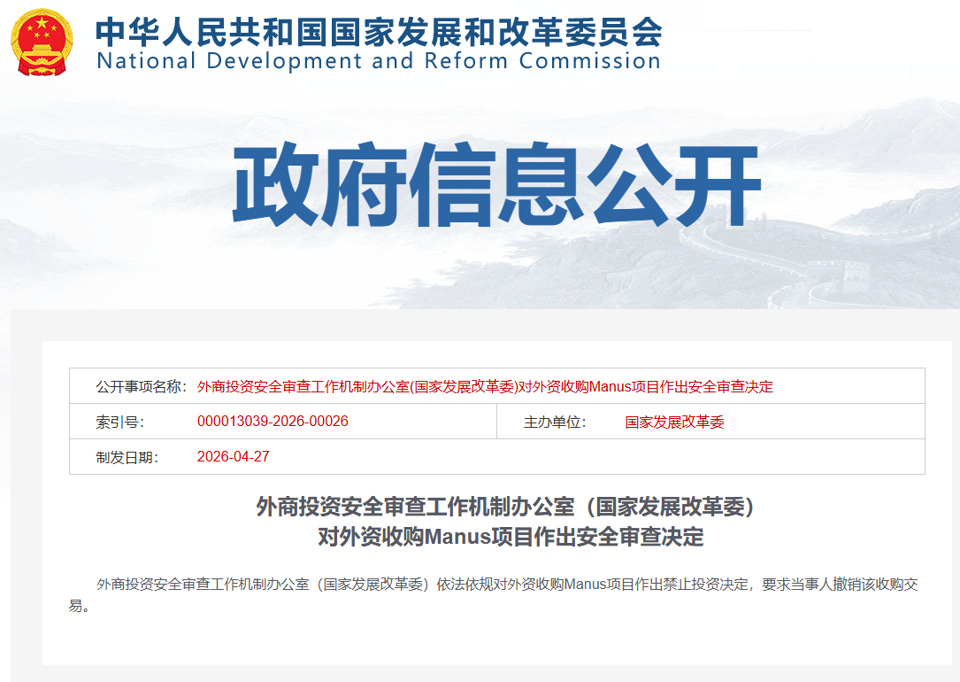
On April 27, 2026, China’s National Development and Reform Commission, or NDRC, formally intervened.
The office responsible for China’s foreign investment security review mechanism issued a decision prohibiting foreign investment in the Manus project.
The parties were also required to withdraw the acquisition transaction.
This was not simply media speculation about Beijing’s intentions.
It was a formal Chinese government action.
The significance extended beyond Manus itself.
Although Manus had already shifted its business base to Singapore, Beijing effectively drew a line around AI technology, intellectual property and talent originating from China.
The message was clear: relocating abroad does not necessarily place strategically important Chinese-origin technology beyond Beijing’s national security concerns.
There is nothing inherently extraordinary about China conducting national security reviews.
China, like the United States or any other major state, has legitimate security interests.
If Beijing believes the transfer of strategically important AI technology to a U.S. company threatens those interests, it has a rational basis for examining the transaction.
Therefore, the fact that China blocked the Manus acquisition does not by itself demonstrate hypocrisy or wrongdoing.
The more interesting issue emerges when the Manus decision is compared with what Beijing said only a few months later.
At WAIC on July 17, 2026, Chinese President Xi Jinping outlined four principles for global AI governance.
The first emphasized openness and win-win cooperation.
China again called for:
open-source development
openness
cooperation
sharing
That was broadly consistent with Beijing’s previous messaging.
The second principle, however, creates a more difficult comparison.
While emphasizing the importance of AI safety governance, Xi called for opposition to the excessive expansion of the concept of national security in the AI field and to practices that place one country’s security above the security of others.
Placed chronologically, the sequence is striking:
April 2026: China invokes its national security review mechanism to block Meta’s acquisition of Manus.
July 2026: China warns against excessively expanding national security concepts in AI and placing one country’s security above that of others.
The question is not whether either statement can be defended individually.
The question is how they fit together.
China has an obvious answer available.
Beijing can argue that it opposes only the excessive expansion of national security concepts.
Under that interpretation:
blocking the Manus transaction represents a legitimate Chinese national security measure
U.S. restrictions on Chinese AI and semiconductor companies represent an excessive expansion of national security
Formally, the two positions can coexist.
But that answer immediately creates another question:
Where is the boundary?
What makes one restriction a legitimate national security measure and another an unacceptable expansion of national security?
More importantly:
Would China apply the same standard to its own policies that it asks other countries to apply to theirs?
China’s WAIC principles do not yet provide a sufficiently clear answer.
It would be equally simplistic to conclude that the United States restricts technology, China restricts technology, and therefore there is no meaningful difference.
Both governments clearly view AI as strategic technology.
Both intervene when they believe national interests are threatened.
The important difference lies partly in the international narrative accompanying those policies.
The United States openly frames its strategy around:
American leadership
national security
technological dominance
reducing strategic dependence on adversaries
strengthening allied technology ecosystems
It is an explicitly U.S.-centric strategy.
But that self-interest is not particularly hidden.
China’s international messaging at WAIC emphasizes something different:
openness
sharing
fairness
inclusive benefits
international cooperation
reducing technological barriers
In 2026, Beijing went further by criticizing the excessive use of national security arguments by other countries.
Yet when strategically significant Chinese-origin AI technology was potentially moving into U.S. ownership, Beijing itself used national security powers to stop the transaction.
That does not automatically invalidate China’s position.
It does mean that China’s definition of “openness” requires closer examination.
The Manus case also exposes a deeper dilemma facing China’s technology policy.
Beijing wants Chinese technology companies to become global.
It wants Chinese AI technologies, companies and standards to compete internationally.
But it does not necessarily want strategically important Chinese technology, intellectual property or talent to become permanently detached from China.
That creates tension between two objectives:
encouraging Chinese technology companies to globalize
retaining strategic control over Chinese-origin technological capabilities
Following the Manus case, China has also moved toward tighter oversight of the overseas transfer of strategically important technologies and talent.
The practical policy therefore looks more complicated than the idea of AI as a freely shared international public good.
China supports globalization of Chinese AI.
That does not necessarily mean it supports unrestricted transfer of Chinese AI capabilities into foreign ownership.
None of this means the U.S. approach should escape scrutiny.
Washington’s policies raise their own difficult questions.
If AI and advanced semiconductors can legitimately be restricted for national security reasons:
How broad should those restrictions become?
Which technologies genuinely present military or security risks?
When does targeted export control become broad economic containment?
How far should restrictions extend to third countries?
Should allies be pressured to adopt the same technology boundaries?
At what point does protecting technological leadership become protectionism?
Those questions matter just as much as questions about Chinese policy.
A consistent analysis should not begin by deciding which country is right.
It should begin by applying the same test to both.
This is why the Manus case matters beyond one failed acquisition.
The central issue is not simply that China used national security powers.
Most major governments do.
The more significant question is the relationship between China’s domestic policy tools and the international principles Beijing promotes.
If China asks the international community to support:
openness and sharing
lower technological barriers
international AI cooperation
limits on the excessive expansion of national security
security policies that do not privilege one country at the expense of others
then it is reasonable to ask whether those principles apply equally when China itself faces a strategic technology transfer.
Likewise, if Washington explicitly prioritizes national security and U.S. technological leadership, its policies should be evaluated according to whether individual restrictions are proportionate to the risks they claim to address.
The standard should be consistent.
The reality of the 2026 AI competition cannot be adequately described as:
China supports openness, while the United States imposes restrictions.
China also restricts strategically important AI transactions when it believes national security is at stake.
Nor is the reverse formulation sufficient:
Both sides are protectionist, so they are identical.
Their policies, legal systems, strategic objectives and international narratives differ substantially.
The more useful analytical framework is to compare what each government says with what it actually does.
For the United States:
Does a policy presented as necessary for national security remain proportionate, or does it become broader economic and technological containment?
For China:
Does the openness it advocates internationally apply equally when openness could result in strategically important Chinese technology moving beyond Chinese control?
The Manus case and WAIC together reveal a significant gap that Beijing still needs to explain.
China is proposing an international AI order built around openness, cooperation and shared benefits.
At the same time, it is demonstrating that national security can override those principles when strategically important Chinese AI capabilities are involved.
That may ultimately be a defensible position.
But if so, the boundary between legitimate security protection and the “excessive expansion” of national security needs to be defined more clearly.
The same challenge applies to Washington from the opposite direction.
The U.S.–China AI rivalry is therefore not only a competition over chips, models, computing infrastructure and talent.
It is increasingly a competition over who gets to define the rules governing those technologies.
And when evaluating those competing visions, the most useful question may be the simplest one:
Do the rules each country proposes for everyone else also apply to itself?
No posts
Comments
Nothing yet. Say the first thing.
Sign in to join the conversation.