
China’s in-car AI competition is beginning to move overseas.
On August 12, 2026, Volcano Engine, the cloud and AI business of ByteDance, announced a new stage in its cooperation with OMODA & JAECOO, the international automotive brand under Chery.
The partnership centers on the global expansion of China’s increasingly advanced AI cockpit architecture.
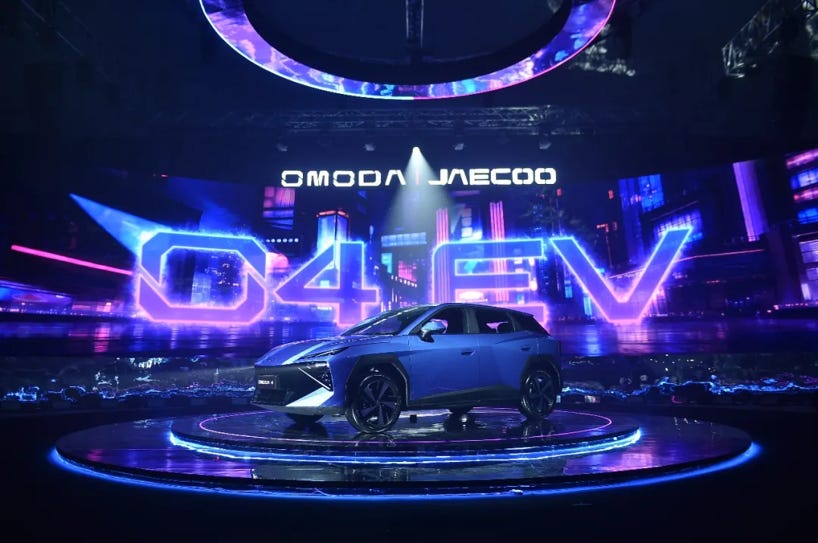
In July, OMODA & JAECOO held a “Super AI Night” event in Indonesia, where it introduced the new OMODA 4 EV together with a next-generation AI cockpit based on Doubao, ByteDance’s large language model.
The system is designed to move beyond conventional voice interaction based on simple commands and responses.
Instead, OMODA & JAECOO says the goal is for the vehicle to understand user intent, coordinate multiple functions, and respond in a way that reflects local language and culture.
Local reporting in Indonesia also confirmed that the production vehicle is designed around 10 integrated AI agents.
The significance of the project is therefore not simply that a Chinese LLM is being installed in a Chinese vehicle and exported abroad.
Chery and Volcano Engine are attempting something more difficult:
taking the large-model-plus-agentic-AI architecture developed in China and making it work in markets with different languages, cultures, habits and infrastructure.
The OMODA 4 AI cockpit supports five languages:
Chinese
English
Indonesian
Thai
Malay
Multilingual capability itself is no longer especially unusual for modern large language models.
What Chery and Volcano Engine emphasize more strongly is localization beyond translation.
The objective is not simply to understand words in another language.
The AI must understand the cultural context in which those words are used.
A simple example is restaurant recommendation.
If a user says:
“I want something spicy.”
A China-centric AI should not simply recommend Sichuan cuisine because that is what it associates most strongly with spicy food.
For an Indonesian user, more appropriate suggestions might include:
spicy Padang-style beef dishes
regional Indonesian cuisine
tom yum in a neighboring Southeast Asian context
The aim is therefore not to build a Chinese AI that speaks Indonesian.
It is to build an AI that behaves appropriately in an Indonesian context.
Language use across Southeast Asia can also be highly fluid.
People frequently mix languages and dialects within everyday conversation.
The presentation highlighted examples such as “kopitiam”, a regional term combining the Malay word “kopi” for coffee with “tiam,” derived from Hokkien.
For an AI system, understanding this kind of expression requires more than direct dictionary translation.
It requires knowledge of:
local linguistic history
slang
mixed-language usage
cultural context
everyday consumer behavior
That gives the localization effort a broader objective.
The system is meant to understand not just what language is being spoken, but how people in that market actually speak.
Another major component is agentic AI.
OMODA 4 uses a Master Agent coordinating 10 specialized AI agents.
These cover areas including:
vehicle control
navigation
entertainment
news
sports
casual conversation
vehicle-related Q&A
AI image generation
personalization
other cockpit functions
Traditional voice assistants typically process commands individually.
A user might say:
“Navigate to the office.”
“Play some music.”
“What is the weather today?”
Each command is treated as a separate task.
OMODA 4 is designed to handle something more complex, such as:
“Take me to the office, play something upbeat, and check whether it is going to rain today.”
The LLM can interpret that single statement as multiple intentions.
The Master Agent then distributes those tasks to the relevant specialized agents, which execute them together.
This is more important than the voice assistant itself.
The LLM is beginning to become a higher-level orchestration layer connecting multiple vehicle functions.
This changes the role of AI inside the car.
Historically, voice systems were another interface alongside buttons and touchscreens.
The user issued a command, and the system called a specific function.
With an agentic architecture, the LLM can sit above multiple vehicle systems.
The interaction increasingly becomes:
user expresses a goal
AI interprets the intention
AI breaks it into tasks
agents coordinate execution
navigation, entertainment and vehicle systems respond together
The LLM is therefore moving from being a question-answering interface toward being an intent-management layer for the vehicle.
That is one of the defining ideas behind what Chinese companies increasingly describe as the AI Vehicle, or AIV.
But cars face a problem that smartphones do not.
A vehicle cannot lose access to essential functions simply because network coverage disappears.
OMODA 4 therefore uses an edge-cloud collaborative architecture.
The cloud handles workloads that require larger-scale computing resources.
Meanwhile, core functions can continue locally in poor or unavailable network conditions.
These include areas such as:
vehicle control
navigation
offline video
offline music
other basic cockpit functions
This architecture is particularly relevant in Southeast Asia.
Network quality can vary substantially between:
major cities
suburban areas
rural regions
islands
different national markets
A system designed only for highly reliable cloud connectivity in China’s largest cities would not necessarily work well across the region.
For that reason, the globalization challenge is not simply:
translate the interface and connect it to the same cloud service.
The technical architecture itself must adapt to different operating environments.
OMODA & JAECOO selected Indonesia as one of the key markets for the global rollout of OMODA 4.
The company describes Indonesia as:
a fast-growing automotive market
a market with high consumer acceptance of new technology
For AI, however, Indonesia also offers something else: complexity.
Southeast Asia combines:
multiple languages
multiple cultures
different religious practices
local expressions and habits
varied consumer behavior
complex traffic environments
highly uneven communications infrastructure
That makes the region a difficult test for an AI cockpit developed primarily in China.
But it also makes it strategically valuable.
If the system can be made to work reliably there, the underlying architecture may become easier to adapt to other international markets.
OMODA & JAECOO says its Super AI Cockpit is designed to be deeply localized around the language habits and lifestyles of each market while remaining scalable and customizable.
This is where the project becomes more significant for Chery’s globalization strategy.
OMODA & JAECOO has already surpassed one million cumulative global sales.
The company is positioning OMODA 4 as a central product in what it calls “Globalization 2.0.”
Its next target is annual sales of one million vehicles by 2027.
Chinese automakers’ overseas expansion has evolved in stages.
The first stage was largely:
develop the vehicle in China
manufacture it in China
export it overseas
The next stage increasingly involved:
local manufacturing
local supply chains
transferring Chinese EV and PHEV technology abroad
Now another layer is being added.
Chinese companies are beginning to export the software and AI architecture itself.
The division of roles is relatively clear.
Chery / OMODA & JAECOO provides:
the vehicle
vehicle integration
manufacturing
overseas sales channels
local market access
Volcano Engine provides:
large language models
agentic AI
cloud infrastructure
AI orchestration
related digital capabilities
Above that common technical foundation, the system can then be adapted market by market around:
language
culture
local content
user habits
regional services
The resulting model is not simply:
translate the Chinese-market vehicle into another language.
It is closer to:
build a common AI platform, then create a local AI layer for each market.
That is a much more scalable globalization strategy if it works.
The project is also important for Volcano Engine.
It provides a practical route for ByteDance’s Doubao ecosystem to move from domestic AI services into real products used outside China.
That has particular significance because Volcano Engine is also involved with SERES in the development of the new AIVA brand, another project with strong international ambitions.
The Chery partnership may therefore become a highly practical proving ground.
Automotive AI is different from AI running on a PC or smartphone.
Inside a vehicle, AI can:
understand speech
infer intention
coordinate multiple software functions
issue commands to navigation
interact with vehicle systems
influence a physical product in real time
The LLM is no longer merely answering questions.
It is becoming an upper-level interface controlling how a physical machine responds.
OMODA 4 can therefore be viewed as an early overseas production example of this transition.
Most of the capabilities announced so far are manufacturer claims and demonstrations.
Their actual quality will need to be tested after the vehicle reaches customers.
Several questions remain particularly important:
How reliably can the system understand conversations mixing multiple languages?
Can 10 agents coordinate without creating conflicts or incorrect actions?
Does cultural localization work in daily use, not just in carefully designed demonstrations?
How well does the system understand local slang and regional expressions?
Can cloud and onboard AI switch naturally when connectivity becomes weak?
How consistently can the same AI architecture be adapted across different Southeast Asian markets?
These are difficult problems.
A multilingual demo is relatively easy.
A reliable production system used every day by thousands of people is much harder.
Even with those uncertainties, the strategic direction is already clear.
Chery and Volcano Engine are not simply trying to export Chinese AI overseas.
They are attempting to take a common Chinese-developed AI architecture and localize it around the culture and daily life of each market.
That represents a new phase in the globalization of China’s automotive industry.
The progression is increasingly:
export vehicles
localize manufacturing
globalize supply chains
export EV and PHEV technology
export software architecture
localize AI itself
For years, Chinese automakers competed internationally mainly through vehicle hardware, cost and manufacturing capability.
The next competition may increasingly involve something less visible:
Who can make an AI developed in China feel genuinely local outside China?
OMODA 4 makes Southeast Asia one of the first major proving grounds for that question.
No posts
Comments
Nothing yet. Say the first thing.
Sign in to join the conversation.