
CATL is moving deeper into the business that begins after a battery has been sold.
On August 10, 2026, CATL’s independent aftermarket brand Ning Service (宁家服务) held its annual brand event in Haikou, Hainan Province.
The company simultaneously opened 10 directly operated experience centers across markets including:
Haikou
Hangzhou
Guangzhou
Hong Kong
Norway
Türkiye
Ning Service has also completed agreements supporting expansion into 100 cities. During the second half of 2026, it plans to progressively establish directly operated experience centers across those markets.
But the more important story is not simply that CATL is opening more EV battery repair locations.
The company is beginning to transfer the battery technology, diagnostics, repair expertise, data capabilities and supply-chain infrastructure developed for automotive applications into other industries.
Ning Service describes the strategy through five areas:
Sea — electric vessels
Land — electric vehicles and battery-swap infrastructure
Air — eVTOL and low-altitude mobility
Intelligence — robots and other smart machines
Energy storage — stationary battery systems
The result could transform CATL from a company that primarily manufactures and supplies batteries into one that manages batteries throughout their operational lives.
Ning Service is not building an after-sales network exclusively for electric vehicles.
On land, it already supports operation and maintenance for a cumulative 1,505 battery-swap stations.
In June 2026, the company also completed after-sales service for its first generation of marine propulsion batteries.
Its expansion is now reaching the air.
Ning Service has become a distributor for Chinese eVTOL manufacturer AutoFlight.
It has also entered a strategic partnership with Galbot, a Chinese robotics company developing general-purpose humanoid and embodied-AI robots.
The pattern is becoming clear.
CATL is attempting to extend its battery service capabilities across:
electric vehicles
battery-swap stations
electric ships
eVTOLs and low-altitude aircraft
robots and intelligent machines
stationary energy-storage systems
As electrification spreads beyond cars, another market expands with it:
Who will maintain all these batteries?
CATL increasingly wants the answer to be CATL itself.
One of the most ambitious applications is the operation and maintenance of stationary battery energy-storage systems.
Ning Service is developing an integrated monitoring network combining:
satellite remote sensing
drones
embodied-AI robots
cloud-based data systems
The company describes this as an “air-ground-cloud” monitoring architecture.
The objective is to move beyond conventional maintenance in which technicians respond after a problem has already occurred.
Instead, data from multiple sources can be used to identify abnormal conditions and predict potential failures in advance.
According to Ning Service, the system can:
reduce operational risk by 90%
reduce operation and maintenance costs by 30%
These are company-stated figures, but they illustrate the direction of the business.
CATL does not simply want to supply the battery hardware.
It wants to commercialize the monitoring, diagnostics, maintenance and repair required throughout the battery’s operational life.
In the automotive business, Ning Service is emphasizing another transition:
from replacing battery packs to repairing them.
The traction battery represents a significant portion of an EV’s total cost.
If a fault leads to replacement of the entire battery pack, repair costs can become extremely high.
At the same time, newer battery structures are becoming more difficult to repair.
CATL’s Cell-to-Pack, or CTP, technology integrates cells directly into the battery pack without conventional intermediate module structures.
This can improve packaging efficiency, but sophisticated integration also requires more advanced repair capabilities.
Ning Service says it has combined CATL’s advanced CTP repair technology with a tiered certification system to create a repair network using:
genuine parts
manufacturer-defined procedures
certified technical capabilities
According to the company, advanced battery repair coverage has now reached 76.8% of vehicle models in its service scope.
For EV owners, this could have important implications.
If battery manufacturers can expand the range of faults that can be repaired rather than requiring complete pack replacement, the long-term cost of EV ownership could fall.
The second major pillar is digitization.
Ning Service has developed its own Eagle Eye System, with more than 150 monitoring checkpoints covering advanced battery-repair procedures.
The system records the battery throughout the repair process, from arrival to final release.
That creates a data trail capable of answering questions such as:
What condition was the battery in when it arrived?
What work was performed?
Which procedures were used?
When was each step completed?
What was the battery’s condition when it left?
Ning Service claims it is the only brand in China’s NEV aftermarket to provide full-process traceability for battery repair.
The implications extend beyond repair quality.
As EVs enter the used-car market, battery condition is likely to become an increasingly important component of vehicle valuation.
But state of health may not be the only relevant information.
A vehicle’s value could also depend on:
whether the battery has previously been repaired
which components were repaired or replaced
who performed the work
whether genuine parts were used
whether manufacturer procedures were followed
In that sense, CATL is beginning to turn battery repair history itself into a data asset.
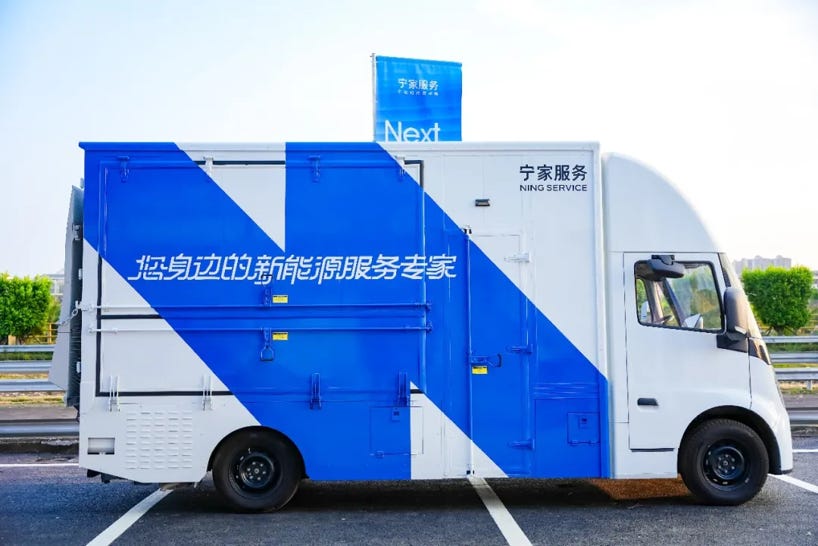
Ning Service also unveiled its first dedicated mobile battery repair vehicle.
The vehicle has a combined driving range of 800 km and provides:
more than 30 inspection functions
more than 50 on-site repair functions
Ning Service says the mobile unit can handle approximately 90% of service requirements, excluding cases requiring advanced repair facilities.
For more difficult failures, the company expects the system to reduce response time from:
72 hours previously
to 48 hours
Ning Service describes the concept as a shift from:
“users looking for service”
to:
“service looking for users.”
The logic makes particular sense for batteries.
Battery packs are large, heavy and difficult to transport. Removing them from vehicles or equipment also adds time and complexity.
Instead of always transporting the battery to the repair capability, CATL is attempting to move part of the repair capability to the battery.
At the same time, Ning Service is expanding its relationship with vehicle owners.
The company announced a RMB 1 billion user subsidy program and introduced inspection and maintenance packages at two broad price levels:
a basic package priced in the RMB 100 range
a PLUS package priced in the RMB 1,000 range
The packages incorporate services such as official repairs and extended warranties while emphasizing genuine parts and manufacturer-standard support.
This is strategically significant.
CATL has traditionally been a company most consumers encountered indirectly.
An automaker selected the battery.
The battery was installed in the vehicle.
The consumer bought the car from the automotive brand.
CATL remained largely behind the vehicle manufacturer.
Ning Service changes that relationship.
Through branded service locations, maintenance products and direct customer interaction, CATL is taking a step from being primarily a B2B battery supplier toward becoming a service brand recognized directly by end users.
The planned network of directly operated centers across 100 cities should be understood in that context.
CATL became one of the world’s largest automotive battery manufacturers by producing batteries at enormous scale.
Ning Service suggests that the company now sees another major opportunity after manufacturing.
The lifecycle could increasingly look like this:
manufacture the battery
install it in a vehicle, ship, aircraft, robot or energy-storage system
monitor its operating condition
analyze its data
predict abnormalities
diagnose failures
repair components rather than automatically replacing the entire system
record the repair history
continue managing the battery through its useful life
If CATL can bring those stages into its own ecosystem, its commercial relationship with a battery no longer ends when that battery leaves the factory.
The strategy also has an important scaling advantage.
CATL’s battery expertise was initially built around automotive electrification.
But batteries are spreading rapidly into other physical systems.
Electric ships need battery maintenance.
eVTOL aircraft need battery monitoring.
Robots need reliable energy systems.
Stationary energy-storage facilities require continuous diagnostics and predictive maintenance.
Many of the underlying competencies can be reused across those industries:
battery diagnostics
state monitoring
failure prediction
repair engineering
parts supply
technician certification
lifecycle data management
That makes Ning Service more than an automotive aftermarket project.
It potentially gives CATL a way to follow electrification into every new physical market it enters.
For years, CATL’s growth story was fundamentally about selling more batteries.
The next phase could increasingly be about managing those batteries for their entire lives.
The expansion of Ning Service into 100 cities is one of the clearest signs yet that CATL is beginning to make that transition.
No posts
Comments
Nothing yet. Say the first thing.
Sign in to join the conversation.