
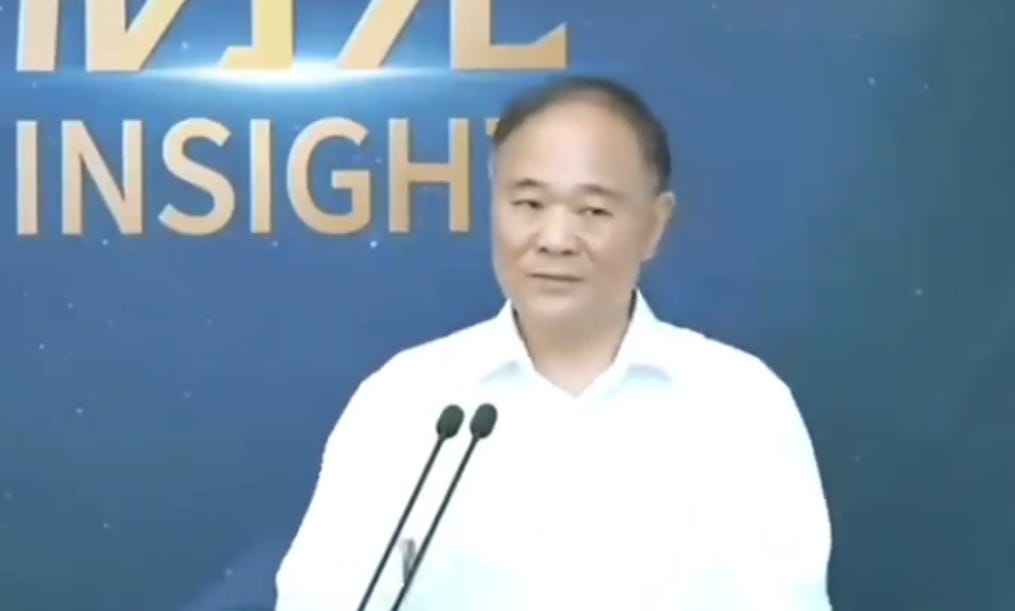
Geely announced on August 17, 2026, a major leadership transition at Geely Automobile Holdings, its Hong Kong-listed automotive company.
Founder Li Shufu will step down as chairman of the board and executive director, effective August 18. An Conghui, a long-serving Geely executive, will become the new chairman.
This is not Li’s retirement from Geely.
Li will become lifetime honorary chairman of Geely Automobile Holdings and remain a major and controlling shareholder. More importantly, he will continue as chairman of Zhejiang Geely Holding Group, the parent group overseeing Geely’s broader automotive and mobility businesses.
The significance of the change is therefore not simply that Li is stepping down.
Geely is beginning to transfer the governance of its core listed automaker from its founder to a professionally managed leadership structure.
That makes the transition relevant far beyond Geely itself. China’s auto industry is full of companies closely identified with powerful founders and individual leaders. Eventually, all of them will face the same question:
Can the company continue to thrive after the individual who built, shaped or personified it steps back?
An Conghui is not a member of Li Shufu’s family.
He is a veteran Geely executive who has spent decades inside the organization. In announcing the transition, Li described An as an outstanding professional executive developed within the Geely system.
That distinction matters.
This is not a succession from:
Li Shufu to another member of the Li family.
Instead, it is:
Li Shufu to An Conghui, a professionally developed internal executive.
At the same time, Li is retaining his position at Zhejiang Geely Holding Group.
The emerging structure can therefore be understood as:
Zhejiang Geely Holding Group: Li Shufu remains chairman.
Geely Automobile Holdings: An Conghui becomes chairman.
Operating management: Professional executives run the listed automaker.
Rather than suddenly removing the founder from the organization, Geely appears to be creating a transitional structure in which the founder remains influential while the listed company learns to operate without his direct chairmanship.
That distinction could prove important.
China has produced an extraordinary number of large private companies since the beginning of the reform and opening-up era.
Yet successful examples of a founder handing management to a non-family professional executive — followed by many years of continued corporate growth — remain surprisingly limited.
One example continues to appear repeatedly in discussions of corporate succession in China even nearly 15 years later:
Midea Group.
The continued relevance of a succession completed in 2012 says something about how unusual successful professional-management transitions remain among major Chinese private enterprises.
In 2012, Midea founder He Xiangjian stepped down as chairman at the age of 70.
He did not choose his son as his management successor.
Instead, leadership passed to Fang Hongbo, a professional executive who had joined Midea in 1992.
He moved toward the controlling-shareholder side of the organization while Fang and a professional management team took responsibility for running the company.
Importantly, the transition had not been improvised shortly before He’s retirement.
Midea had spent roughly a decade developing professional managers and gradually transferring authority. Fang had already become chairman of the listed Midea Electric Appliances in 2009, before taking over leadership at the broader group level in 2012.
The Fang era continues today.
Midea consequently became one of China’s clearest answers to a fundamental question:
Can a major Chinese private enterprise continue growing after its founder relinquishes day-to-day leadership?
The answer in Midea’s case has largely been yes.
But the reverse observation is equally important.
Nearly 15 years after the transition, Midea is still repeatedly cited as a benchmark for founder-to-professional-manager succession in China.
If such transitions were routine, a 2012 case would hardly remain such an important reference point in 2026.
One explanation is simply history.
China launched its reform and opening-up policy in 1978. Many of today’s largest private companies were founded or began their rapid expansion during the 1980s and 1990s.
As a result, many enormous Chinese corporations have remarkably little experience with management succession.
In mature corporate systems, a company may already have experienced:
Founder
Second-generation management
Third-generation management
Multiple subsequent CEOs
Many Chinese private companies are still confronting a much more basic sequence:
Founder
Who comes next?
This is not simply a question of finding another CEO.
In many Chinese private companies, the founder can be closely connected to ownership, management authority, personnel decisions, corporate culture, branding, external relationships and even the public identity of the company itself.
Replacing that person is therefore fundamentally different from replacing a professional CEO.
The fact that Midea prepared for its transition for years illustrates how difficult institutionalizing a founder-led organization can be.
The issue becomes particularly striking when viewed through China’s automotive industry.
Many of its most important private automakers remain strongly associated with individual leaders:
Geely: Li Shufu
BYD: Wang Chuanfu
Great Wall Motor: Wei Jianjun
Chery: Yin Tongyue
NIO: William Li (Li Bin)
Li Auto: Li Xiang
XPeng: He Xiaopeng
The phenomenon extends beyond traditional automakers.
At Xiaomi, founder Lei Jun remains extraordinarily visible across product development, product launches and marketing, including Xiaomi’s automotive business.
Huawei presents a somewhat different case. Richard Yu (Yu Chengdong) is not Huawei’s founder, but he has become closely identified with the company’s automotive business and particularly HIMA — the Harmony Intelligent Mobility Alliance, Huawei’s multi-brand automotive collaboration ecosystem.
In all these cases, separating the company or automotive business completely from the individual leader remains difficult.
This should not automatically be regarded as a weakness.
Powerful founders and highly influential executives have been one reason Chinese automakers can move so quickly.
A strong individual leader can:
Define product philosophy.
Make rapid strategic decisions.
Mobilize the organization.
Resolve internal conflicts.
Communicate directly with consumers.
Personally embody the brand.
That structure can be exceptionally effective during periods of rapid growth and technological disruption.
China’s EV and intelligent-vehicle industry has provided numerous examples.
But companies hoping to survive for 30, 50 or 100 years cannot depend indefinitely on one individual.
Eventually, the industry will have to contemplate:
Li Auto without Li Xiang.
NIO without William Li.
XPeng without He Xiaopeng.
Xiaomi’s automotive business without Lei Jun.
Huawei faces a different version of the same question.
Yu Chengdong is a professional executive rather than a founder, but his personal presence has become unusually important to Huawei’s automotive business. At some point, Huawei will also have to demonstrate that the institutional strength and consumer appeal of that business can persist without depending so heavily on one highly recognizable executive.
This is why Geely’s latest leadership change deserves attention.
Li Shufu is not disappearing from the organization.
He remains chairman of Zhejiang Geely Holding Group while handing the chairmanship of the listed Geely Automobile Holdings to An Conghui.
In effect, Geely has an opportunity to test whether its core listed automotive company can operate under professional leadership while its founder remains available at the group level.
There is an interesting parallel with Midea.
Midea did not move from He Xiangjian to Fang Hongbo overnight. Professional management was developed over time, authority was gradually transferred, and the listed company became an early stage of the transition before the broader succession was completed.
Geely’s structure is not identical, but the philosophy appears similar:
Build an organization capable of operating without direct founder management before the founder completely steps away.
That interpretation is also consistent with the language surrounding Geely’s announcement.
Li framed the transition in terms of a modern corporate governance system and strengthening “One Geely” — the group’s broader effort to simplify and integrate a sprawling collection of brands, businesses and organizational structures.
The change should therefore not be reduced to Li’s age or treated simply as a retirement announcement.
China’s auto industry has spent decades demonstrating that founder-led companies can grow extraordinarily quickly.
Its next challenge is different.
The question is shifting from:
Can an entrepreneur build a great automaker?
to:
Can that automaker remain great without its entrepreneur?
Those require different organizational capabilities.
And China still has relatively few long-running examples of major private companies successfully completing the transition from founder leadership to professional management.
That is precisely why Midea’s 2012 succession remains so relevant in 2026.
China’s automotive industry is now approaching the same test.
The first generation of major private automakers will face it first. China’s younger EV companies will follow later. Xiaomi’s automotive operation and Huawei’s automotive ecosystem will encounter their own versions of the same challenge.
The timing will differ, but the underlying question will not.
Li Shufu’s transfer of the Geely Automobile chairmanship to An Conghui is therefore about more than one executive appointment.
It is an early experiment in whether one of China’s largest founder-built automotive groups can institutionalize the capabilities that were previously concentrated around its founder.
Geely’s new structure may succeed. It may encounter difficulties. The outcome cannot yet be known.
But if the transition works, Geely could become for China’s auto industry what Midea became for the broader private sector: a reference model for turning a founder-built company into an institution capable of outliving its founder.
Ten or 20 years from now, when today’s younger Chinese automotive companies confront their own succession questions, Geely’s experience may be one of the cases they study most closely.
No posts
Comments
Nothing yet. Say the first thing.
Sign in to join the conversation.