
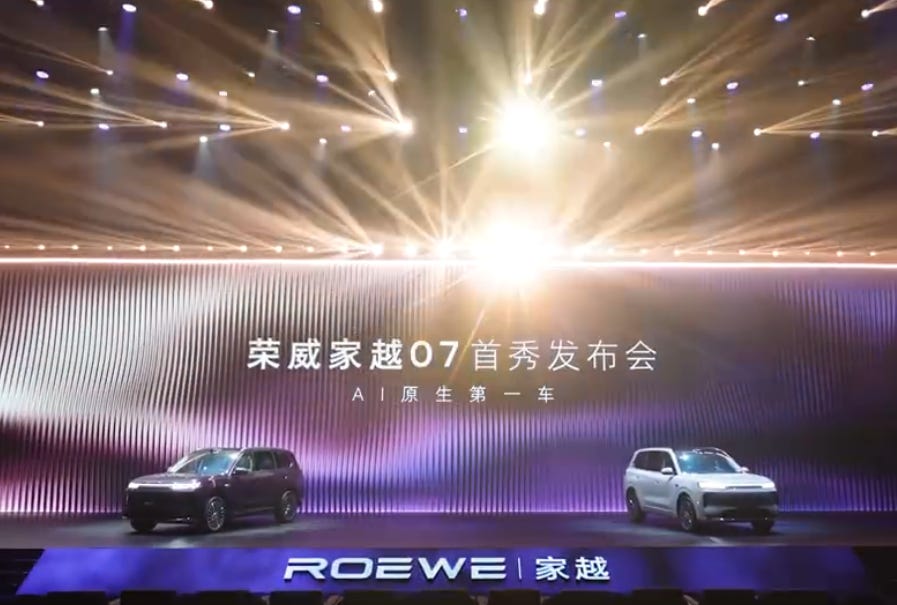
SAIC Motor’s Roewe brand unveiled the production version of the Jiayue 07 on August 13, 2026. The five-seat midsize SUV is the first production model in Roewe’s new Jiayue family.
The Jiayue series was announced on April 21 at Roewe’s 20th-anniversary event. Developed with ByteDance-owned Volcano Engine, the program was introduced under an “AI go first” philosophy.
The idea was not to build a conventional vehicle and then add AI features. Instead, Roewe and Volcano Engine said they would first define the AI-enabled user experience and then design the vehicle around it.
In other words, the Jiayue series was conceived as an AI-native car.
Four months later, however, the production Jiayue 07 reveals something more interesting.
Roewe still talks about AI. But when it came time to explain why families should actually buy the vehicle, much of the presentation shifted toward familiar and highly tangible values: space, comfortable seats, a refrigerator, a large rear display, long range and advanced driver assistance.
That gap between the original AI-native concept and the production vehicle’s consumer proposition may point to the next phase of China’s automotive AI race.
When Roewe announced the Jiayue series in April, it described the project as an industry-first AI-native vehicle family developed with Volcano Engine.
The two companies established a joint team from the product-planning stage and said they would jointly define:
User interaction
AI platforms
Intelligent cockpit functions
Vehicle-cloud integration
At the center is an AI-native architecture called CPP.
Roewe describes its main elements as:
Context: Collects information from inside and outside the vehicle and supports long-term memory.
Planner: Handles analysis, planning and decision-making.
Pixel-level function calling: Executes specific vehicle functions at a highly granular level.
Roewe says it has also prepared more than 2,000 service-oriented architecture, or SOA, interfaces, allowing large AI models to interact directly with physical vehicle functions.
The conceptual sequence is therefore reversed.
The traditional approach is:
Build the car.
Add software.
Add AI.
The AI-native approach is:
Define the desired AI experience.
Determine what software and physical capabilities are required.
Build the vehicle around that experience.
This thinking overlaps with the rapidly expanding discussion in China around AI-native vehicles, Physical AI and embodied AI.
Roewe reiterated the AI-native concept at the beginning of the August 13 Jiayue 07 presentation.
What followed, however, was largely a presentation about building a better family car.
The Jiayue 07 is a large five-seat SUV measuring roughly 5 meters in length with a wheelbase of about 3 meters.
Its practical features include:
834 liters of standard cargo capacity
81 liters of additional underfloor storage
915 liters of combined storage capacity
An approximately 2.3-meter flat space with the rear seats folded
Roewe organized the vehicle’s design philosophy around three Chinese concepts:
安全感 — a sense of security
松弛感 — a sense of ease and relaxation
生命力 — vitality and adaptability
The interesting part is how Roewe defines the family itself.
Rather than presenting the advertising cliché of a perfectly happy family smiling together during a road trip, Roewe describes real family travel as inherently messy.
Before departure, someone cannot find the keys. A child refuses to sit in the middle seat. An older passenger asks the driver to slow down. Then the navigation system announces another traffic jam.
The family is not a perfectly organized unit. It is noisy, constantly changing and full of small conflicts and unexpected needs.
Roewe therefore interprets its three concepts through physical space:
Security means having enough room.
Relaxation means creating a welcoming space.
Vitality means creating a space that can change with the family.
Viewed this way, the Jiayue 07’s product philosophy is almost more about the reality of Chinese family life than about AI.
The actual equipment makes the shift even clearer.
The Jiayue 07 embraces what Chinese consumers often call the “refrigerator, TV and sofa” formula — shorthand for the comfort-oriented equipment that has become common in premium Chinese NEVs.
The vehicle includes:
Zero-gravity functions for both front seats
16-point seat massage
Rear seats with electric reclining up to 143 degrees
A 2.5K rear entertainment display
A 20-speaker audio system
Ambient lighting
Its refrigerator was jointly developed with Chinese appliance giant Midea.
The 7.5-liter unit operates from -6°C to 50°C and adds sterilization, frost prevention and even ice-making capability.
Roewe itself acknowledged during the presentation that refrigerators are now available in many Chinese vehicles.
Its answer was therefore not simply to install one, but to add more functions based on specific family-use scenarios.
That distinction is revealing.
The question is no longer whether a car has a refrigerator. The question is whether one manufacturer can make its refrigerator more useful than everybody else’s.
Strip away the AI-native terminology one layer at a time and the Jiayue 07 ultimately presents a familiar package:
Large cabin
Five-seat layout
Comfortable seats
Refrigerator
Large displays
Long-range REEV powertrain
Advanced driver assistance
Family-oriented design
There is a reason this formula feels familiar.
It closely resembles the product strategy that Li Auto has spent years developing.
Li Auto built its identity around the idea of creating a “mobile home” for Chinese families. Large SUVs, range-extender powertrains, spacious interiors, refrigerators, large displays, comfortable seats and increasingly sophisticated driver assistance became parts of a coherent product formula.
Many of those features have since become mainstream across China’s NEV industry.
The Jiayue 07 follows much of the same logic.
The Jiayue 07 uses a range-extender electric vehicle, or REEV, powertrain.
Roewe describes the usage pattern simply:
Drive electrically during weekday commuting.
Use the extended total range for long weekend trips.
The company claims:
320 km of battery-electric range
1,480 km of combined range
Toward the end of its presentation, Roewe itself brought up the Li Auto L6 as a comparison.
That makes the underlying competitive problem difficult to ignore.
The Jiayue series was introduced through a new AI-native narrative. Yet once the production vehicle appears, much of its core product proposition resembles the family-oriented formula Li Auto has already established.
The Jiayue 07 can therefore be interpreted as an attempt to reconstruct a familiar Chinese family-NEV formula around a new AI-native architecture.
That is not necessarily a problem technologically.
Commercially, however, it creates a difficult starting point.
The Jiayue 07 is not lacking in sophisticated technology.
In addition to Volcano Engine, Roewe has brought in Momenta for advanced driver assistance.
The Jiayue 07 is the first vehicle jointly developed by Roewe and Momenta and uses the latest Momenta R7 world model.
SAIC is also a strategic investor in Momenta.
Roewe says the system was not simply transplanted into the vehicle as an off-the-shelf solution. The two companies worked together across the vehicle and cloud stack.
The architecture combines:
Momenta’s R7 world model
The X7 chip for large-model processing
Joint vehicle-cloud development
R7 is presented as a form of Physical AI capable of understanding physical properties, causal relationships in object movement and potential interactions, then predicting what may happen next before making driving decisions.
Parking functions are also designed for practical scenarios such as:
Narrow parking spaces
Parking while the driver is outside the vehicle
Custom parking positions
The technology stack can therefore be simplified as:
Volcano Engine: AI cockpit and AI agents
Momenta: Advanced driver assistance and Physical AI
SAIC/Roewe: Vehicle engineering, REEV system, chassis, battery, motor and control systems
On paper, it is an impressive combination.
It also reveals the next problem.
Volcano Engine is not exclusive to Roewe.
Momenta is not exclusive to Roewe either.
Both are expanding across multiple Chinese automotive manufacturers and brands.
As large models, world models, AI agents, long-term memory and multimodal perception spread throughout the industry, simply describing a vehicle as “AI-native” will become less meaningful as a differentiator.
The technologies may make every vehicle better.
But they do not necessarily answer a consumer’s most important question:
Why should I buy this brand’s car?
This is particularly important when suppliers provide increasingly capable technology to multiple competing automakers.
If several brands use similar AI foundations, the differentiation has to come from somewhere else.
Huawei provides a useful contrast.
The company has established recognizable automotive technology brands such as Qiankun ADS for assisted driving and HarmonySpace for the intelligent cockpit.
Chinese consumers can therefore develop a relatively straightforward perception:
“Huawei assisted driving”
“Huawei cockpit”
Volcano Engine and Momenta face a somewhat different situation.
As their technologies spread across multiple automakers, they can raise the technological baseline of the entire market without necessarily creating a unique reason to buy one particular vehicle.
For the automaker, this can become uncomfortable.
The better the common technology becomes, the more important the remaining differences become:
Design
Packaging
Chassis
Brand
Service
Pricing
Ownership experience
The Jiayue 07 may confront this issue unusually early.
There is also a more fundamental question:
Do consumers actually want to buy AI?
Probably not.
Consider the Jiayue 07’s personalized cockpit.
Its family account and long-term memory functions can recognize individual users and restore their preferred seat positions and other settings.
Roewe describes this as a personalized family cockpit capable of adapting to different individuals.
But the consumer does not necessarily care whether this is achieved through:
AI
A large language model
Long-term memory architecture
Conventional rule-based software
What matters is much simpler:
I get into the car and it already knows how I like it.
The refrigerator illustrates the same point.
The consumer probably cares less about whether AI controls the appliance than whether:
Drinks stay cold in summer.
Food can stay warm in winter.
A baby bottle can be kept hygienic.
The refrigerator can make ice when needed.
Driver assistance is no different.
“World model” may be technologically important.
But for the driver, “it can reliably park in that difficult space” is much easier to understand.
AI is the means.
It is not necessarily the product.
This leads to a broader hypothesis.
Chinese automakers may eventually start talking less, not more, about AI.
Today the industry is saturated with terms such as:
Generative AI
Large models
World models
Physical AI
Embodied AI
AI-native vehicles
That language makes sense while the technology remains new and differentiating.
But once almost every competitive vehicle incorporates AI, the term itself loses much of its commercial value.
Automotive connectivity followed a similar path.
There was a period when terms such as “internet car” and “connected car” were powerful marketing messages in China.
Today, connectivity is simply expected.
Automakers rarely need to explain that a modern Chinese NEV can connect to the internet.
AI could follow the same trajectory.
Li Auto itself offers an interesting example.
The company has strongly promoted AI and has experimented with concepts extending toward embodied intelligence.
Yet its recent consumer-facing product communication increasingly emphasizes what the technology actually does for driving, family life and comfort rather than requiring consumers to understand the underlying AI terminology.
That makes sense.
Consumers do not buy a vehicle because it satisfies a particular academic definition of embodied AI.
They buy it because it is:
Convenient
Comfortable
Safe
Easy to drive
Suitable for their family
Better than the alternatives
The more mature automotive AI becomes, the less consumers may need to hear the word AI.
That leaves Roewe with a difficult question.
If the words “AI-native” are removed, what remains?
The answer is:
A spacious five-seat SUV
A range-extender powertrain
320 km of battery-electric range
A refrigerator
Large displays
Zero-gravity seats
Family-oriented comfort
Advanced driver assistance
Personalized cabin functions
In other words, much of what remains is already familiar from Li Auto and the broader Chinese family-NEV market.
That does not mean the Jiayue 07 is a weak product.
It means Roewe needs to answer a harder question than whether its AI technology is advanced:
Why should a Chinese family choose Jiayue instead of Li Auto?
Price can provide one answer.
But relying on price alone is dangerous.
China’s auto market is full of brands that successfully reproduced the visible attributes of a winning product formula but struggled to reproduce the reason consumers originally chose the leader.
If the underlying product proposition is not sufficiently differentiated, competition eventually collapses toward price.
The Jiayue 07 therefore represents something larger than one new Roewe SUV.
It shows where China’s AI-defined vehicle race may be heading next.
The first phase was:
Who has AI?
The second is becoming:
Whose AI is better?
But the more important third phase may be:
When everybody has good AI, why should consumers choose your car?
That is the question facing Roewe.
Volcano Engine can provide sophisticated AI. Momenta can provide sophisticated assisted driving. SAIC can provide the vehicle engineering.
But suppliers cannot ultimately create Roewe’s brand identity for it.
Four months after the Jiayue series was introduced as an AI-native vehicle family, the production Jiayue 07 already suggests that AI itself may be disappearing into the background.
If that happens, it will not mean AI failed.
It may mean exactly the opposite.
AI will have become so fundamental to the automobile that consumers no longer need to be told it is there.
And at that point, the competitive question returns to an old one:
What makes this particular car worth buying?
No posts
Comments
Nothing yet. Say the first thing.
Sign in to join the conversation.