
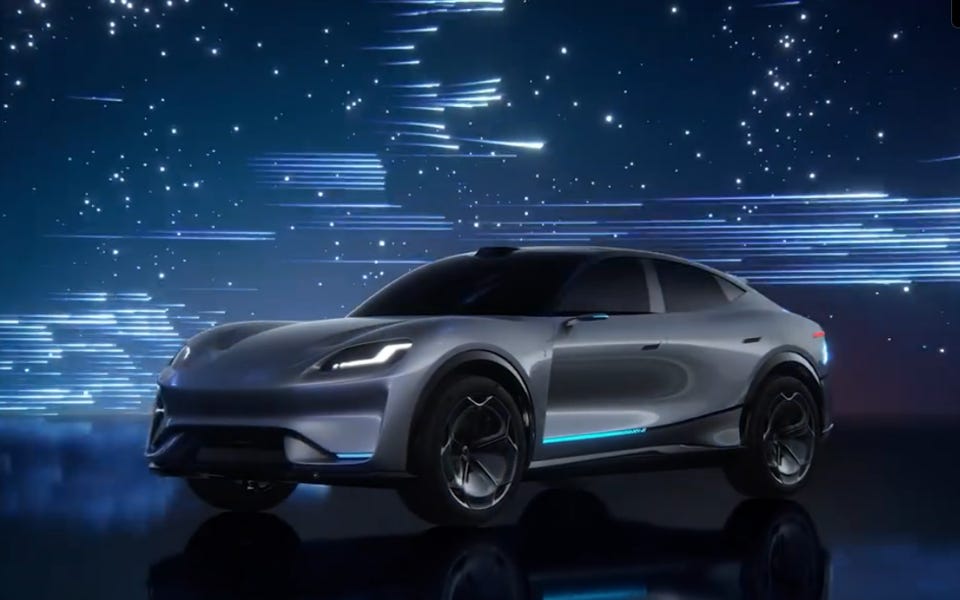
On August 15, 2026, AIVA, the AI Vehicle brand developed by SAITOU Technology under Chinese automaker SERES, released a new video explaining the design philosophy behind the AIVA Origin Concept.
AIVA has repeatedly described its approach with two core ideas: “AI defines the vehicle” and “AI first, car second.”
The concept reverses the conventional development process. Instead of building a vehicle and then adding AI features, AIVA starts by asking what an AI should be able to do for the user. It then works backward to determine the sensors, computing power, climate controls, seats, lighting, navigation systems and other vehicle functions required to deliver that experience.
In other words, the vehicle is designed outward from the AI.
The basic philosophy in the latest video is not new. What makes the Origin Concept significant is that AIVA is now applying the same logic to the physical form of the vehicle itself.
At the beginning of the video, an AIVA designer says the team repeatedly asked a fundamental question while developing the Origin Concept:
What exactly is an AI Vehicle?
AIVA contrasts AI Vehicles with conventional smart devices.
Traditionally, product managers identify user needs and define a product, while engineers write the software required to deliver predetermined functions. The resulting intelligence therefore operates within fixed rules and functional boundaries.
Users, in turn, must learn how the product works and adapt their behavior to it.
AIVA argues that general-purpose capabilities enabled by large AI models fundamentally change this relationship.
Rather than merely executing predefined code, AI can observe its surroundings, learn, adapt and respond dynamically. AIVA ultimately expects such systems to understand a user’s situation and emotional state and proactively provide assistance.
This part largely repeats AIVA’s previously stated vision of an AI-native vehicle that can develop into something closer to an AI companion.
AIVA is working with Volcano Engine, ByteDance’s cloud and AI platform, and its vision is expected to make use of capabilities associated with ByteDance’s Doubao large language model ecosystem.
The more important part of the new video comes next.
AIVA says an AI Vehicle should not simply be transportation. It should become a new kind of intelligent life form.
That premise leads to a much more radical design question: If the AI is a form of intelligence with a physical body, should the vehicle itself still be designed according to conventional automotive logic?
AIVA’s answer is no.
The design hierarchy behind the Origin Concept is unusually explicit.
AIVA describes the large AI model as the vehicle’s “soul.”
From that starting point, it builds a comprehensive perception network. The physical vehicle then becomes the body through which that intelligence exists and interacts with the real world.
The basic structure can be summarized as:
Large AI model: the soul
Perception network: the senses
Vehicle: the physical body
AIVA describes the Origin Concept as an attempt to move AI from virtual computing into a physical artificial-intelligence entity.
This is an important progression from the company’s previous messaging.
AIVA has already argued that a vehicle should be created as a body for AI. With the Origin Concept, that idea is no longer merely a metaphor for software architecture or product development.
It becomes a physical design principle.
To create that body, AIVA turned to biomechanics and the evolution of natural life.
If AI is defined as an intelligent life form, AIVA argues, its physical body should not simply be approached as a conventional industrial product.
The company says it used the large AI model as the “soul” and reconstructed the overall vehicle design through biomechanics, referring to the evolution of natural organisms when developing everything from major body lines and contours to detailed surface textures.
An international designer appearing in the video explains that the team studied how biological forms change and evolve, extracting characteristics including movement, stability and lightness.
Natural organisms are not static finished products. They move, maintain balance, adapt to their environments and evolve toward forms that are increasingly efficient for their circumstances.
The flowing surfaces of the Origin Concept are intended to reflect this sense of continuous movement and adaptation.
This also makes AIVA’s approach somewhat different from straightforward automotive biomimicry.
The objective is not simply to copy the appearance of an animal or plant.
Instead, AIVA is attempting to incorporate the principles through which living organisms acquire and evolve their physical forms into automotive design.
The front lighting provides one of the clearest examples.
AIVA does not treat the Origin Concept’s lights merely as devices for illuminating the road.
In the video, the vehicle reacts as a person approaches, creating the impression that it senses the individual’s presence and responds naturally.
AIVA describes the two lights as a pair of animated or expressive “eyes.”
Their conceptual role therefore changes from:
a device that illuminates the road
to:
the eyes through which an AI life form perceives and responds to a human
AIVA says this interaction is intended to establish a new form of emotional connection between the person and the vehicle.
Automotive designers have long used headlights to give vehicles human- or animal-like faces. What makes AIVA’s interpretation different is the attempt to connect that visual expression with AI perception, recognition and response.
The “eyes” are not supposed to merely look alive. The vehicle is supposed to behave as though it is perceiving the person in front of it.
The wheels provide another example of the same philosophy.
AIVA says their structure was inspired by the wishbone, the Y-shaped bone found in birds and derived from the fusion of the clavicles.
The stable Y-shaped structure is intended to combine structural stability with a sense of biological lightness and movement.
AIVA also compares the low-drag wheel covers to thin biological membranes.
The idea is to use a structure that appears extremely thin but retains sufficient strength while managing aerodynamic drag and airflow disturbance.
Again, AIVA is attempting to provide a biological rationale for the form.
The argument is not simply:
“This shape looks futuristic.”
Instead, it is:
“If this vehicle is the body of an AI life form, its physical structures should draw on solutions that evolved in nature.”
The Origin Concept therefore gives AIVA’s broader strategy a new dimension.
Chinese automakers are rapidly adopting large AI models, AI agents, AI cockpits and concepts such as Physical AI. But much of the industry’s discussion still centers on one question:
What can AI do inside a car?
AIVA is beginning to ask a different one:
If the vehicle is created from AI outward, what should that vehicle physically look like?
The progression can be viewed in three stages.
Conventional approach: Design the vehicle → Add AI
AIVA’s earlier AI-native approach: Define the AI experience → Work backward to determine the required vehicle capabilities
Origin Concept: Define AI as an intelligent life form → Design a physical body appropriate for that intelligence
Under this logic, the large AI model becomes the soul, the perception network and sensors become sensory organs, the lights become eyes, and the vehicle structure becomes a body informed by biological evolution.
The important point is not whether those metaphors are scientifically precise. They reveal how AIVA wants its development process to differ from the conventional smart-car model.
The Origin Concept remains a concept vehicle.
There is no guarantee that its biological surfaces and unusual structures will transfer directly to AIVA’s future production models. Manufacturing cost, crash safety, repairability, aerodynamics, packaging and other engineering requirements will inevitably impose constraints.
But the concept raises a larger question for the emerging AI Vehicle industry.
If “AI first, car second” is genuinely the starting point for vehicle development rather than simply a branding slogan, its influence should eventually extend beyond software and the cockpit.
It should affect the physical vehicle as well.
That is what AIVA is now attempting to demonstrate.
An AI-native car could simply mean a conventional vehicle equipped with far more capable artificial intelligence.
Or it could mean something more fundamental: a vehicle whose functions, architecture, interaction model and eventually even physical form are derived from the AI itself.
With the Origin Concept, AIVA has made its position increasingly clear.
“AI first, car second” has now reached the design studio.
No posts
Comments
Nothing yet. Say the first thing.
Sign in to join the conversation.