
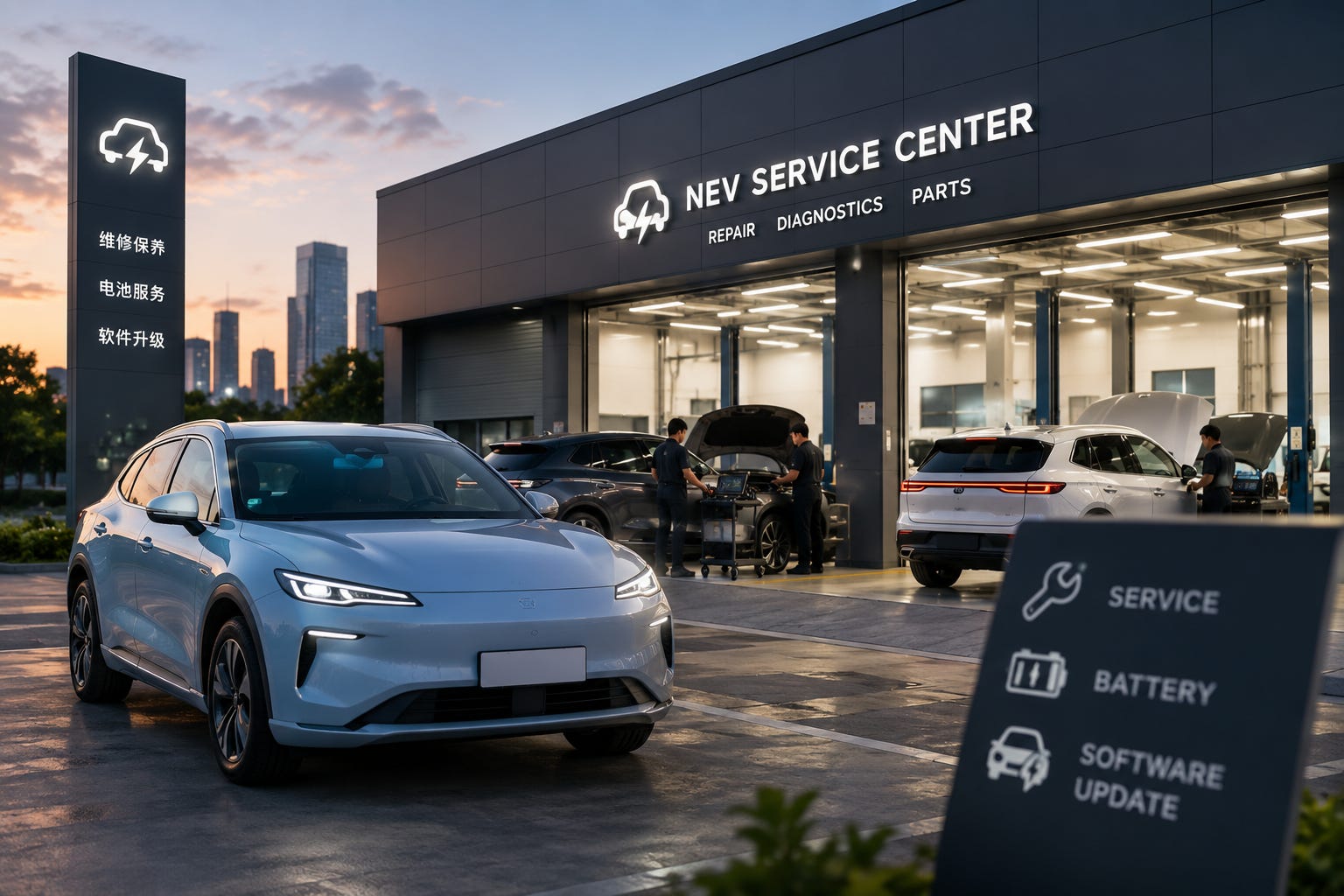
China’s new-energy vehicle market has spent years competing on price, range, technology and equipment.
The next battleground may be much less glamorous: what happens after the car is sold.
On August 10, 2026, Chinese automotive research company LandRoads released its 2026 H1 NEV Brand After-Sales Service Capability Survey.
The study covered:
32 automotive brands
4,346 NEV owners
respondents who had visited a dealership or service location within the previous six months
The industry average score was 78.33 points, down 1.41 points from the second half of 2025.
The leading brands were:
NIO: 87.38
AITO: 86.67
Li Auto: 85.01
Tesla: 84.59
ZEEKR: 84.25
Xiaomi: 83.75
Those results are not especially surprising.
NIO, AITO and Li Auto have generally competed in relatively high price segments and have treated the relationship with owners after delivery as part of their brand proposition.
NIO, in particular, has built an ecosystem combining service locations, owner communities, loyalty points and its own e-commerce operations.
The more important question is not why these brands rank highly.
It is whether brands experiencing extremely rapid sales growth can expand their after-sales capabilities fast enough to support the equally rapid increase in vehicles already on the road.
One of the clearest examples is Leapmotor.
Leapmotor scored 76.81 points, ranking 19th among the 32 brands.
That was:
1.52 points below the industry average
three positions lower than in the previous survey
This does not, by itself, prove that Leapmotor has poor after-sales service.
The more relevant issue is the score’s relationship with the company’s rapid growth.
Leapmotor has become one of the fastest-growing brands in China’s NEV market.
Its core competitive advantage is easy for consumers to understand:
a lot of car for the money.
Its vehicles often deliver equipment, space and technology that would previously have required a much higher purchase price.
But rapid sales growth creates another problem for an automaker.
Every car sold today becomes an after-sales service obligation tomorrow.
A surge in deliveries means a corresponding increase in:
maintenance demand
repairs
parts logistics
technical support
software troubleshooting
battery-related service
customer communication
If vehicle sales expand faster than the service infrastructure supporting them, pressure inevitably builds.
This creates a simple but difficult structural problem.
Rapid sales growth leads to:
a larger vehicle population
more maintenance and repair demand
heavier workloads for service centers
greater staffing requirements
longer waiting times if capacity does not keep pace
greater risk of inconsistent explanations or repair quality
Eventually, those pressures can show up in owner satisfaction.
LandRoads’ latest results suggest that this may already be happening across China’s NEV industry as a whole.
Compared with the second half of 2025:
overall after-sales evaluation fell 1.41 points
dealership revisit experience fell 0.72 points
perceived technical quality fell 1.06 points
satisfaction with service benefits fell 2.17 points
support for official channels and products fell 1.70 points
The issue is therefore broader than any single brand.
China’s NEV market may be entering what could be described as a battle against the installed base.
Selling hundreds of thousands of cars is one challenge.
Supporting those same cars for years afterward is another.
One of the most interesting findings concerns the difference between centralized digital capabilities and dealership-level human service.
LandRoads found that capabilities such as remote diagnostics, which can be centrally managed and standardized by manufacturers, remained relatively stable or improved.
By contrast, areas that depend heavily on people at individual service locations deteriorated more clearly.
These included:
technical explanations
pricing explanations
service duration
owner benefits and service privileges
This suggests an important imbalance.
The digital side of after-sales service is scaling.
The human side may not be scaling as quickly.
That matters especially for rapidly growing brands.
An automaker can distribute software updates to hundreds of thousands of vehicles almost instantly.
It cannot train hundreds of experienced technicians, build new service locations and develop local operational quality at the same speed.
For Leapmotor, the biggest risk is not the number 19 itself.
The real risk would be a lasting change in how consumers describe the brand.
Today, one of Leapmotor’s strongest perceptions can be summarized as:
“It is inexpensive, but the car itself is surprisingly good.”
If weaker after-sales evaluations persist, that perception could gradually become:
“It is inexpensive, but ownership may be difficult after purchase.”
Those two statements may sound similar.
For a car brand, they are fundamentally different.
The first supports value perception.
The second introduces risk perception.
And risk can undermine the purchasing advantage created by a low price.
This matters because cars remain in use for many years.
The relationship between an NEV owner and the manufacturer can be particularly long and complex because ownership increasingly involves:
OTA software updates
ADAS functions
traction batteries
vehicle operating systems
electronic control systems
connected services
cloud-based diagnostics
Even if the initial purchase price is attractive, consumers may begin asking different questions:
How long will repairs take?
Will replacement parts be available quickly?
Are there enough service centers?
What happens if the battery or electronics fail?
Will the manufacturer still provide support several years later?
A low purchase price is experienced once.
After-sales service is experienced repeatedly throughout ownership.
That difference becomes increasingly important as China’s NEV market matures.
BYD ranked 10th with 81.47 points.
Leapmotor ranked 19th with 76.81 points.
The gap between them was 4.66 points.
The two companies differ in size, sales networks, product mix and owner demographics, so the comparison should not be interpreted too literally.
But it illustrates the strategic challenge facing fast-growing companies such as Leapmotor.
As they expand, they must eventually compete not only on vehicle price and specifications, but also on something less visible:
confidence after purchase.
That is an area where larger and more established manufacturers may have structural advantages.
This question becomes even more important because differences between vehicles themselves are narrowing rapidly in China.
Within the same price segment, buyers increasingly encounter similar combinations of:
competitive driving range
large displays
ADAS
connected infotainment
comfort features
fast charging
As the hardware and feature gap narrows, post-purchase experience becomes a more meaningful differentiator.
A manufacturer may win a customer with specifications.
It may retain that customer through service.
Leapmotor was not the only brand below the 78.33-point industry average.
Other brands below the benchmark included:
IM Motors: 77.82
SAIC Volkswagen: 77.62
Deepal: 77.27
FAW-Volkswagen: 76.92
Further down the ranking were:
Lynk & Co
GAC Trumpchi
Geely Galaxy
Arcfox
GAC AION
AVATR
Roewe
Great Wall Motor
Buick
Dongfeng eπ
Chery
Wuling
This is why the survey should not be interpreted as a story about Leapmotor alone.
The larger issue is that China’s NEV industry may be entering a new phase.
The first phase was about expanding sales.
The next is about supporting the massive vehicle population created by that expansion.
The survey points to another important development.
As Chinese automakers attempt to reduce costs, consumers appear to be noticing the effects in after-sales service as well.
LandRoads reported weaker scores for areas including:
equipment and amenities in customer waiting areas
technical explanations
service duration
owner benefits
Satisfaction with service-related benefits fell by 2.17 points.
More than 20 of the 32 surveyed brands declined in this category.
That suggests that cost reduction in China’s auto industry is not limited to vehicle manufacturing.
It may also be reaching the post-sale customer experience.
This creates an increasingly difficult equation for manufacturers:
reduce vehicle prices
increase sales volume
support a rapidly expanding vehicle population
control service costs
maintain customer satisfaction
The faster a brand grows, the harder that equation can become.
For that reason, Leapmotor’s current score of 76.81 should not be treated as a final judgment.
What matters is the trend.
If Leapmotor continues to expand sales while its after-sales score improves, that would suggest its service network is successfully catching up with growth.
If sales continue rising while the score falls from 76.81 to 75 and then 73, the interpretation would be very different.
At that point, the issue would no longer be a customer-satisfaction ranking.
It would raise a more fundamental question:
Can the operating infrastructure behind the brand grow as quickly as vehicle sales?
If the answer is no for long enough, the weakness could eventually damage the very advantage that helped drive growth in the first place: being affordable and easy to buy.
Until now, competition in China’s NEV market has focused heavily on:
launch speed
price
driving range
smart cockpits
ADAS
charging
new technology
As the market matures and the NEV vehicle population accumulates, the competitive conditions change.
The industry must increasingly answer much less glamorous questions:
Who repairs all these cars?
How quickly can they be repaired?
How efficiently can spare parts be delivered?
What happens when OTA cannot solve the problem?
Can owners trust the manufacturer and service network several years after purchase?
These capabilities rarely attract attention at a product launch.
But they can determine whether customers return to the same brand.
There is little surprise in seeing NIO, AITO and Li Auto near the top of the LandRoads ranking.
The more important development will be what happens to brands whose sales are expanding fastest.
China’s next NEV competition will not be determined only by how cheaply a manufacturer can sell a car, or how many cars it can deliver.
It will increasingly depend on whether that manufacturer can continue supporting the hundreds of thousands—and eventually millions—of owners created by its own growth.
The price war brought customers through the door.
The next battle starts after delivery.
No posts
Comments
Nothing yet. Say the first thing.
Sign in to join the conversation.