
Shaojie Bai, Seunghyeon Seo, Yida Wang, Chenghui Li, Owen Wang, Te-Li Wang, Tianyang Ma, Jason Saragih, Shih-En Wei, Nojun Kwak, Hyung Jun Kim
1Meta Reality LabsUSA
2Seoul National UniversityRepublic of Korea
🚧 Project: https://shawn615.github.io/genhmc/
📄 Paper: https://arxiv.org/pdf/2507.05620
💻 Code: N/A
❌ ArXiv: https://arxiv.org/abs/2507.05620
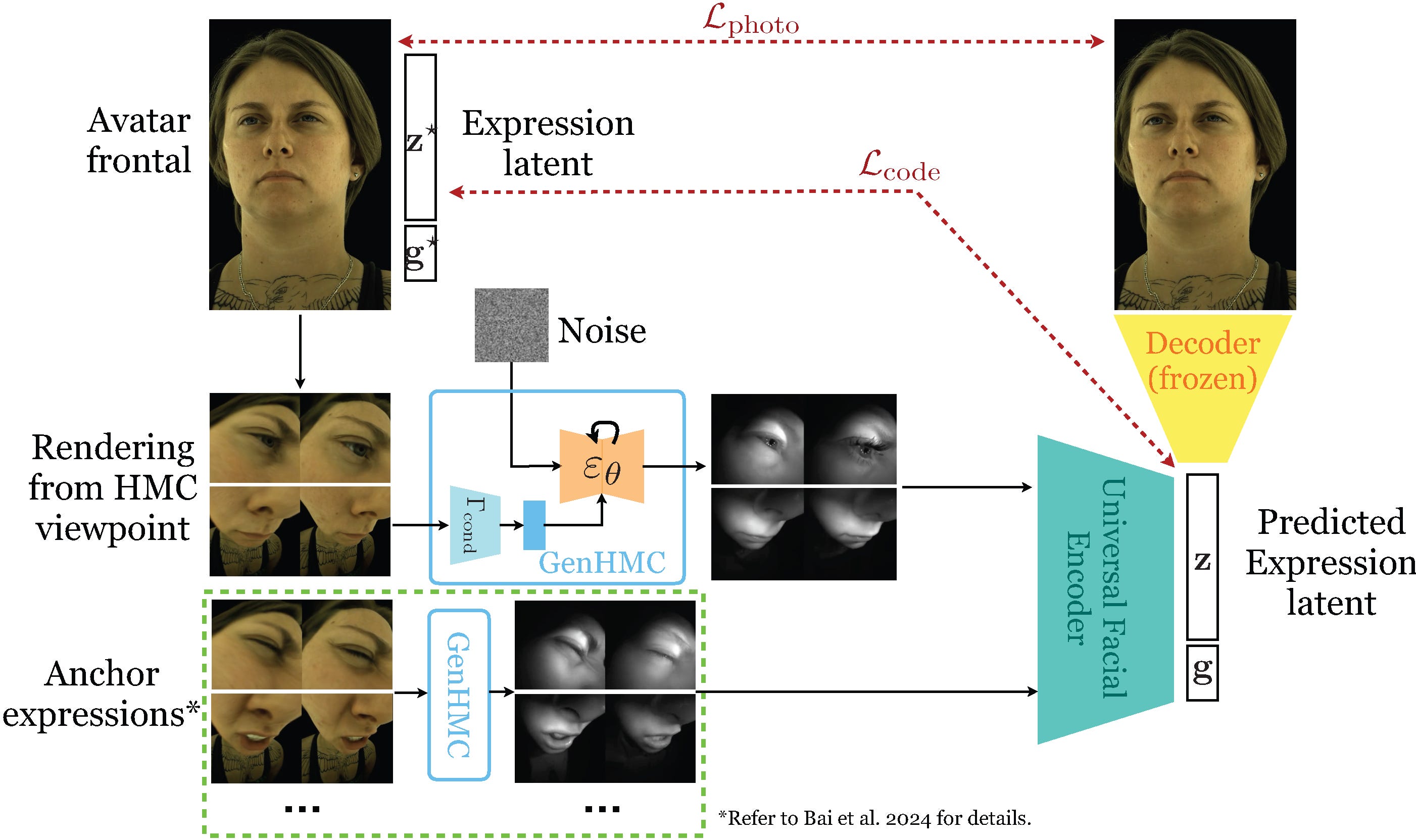
Enabling photorealistic avatar animations in virtual and augmented reality (VR/AR) has been challenging because of the difficulty of obtaining ground truth state of faces. It is physically impossible to obtain synchronized images from head-mounted cameras (HMC) sensing input, which has partial observations in infrared (IR), and an array of outside-in dome cameras, which have full observations that match avatars’ appearance. Prior works relying on analysis-by-synthesis methods could generate accurate ground truth, but suffer from imperfect disentanglement between expression and style in their personalized training. The reliance of extensive paired captures (HMC and dome) for the same subject makes it operationally expensive to collect large-scale datasets, which cannot be reused for different HMC viewpoints and lighting. In this work, we propose a novel generative approach, Generative HMC (GenHMC), that leverages large unpaired HMC captures, which are much easier to collect, to directly generate high-quality synthetic HMC images given any conditioning avatar state from dome captures. We show that our method is able to properly disentangle the input conditioning signal that specifies facial expression and viewpoint, from facial appearance, leading to more accurate ground truth. Furthermore, our method can generalize to unseen identities, removing the reliance on the paired captures. We demonstrate these breakthroughs by both evaluating synthetic HMC images and universal face encoders trained from these new HMC-avatar correspondences, which achieve better data efficiency and state-of-the-art accuracy.
Jungbin Cho, Minsu Kim, Jisoo Kim, Ce Zheng, Laszlo A. Jeni, Ming-Hsuan Yang, Youngjae Yu, Seonjoo Kim
1Yonsei University
2Carnegie Mellon University
3UC Merced & Google DeepMind
4Seoul National University
🚧 Project: https://sceneadapt.github.io/
📄 Paper: https://arxiv.org/pdf/2510.13044
💻 Code: (coming, see project page)
❌ ArXiv: https://arxiv.org/abs/2510.13044
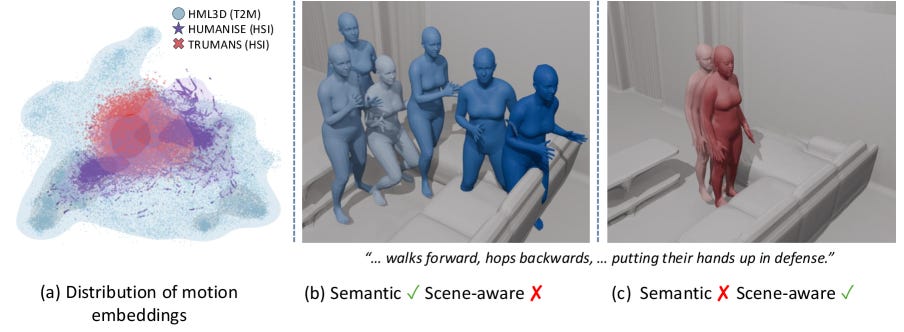
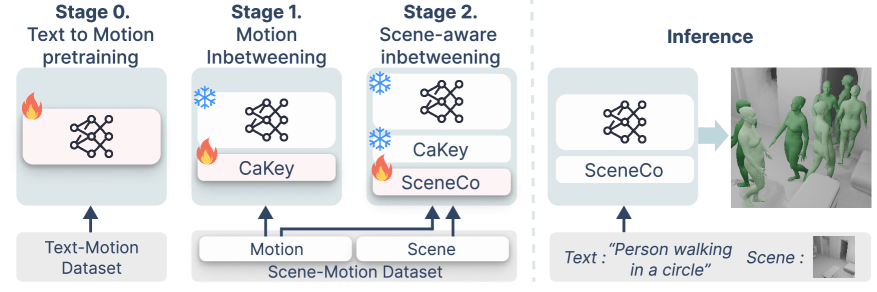
Human motion is inherently diverse and semantically rich, while also shaped by the surrounding scene. However, existing motion generation approaches address either motion semantics or scene-awareness in isolation, since constructing large-scale datasets with both rich text--motion coverage and precise scene interactions is extremely challenging. In this work, we introduce SceneAdapt, a framework that injects scene awareness into text-conditioned motion models by leveraging disjoint scene--motion and text--motion datasets through two adaptation stages: inbetweening and scene-aware inbetweening. The key idea is to use motion inbetweening, learnable without text, as a proxy task to bridge two distinct datasets and thereby inject scene-awareness to text-to-motion models. In the first stage, we introduce keyframing layers that modulate motion latents for inbetweening while preserving the latent manifold. In the second stage, we add a scene-conditioning layer that injects scene geometry by adaptively querying local context through cross-attention. Experimental results show that SceneAdapt effectively injects scene awareness into text-to-motion models, and we further analyze the mechanisms through which this awareness emerges. Code and models will be released.
No posts
Comments
Nothing yet. Say the first thing.
Sign in to join the conversation.