
Felix Taubner, Ruihang Zhang, Mathieu Tuli, Sherwin Bahmani, David B. Lindell
1University of Toronto 2Vector Institute 3LG Electronics
🚧 Project: https://felixtaubner.github.io/mvp4d/
📄 Paper: https://arxiv.org/pdf/2510.12785
❌ ArXiv: http://arxiv.org/abs/2510.12785
💻 Code: https://github.com/felixtaubner/mvp4d/ (coming soon)

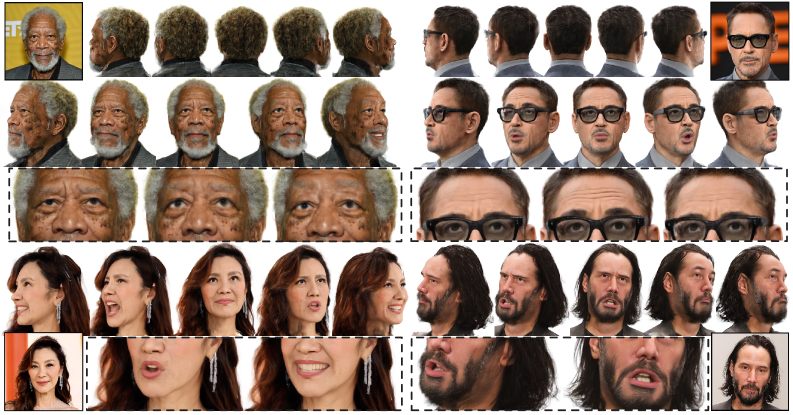
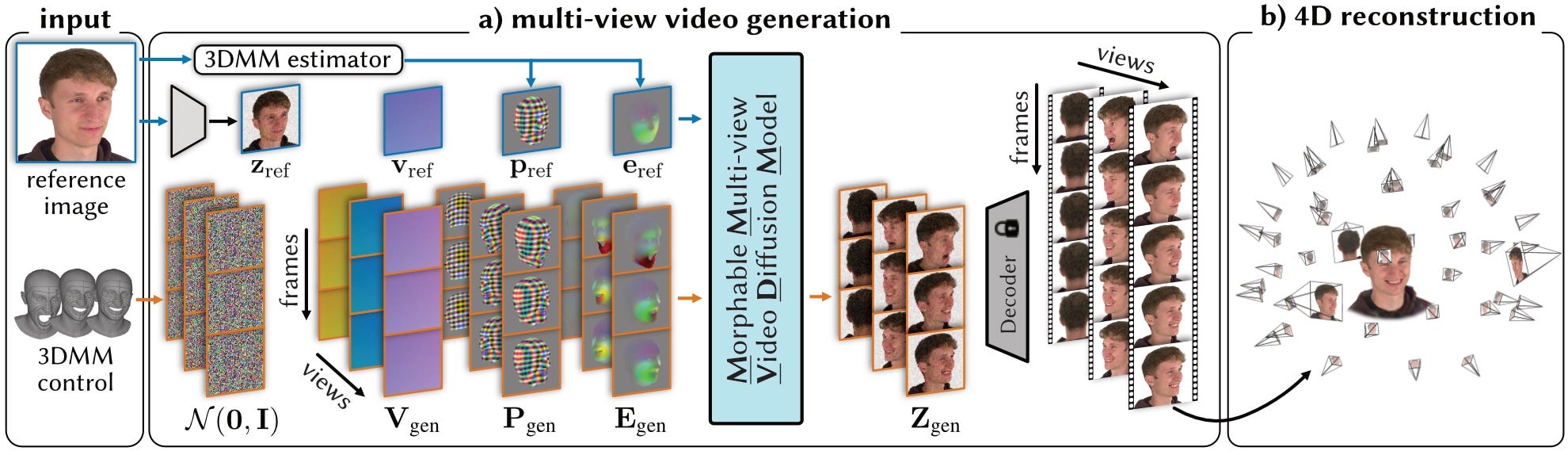
Digital human avatars aim to simulate the dynamic appearance of humans in virtual environments, enabling immersive experiences across gaming, film, virtual reality, and more. However, the conventional process for creating and animating photorealistic human avatars is expensive and time-consuming, requiring large camera capture rigs and significant manual effort from professional 3D artists. With the advent of capable image and video generation models, recent methods enable automatic rendering of realistic animated avatars from a single casually captured reference image of a target subject. While these techniques significantly lower barriers to avatar creation and offer compelling realism, they lack constraints provided by multi-view information or an explicit 3D representation. So, image quality and realism degrade when rendered from viewpoints that deviate strongly from the reference image. Here, we build a video model that generates animatable multi-view videos of digital humans based on a single reference image and target expressions. Our model, MVP4D, is based on a state-of-the-art pre-trained video diffusion model and generates hundreds of frames simultaneously from viewpoints varying by up to 360 degrees around a target subject. We show how to distill the outputs of this model into a 4D avatar that can be rendered in real-time. Our approach significantly improves the realism, temporal consistency, and 3D consistency of generated avatars compared to previous methods.
Xingpei Ma, Shenneng Huang, Jiaran Cai, Yuansheng Guan, Shen Zheng, Hanfeng Zhao, Qiang Zhang, Shunsi Zhang
🚧 Project: https://playmate111.github.io/Playmate2/
📄 Paper: https://arxiv.org/pdf/2510.12089
❌ ArXiv: https://arxiv.org/abs/2510.12089
💻 Code: https://github.com/Playmate111/Playmate2
![[Uncaptioned image]](https://substackcdn.com/image/fetch/$s_!1g3T!,f_auto,q_auto:good,fl_progressive:steep/https%3A%2F%2Fsubstack-post-media.s3.amazonaws.com%2Fpublic%2Fimages%2F53411fa9-46e4-4a87-84e0-bec3d7366aa6_997x559.png "[Uncaptioned image]")
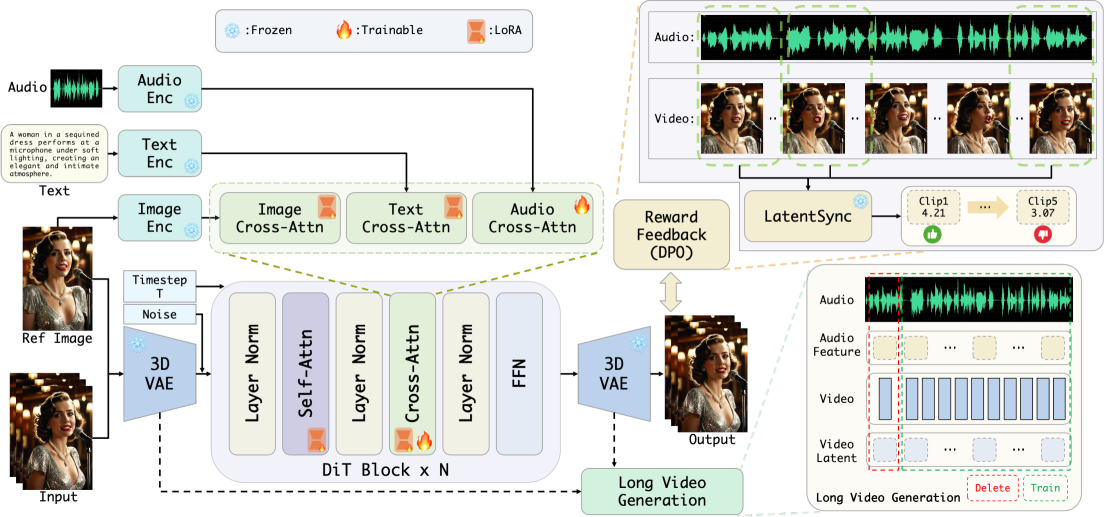
Recent advances in diffusion models have significantly improved audio-driven human video generation, surpassing traditional methods in both quality and controllability. However, existing approaches still face challenges in lip-sync accuracy, temporal coherence for long video generation, and multi-character animation. In this work, we propose a diffusion transformer (DiT)-based framework for generating lifelike talking videos of arbitrary length, and introduce a training-free method for multi-character audio-driven animation. First, we employ a LoRA-based training strategy combined with a position shift inference approach, which enables efficient long video generation while preserving the capabilities of the foundation model. Moreover, we combine partial parameter updates with reward feedback to enhance both lip synchronization and natural body motion. Finally, we propose a training-free approach, Mask Classifier-Free Guidance (Mask-CFG), for multi-character animation, which requires no specialized datasets or model modifications and supports audio-driven animation for three or more characters. Experimental results demonstrate that our method outperforms existing state-of-the-art approaches, achieving high-quality, temporally coherent, and multi-character audio-driven video generation in a simple, efficient, and cost-effective manner.
Shuhei Tarashima, Yushan Wang, Norio Tagawa
NTT DOCOMO Business
Tokyo Metropolitan University
🚧 Project: N/A
📄 Paper: https://arxiv.org/pdf/2510.12660
❌ ArXiv: https://arxiv.org/abs/2510.12660
💻 Code: N/A
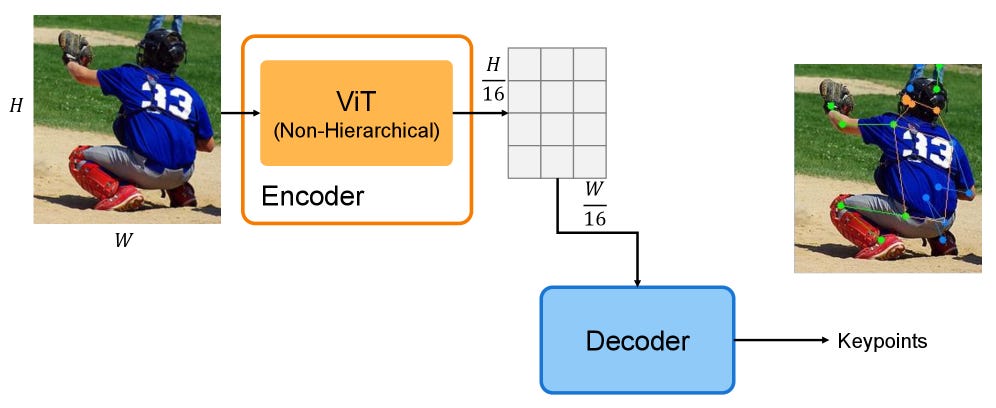
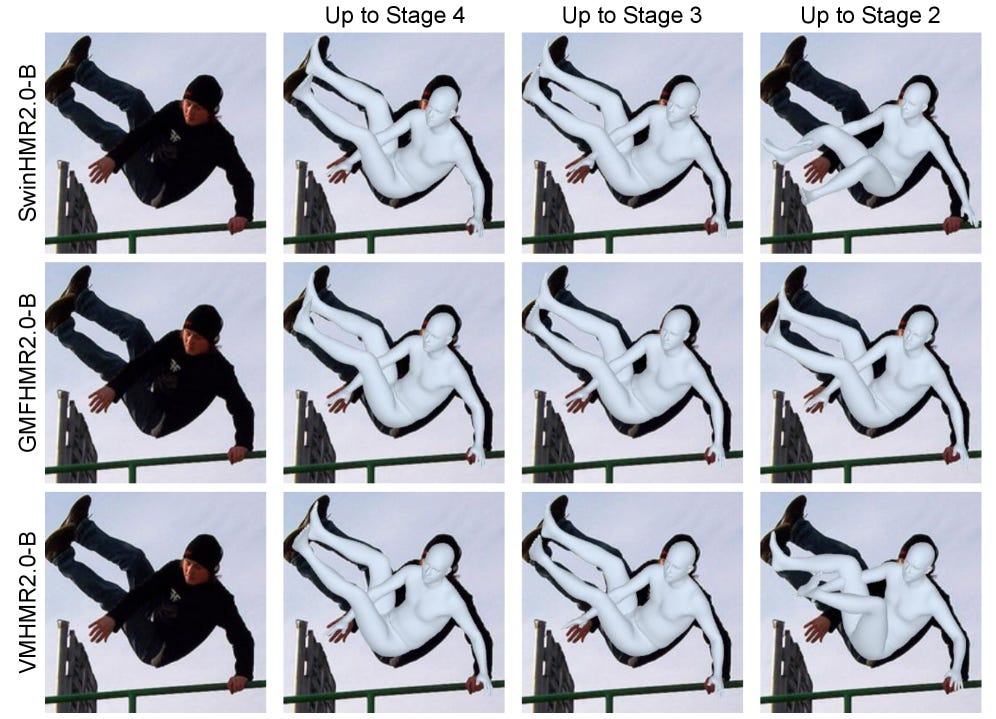
In this work, we aim to develop simple and efficient models for human mesh recovery (HMR) and its predecessor task, human pose estimation (HPE). State-of-the-art HMR methods, such as HMR2.0 and its successors, rely on large, non-hierarchical vision transformers as encoders, which are inherited from the corresponding HPE models like ViTPose. To establish baselines across varying computational budgets, we first construct three lightweight HMR2.0 variants by adapting the corresponding ViTPose models. In addition, we propose leveraging the early stages of hierarchical vision foundation models (VFMs), including Swin Transformer, GroupMixFormer, and VMamba, as encoders. This design is motivated by the observation that intermediate stages of hierarchical VFMs produce feature maps with resolutions comparable to or higher than those of non-hierarchical counterparts. We conduct a comprehensive evaluation of 27 hierarchical-VFM-based HMR and HPE models, demonstrating that using only the first two or three stages achieves performance on par with full-stage models. Moreover, we show that the resulting truncated models exhibit better trade-offs between accuracy and computational efficiency compared to existing lightweight alternatives.
No posts
Comments
Nothing yet. Say the first thing.
Sign in to join the conversation.