
A few days ago, one of the managers recorded a short video to explain a scoring decision, and his argument has stayed with me all week. It is a good one. It shows a lot of care going into supporting our people.
We had just finished calibration. Each manager ran 360 input on their own people first, then the whole group came together and placed everyone on a shared grid. Horizontally, performance on a five-point scale. We don’t normally have 1s for many reasons. A 2 means we are in a performance conversation. A 3 is solid performance. A 4 means almost ready for the next level. A 5 means this person has been operating at the next level for a couple of cycles and we should be talking about promotion. Vertically, potential. Low at the bottom, high at the top.
His point was that a high 2 is in better shape than a low 3.
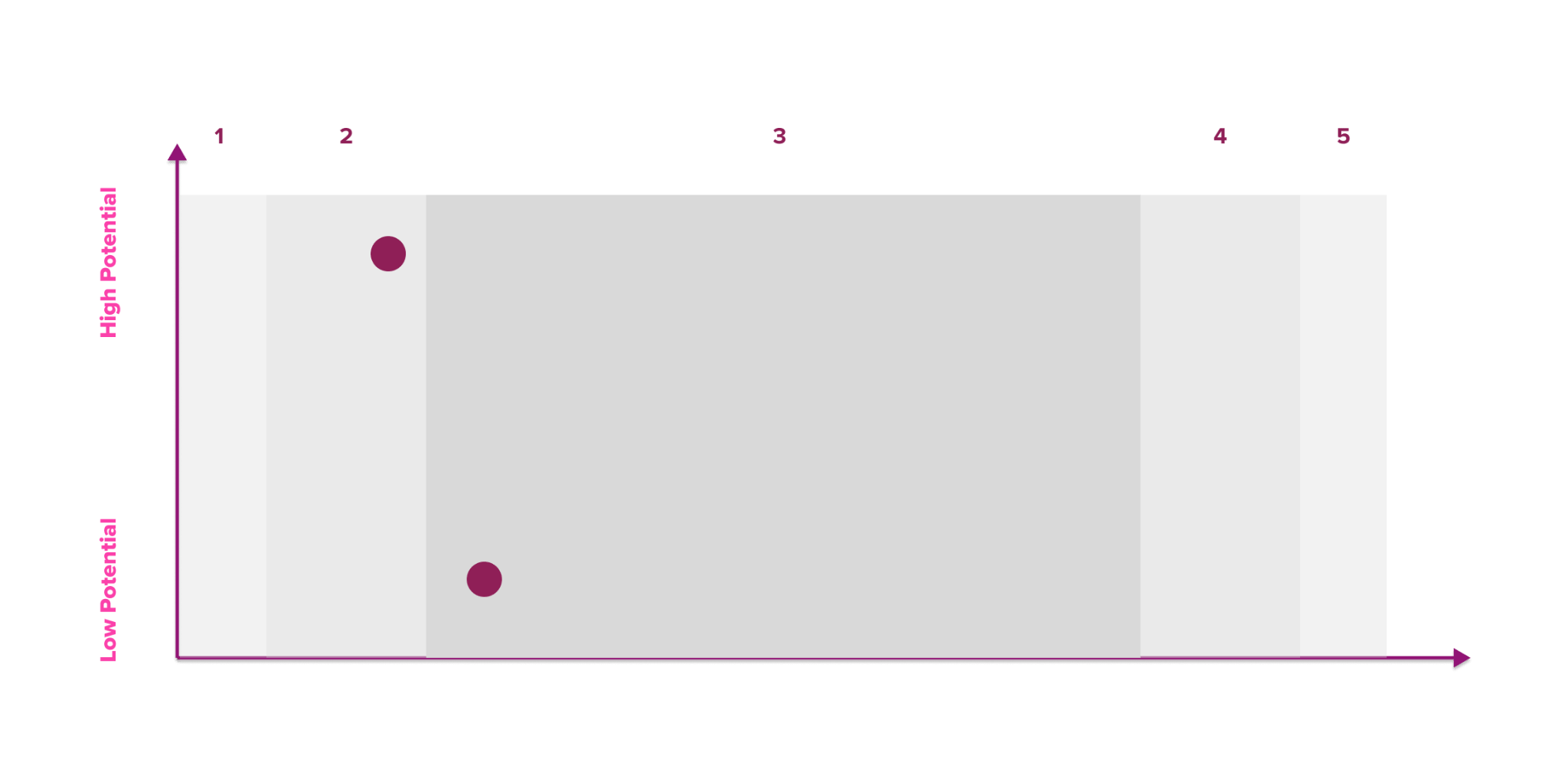
I realized I agreed with him immediately, but never articulated it as well as our manager did. Aren’t performance ratings supposed to be standards? Doesn’t a 3 always beat a 2? We were measuring two different things at once: position and direction. In evaluation, direction is actually more important than position.
Our typical career ladder is a linear position trajectory. Professional levels 1 to 5, or whatever the company has. It focuses so much on skills. But skill is not the only measurement of a worker. Adding a second dimension is the key to fair evaluation.
Potential adds the second dimension: how likely the person will move in the right direction.
In a linear perspective, A 2 is a person on a plan. A 3 is a person doing their job. The gap between the two numbers matters less if we take the movement trajectory into consideration. A high 2 is someone who received hard feedback and started correcting. You can see the correction.
A high 2 demonstrates three things managers should care about: coachability, trajectory, and adaptability. Someone is absorbing difficult feedback, changing behavior, and moving quickly enough that you can already see the correction. In a moving environment, those may be more predictive than where they happen to sit today.
Adaptability is increasingly valuable.
A low 3 has demonstrated something else. They can hold steady. They meet the bar, and they have met the bar for a while, and nothing in their recent work suggests they are reaching past it. In a stable environment, that is an ok place to sit. Plenty of teams are carried by people who do exactly what they said they would do, on time, for years. They get the job done.
The environment is not stable, at least for tech. (Admittedly, this is a stressor for many people now.)
Here is the part that managers need to pay attention to a low 3 now. The definition of solid performance in 2026 isn’t the definition of solid performance in 2016.
On design teams, I have watched the floor rise in specific, measurable ways. Both in capability and speed. In capability, a designer who could not write code eighteen months ago is now shipping working prototypes into engineering review. Research synthesis that filled an analyst’s month gets a first pass in an afternoon by designers. In speed, the bar now is moving at a speed we have not seen in the past decades.
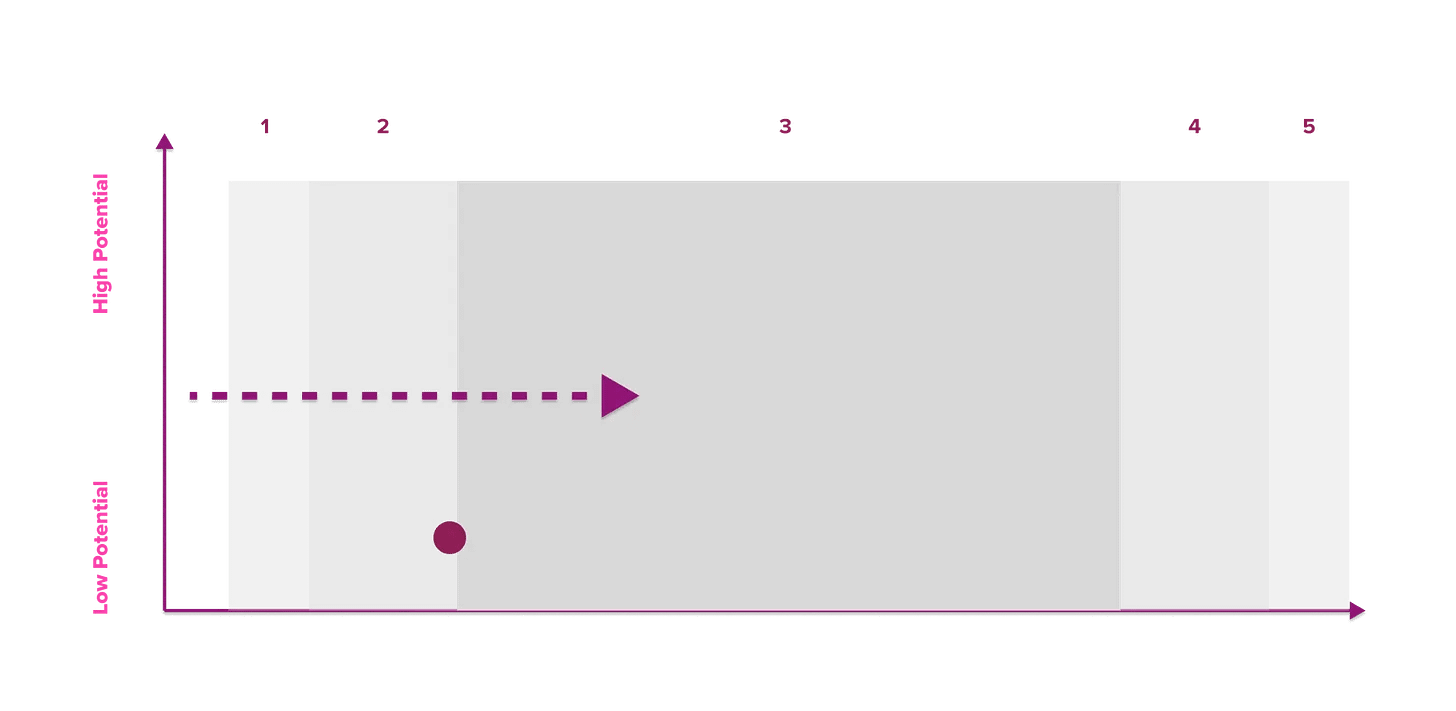
The last decade gave us a healthier conversation about work and life. Work funds a life, and plenty of strong people have decided not to put work at the center of theirs. That is a legitimate choice. I have never wanted to argue anyone out of it, even though I put a lot into my work-life. However, what is outside anyone’s control is that now the bar is constantly moving, and moving faster than ever before. It is the part managers owe people honesty about.
So a person can sit still, do exactly what earned them a 3 last cycle, and receive a 3 again, while the actual distance between them and the rest of the team widens. The score is a position. A relative position, not a fixed one. Linear performance ratings are measurements of position. But position only makes sense relative to a moving bar.
As managers, have we explained this to our IC’s? Because reading the rubric, our IC’s would think they pass the bar perfectly. And are surprised when they all of a sudden have been put on a performance plan the next cycle.
That is why the direction of travel deserves as much attention in the evaluation as the placement. A high 2 has velocity to accelerate to the right direction to keep up with the moving bar. A low 3 has none.
None of that makes a 2 a comfortable place to be. A high 2 is still someone whose job is at risk, and the arrow only counts for as long as it keeps moving. The comparison is useful for a different reason. It tells managers where your attention is worth spending. The high 2 already has a plan, a date, and a manager watching closely. The low 3 has none of that, and nobody is going to build it for them because, on paper, nothing is wrong.
So the harder question coming out of calibration is not what to do about the 2s. We know what to do about the 2s. It is what to give the 3s to move toward, when the thing they need to move toward has not been written into the rubric yet.
How to move the 3s?
If the problem with a low 3 is that the bar keeps moving, then managers owe people somewhere to move toward. That’s difficult when the next expectation hasn’t been written into the rubric yet.
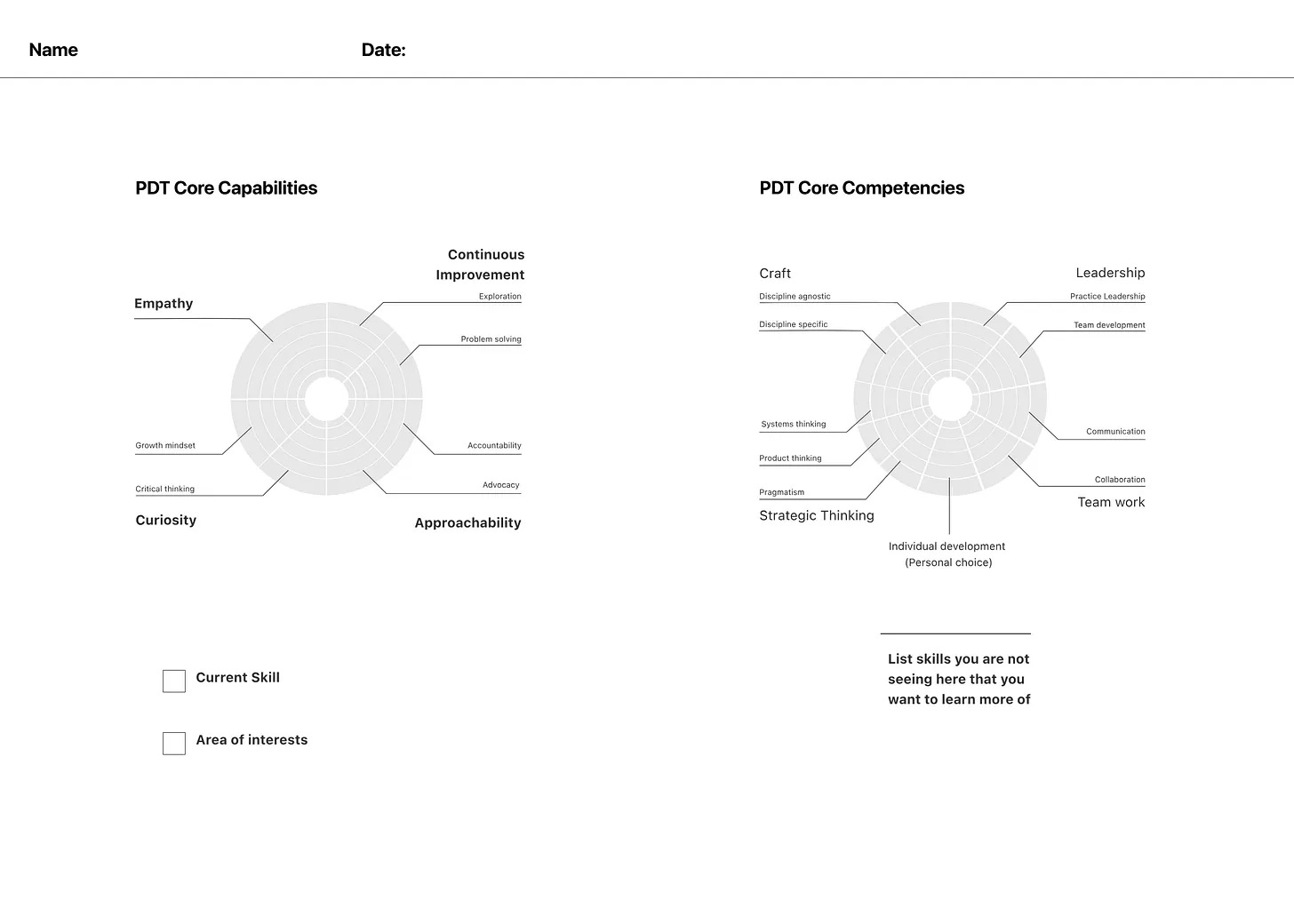
Every rubric I have built in the past leaves one area open for the person to fill in. They name it. They tell us what they are going for, why it matters to the work, and what evidence would count. I wrote about this as leaving room for a person’s natural strengths when I first published my career ladder guide in a blog last year, Navigating the UX/Product Designer Career Ladder, and it has become the part of the framework I defend hardest, because it is the part that can work when the job description starts to move. In the past, I looked at it as an aspiration for ICs, but now, I am thinking we can also use that sliver for managers to define new goals. The open slot helps to solve the role fluidity problem without predicting the future.
Two rules to consider
Named before the cycle, not during review. A fluid area declared before the next review cycle to explain what the (new) expectation is.
Written at the same level as everything else. If a senior designer picks enabling teams with tools, it has to be senior-level enablement, with the evidence a senior would produce. The freedom is in the what.
Performance ratings are mostly measurements of position. Position only makes sense relative to a moving bar. The difficult truth for managers to communicate is that standing still is also a movement when everyone else is moving around you. As managers, showing our people the moving direction, where the next move needs to be before falling behind, is just as important as measuring their position.
The open slot solves one problem. It creates room for people and organizations to evolve together. It doesn’t solve another question I’ve been wrestling with: what happens when the ladder itself begins to disappear?
If roles become increasingly fluid and organizations become flatter, how do we evaluate growth at all?
That’s the question I’m exploring as I build an app (as explained in my post Leadership Is an Axis, Not a Title). For now, keep your eye on those low 3s.
No posts
Comments
Nothing yet. Say the first thing.
Sign in to join the conversation.