
Most weeks my companion piece is the practical half of the main post. The template, the worksheet that supports the main piece. This week it is not.
Direction Matters More Than Position ended on a question I have not resolved. The open sliver solves role fluidity inside a ladder. It does not solve what happens when the ladder itself starts to disappear. The reality today: roles keep getting more fluid, and organizations keep getting flatter. The question is: how do we evaluate growth as our work environment continues to change every month?
To continue that thought, I want to explore a different method for career evaluation. This method works for both flat organizations and conventional ones, and for individual contributors as well as managers. Leadership becomes the second dimension being measured, independent of title.
People are stressed. Job descriptions are moving targets. The capabilities we ask people to demonstrate today weren’t part of many role descriptions even a year ago. At the same time, organizations are getting flatter. Managers are becoming ICs. ICs are taking on leadership work that used to belong to management. If both roles and organizations are changing this quickly, how do we evaluate growth fairly?
In the effort of finding stability in chaos, I am turning to a framework Joost Minnaar wrote a few years back in his blog remuneration method for flat organizations. Looking at what you can do and how you carry others. Skills and capabilities, as well as leadership, are all part of a rubric.
The overlap is the point.
Leadership is not leadership potential or influence without authority sitting at the bottom of the rubric somewhere or a people manager track. It’s one of the two dimensions everyone can be measured against.
This is worth a close look right now because flattening is a huge trend. Layers are coming out of organizations across the industry. The rubric model is more durable than a simple 1—5 ladder.
Minnaar’s write-up comes from an Australian social care organization that needed a pay method after they removed the hierarchy. They defined three levels of skills and capabilities, labeled A, B and C. Then three levels of leadership, labeled 1, 2 and 3. Combined, that gives nine grades. 1A through 3C.
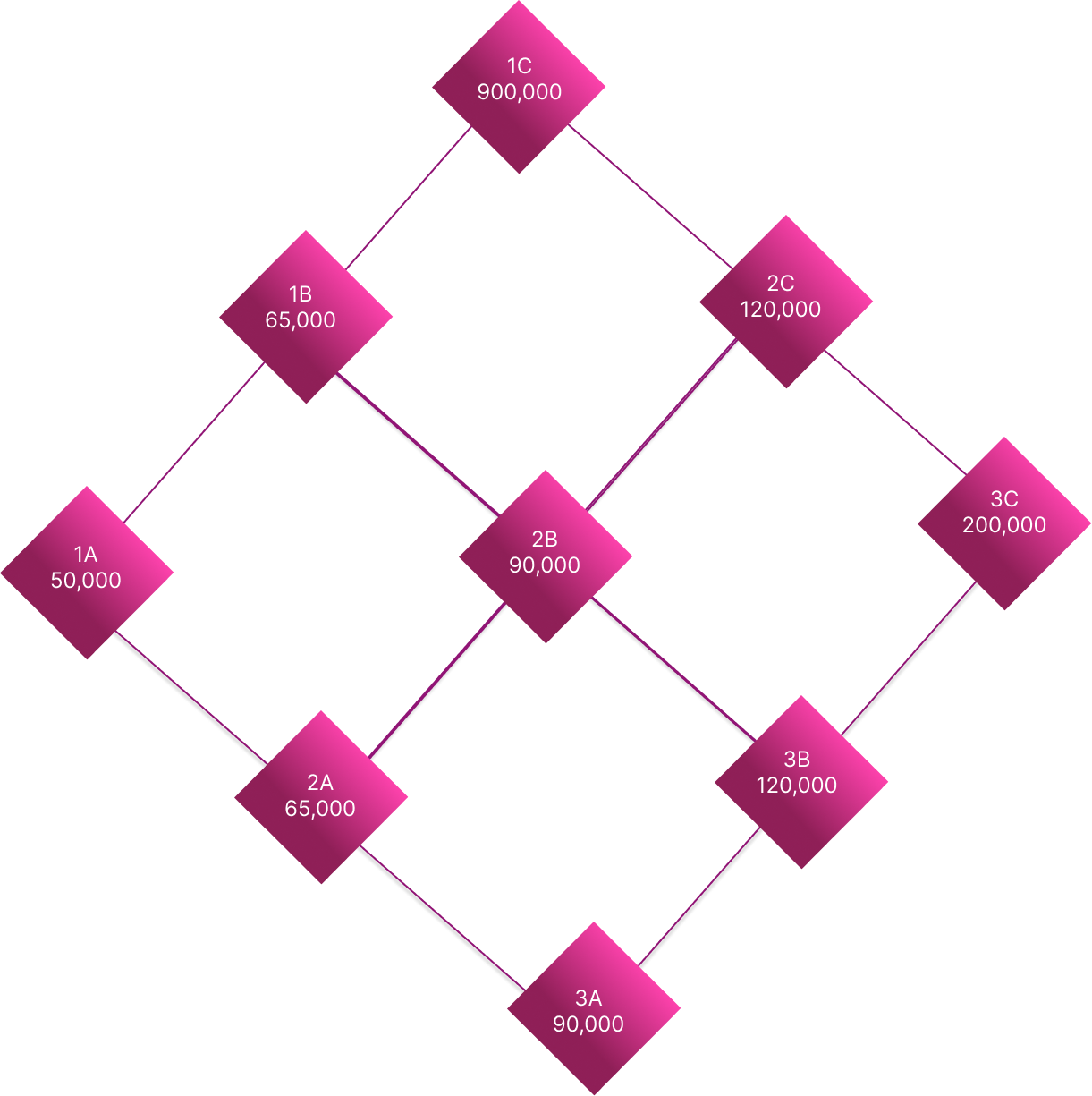
A, B and C describe the complexity of craft. A works inside a process. B works on a process. C designs and improves the process. (Can map to our traditional levels.)
1, 2 and 3 describe the scope of responsibility. 1 is accountable for their own outcomes. 2 is accountable for a team’s outcomes. 3 is accountable for the organization’s.
This is a 3x3 grid. You can expand to a larger grid with this principle.
Every grade maps to a pay band, and several grades can share one. 1C, 2B, and 3A can all sit at the same pay band. Three genuinely different shapes of contribution, paid the same.
Managers can use this method to evaluate all members, but what makes this more progressive is to have peers score each other in the open. Make career development a place for conversation. The group also decides the payband. (This requires high psychological safety in place. So if the org lacks it, manager evaluation still can work.)
Currently, many companies, when moving managers and ICs from one track to another, tell employees there is no salary change because it is a horizontal job function change. But it is really hard to understand the rationale behind it. But I envision we can expand the rubric and evaluate managers and ICs on the same rubric, not what we currently do as an IC track vs. a manager track. In return, when we move people between the IC track and manager track, the pay band actually makes sense. (In theory, the pay band could move up and down.)
Let’s dig into the details
Comments
Nothing yet. Say the first thing.
Sign in to join the conversation.