
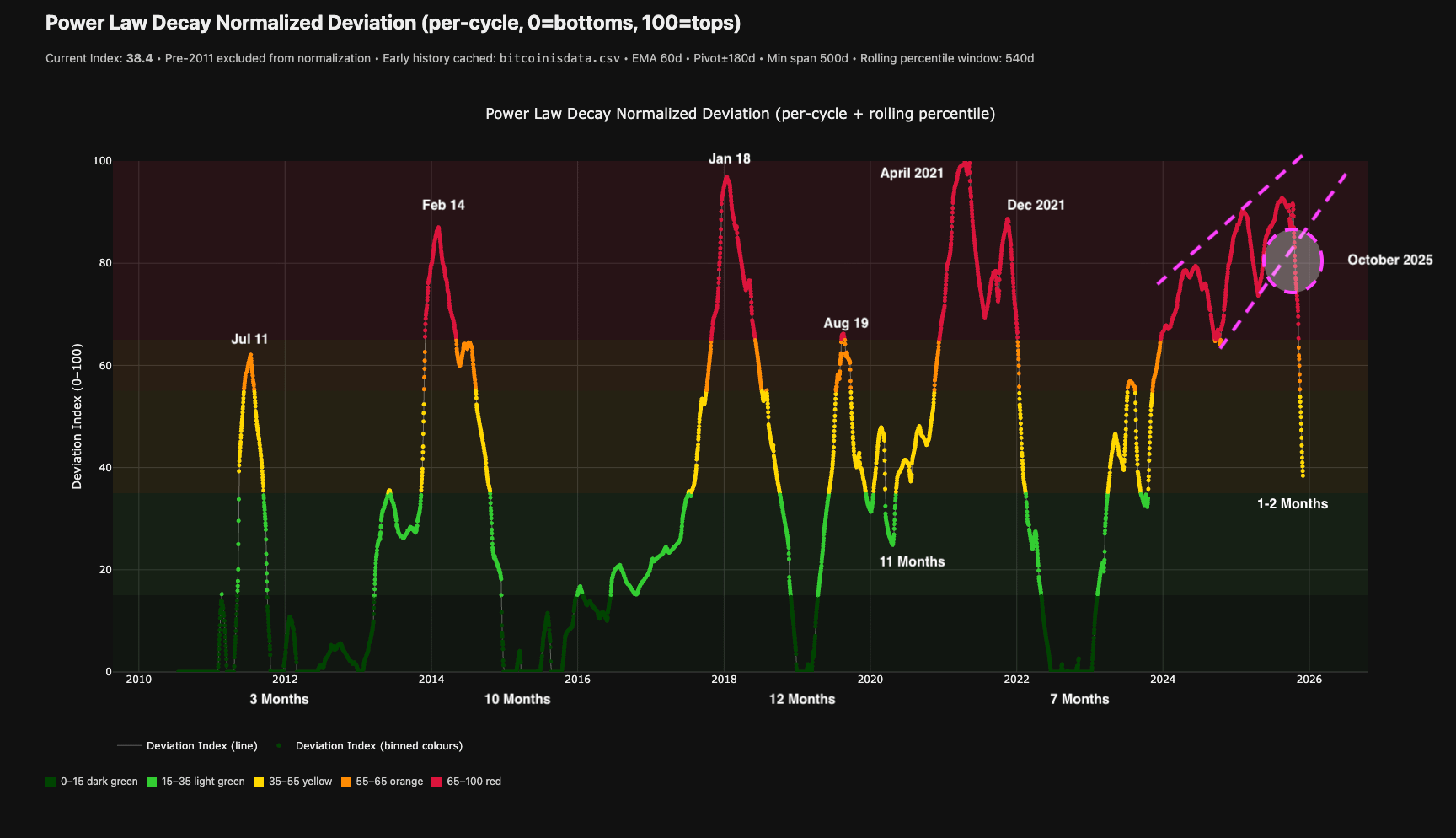
Bitcoin’s sell-off following its break below the rising wedge has been severe, but unusually fast. In power-law decay terms, a move that historically unfolds over 7–12 months has compressed into roughly 1–2 months — assuming the decline continues. The structure is abnormal, but the broader context explains why.
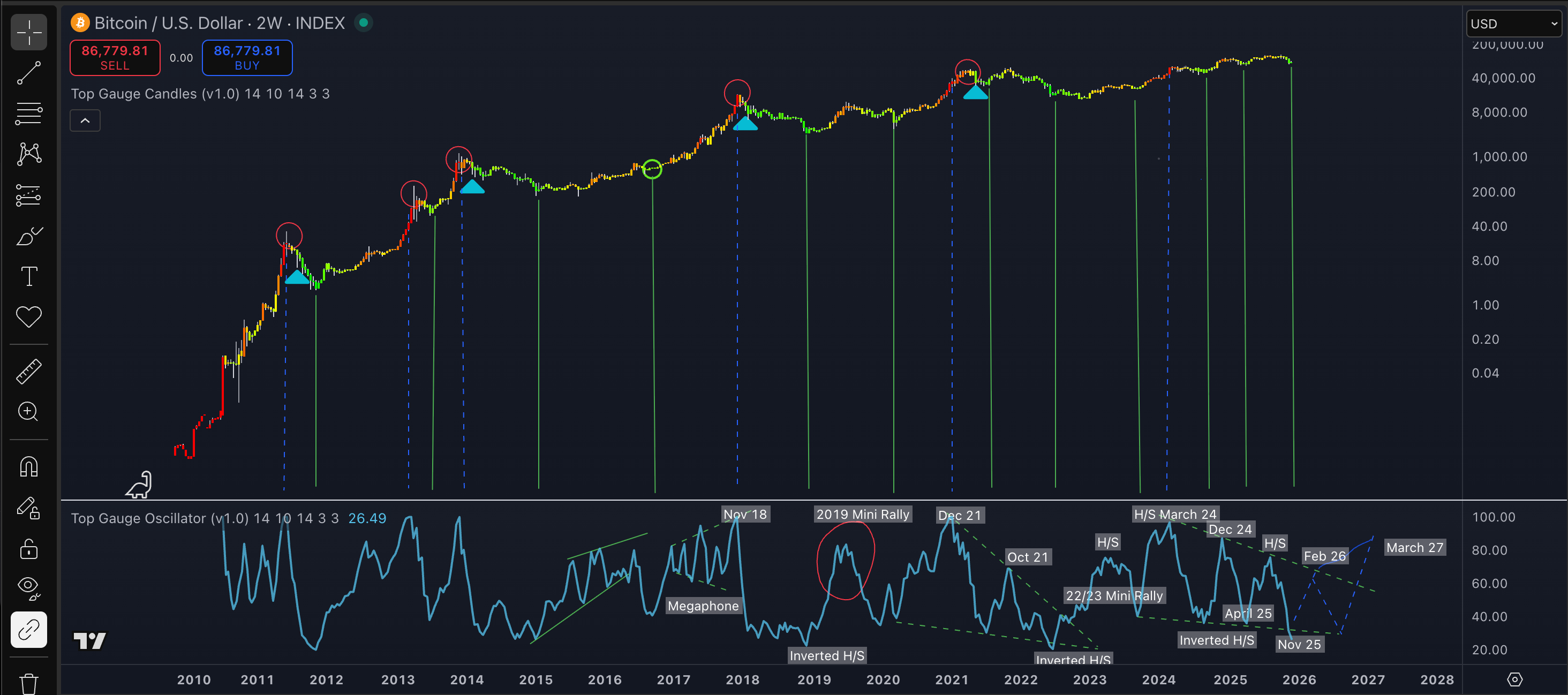
Signs of strain were clear. Under typical conditions, the 2022Q3–25 cycle would have produced a classic blow-off top in Bitcoin and a pronounced alt-coin season. Instead, political and policy dynamics interrupted the process:
In September 2024, the outgoing administration wound down QE-Not-QE.
The Federal Reserve simultaneously suppressed YCC-Not-YCC.
Together, these moves effectively withdrew an estimated multi-trillion-dollar liquidity wave, finalizing just as the new administration entered office.
Once in office, Treasury operations pivoted back toward short-end refinancing — effectively a form of Treasury QE — but the damage to the cycle structure was already done.
Bitcoin benefited early from ETF-driven flows, and alt-coins caught a smaller rally into early 2025. But the absence of the usual liquidity blow-off meant the true cycle top passed quietly.
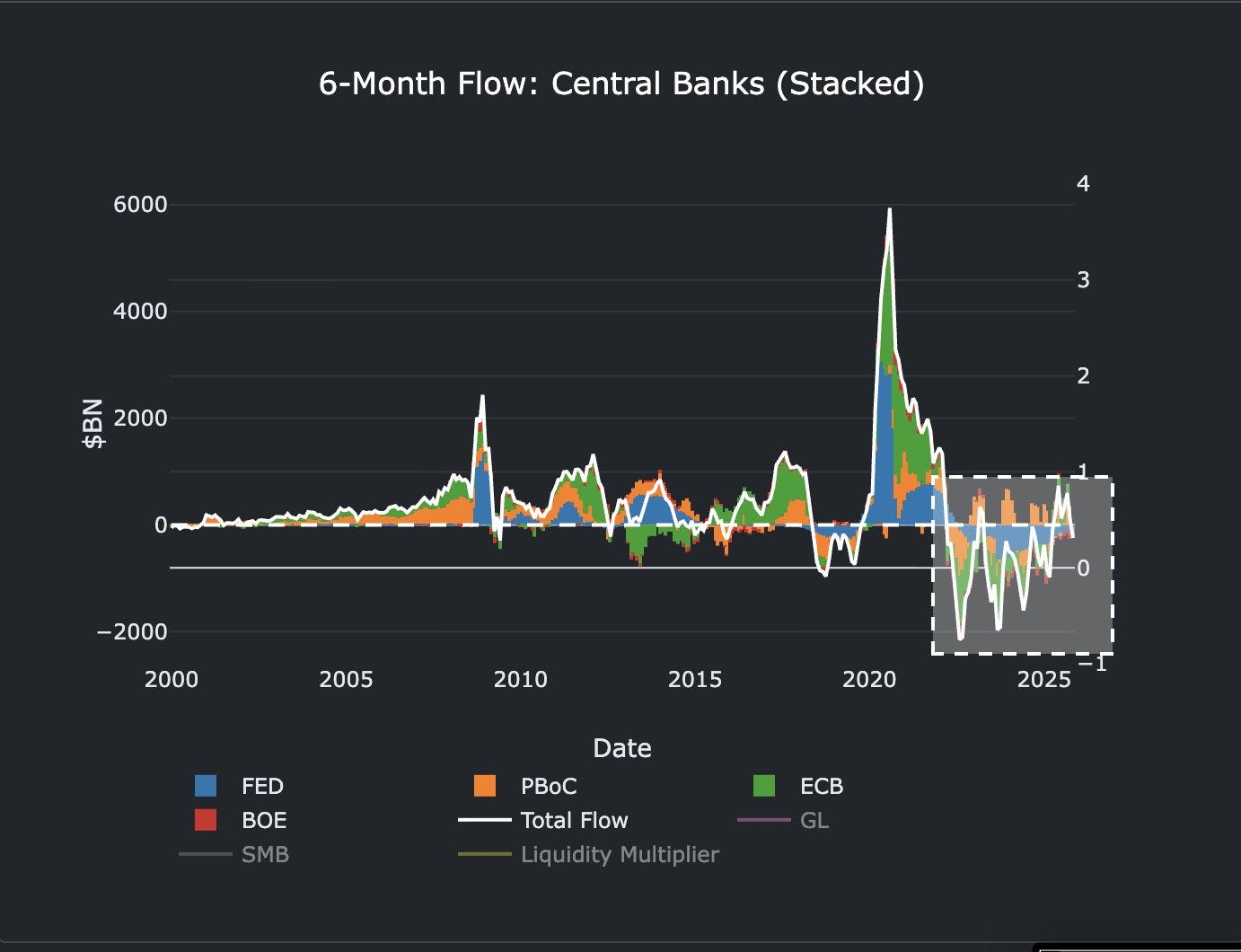
The business cycle was already softening. With liquidity tight, collateral scarce, and the Fed refusing to assist, the environment became fragile. This fragility contributed to the April–May market break, amplified by Trump tariff-related volatility.
Alt-coins — which rely heavily on surplus liquidity and momentum alongside a strong business cycle — never saw the broad, speculative season normally accompanying a mature cycle.

A second potential blow-off window opened in October 2025. It also failed. A sudden policy-driven shock — delivered during a period when only crypto markets were open — caused significant losses and several crypto institutional blow-ups/outs. The disruption effectively reset market psychology and reinforced the cycle bottoming process.
The business cycle appears to be forming a base. But the liquidity cycle is (or should be) peaking, with major refinancing needs ahead:
Roughly $10T of debt must be refinanced.
Some arguments suggest $6T could be absorbed by banks with the SLR constraints ease, enabling renewed credit creation.
Stablecoins may purchase $1–2T in short-term Treasuries.
The remaining ~$2T source is unclear.
QT (~$20B/month) is ending; QE (~$20B/month) is beginning — but the size is modest relative to systemic needs.

Any liquidity flowing directly into the real economy will support wages, employment, and domestic activity, though these gains will likely be eroded by cost-of-living increases. Fed-driven QE typically inflates asset prices more than everyday expenses, whereas Treasury-driven QE tends to lift both, often more painfully.
Rather than a conventional recession, the March–April–May period functioned more like a feedback shock — a compressed, liquidity-driven contraction without the classic employment or credit-flow characteristics. Under this interpretation, the recession has already occurred.
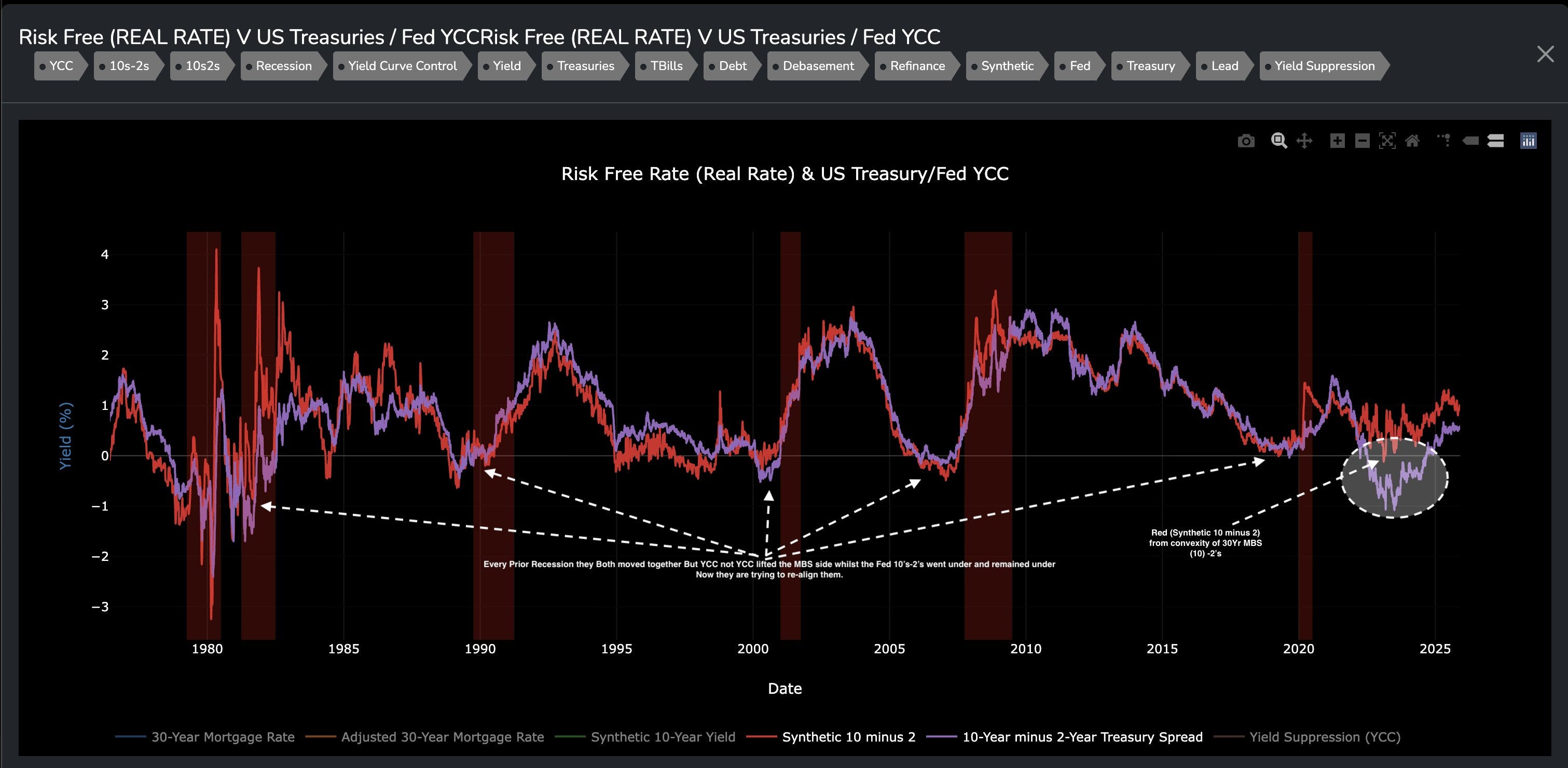
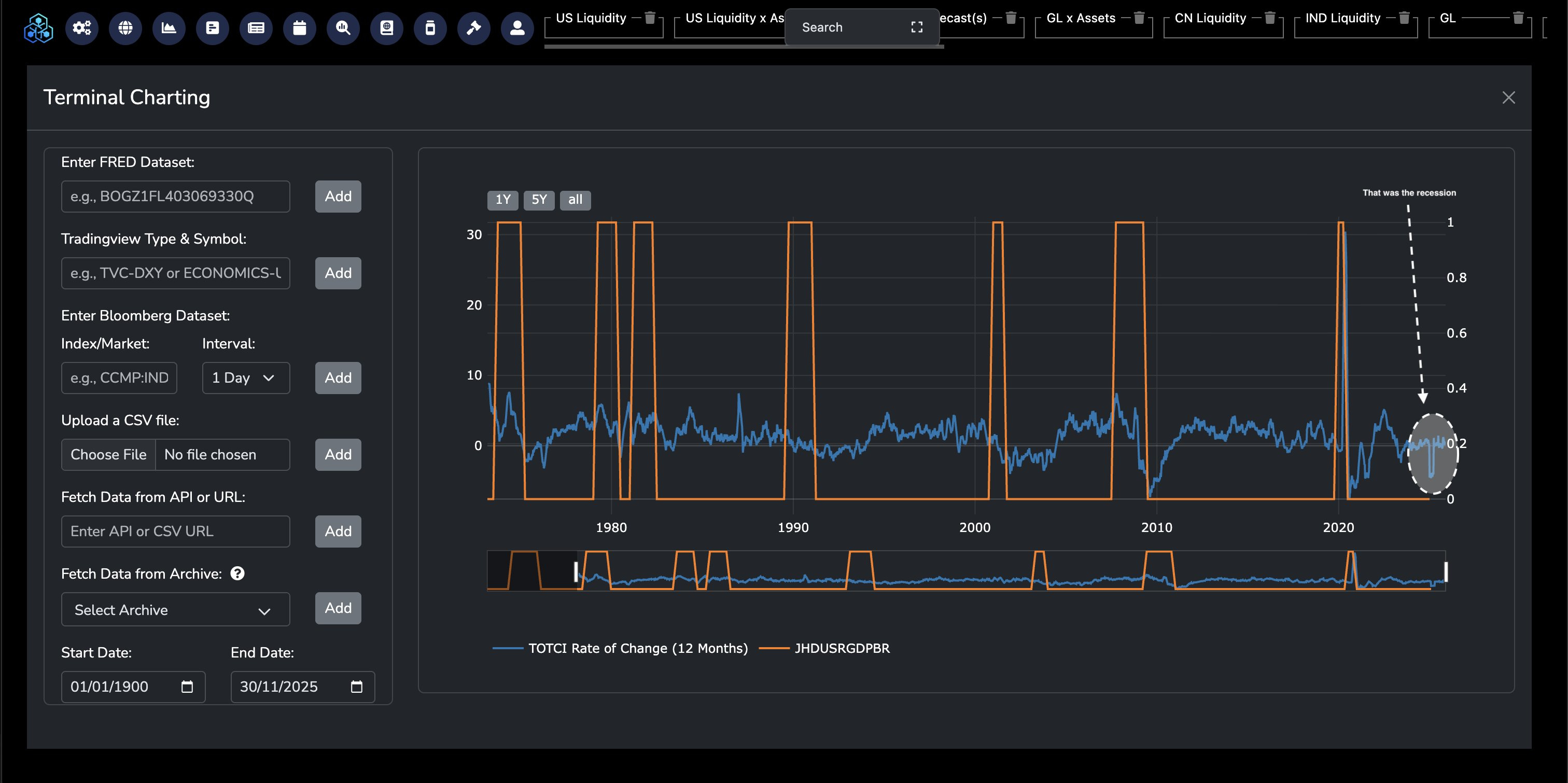
From our perspective, markets remain closer to a bottom than a top:
The true top was in December 2024.
Subsequent highs were distorted by Treasury QE.
Global liquidity has risen through 2025.
More Treasury QE and mild Fed balance-sheet expansion lie ahead.
However, the new environment — monetization of debt, monetary and variable inflation, and the absence of financial repression — likely means slower Bitcoin upside relative to past cycles. A recovery is expected, but without the explosive dynamics of earlier eras.
A bottom is most plausible in Q1 2026.
As for Alt-coins…

The alt-coin market has been brutal since mid-2022. Many projects are barely afloat. But if more liquidity reaches main-street and economic activity rises, investment into functional alt-coins with real utility should grow. Those with genuine use-cases may integrate more deeply into the economy and benefit from organic demand.
However, tokens without substance — which previously rose simply because liquidity rose — will likely be abandoned en masse. The era of “rising tide lifts all ships” may be ending.
No posts
Comments
Nothing yet. Say the first thing.
Sign in to join the conversation.