
As far back as early October, when we experienced a corporate systemic issue — one I recognized immediately and documented at the time — it was already clear we were riding a fragile wave. That fragility stemmed from the inaccessibility of corporate positions after the security device suffered voltage damage and effectively went offline.
Instinctively, I knew this period would not be pleasant. Yet with responsibilities, pressures, and competing forces — kids, lions, hyenas — we had no choice but to operate within reality and allow the digital landscape to unravel along the trajectory it appeared destined to follow.
During that period, a sequence of liquidity-providing entities within the ecosystem collapsed following another Trump-driven disruption. The result was a market pushed into the highest-risk end of the spectrum, with the thinnest liquidity structure seen in years. The collapse of that float exposed a deeper truth: a catalyst was simply waiting for its moment. The top was effectively in during late February 2024, and true peak exhaustion occurred by early Feb 2024. Regardless of price pushing higher afterwards, the structure — not the optics — was the meaningful signal. Momentum was already deteriorating.
The next structural peak formed in August 2025. Yet price continued to make new highs into early October 2025, coinciding precisely with the beginning of my field trip and the consequential hit to our wider macro position.
Now the focus shifts to the structure itself — because it’s clear. And this clarity is why I remain cautious about the potential gap ahead.
Incorporating external perspectives
I want to frame the broader landscape by including the views I’ve absorbed from others, and then present my own warning.
Raoul Pal
Positions us at the bottom of the business cycle.
Expects liquidity to return.
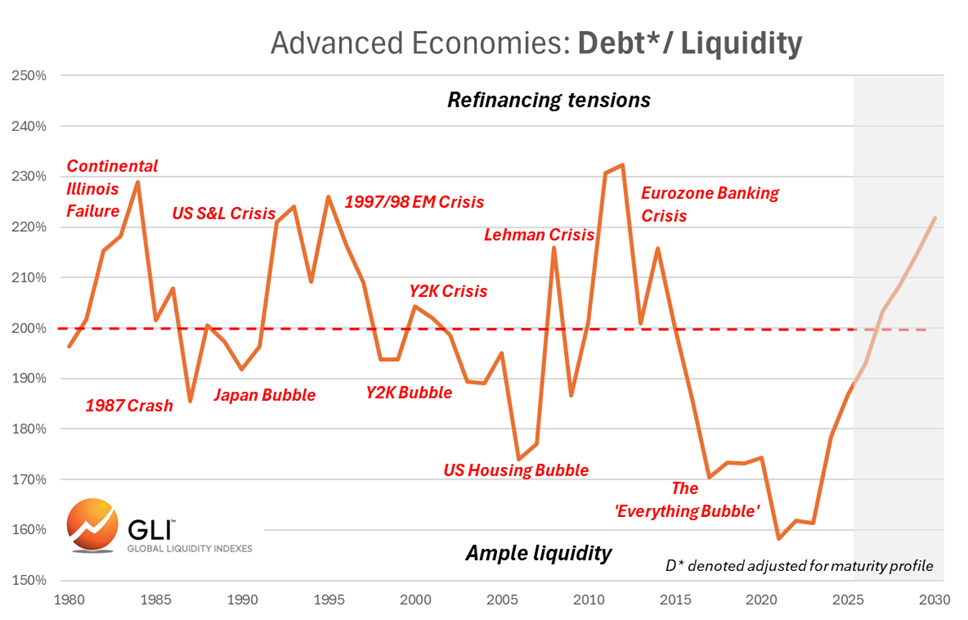
Emphasizes debt refinancing as the dominant macro driver, noting approximately $10T that must be financed.
Michael Howell
Argues we are at the end of the liquidity cycle.
Suggests liquidity will remain on life-support via Treasury QE.
Anticipates a bubble-style collapse event akin to historical precedents.
Recommends BTC as a long-term hedge against monetary inflation.
Views inflation as the only viable exit from the political and fiscal imbalances created by widespread populism.
Henrik Zeberg
States we are approaching the end of the business cycle.
Believes “liquidists” will be wiped out, consistent with his broader cycle thesis.
My perspective on these viewpoints
Raoul Pal is deeply — almost entirely — committed to crypto exposure. By his own statements, 100% of his liquid-net-worth sits in the market, concentrated notably in SUI. His macro framework and major calls so far have been correct, but his positioning remains extremely high-risk, especially given that chains such as Solana, Ethereum, and Bitcoin represent very different levels of durability and network security. Conventionally, it would be prudent to allocate no more than 10% of a portfolio to speculative-high-beta assets. I remain hopeful his view proves right — but the risk profile is substantial or absurd.
Michael Howell, with his deep specialization in liquidity, cannot simply be dismissed. His framework is coherent and historically grounded. However, the scenario he outlines is one the Western hegemonic system is structurally incentivized to prevent. Each time the system has approached a breaking point, a mechanism has ultimately been engineered to stabilize it. Allowing markets to unravel fully would amount to voluntarily ceding strategic and monetary influence to rising powers — especially commodity-rich nations with internally controlled debt dynamics, primarily China and Russia.
Henrik Zeberg’s Framework — and the Core Flaw
Henrik Zeberg argues that the business cycle is ending and that liquidity is insufficient to generate a cyclical upswing. The problem with this logic is that 2020 disproves the premise outright. When policymakers directly inject liquidity into main-street rather than restricting it to the financial system, the business cycle can and does turn upward — albeit at the cost of inflation.
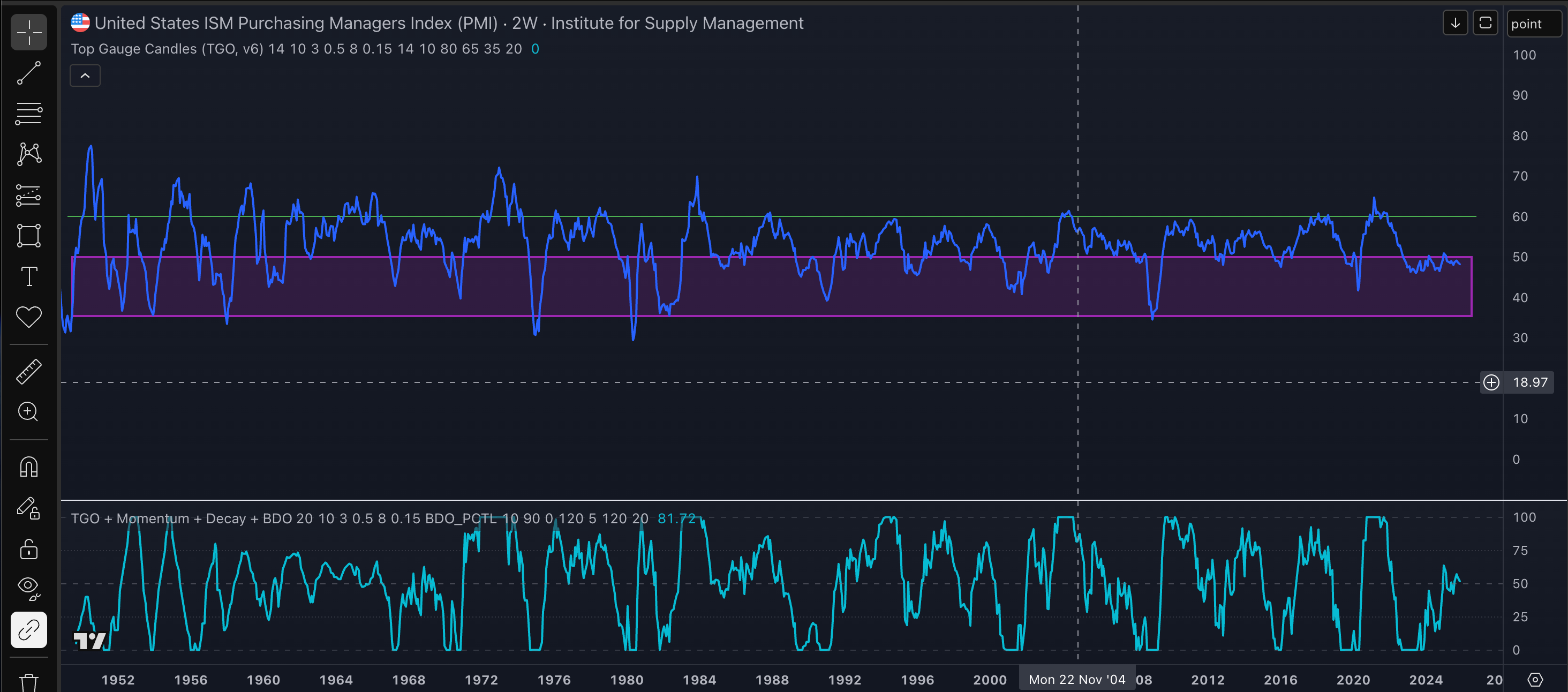
One could also argue that the business cycle has only barely lifted itself above the 50-line since its brief poke in 2024. Functionally, the economy has been operating in a K-shaped, quasi-recessionary or quasi-depressive state since 2022. A system that remains in that condition eventually has to resolve — and resolution tends to come through expansion supported by policy, not through a voluntary collapse.
With the current configuration — Trump’s assertive direction over the Federal Reserve, Treasury QE revitalizing the banking sector, and targeted mechanisms that stimulate lending and liquidity transmission — the more probable path is upward, not a plunge into an abyss. In practical terms, we are already over the cliff, and the policy response is pushing from behind rather than allowing gravity to finish the job.
Revisiting the Cycle Structure: 2000–2021, 2019, 2023, and the Current Setup
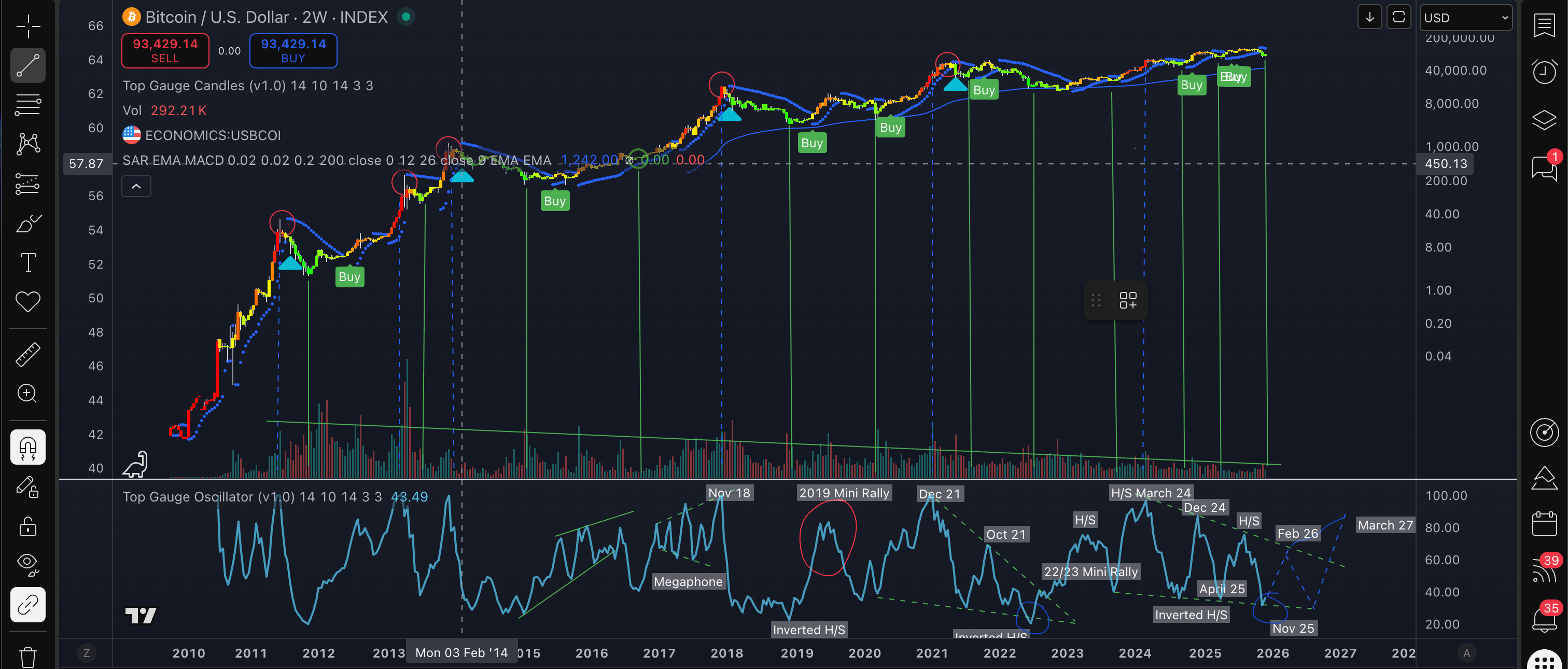
The 2000–2021 rally showed two major expansions before forming a decisive bottom in late 2022. But the periods that matter most for the present cycle comparison are 2019, 2023, and the unfolding structure from 2024 to now. When viewed beneath the main structural chart — specifically through the Top Gauge Oscillator — the parallels become harder to ignore.
2019 → mini rally
A sharp, reflexive move higher after severe overshooting to the downside, followed by a fade and a new structural reset.
2023 → mini rally
A similar compressed upswing driven by liquidity impulses and post-FTX reflex recovery, before rolling into another corrective phase.
2024–present → the third analogue (early 2026)?
The oscillator, and the broader structural context, point to two plausible paths:
A move toward ~108,000, followed by a substantial drawdown marking the true bear-market base; or
A 2019/2023-style rally, after which the bear phase begins in earnest.
Given the ETH structure — particularly the double top followed by a retreat to around $1,500 — the 2019/2023 analogue looks cleaner. Under that path, Bitcoin could reasonably extend into the $140,000–$180,000 range. Even so, prudence suggests de-risking into the $100,000–$105,000 region for BTC, and $4,500–$6,000 for ETH, while still keeping partial exposure in case the market behaves exactly like the 2019/2023 pattern.
Whichever path unfolds, the Top Gauge Oscillator still places us closer to a bottom than a top. A full cleansing bottom — if it occurs — would most likely form somewhere in the $40,000–$75,000 region depending on macro conditions and policy reaction functions.
Raoul Pal’s structural view (see this) — that the market could bottom here and transition directly into a new multi-year expansion into 2026 — is theoretically appealing but historically unprecedented in crypto. No cycle has ever transitioned into a new structural advance without first clearing out malfeasance, leverage excess, and risk-layer fragility. That cleansing process seems unavoidable, and I expect it to arrive.
The Macro Backdrop: Mind the Potential Gap
This leads back to the macro environment. A gap — should it appear — is less a risk than an opportunity. The dominant policy path is debt monetization via Treasury short-end QE, because financial repression has failed to discipline political behaviour. This is the replay of the post-WW2 template:
the 1940s–60s phase is effectively done,
and the system is now entering the 1960s–80s analogue.
In this phase, those who are leveraged are likely to lose their shirts. Those who sit in cash as that leverage detonates may find they lose their underpants through inflationary erosion. It is musical chairs now; positioning correctly before the music changes is essential.
No posts
Comments
Nothing yet. Say the first thing.
Sign in to join the conversation.