
DISCLAIMER: This is a long one. Grab a snack and your favorite drink, and buckle up. Time to strengthen your attention span muscles.
The chief of the lizard gang approaches, hunched and deliberate, a chipped blade hanging at his hip. His eyes blink out of sync as a crooked smirk spreads across his snout.
“Well, well, well… what do we have here?”
He takes another step closer. What do you do?
Now imagine you’re in this situation. You glance at your character sheet and see something like this:
Scalepiercer Dagger
+2 when striking scaled foes. On a 1-in-6, kill outright. If you succeed, gain advantage against similar enemies for the rest of the fight.
Or perhaps you see something like this instead:
Read the Threat
When facing a dangerous opponent, decide what you’re willing to risk—your composure, your position, or your gear. In return, learn one thing: their weakness or their deepest desire.
Same scene. Same lizard. Two very different approaches.
This is, admittedly, a bit on the nose. It also ignores a third approach: don’t look at your sheet at all—just act as you’d like. But for now, set that aside.
What I want to examine is how the way your character is framed through their abilities shapes the decisions you make, and ultimately, the experience you have at the table. And I think Ironsworn’s Assets are a great example of that.
Wait, before I continue, I guess I should clarify something.
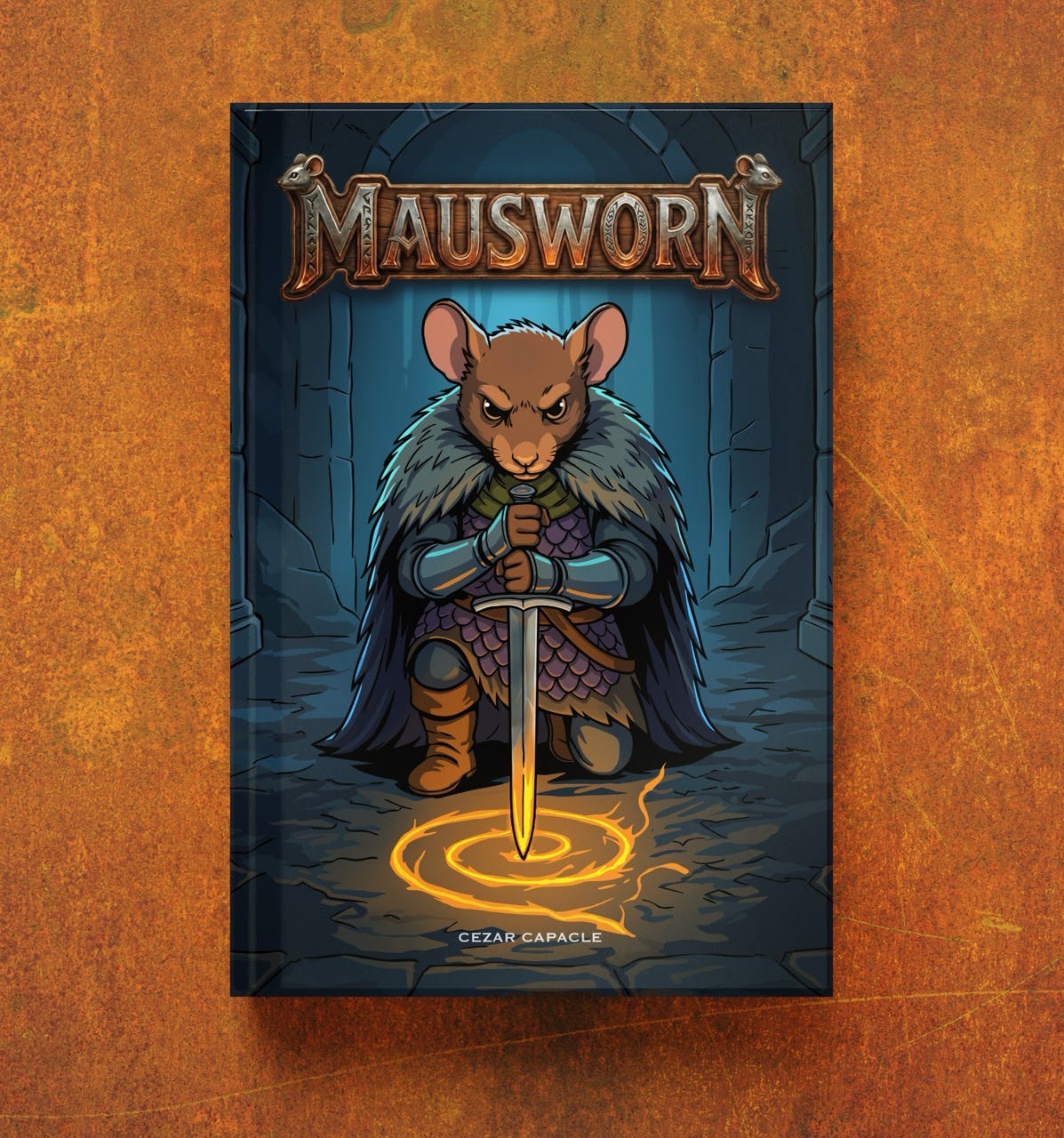
If you stumbled upon this article with zero context, I am designing a game that combines Mausritter and Ironsworn, and I am doing so in the open. Here’s part one and part two of the discussion, but you can also read the current draft of the game on a live document online, for free, here.
So where was I? Oh, yes. Assets.
Assets in Ironsworn are at the core of how you envision your character. So much so that, in later variants of the game (Starforged, Sundered Isles), you start character creation by picking your assets, and working your way back to stats, vows and other minutiae.
But what is an asset, you ask? Well, it’s better if I show you one. Here’s Cutthroat:
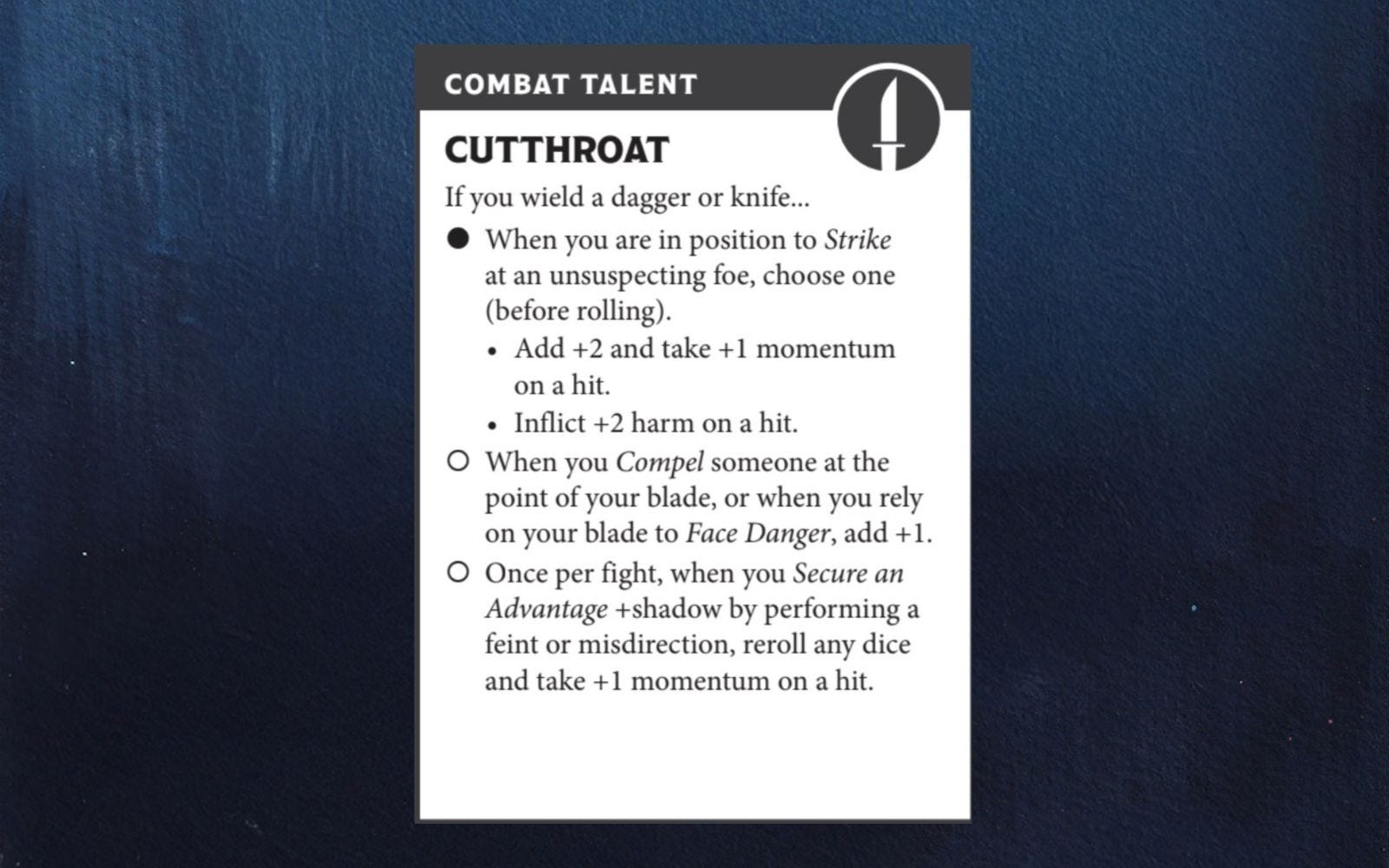
As you can see, an asset...
...is a standard-size physical card (this is important; let’s put a pin on it)
...belongs to one of many categories (combat talents, paths, companions, etc.)
...gives your character a series of abilities that allow you to do something (or do something better than others)
...has custom tidbits of rules, almost like custom moves
Many a hack of Ironsworn starts from this template, and their assets are often reskins of the original ones. And hey, there is nothing wrong with that. Assets are so powerful in defining what the vibe of your character—and your setting, by extension—is that a couple of choice changes in their wording are enough for you to play an entirely different game.
I love assets as they are, but from early on I knew I wanted to change some things about them for Mausworn.
Although I can clearly see the appeal of what I can essentially call a mini-game in each card (they remind me of TCGs, with rules-breaking additions in each of them), I feared that they would be too much to track, what with the addition of Mausritter’s inventory system, the whole crawling procedure I came up with (stay tuned for that one; can’t wait to share more), and all the other variables to keep in mind.
Also, I am just gonna say that, I am not a big fan of modifiers. I know, it’s silly, and I might come around some time in the future, but for now, I want to keep them to a minimum in Mausworn. So the classic asset benefit of ‘add +1 and take +1 momentum on a hit’ just won’t do it for me (not to mention the amount of times I have listened to people forgetting about this +1 momentum on the many actual plays I follow).
The delightfully cozy Iron Valley—an Ironsworn hack to play Stardew Valley/Animal Farm-esque adventures— gets rid of assets altogether in favor of Skills.
Well, in fact, you could say a skill is a minimalist asset.

Instead of providing a card with discrete, rules-altering mechanics, a skill has a description, and every time you perform an action that fits that description, you get a bonus of some sort.
So for example, the Farming skill reads:
Farming: This skill encompasses all elements of farm life, from hoeing to sowing, watering, and harvesting. If it’s got something to do with crops, it’s most likely farming!
In play, if you find a strange vegetable in the woods, it is up to you to decide if your farming skills apply, and grant yourself that bonus on your roll to identify it. Since there is no predetermined trigger for your ability, how much you can stretch the definition of farming is a conversation you need to have at your table (or an honest assessment by yourself, in case you are playing solo).
Simple, if a bit loose. Ideally, for Mausworn, I’d aim for something with a bit more precision. But how?
I started drafting assets for Mausworn some three months ago (gods, where has time gone?) and frankly, I explored dozens of avenues, some for a long while, some I just peeked around the corner and went, “nah”.
I’ll walk you through some of those here, highlighting what I like and dislike about them, and then present the current version I am working with.
If I you stick with me through it, I’ll wrap things up with a reflection about this journey that I believe might help you in your design adventures, whether Ironsworn related or not.
So let’s start with version A, which I am dubbing “The List”. Here’s a rough draft of the card (please excuse the stand-in generic graphics).
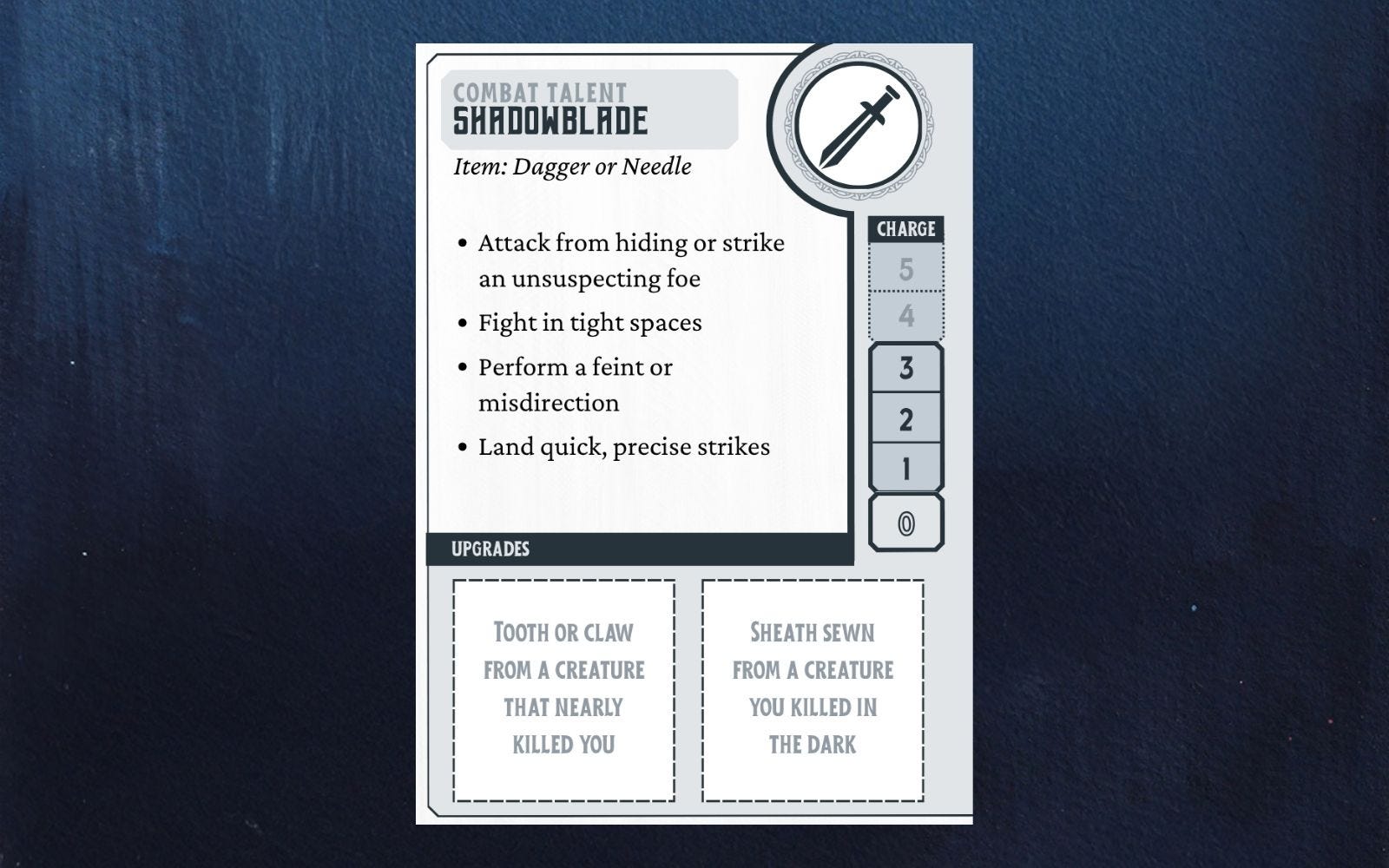
What I attempted to achieve here was:
Uniform mechanics. Much like skills, all assets will have the same benefit—they grant you a Boon (my version of an advantage-like mechanic) in relevant situations.
Guidance. An easy-to-scan list of situations in which your asset may apply. Although non-exhaustive, the list at least nudges you in the right direction.
Resource management. Enter Charge. Since assets are broader in their application, a cost to use felt right (foreshadowing). Essentially, you’d spend 1 Charge to activate your asset and grant you a Boon. Much like Fate Aspects, assets are always “on” in the sense that they keep informing who your character is and how they do things, but when you pay the cost, you bring it to the spotlight. You’d recover Charge on downtime activites.
Diegetic advancement. This is a fancy way of saying that your character advances through story beats instead of through a number. OG Ironsworn has you spending XP to unlock new asset abilities. In this version, you’d have slots for specific items that you might get a hold of during your adventures. Place one on your asset, your max Charge is increased by one (starts on 3, goes up to 5). This was also a flavorful way to mix Mausritter’s items with Ironsworn’s assets, which felt good somehow (keep this detail in mind).
I thought I had struck gold with this one. Early feedback on our Discord server, however, showed concern about Charge—namely, the fact that we would have yet another meta-currency to deal with (one that is not particularly easy to visualize in the narrative) on top of all the tracks and items and other stuff we need to juggle during play. Could be finicky. Could feel unsatisfying to see your asset simply drain out without a tangible story reason. Not ideal.
Oh, I forgot something important.
From this early concept, I also had the idea of burdening an asset, which meant placing a Condition token on the item slot. That would have the advantage of freeing up an inventory slot (if you know Mausritter, you know that conditions share the same limited space with items in your inventory, which is a big part of its resource management mini-game), but it would disable the asset while it was there. There was untapped potential there.
The sample size was less than ideal, but the feedback was enough to take me back to the drawing board.
Let’s try something different.
The diegetic advancement was well-received overall. Charge... not so much. Can I simply get rid of it and keep assets as always-on, Boon-granting abilities? I could.
But looking back at the list, I felt that it was not invinting enough. That is to say, a discrete list felt finite. It offered guidance, yes, but not much in the sense of picturing your little mouse and wondering “what does this say about them? How can I use it in other situations?”
So I tried something else. Here it is:
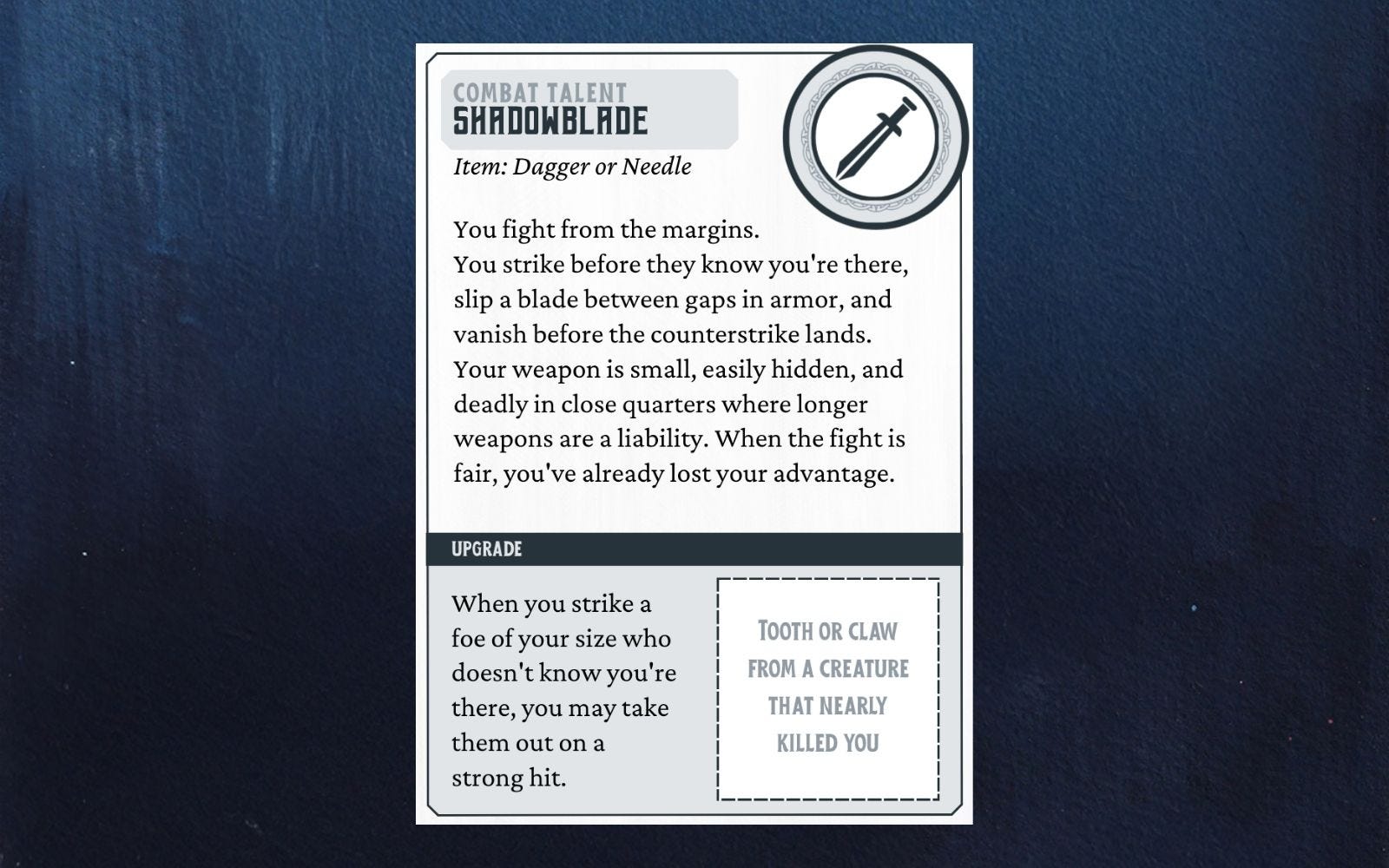
With this version, I aimed to offer:
Flavor. Instead of bullet points, a bit of text. The content is not that different, but my hope was that it would feel less constricted, if a tad harder to read at the table.
Limitations. That last line is doing a lot of heavy lifting. It shows you a boundary for the applicability of the asset. Not a hard line, but just enough to inform your guess. This would prove to be much more influential than I anticipated.
Mechanics. Perhaps contradictorily, this version came with a single upgrade (still diegetic) that offered a tidbit of specific mechanics. A nod to the OG assets, but instead of a numerical advantage, this version would grant something cool you couldn’t do otherwise.
Less bookkeeping. No more Charge meant your asset is always on, and one less resource to manage.
Burdening. I kept the idea of placing a condition token on the asset card to burden it. So you could lose access to your asset abilities, although not based on an arbitrary number, but rather on a fictional moment. Your injury keeps you from fighting like a master skirmisher. Your companion is knocked down and can’t help you until you tend to them, and so on.
To be candid, I didn’t know how I felt about that. So besides sharing it on Discord, I made a post on Patreon and opened an informal poll of sorts.
I am disheartened to report that the split was very close to 50/50.
Perhaps there is a lesson here about not outsourcing game design decisions, but we are not unpacking that here today.
Instead, I’ll just say that this result sent me back to my discarded notes and into a spiral-shaped rabbit hole of the wackiest ways one can design an asset card.
Before I reveal where I landed, let me share a couple of the odd balls I explored, even if briefly. I don’t know, perhaps they can be inspiring—if not, they serve as cautionary tale of how far you can go when you stick your nose too close to a game design problem.
This one I dubbed the “Memories/Experiences” approach.
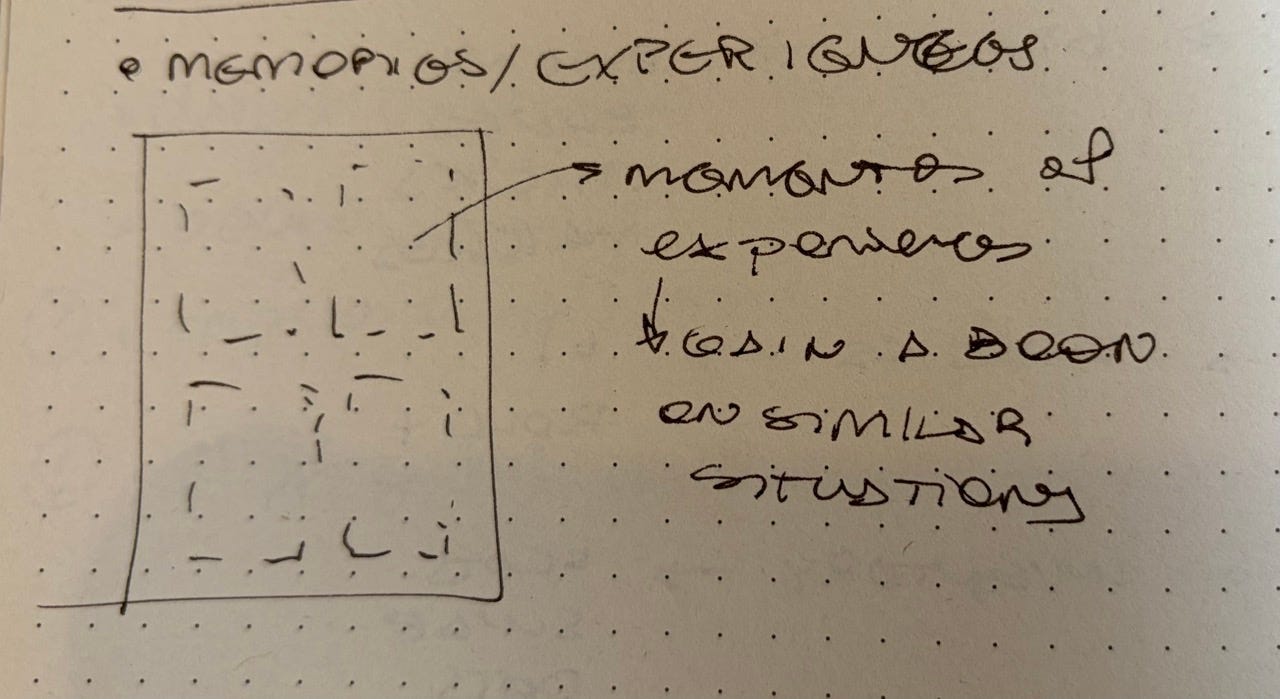
What if I leaned hard on the idea that Mausworn characters are untested (one of the truth pillars I established) and you’d start with a totally blank asset card?
You’d have its name, a short flavorful sentence, and four item slots.
When a situation on the road tests your asset in a meaningful way and you come through it, you take a token from that moment, a small memento that calls back to that circumstance. Place that token on an empty slot, and whenever a similar situation recurs, you’d have a Boon.
That was a tempting approach, if only for the minimal amount of work I’d have to do to create all the assets (it’s OK to confess you make some decisions out of laziness; some of my best work came out of such cases).
However, one important function of the assets would be neglected: envisioning your character. A blank card does not say much about who this mouse is, and it leaves a lot on the shoulders of the player to shape up what being, say, a Shadowblade meant.
So, not ideal.
I then went exploring the OSR domain. Since Mausritter has its roots in that space, it felt like a natural path to follow.
Mausritter itself does not offer much in terms of character personalization and advancement—your mouse is not expected to live that long anyway; and whatever image you form about them is based on their background and the items they carry. Other OSR games carry their own set of abilities, talents and even feats. I liked the approach of some of them, but they still didn’t feel quite right.
What did inspire me was the spell generation in Maze Rats (the name is a coincidence; you don’t play actual rats—as far as I know). Basically, you roll a combination of words and interpret what they mean. In essence, no more than a good old Oracle roll that we solo players know and love.
So this is what I called the “Oracle” approach.
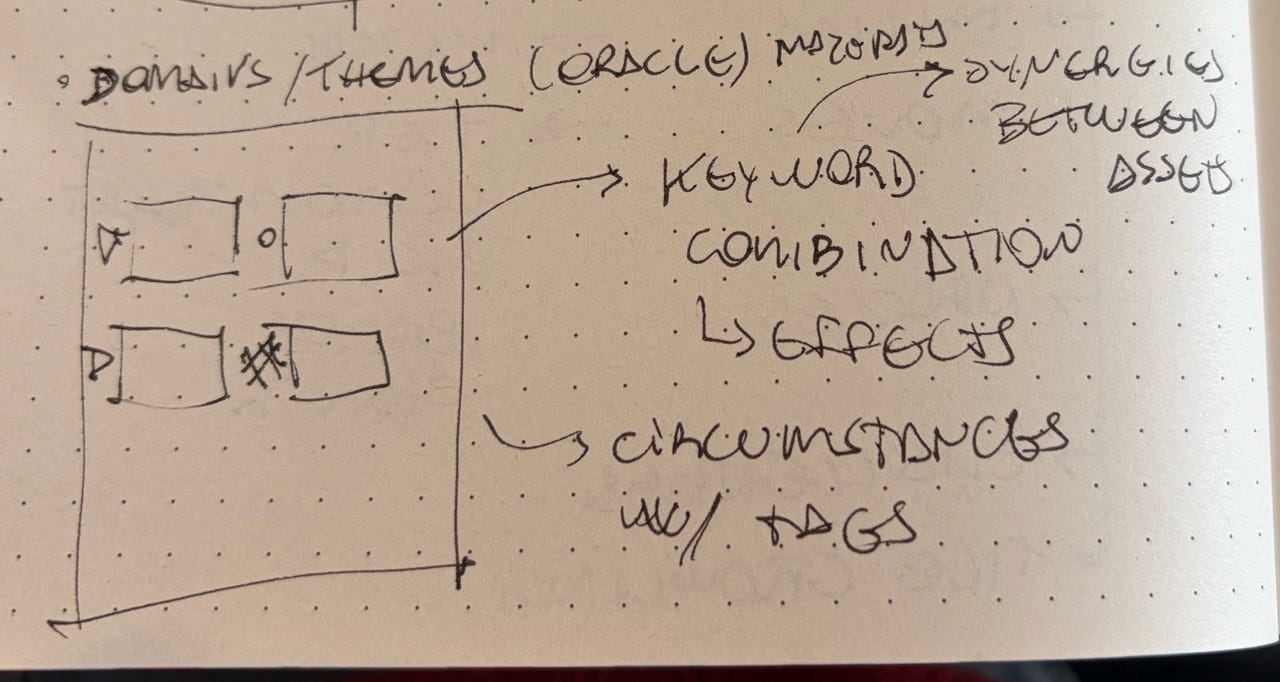
You’d have an asset with a bunch of keywords (perhaps some unlocked by default, others that you’d unlock with advancement) and you’d combine them to create effects. If you could justify the interpretation of your word combo as applicable to the situation, you’d have a Boon.
That opens the door to all sorts of exploits, but I never jerk-proof my games anyway (if you play TTRPGS to find loopholes and “win”, that’s on you). It also offered the opportunity for some cool synergies between assets: imagine combining keywords from two different cards to create a special maneuver? Sounds fun.
Then I went, “what if the scenarios had keywords too? What if you needed your asset keywords to match the ones in the scene to create effects?”. Oooh. Perhaps we could have some world-level domain keywords, perhaps with symbols, and then we would match the symbols for interesting combos, and then...
And then... and then I realized I was making a different game. Scratch that.
I confess a large portion of the reason why I am writing this very article is to answer this question. As I am typing this, I still have neither a title, nor an intro. Nor a point to make, really. By the time you are reading this, it is my hope that I will have figured that out, and you’ll feel that I knew what I was doing all along. That is the magic of editing, folks.
Why am I redesigning assets so much? What am I looking for here? Ok, I established they are crucial to envisioning your mouse, but that can be accomplished with almost any of the approaches. Including keeping them as they originally were in Ironsworn.
So I took a step back.
Amidst this identity crisis, I was reminded of a very basic tenet of game design, which is to ask:
What is this game about?
And, with that answer, check if the rules you put in place actually help or hinder your game in accomplishing this goal.
Because if you state that your game is about personal horror and identity, but your rules focus on the rate of fire of machine guns, well, guess what your game is going to be about? The purpose of a system is what it does.
See, when you spend too much time working on a thing at such a high level of zoom, you get the feeling you are designing it in a vacuum. But assets, as important as they are, are but a cog in the machine, and the best way to evaluate a cog is to zoom out and check if it's serving the machine's intent.
And one good way to check that is to see what kind of behavior it is incentivizing.
Side note: somewhere in the past few years saying that rules are meant to influence player behavior became controversial? That sounds absurd to me, as I think all rules (in games or in a society) are created to model behavior through incentives or punishment (and even as an invitation to question or break them), so I’ll just assume this interpretation here, cool? Cool.
So, how do I want assets to feel in play? What meaningful decisions am I offering the player? What moments does it help brew?
As I worked through these questions, I kept coming back to a simple checklist I use for what makes a rule worth keeping:
They don’t get in the way
They reinforce what your game is about
They are fun to play with as a “toy”
You are a mouse adventurer. Life is harsh out there. You have to lean on what you are good at to maximize your chances of survival. But what you are good at often reveals what you struggle with too. In other words, your assets also show your liabilities.

Going through my notes, I found a gem.
When the Mausritter SRD came out and I got excited to hack it, my first idea was to make it a Belonging Outside Belonging game—or at least to use the No Dice, No Masters engine.
If you are not familiar with the system, I definitely recommend you check out Dream Askew, Dream Apart, Sleepaway, Orbital, and Wanderhome.
But for our purposes here, I’ll focus on the token economy.
In short, your character playbook has:
Strong moves. You spend a token to perform an action that shows your character at their best, moving the story forward in their own terms.
Neutral moves. You neither spend nor gain a token. These are actions your character can always take, and they serve as prompts to remind you of what the game is about.
Weak moves. You gain a token to show your character in a moment of vulnerability, or failure.
I am oversimplifying it, but that’s the gist. I soon abandoned the idea of making my hack a full BoB game, but when revisiting that note, I thought I could find a place for it in my asset design.
What if I could keep assets simple (“They don’t get in the way”), lean into the ebb and flow of being at your best and at your worst when facing the unforgiving wilderness of a vast world (“They reinforce what your game is about”), all the while taking advantage of the physicality of assets as cards (“They are fun to play with as a ‘toy’”)?
Here’s where I ended up with:
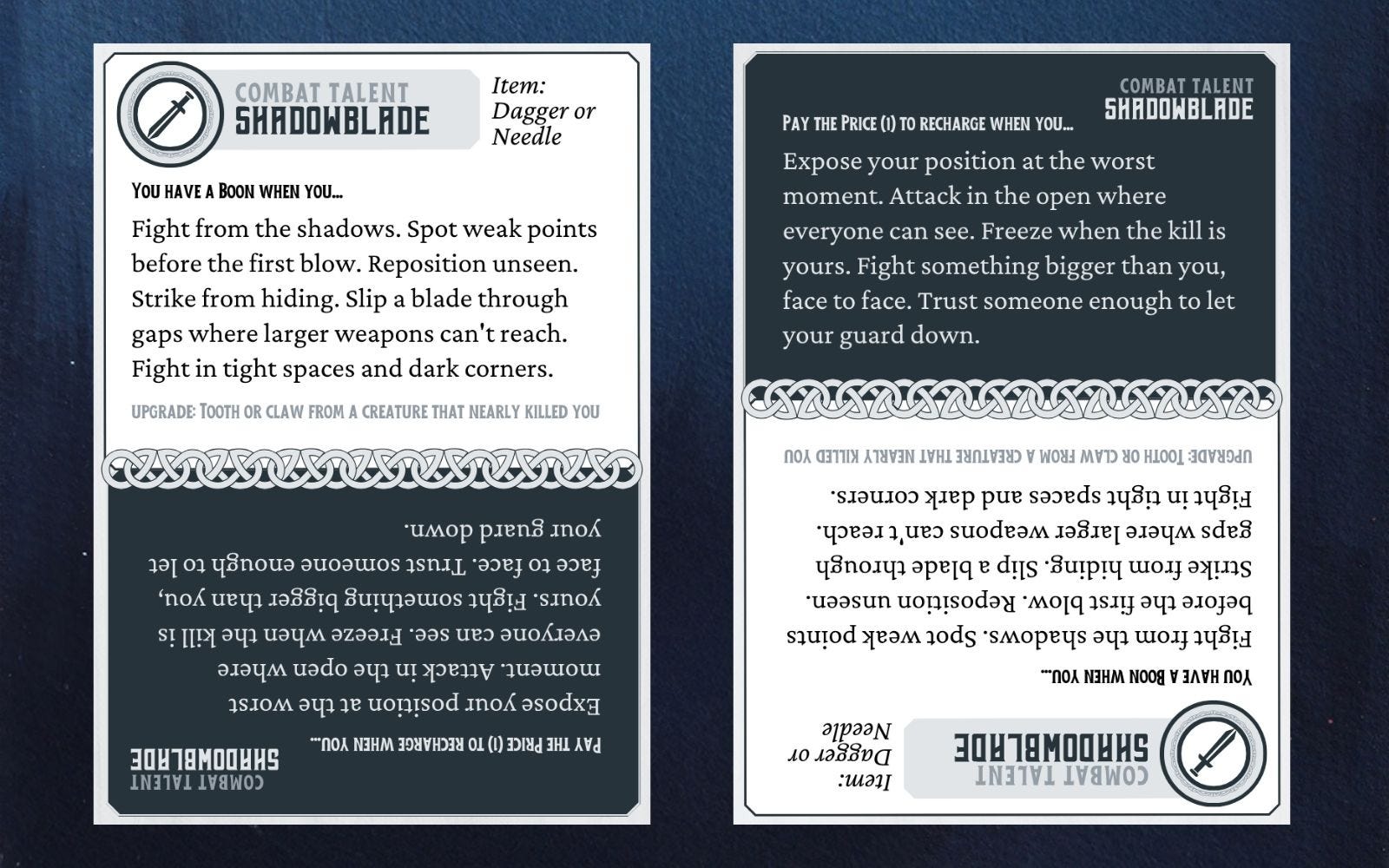
What I believe I achieved here was:
A middle-ground. Not exactly bullet points as version A, not exactly a flavorful paragraph as Version B. Any situation you feel your asset would grant you an edge, you have a Boon.
A story beat. When something goes wrong, you may choose to spend your asset: rotate it 180º. Now it is unavailable until you Pay the Price and frame one of the suggested circumstances in the fiction. When you do, flip your card back and the asset is available to you again.
A tactile reward. Flipping cards feels good, I don’t know. It’s like turning a key. It carries some weight.
If there is still anyone reading this with any level of interest or focus (or even hubris—I appreciate you in any case), you’ll notice that this version does not have item slots. I tried. Trust me, I really did.
The solution for this is enough game design rambling to warrant its own article, but for now it suffices to say that I moved them to the character sheet, using the prime real estate that was once only reserved to place your asset cards on to.
It allowed me to keep the diegetic upgrade and burdening approaches, and served as a backup tracking device in case you misplaced your asset cards.
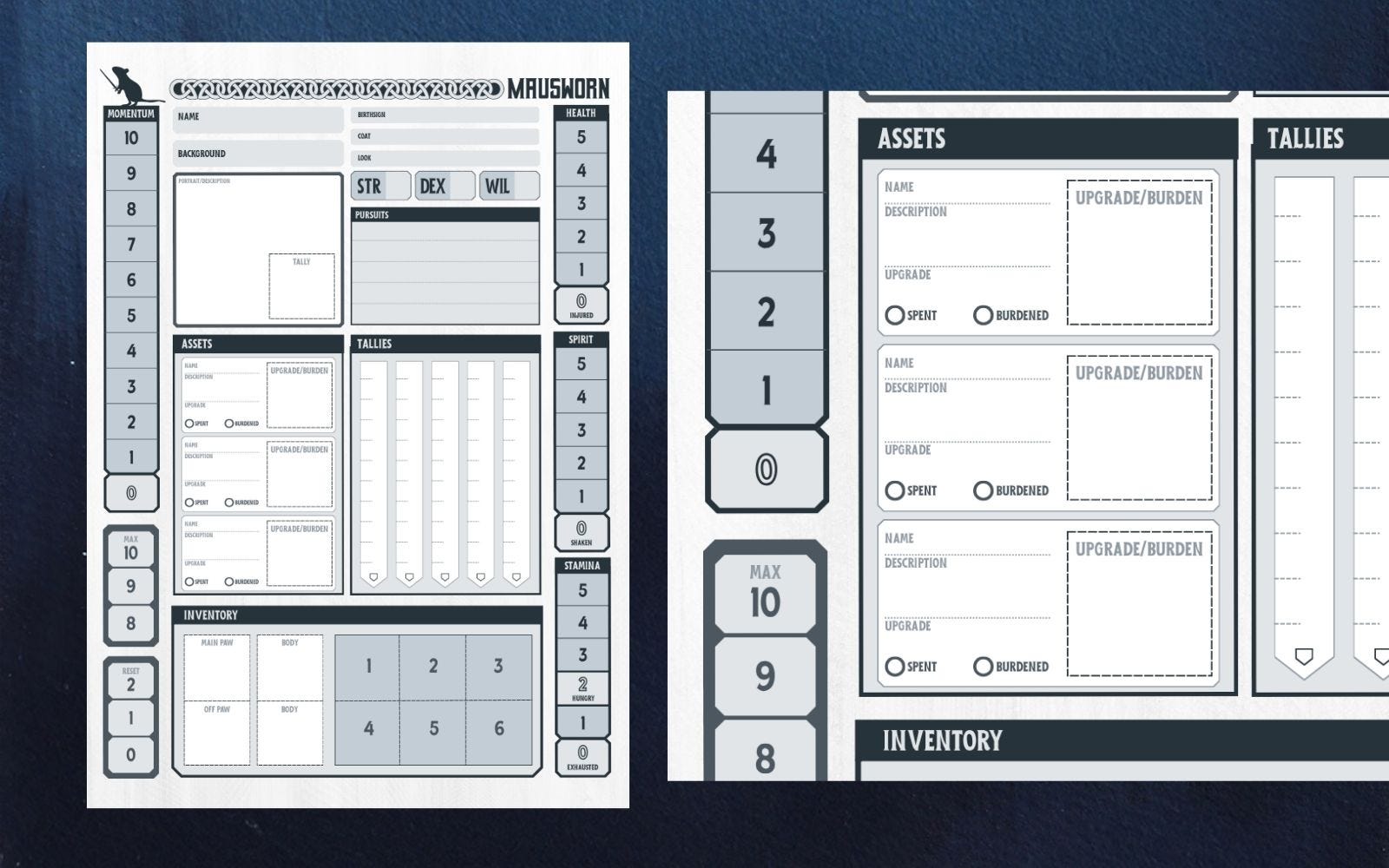
Is this the final version of assets?
I seriously doubt it.
There is still a lot to define. Fine-tuning the wording will be tricky. What upgrades mean for this version of assets, I am still not sure.
But it’s close enough to how I picture the experience of playing Mausworn that I’m allowing it to stay. For now.
I can see the rhythm already: you do something cool because of your asset, and then your very nature brings about a complication that makes your friends around the table face-palm with a half smile and go, “Oh no, here we go.” Those moments. I live for those moments.
And then you look at your own character sheet, see those assets inviting you to step into the spotlight yourself, and you can't wait for it to be your turn to answer:
So, what do you do?
If you made it to the end (phew, what a ride. Thank you!), I want to remind you that Mausworn is coming soon to BackerKit, and it would mean a lot to me if you could follow the page right now to show them that people love the idea!
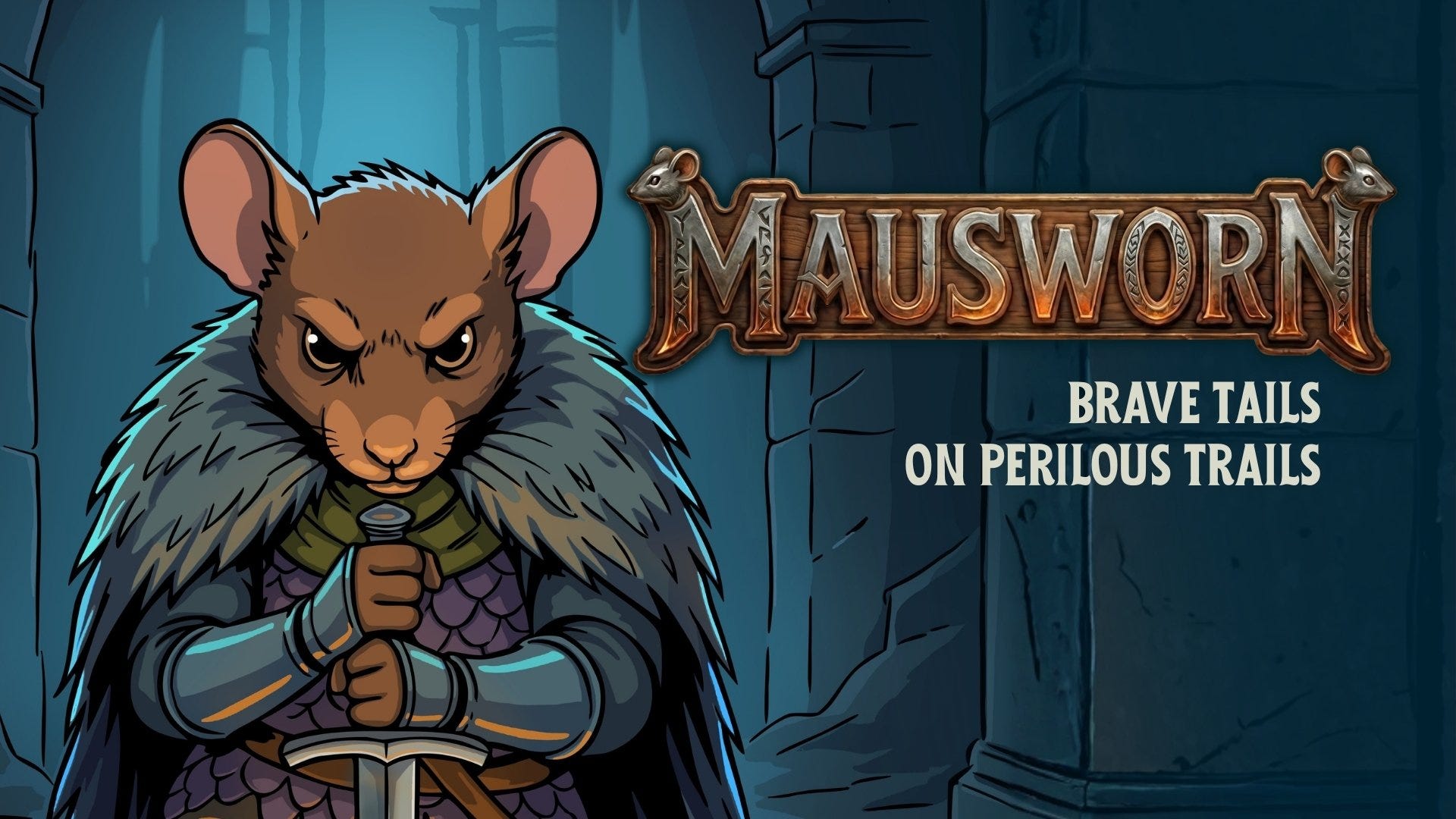
I am planning a bunch of cool rewards and trinkets, while offering the unique experience of watching the game being refined as we go, with the chance to chime in with your impressions as well!
Finally, a big shoutout to all the kind people on our Discord and on Patreon that offered feedback and ideas. You are the real ones.
No posts
Comments
Nothing yet. Say the first thing.
Sign in to join the conversation.