
I remember my first week at architecture school. An eccentric professor walks into the classroom and gives us our first assignment:
“Design a cat with wings”
He did not elaborate.
The only requirement: the cat should be able to do all its cat things—the wings couldn’t get in the way of its “catness“.
You should see the look on our faces. A bunch of 18-year-olds, dumbfounded, not knowing how to start. For the following two weeks, we got together discussing what kind of wings it should have. Some people went with bat wings, some adapted wings of birds of prey.
When the day arrived to submit the assignment, we approached the professor to ask which type of wings would be best for a cat. His answer:
“Well, it’s obvious. It should have cat wings.“
Back to the mice
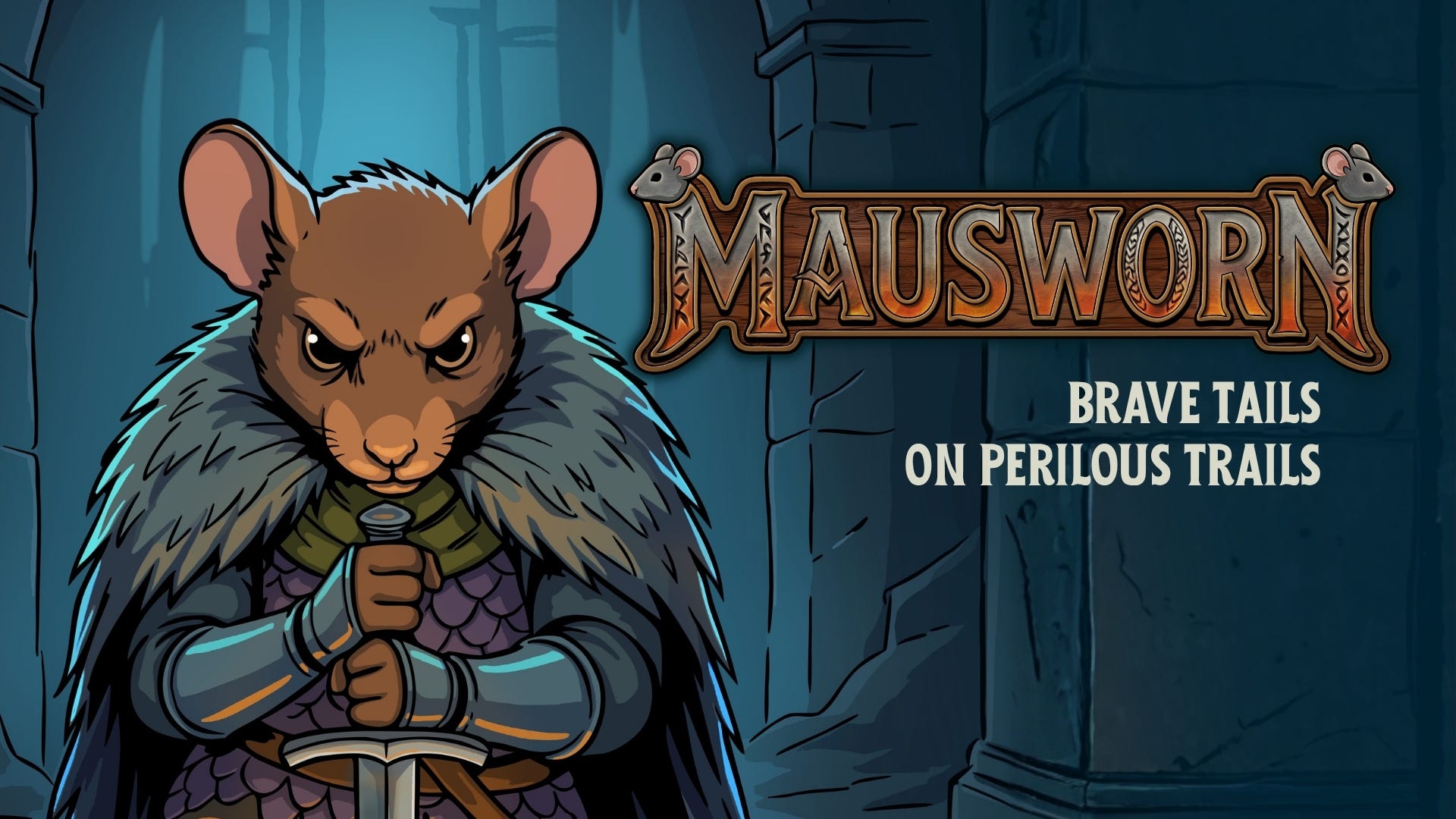
It has been nearly a year since I announced here that I was working on a game that aimed to combine my favorite bits of Mausritter and Ironsworn into its own new thing that I had no other choice than to call it Mausworn.
(Side note: the sharp-eyed among you will notice that I changed from “Devlog” to “Design Diary”. Is there a difference? I don’t know. Diary feels more... romantic, somehow. So I’ll stick with it. Okay, back to the thing)
Since then, I got invited to participate in the Mausritter Month Companion Jam, which got me really excited to work more in the game. But when the deadline came, the only thing I was able to produce was a new cover art. Which… was no small feat, if I am being honest. From a 3-hour effort to a 3-week marathon, it is my hope that it paid off.
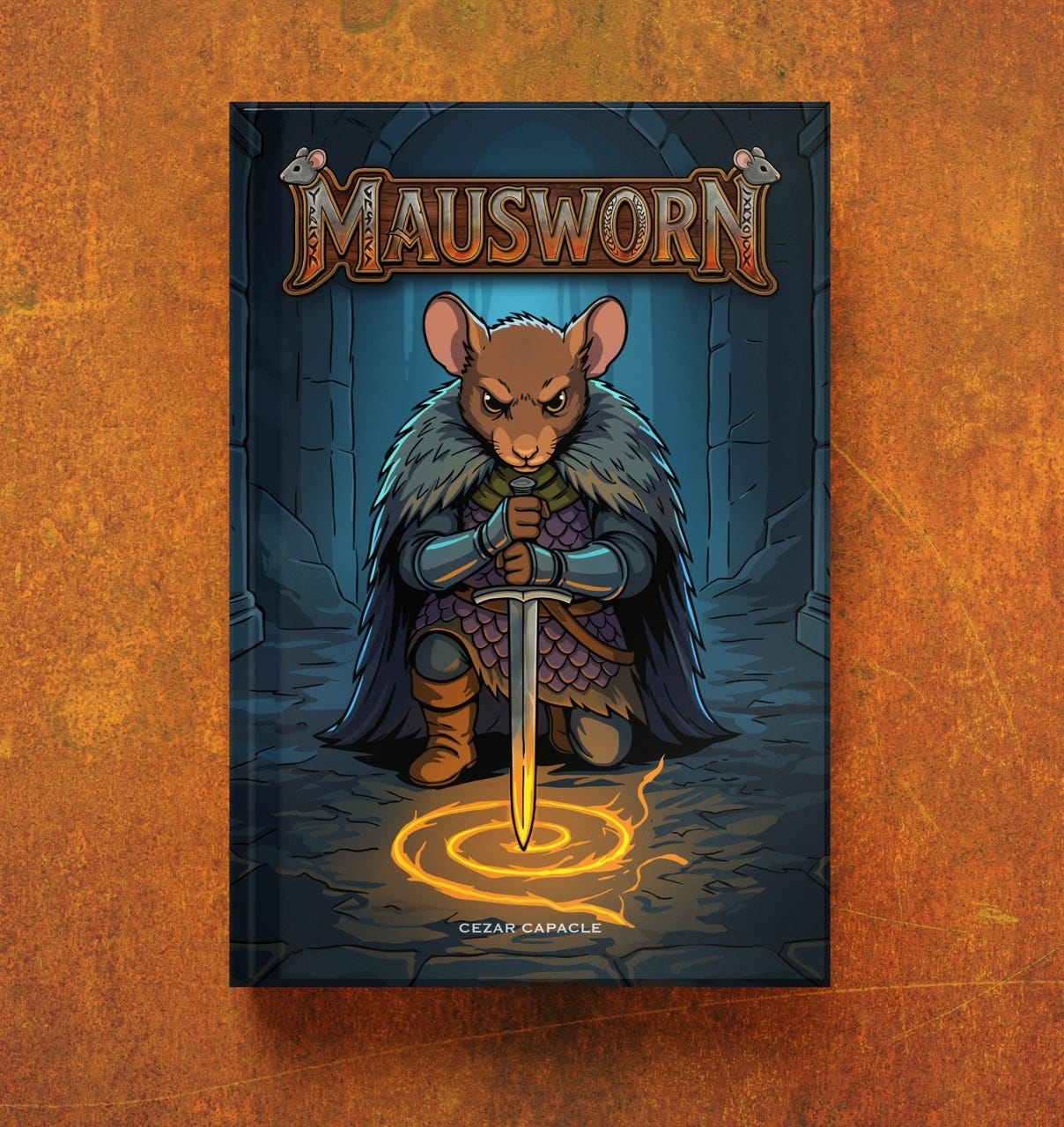
Ok, that’s not totally true.
I worked a lot in the game. What was announced here as essentially a blank document with chapter titles is, as we speak, filled with 27,656 words of actual game material. However, it hasn’t left its pre-alpha state.
And that’s what I want to talk about.
What if 1+1=0?
The idea was very simple (although, in hindsight, a better word would be naive): grab the vibes and the inventory system from Mausritter, and the core mechanics from Ironsworn, mix them well and voilà, here’s your new game!
I am not new to remixing existing games and SRDs. Of the more than 40 games I published, a considerable amount came straight from other people’s SRDs mixed with my own ideas. And the other ones, in one way or another, were inspired by numerous other projects, and not rarely from very different play styles.
However, this one is different. It’s the first time I am intentionally fusing two games into a new one. I feel like a kid smashing their action figures together and saying “now kiss“.
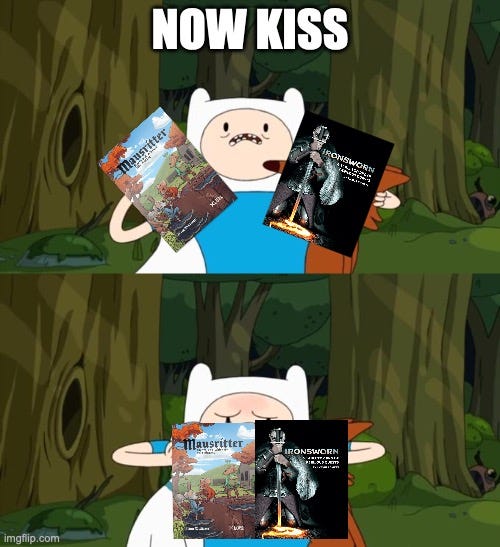
Combining two games that have very different design philosophies and intents is, as it turns out, quite challenging. But also, a lot of fun. Just to illustrate, here are some of the head-on clashes I spotted early on:
One game doesn’t even track currency; the other has it as its major reward system.
One game hand waves distances and passage of time; the other has precise tracks for rounds, turns, watches.
One game is designed for solo; the other relies on GM adjudication.
One game is based on precisely worded packets of mechanics for every single interaction; the other considers reaching for the dice a bad idea.
I could go on. But let’s zoom in on the last one: the dice. More specifically: moves.
What even is a move?
If you played a PbtA game before, chances are you are familiar with the concept. A move is a little packet of mechanics that contain a trigger, a resolution, and a set of predefined outcomes. It goes something like:
When you (try to do X), roll (or draw, or check, or ask). On a hit, you… On a miss, you…
It is a neat little technology that allows you to imbue the situations you expect to come up in play with the specific flavor you are going for.
I knew from the beginning that I wanted to use moves, although I promised myself I wouldn’t go overboard with the number of moves. Ten, maximum. (Narrator: He did not, in fact, keep it under ten moves).
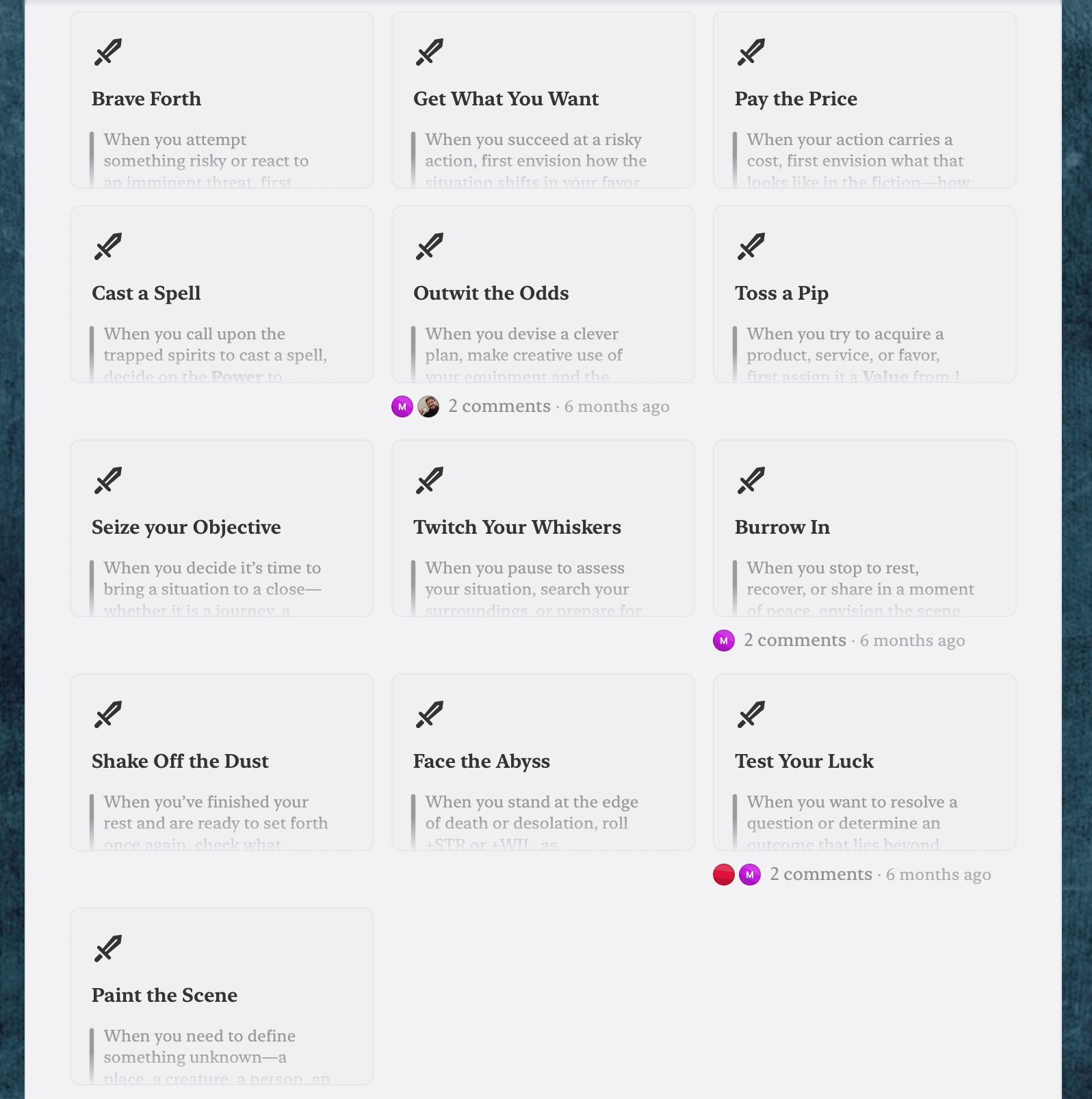
It started well. My catch-all move is called Brave forth (I really like this name), and it is the one you make for most risky situations. Brave forth unfolds into two other moves: Get what you want and Pay the price—essentially, two pick lists of benefits and costs, respectively.
Easy and elegant. You roll well, you choose your advantages and opportunities. You roll badly, you pick how you are affected.
From then on, our little mice start tripping a bit.
The first challenge was translating the deliciously funky magic rules from Mausritter into a move. Cast a spell went through at least five iterations before arriving at its current form. Toss a pip, my move about negotiating and acquiring goods and services, was rewritten seven times.
Burrow in, the downtime move, revealed so many intricacies that resolving it involved revisiting how resources were managed in the game.
It was clear that it was not a matter of adding one game to the other and making a new one. I should treat them as source material, but I was essentially starting from scratch.
But that was the moment everything began to click, and I felt a surge of confidence—enough to risk what some might even call blasphemy.
Subscribe for free to receive new posts and support my work.
Ok, I am pretty sure I know what I am doing
Mausritter states in its best practices:
Dice are dangerous. Clever plans don’t need to roll.
Now, how do you translate such a statement into the Ironsworn engine?
Well. I turned it into a move.
(Yes, I encapsulated an OSR principle into a PbtA move. Please don’t sue me.)
Here’s an excerpt of Outwit the Odds:
When you devise a clever plan, make creative use of your equipment and the environment, or coordinate a smart team effort, evaluate the impact of your idea—how effective, plausible, and well-timed it seems.
Then, choose one benefit from the list below.
You gain a Boon (…).
You reduce the risk (….).
You skip the roll (…)
You bypass the challenge entirely (…)
If you’re unsure how effective or plausible your idea really is, you may choose to Test Your Luck.
Yes, a clever plan won’t require a roll, or it will at least make it easier. I guess that was always implicit, but for a game that can be played solo, an explicit permission to avoid rolls felt necessary.
And you’ll notice that if you are not sure, instead of asking the GM and waiting for the “Sure, I’ll allow it“, you instead Test your Luck—which is essentially how you answer a yes or no question with the dice.
I love that.
The concept of skipping a roll became a core design decision for this game. Essentially, at any point that you feel a task is not particularly risky, but that there should be a cost, you can skip it: Pay the Price and get it over with.
Searching a room? Sure, lose 1 momentum to reflect the time spent and you did it. Moving a rock out of the way, but you have no interest in the potential snowballing ramifications of a miss? Spend 1 stamina and move on.
I. Love. That.
The mouse moves and the cat flies
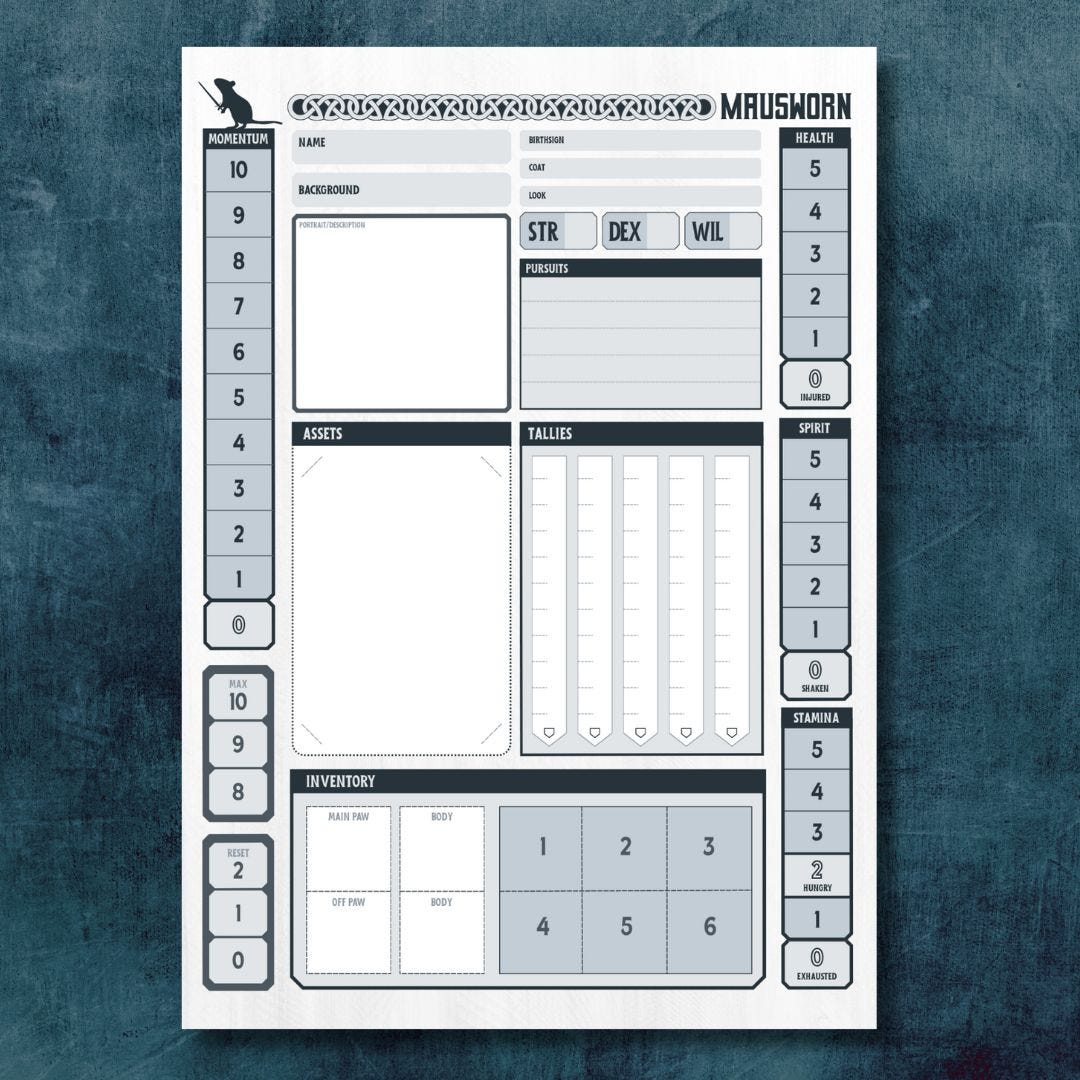
I could show a number of other examples where the conflict between play styles offered the most interesting design spaces. The introduction of Stamina as a resource. The new Conditions. And I didn’t even mention my favorite new mechanic: tallies—a solution to progress tracks that surprisingly became a central part of the lore of the game.
Perhaps all of this sounds obvious to you. Of course I’d have to adapt rules to make them fit together, right? But it is more than that. It is more akin to a chemical reaction. When I put A and B into my pot, I didn’t get AB. I distilled C.
It was never a matter of picking the Mausritter solution, or the Ironsworn one. I had to find the Mausworn approach. I had to design cat wings.
Final words
It’s been a fascinating process (that, I remind you, you can follow along for free, since I am developing it in the open on an online document) and I am super excited to announce that Mausworn is coming to BackerKit this summer.
The teaser page is up, and I’d love it if you could give it a follow. This is shaping up to be my most ambitious project to date, and I have a lot of cool things planned for it. Spread the word of the mouse! 🐭⚔️
Comments
Nothing yet. Say the first thing.
Sign in to join the conversation.