
The One-Page RPG Jam snuck up on me this year. I participate in every edition, but I almost missed it this time. Mausworn development has been taking up most, if not all, of my time these days. But in the final few days of the jam, as it happens every now and then, I was possessed by an idea and I had to see it through.
This time around, it started with a mechanic I wanted to explore. And although I love how it turned out, it ended up not being the most interesting thing I came up with. In fact, the part of the game I’m proudest of came very late in the development.
Not too long ago, I was reading an article by Clayton Notestine about his idea of doom rolls and how it worked with his experiment of a 1 HP dragon. As I read it, I immediately started spinning ideas on potential hacks and applications. It was very inspiring.
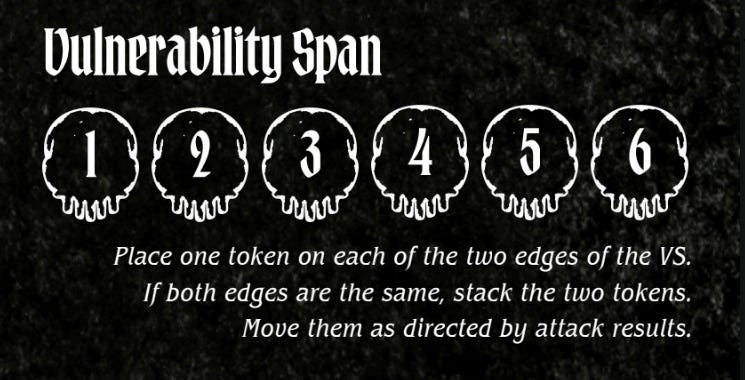
After some frantic scribbles, what I came up with was this: a mechanic where when you gain Stress, you make a Stress Check. If you fail, you gain a Wound and make a Wound Check. Fail again, you gain Ruin and make a Ruin Check. Fail that, and you die.
That’s an oversimplification (there are limits, recovery and other finer detail), but I was really intrigued by this cascading spiral of complications.
And then, looking at it, I started thinking about what setting would suit that soul-crushing spiral. What kind of experience is so stressful that every move can hurt you or outright kill you?
Crawling through the rotting carcass of a horrid leviathan, of course.
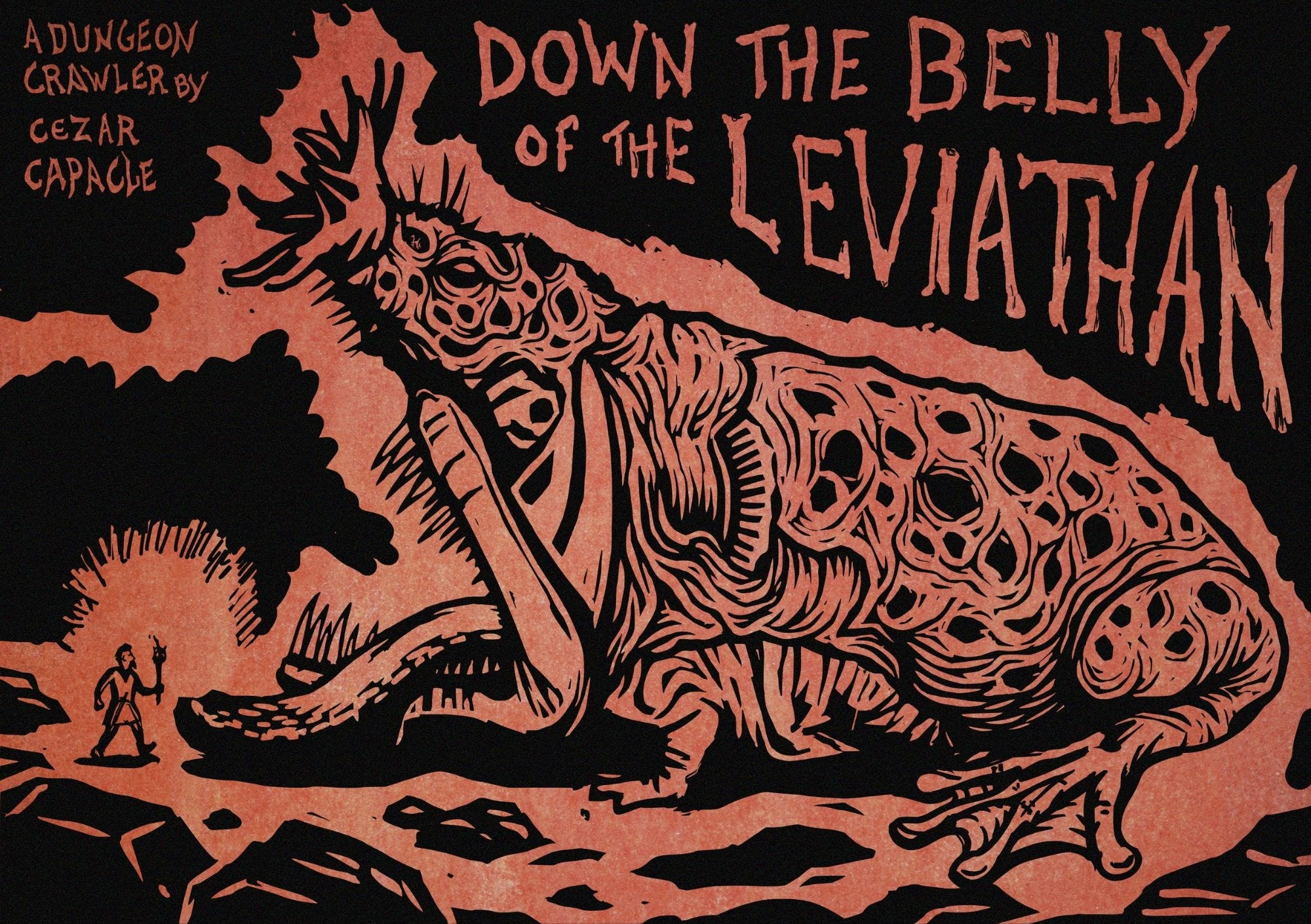
(Fun fact: to draw that, I photobashed images of an anglerfish, a star-nosed mole, two frogs, a naked mole rat, and a dude with a torch, then drew over it. I shared the process picture on Bluesky, but it is quite unnerving. Viewer discretion is advised.)
With the theme in mind, I started rolling the dice, and the playtest proved as cruel as intended. But something was missing: the initial trigger. What gives you Stress? Besides, well, the whole aforementioned corpse-crawling experience.
I toyed with gaining Stress even before you made a roll, but that proved easy to forget and a tad unsatisfying. Stress should be a consequence.
Since this was going to be a solo game, I decided to fold the act of attacking and being attacked into a single roll. When you miss an attack, that gives you Stress. You’re now open to a counterattack, you’re in a bad spot, and that triggers the cascade. Simple enough.
But what is the attack roll to begin with?
I first tried to come up with something that mimicked the other checks, because whenever possible I try to go for this kind of symmetry I appreciate so much, where the mechanics, although not the same, are at least derived from a core concept you can observe throughout. But I couldn’t quite pull it off this time.
I could have made my life easy and just gone with the classic roll-plus-modifier vs. target number. But that felt… lazy, especially compared to how the other pieces of the game were more evocative and satisfying.
Besides, it’s the One-Page RPG Jam, which is such a fantastic, low-stakes opportunity to experiment with wilder ideas, even if they turn out a bit broken in the end. It’s in games like this that you take risks and try to push boundaries.
So it was back to the drawing board for me.
As I try to retrace my steps to tell you how I came up with it, I realize I don’t know exactly when the idea hit me. I remember experimenting with enemies having two stats that could be reasonably generated at random with a d6. Perhaps you could reduce one, but it would increase the other, making the creature easier to hit but at the same time more dangerous. I was going for a sort of self-balancing mechanism.
At one point I thought: what if instead of a target number, we had a target range? And what if this range were dynamic?
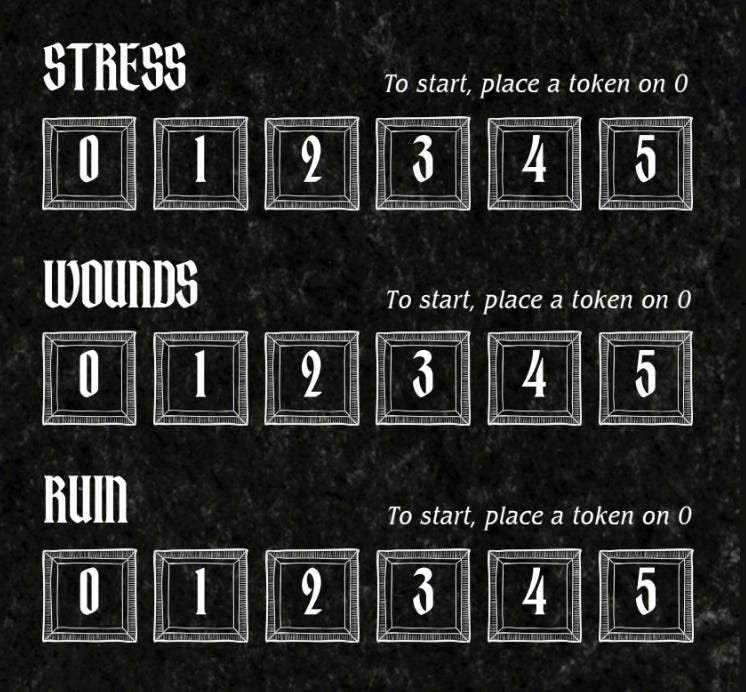
And so the Vulnerability Span (VS) was born. You roll 2d6, and the results are the edges of the span. Say you roll a 3 and a 5, so the VS is 3–5.
When you attack (which is a single d6), if you roll one of the edges, it’s a one-shot kill (called Slay in the game). You defeat the creature and get an amount of Gold equal to the number you rolled.
If you roll inside the range but not on an edge, it’s a regular Hit. You can decide to finish the creature, but you only get one Gold. Instead, you may choose to keep fighting and replace one of the edges with the number you rolled. That’s the dynamic part.
If you roll outside the range, it’s a Miss. You replace one of the edges with the number rolled, and you gain one Stress, triggering the cascade. Stress, Wound, Ruin.
Beautiful.
I started playtesting this idea and very soon realized it was extremely fun. In a way, the VS emulates how a creature can become more defensive after a hit, or more confident and exposed after you miss. A wider initial VS might mean you ambushed your foe. A tighter could represent it in full guard.
Tracking it with tokens makes this feeling tangible and visible. And there’s a push-your-luck layer on top: do I take the kill now, or try to get more Gold? Do I widen the span to make it easier to hit, or narrow it for a potentially larger reward?
Suddenly, what was almost an afterthought, just me playing with the liberty of experimentation on a one-page game, became the central part of the design. It made for a quirky, unique* combat mechanic, one that I feel has potential beyond what I was able to explore here, and that suited the vibe I was going for precisely.
It almost didn’t make it into the game. And now it’s the part I like the most.
*As I always like to point out, I’m not claiming to have invented anything here. Originality is a chimera, everything is a remix, and as my professor used to say, if you think you’ve had an original idea, it’s just because you didn’t find the source yet.
There are more details to the game that don’t fit the scope of this newsletter, otherwise I’d just be transcribing the whole thing. But there are many parts I’m very happy with. How you can only exit through the cloaca or flee by clawing through the flesh. How you recover and gamble to find another leviathan, because they dissolve after you leave them. How it’s a sort of competitive game where you keep a high score of Gold across single and multiple delves.
All of that made this entry one of my favorites I’ve ever made for the jam.
It’s a dungeon crawler, nothing fancy, barely more than a board game experience. But oh boy, is it satisfying. I’m so glad I took the jump to push boundaries and experiment with mechanics. I might have to revisit it soon for a larger release. Who knows.
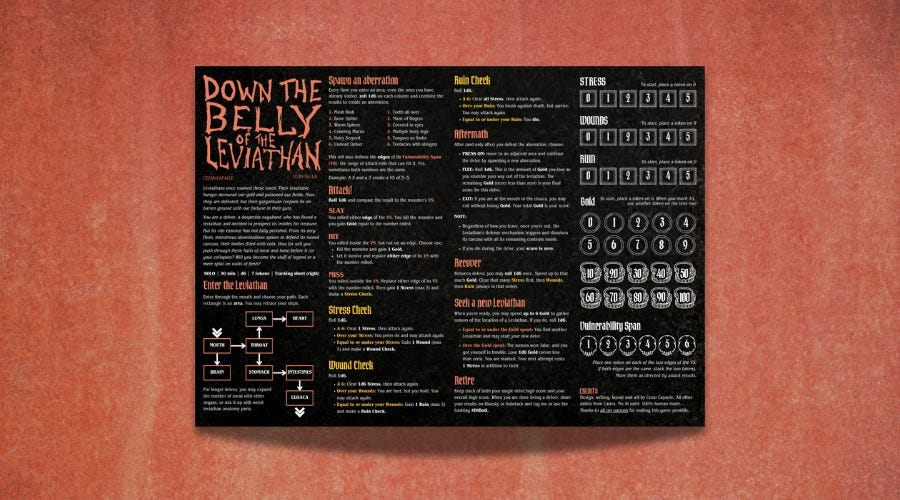
If you like the idea and want to give it a shot at retrieving gold from the insides of a leviathan corpse, you can get it here.
It’s still on launch sale for a couple more days, so it’s literally less than the price of a cappuccino.
No posts
Comments
Nothing yet. Say the first thing.
Sign in to join the conversation.