
This is the second in a six-part series on what education would look like if it were designed for human flourishing. Start with Part 1.
New data dropped this month. The Educational Opportunity Project at Stanford released district-level test scores for most of the country, and the numbers aren’t good. Reading scores fell last year in 83% of school districts compared to a decade ago. Math scores fell in 70%. In one in three districts, kids are reading a full grade level below where they were in 2015.
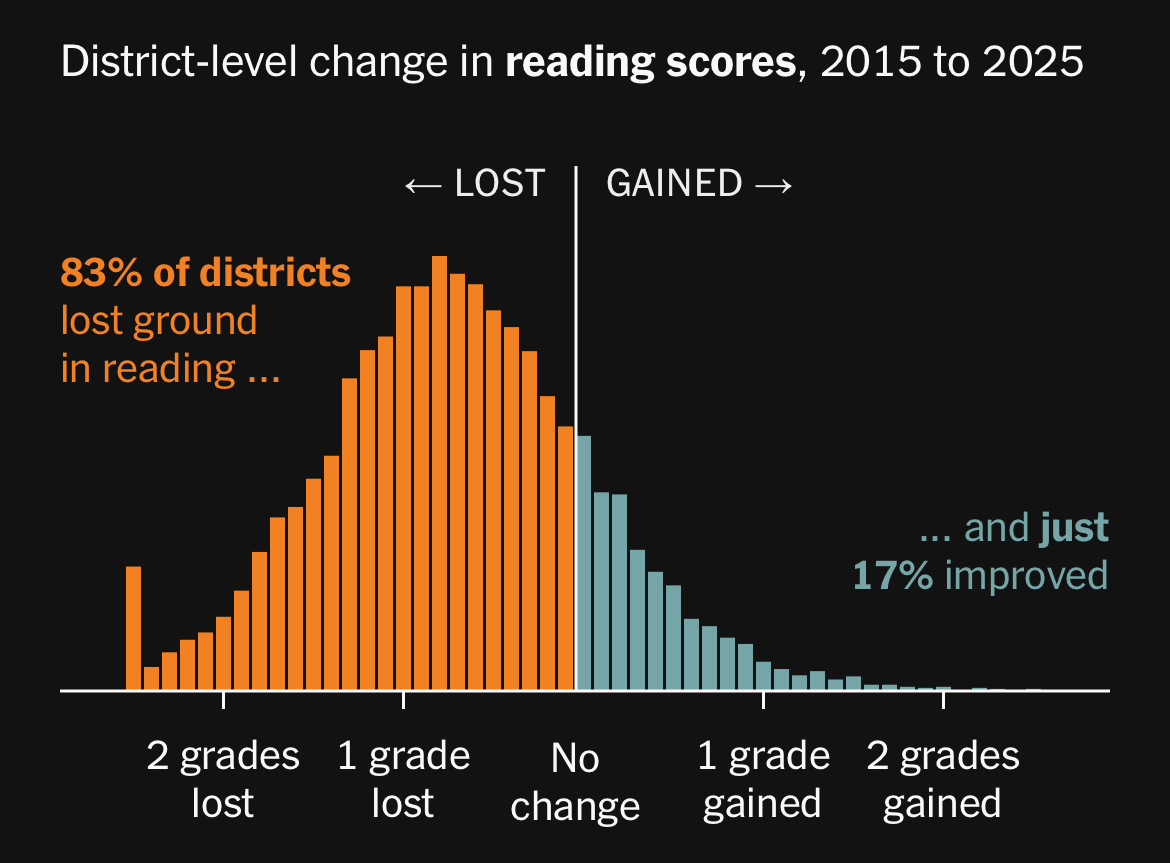
The response was swift. Researchers called it a “generation-long decline.” Policy conversations turned to phonics mandates, tutoring programs, phone bans, and accountability structures. The debate has a familiar shape: scores are down, so we need to fix the system that produces scores.
Here’s the thing, though. We already know how to fix that system. Test scores rose steadily in the U.S. for over a decade under No Child Left Behind, a federal accountability law built almost entirely around standardized testing. When Congress replaced it in 2015, scores fell. There’s no mystery here. If high standardized test scores are the goal, then a mechanism like NCLB is the answer.
The question is whether that is a goal worth having. Do we want a system that is solely measured on how young people perform on multiple-choice standardized tests? Would an increase in reading and math scores alone mean that our schools are “successful”?
I think there’s more to consider as we think about what we want to cultivate in the next generation.
So, my provocation: what if schools were built for human flourishing instead? Not better scores, not higher college placement rates. Flourishing, as the actual aim for schooling.
Which raises an obvious follow-up: what does flourishing mean, exactly? The word gets used loosely. Most of the time, flourishing gets treated as a fancy synonym for happiness. That doesn’t quite get at it. And happiness, it turns out, is its own can of worms.
So, before we unpack flourishing, let’s spend some time on happiness.
On Happiness
Happiness is often pitched as an American birthright.
The Declaration of Independence promises us the right to pursue it. Jefferson wrote it as though happiness were obvious, as though we all knew what it meant and simply needed to be free to go get it.
But what is happiness, exactly? And what would it mean for schools to actually help children pursue it?
The most common answer to “what is happiness?” is something like: feeling good. Pleasure, comfort, the absence of pain. This is the utilitarian view, and it’s deeply embedded in how we talk about education. If we want happy kids, we make school more pleasant. Reduce stress. Add more play. Make the curriculum more engaging.
There’s nothing wrong with any of that. (We should be talking about how to make schools joyful!) But designing for happiness doesn’t quite get at what we mean when we say someone is living a good life.
Let’s go another layer deeper.
On Eudaimonia
Aristotle had a word for the aim our lives should take: eudaimonia. It’s usually translated as “happiness” or “flourishing,” but it points to something more durable than feeling good on a given school day. Eudaimonia is the kind of happiness that comes from a life well lived, across a whole life. It’s closer to what we mean when we look at someone and say: they really figured out how to live.
For Aristotle, three things were necessary to cultivate eudaimonia.
The first is freedom. A person has to be free to make meaningful choices about their own life. You can’t flourish on someone else’s terms. You can comply, you can perform, you can even succeed by external measures (like standardized tests), but eudaimonia requires that the life you’re living is, in some genuine sense, yours.
The second is the development of internal virtues. Eudaimonia isn’t just freedom to do whatever you want. It’s freedom combined with the wisdom to use it well. Aristotle understood virtue as something built through practice: you become courageous by doing courageous things, honest by telling the truth when it’s hard, generous by giving when it costs you something. Virtue is a skill developed over time, through real experience, with real stakes. (Aristotle called this “phronesis,” and described it as the ability to act virtuously by applying general knowledge to real situations).
The third is what Aristotle called external goods: health, financial security, meaningful relationships. These matter for flourishing too. You can have all the freedom and virtue in the world and still be ground down by poverty or isolation. Some of what shapes a life is outside anyone’s control, and a good education has to reckon with that rather than pretend it doesn’t exist.
On Learning
So: what would it mean for schools to be built around eudaimonia?
That question has been getting serious scholarly attention lately. Philosopher Kristján Kristjánsson, whose work has done as much as anyone’s to anchor the conversation, identified the core challenge in a 2017 critical review: flourishing is appealing as an educational aim precisely because it’s rich and human. But it’s also vague enough that almost any educational philosophy can claim it. Defining it carefully matters.
That work of definition has accelerated. A 2024 symposium in Theory and Research in Education brought together researchers from positive psychology, self-determination theory, philosophy, and character education to find common ground.
Curren and colleagues define flourishing as “ongoing healthy growth and functioning involving fulfillment of potential that exhibits admirable qualities and is personally meaningful, satisfying, and enjoyable.” That’s a layered definition on purpose. Flourishing isn’t just feeling good (though that matters). It’s also doing well, functioning, growing, becoming more capable over time.
Frank Martela, drawing on that same body of work, breaks it into three dimensions that are useful for thinking about schools. First, there’s the subjective experience of well-being: how a child actually feels, day to day. Second, there’s psychological functioning, specifically whether a child’s core needs for autonomy, competence, and meaningful connection are being met. Third, there’s the development of foundational virtues: the capacity for self-regulation, good judgment, and moral and civic engagement.
These aren’t three separate goals. They’re pillars. They interlock. A child who feels good but has no autonomy isn’t flourishing. A child with strong self-regulation but no sense of belonging isn’t flourishing. The concept is holistic by design.
Kristjánsson and Tyler VanderWeele pushed this further in 2025, asking a sharper question: what parts of flourishing are actually within the scope of education? Their answer focuses on what they call “educable” virtues: moral, intellectual, and executive capacities that can genuinely be cultivated through learning environments. Not everything that contributes to a good life is something a school can or should be responsible for. But a lot of it is.
That’s a useful frame for school design. It shifts the question from “how do we raise test scores?” to “what are we actually trying to cultivate?”
A Different Aim
Once you frame it this way, the design requirements change significantly.
You need an environment where children have real choices with real consequences. The research on self-determination theory is pretty unambiguous here: autonomy isn’t just nice to have. It’s a precondition for the kind of intrinsic motivation that leads to genuine learning and long-term flourishing.
You need adults who are deliberate about character, about wisdom, about virtue as something practiced rather than performed. Schools that treat character as a separate elective, or as a poster on the wall, have missed the point. Character is cultivated through the everyday grain of how a school operates: whether children are trusted, whether conflict is engaged rather than suppressed, whether failure is treated as information or as shame.
You need children to encounter productive struggle, with support. A school that never lets children experience the natural consequences of their choices, good and bad, isn’t preparing them to flourish. It’s training them to wait for someone else to take the wheel.
And you need to be honest about opportunity gaps. Eudaimonia requires external goods, and children don’t start from the same place. A vision of education that ignores this is incomplete.
This work is messy. An education oriented toward flourishing is harder to design, harder to assess, and harder to scale than one oriented toward test scores. But it’s worth asking whether we’ve been optimizing for the wrong thing for a very long time.
Next: Why education stopped cultivating wisdom and started measuring intelligence, and what got lost in the exchange.
Don’t miss the next article! Subscribe to get it delivered to your inbox.
Comments
Nothing yet. Say the first thing.
Sign in to join the conversation.