
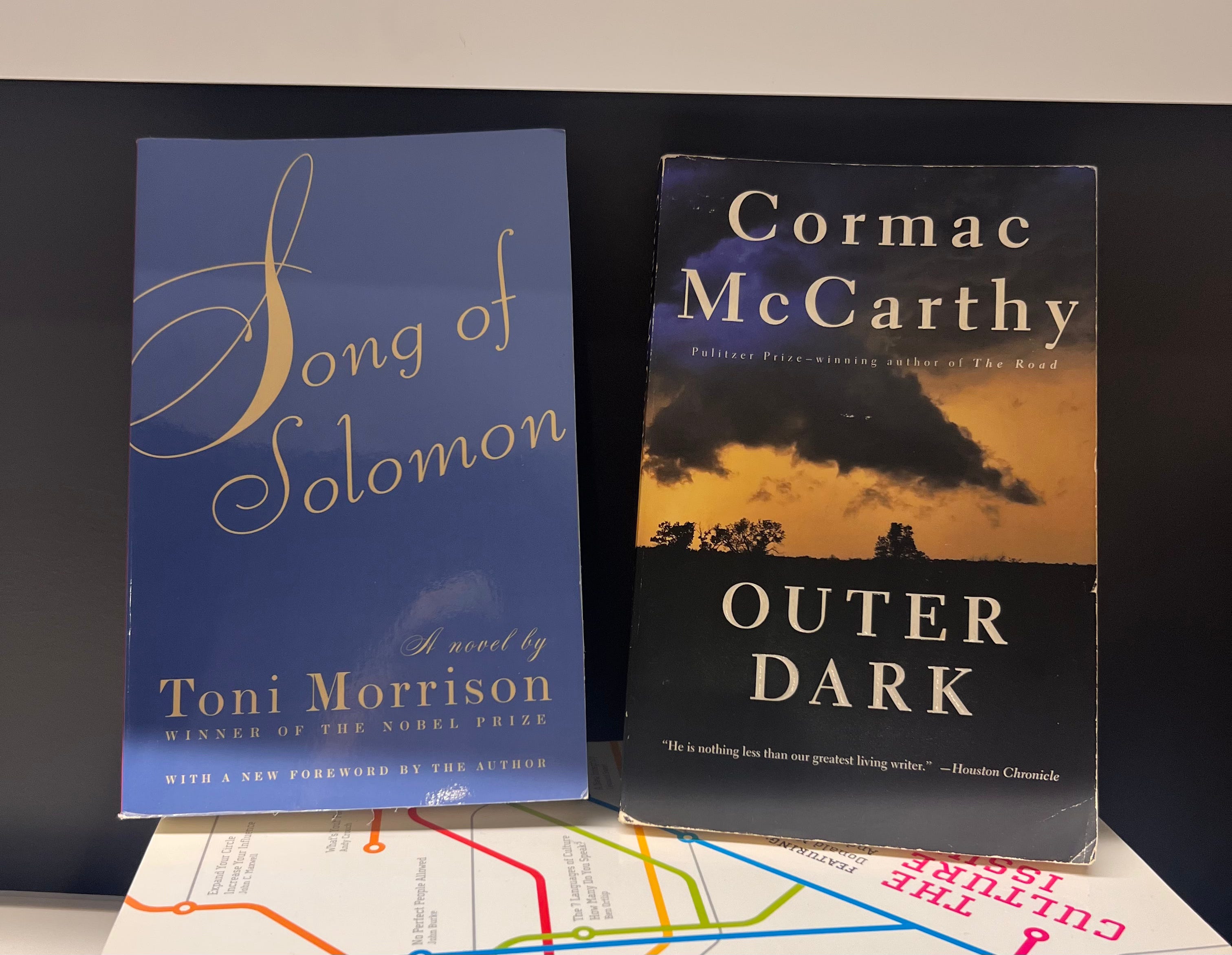
If someone were to ask me (which, to be clear, no one has) to name the best book from the past 50 years, it’s a coin toss for me. Two come to mind. Partly because they are two important American novels of the twentieth century (and come from two authors who landed multiple titles in The Guardians “100 Best Novels of All Time” poll), but also because they share a quality that relates directly to this newsletter. Both crack the world open just slightly. Both insist that something lives in the space between the real and the mythic, the earthly and whatever waits beyond it.
Welcome to The Gap, a newsletter about stories the probes the edges of human experience.
Cormac McCarthy’s Outer Dark (1968) and Toni Morrison’s Song of Solomon (1977) are not often placed in conversation. McCarthy is a writer of sin and violence. His prose is spare, biblical. Morrison is the writer of Black American memory and music: lush, ancestral, and lyrical. Their worlds are different. Their communities are different. Their sentences barely resemble each other.
But they both write in a way that reaches toward the same crack in the wall of the world.
Outer Dark follows Culla Holme across a landscape that seems to be dying around him. He’s committed an unnameable sin and abandoned its consequence, and now three men (or something in the resemblance of men) are trailing him through the Appalachian wilderness toward a judgment he can’t outrun. McCarthy never explains the triune. He doesn’t need to. The reader understands, bone-deep, that Culla is not just being followed. Something is reaching through the crack in the world, a type of apocalyptic reckoning.
Here’s how McCarthy introduces his three other-worldly figures, in a run-on sentence in a chapter break, as if they just stepped into this world from another:
They entered the lot at a slow jog, the peaceful and ruminative stock coming erect, watchful, shifting with eyes sidled as they passed, the three of them paying no heed, seeming blind with purpose, passing through an ether of smartweed and stale ammonia steaming from the chickenrun and on through the open doors of the barn and almost instantly out the other side marvelously armed with crude agrarian weapons, spade and brush-hook, emerging in an explosion of guineafowl and one screaming sow, unaltered in gait demeanor or speed, parodic figures transposed live and intact and violent out of proletarian mural and set mobile upon the empty fields, advancing against the twilight, the droning bees and windtilted clover.
Song of Solomon follows Macon Dead, nicknamed Milkman, through a life he’s inherited and doesn’t understand, until he discovers that his ancestor Solomon flew. Literally flew, up off a Virginia hill, back across the Atlantic toward Africa, leaving his wife and children in the dust below. The myth sits underneath the whole novel like a root system. And then there’s Pilate: Milkman’s aunt, born without a navel, who moves through the world as if the usual rules don’t quite apply to her. She’s not supernatural. There’s some mystery there, though. Some crack in the world. A woman for whom the gap between the living and the dead is thinner than it is for the rest of us.
Here’s Milkman’s father admonishing him to stay away from his aunt:
“Boy, you got better things to do with your time. Besides, it’s time you started learning how to work. You start Monday. After school come to my office; work a couple of hours there and learn what’s real. Pilate can’t teach you a thing you can use in this world. Maybe the next, but not this one. Let me tell you right now the one important thing you’ll ever need to know: Own things. And let the things you own own other things. Then you’ll own yourself and other people too. Starting Monday, I’m going to teach you how.”
Notice the tension. Two worlds are here, in Milkman’s father’s words. The real one, ruled by capitalistic power, and another one, a next one. That’s the world Pilate is familiar with. Milkman spends the novel stuck in the chasm between the worlds, struggling to understand either.
What both writers understand is that the mythic has to be earned through the texture of everything else. McCarthy earns his three wraith-like men through the relentless specificity of the landscape, the way the darkness of the Southern hills feels genuinely pre-human, indifferent to whatever the people walking through them have done or not done. The triune feel inevitable because the world they move through has always contained them. Morrison earns Solomon’s flight through names, through the way she builds the genealogy of Milkman’s family as a kind of archaeology. By the time we reach the myth, we’ve been prepared by a hundred small instances of the world being slightly more than it appears.
The craft difference is in the direction of the prose. McCarthy strips language down to its barest. No quotation marks. Minimal dialogue tags. Long, periodic sentences that read like passages from the Old Testament, followed by short ones that land heavy on the page. He removes everything that might soften the darkness or let the reader off the hook. Morrison builds up. She layers vernacular and elevation, rhythm and plain speech, the music of Black life in America and the silence underneath it. (I once had a conversation with a professor where she said that to truly grapple with Song of Solomon, you needed to be well-read in a variety of literary traditions). Where McCarthy trusts absence, Morrison trusts accumulation.
Morrison and McCarthy differ greatly in craft and style, but the biggest schism is a disagreement about the universe. There’s a difference in how each of these writers see this crack in the world.
McCarthy’s gap is a punishment. The outer dark is where Culla ends up because that’s where his sin leads. It closes around him. There’s no flight, no return, no redemption. The crack in the world opens and swallows.
Morrison’s gap is a birthright. It’s where Milkman came from, and where, in the novel’s final image, he’s going back. His leap toward Guitar at the end of the book is ambiguous, yes. He might die. But Morrison has spent 340 pages teaching us that the Dead family’s loss was also a form of flight, that what looked like abandonment was also transcendence. When Milkman goes airborne, we wouldn’t be surprised if he soared.
Here’s how Morrison ends it: “For now he knew…if you surrendered to the air, you could ride it.”
Both writers put their protagonists at the edge of the same abyss. The gap between the world as it appears and the world as it actually is, between the life you’re living and the forces that shaped it before you were born. McCarthy looks down into that gap and sees judgment. Morrison looks down and sees something like home.
Perhaps both of them are right.
The Gap is a story-driven newsletter that explores the in-between spaces of the human experience. Look for it in your inbox every other Sunday.
Comments
Nothing yet. Say the first thing.
Sign in to join the conversation.