
Welcome to The Gap, a newsletter about stories that probe the edges of the human experience. If you’re here for education writing, take a breath, step back, and sink into something else.
I just finished Orbital by Samantha Harvey. It won the 2024 Booker Prize and was championed by many as a “best book of the year.” I’m slow to the moment (as it just turned up in my neighborhood’s little free library), but it was the sort of reading experience I need to process in words.
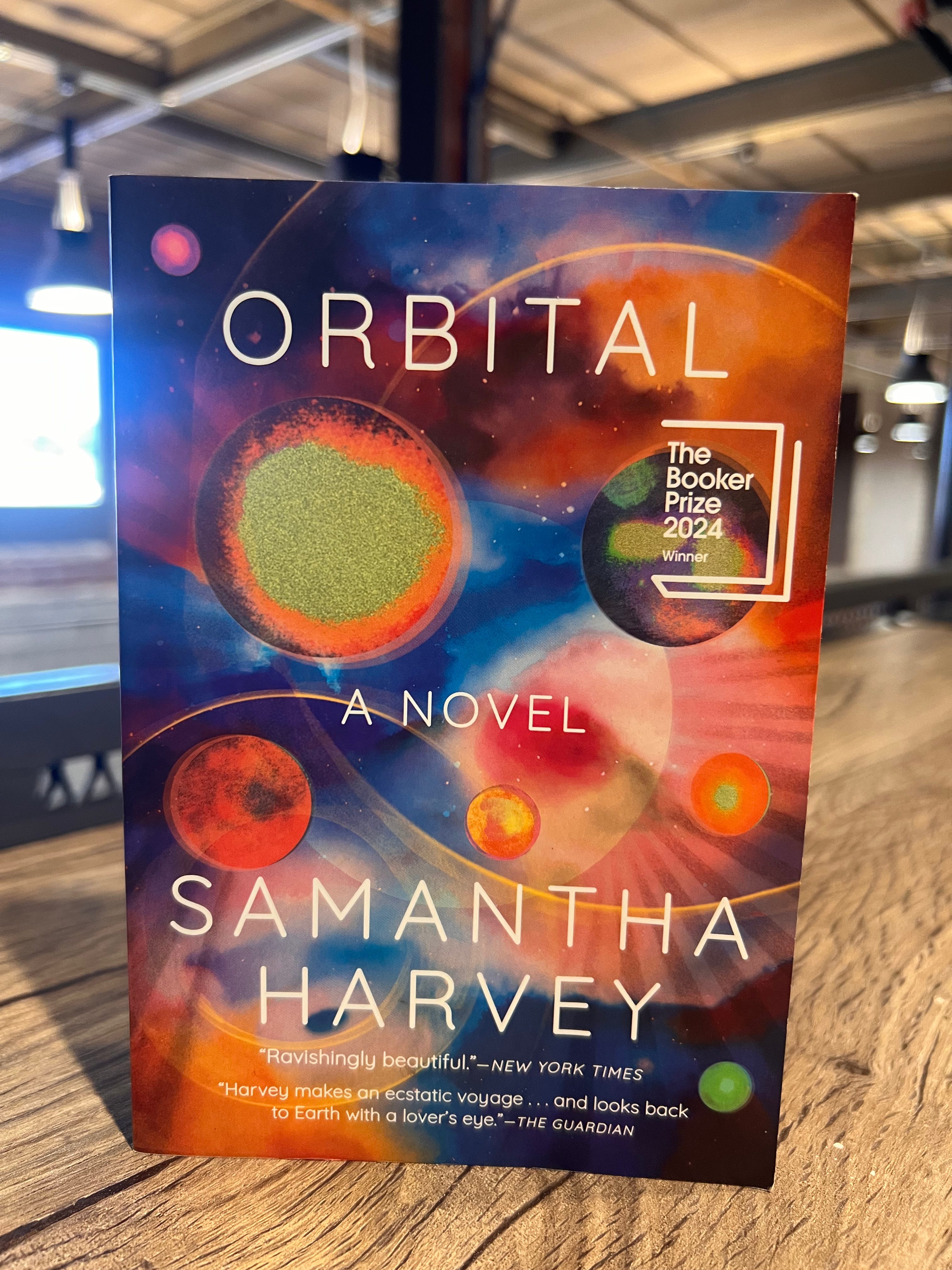
The International Space Station hovers 250 miles above the Earth. Close enough to see every detail of the planet below: the brown-green spiral of continents, the white architecture of storms, the places where rivers meet the sea. Far enough that none of it can touch you. The six astronauts in Harvey’s novel orbit Earth sixteen times in a single day, ninety minutes per loop, watching sixteen sunrises and sixteen sunsets while the world beneath them does what the world does. Wars. Funerals. Children learning to walk. Someone’s mother taking her last breath. All of it visible, but none of it reachable.
Harvey builds a novel out of that distance.
Orbital is not a plot-driven work. Almost nothing happens, in the conventional sense. It covers one day, equal parts magic and mundane, on the ISS. (Remember, for our characters, one day holds sixteen sunrises and sunsets). What happens instead of plot is attention. Harvey turns the act of looking, outward from that impossible distance, but also inward, into the hopes and daydreams of the ISS crew.
What she’s after, I think, is the experience of being caught between worlds. Her astronauts are not quite earthly and not quite cosmic. They’ve left the only home any human has ever known, but they haven’t gone anywhere. They’re just above it, circling, held in place by a physics that is simultaneously banal and miraculous. The space station is a metal tube with recycled air and a coffee machine. The view out the window is the face of God.
That tension is where Harvey does her best work. She keeps pulling the lens back and forth: the intimate and the vast, the domestic and the infinite. One astronaut thinks about a failing marriage. Another thinks about the particular blue of the Atlantic. Both thoughts are weighted the same. Harvey refuses to rank them. The failing marriage is not small because the Atlantic is large. The Atlantic is not abstract because the failing marriage is personal. Everything, from 250 miles up, is both.
It’s one day, but our characters circle the globe sixteen times. They’ve been there for months, with months left to go. They live in loops, not toward or away from anything. During this day, another group of astronauts launch from Cape Canaveral. Their destination: the moon. This group will go further, will leave Earth’s orbit, will land on the lunar surface. Then, they’ll return as heroes. Their mission has an arch, a beginning and end. “You aren’t even the farthest-flung humans now,” the crew on the ISS hears from ground control. “How does that feel?” Harvey’s circling astronauts feel everything: the jealousy, the camaraderie, the giddiness of space exploration. And we, as readers, are invited in.
Orbital is a short book, but I would argue it is better experienced as a slow, meditative read. Harvey isn’t making a case for wonder exactly, or for smallness, or for the importance of stepping outside your life long enough to see its shape. She’s doing something harder: she’s making you feel all of those things at once, without resolving them into something comfortable.
That’s the gap she’s writing from and writing toward. The space between what we can see and what we can know. What we can love and what we can hold. What we believe about the world and what the world actually is when you look at it from far enough away.
There’s a version of this book that would have been about the grandeur of space. Harvey wrote a different one. She wrote about the longing, the specific and unresolvable human longing, to be in two places at once. To know how small you are, and yet, still feel the vast eye of the universe looking at you.
I marked a few passages, but here’s one that stood out, early in the book:
“Some alien civilisation might look on and ask: what are they doing here? Why do they go nowhere but round and round? The earth is the answer to every question…The earth is a mother waiting for her children to return, full of stories and rapture and longing. Their bones a little less dense, their limbs a little thinner. Eyes filled with sights that are difficult to tell.”
The earth, the big beautiful ball spinning in the dark, is really the main character of the book. To see it from 250 miles up is to love it all the more.
That’s a worthy reminder.
So, get a copy for yourself (support your local bookstore by connecting it to your order here or place a hold at your local library).
No posts
Comments
Nothing yet. Say the first thing.
Sign in to join the conversation.