
This week, I’ve covered:
Tracking the gap between what gets hyped and what has long term success
Meta ordered to pay enormous fine in latest ruling on child safety
Spotify introduces a new skip ads button
Hollywood’s falling output
Tracking Docs to Watch’s progress
Welcome to the pitch graveyard.
Before getting to that: Last summer I wrote three mega posts covering everything I thought at the time producers needed to know, and posted one a week while I went on holiday.
This year, I’ve decided to do a refresh on these themes, condensing them to two posts:
The big ongoing strategic issues for you to bake into your thinking
What mindsets and approaches you could consider in response to these market conditions.
How to manage holidays is a regular worry amongst Substackers who are single operators like me. The challenge being, how to deliver what paid subscribers are expecting, while also giving myself a break to recharge with my family.
As a result, over the next two weeks, these two posts will be for paying subscribers (to whom I’m very grateful), and I’m pausing my free Friday posts until the last week of August.
So if you want full access of these summaries covering what (I think) you need to know, then please do take out a paid subscription - go on, you can expense it, and it will help keep me in Ouzo Spritzes in Greece for the next few weeks.
A regular theme of this newsletter is to encourage us all to get beyond the hype, and treat the businesses and new tech around us as ‘normal’: where we apply the same critical logic to these companies and technologies as we do to all the other media companies in our orbit. Here are two pieces I've written previously on this theme:
Indeed, I’m doing a session on this very subject at the Edinburgh TV Festival in a few weeks, with Manori Ravindran of The Ankler Team, Dan Jones, CEO of Little Dot Studios, and Ian Whittaker, of Liberty Sky Advisors and co-host of Unfiltered Media podcast.
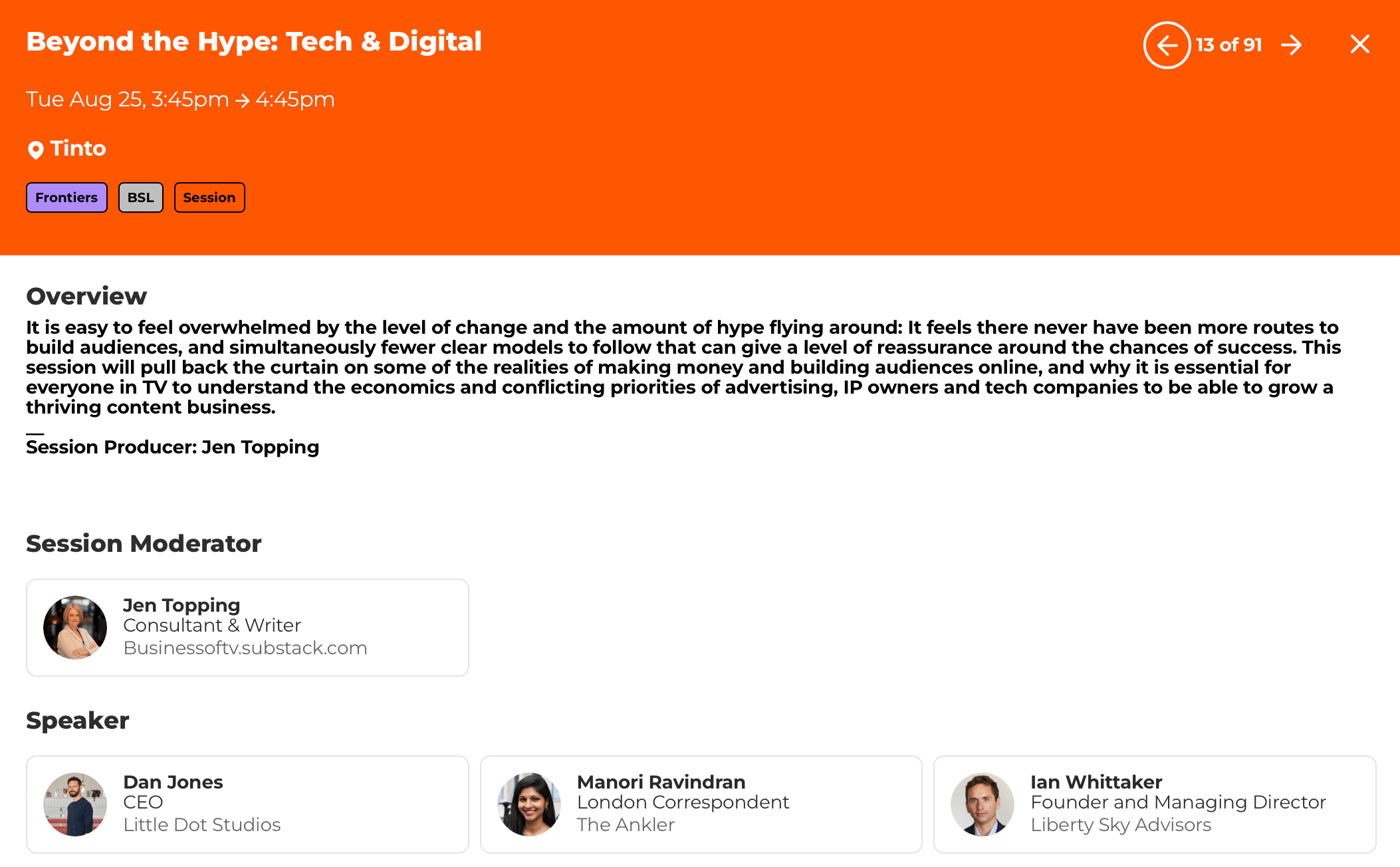
I’ll be sharing my speech from this session afterwards, plus some thoughts on what I heard and observed at the Festival, which hopefully will be of some interest. A quick last shout for a discounted ticket for the Festival, for those making last minute plans:

Business of TV subscribers can secure 20% off Festival passes using the code B20DIS26. Buy your Passes here.
Back to the subject of hype: Konstantine Buhler, partner at Sequoia Capital, shared the following graph on what the internet hyped (tracked by topics on Hacker News) vs what was the most profitable business launched in a particular year.
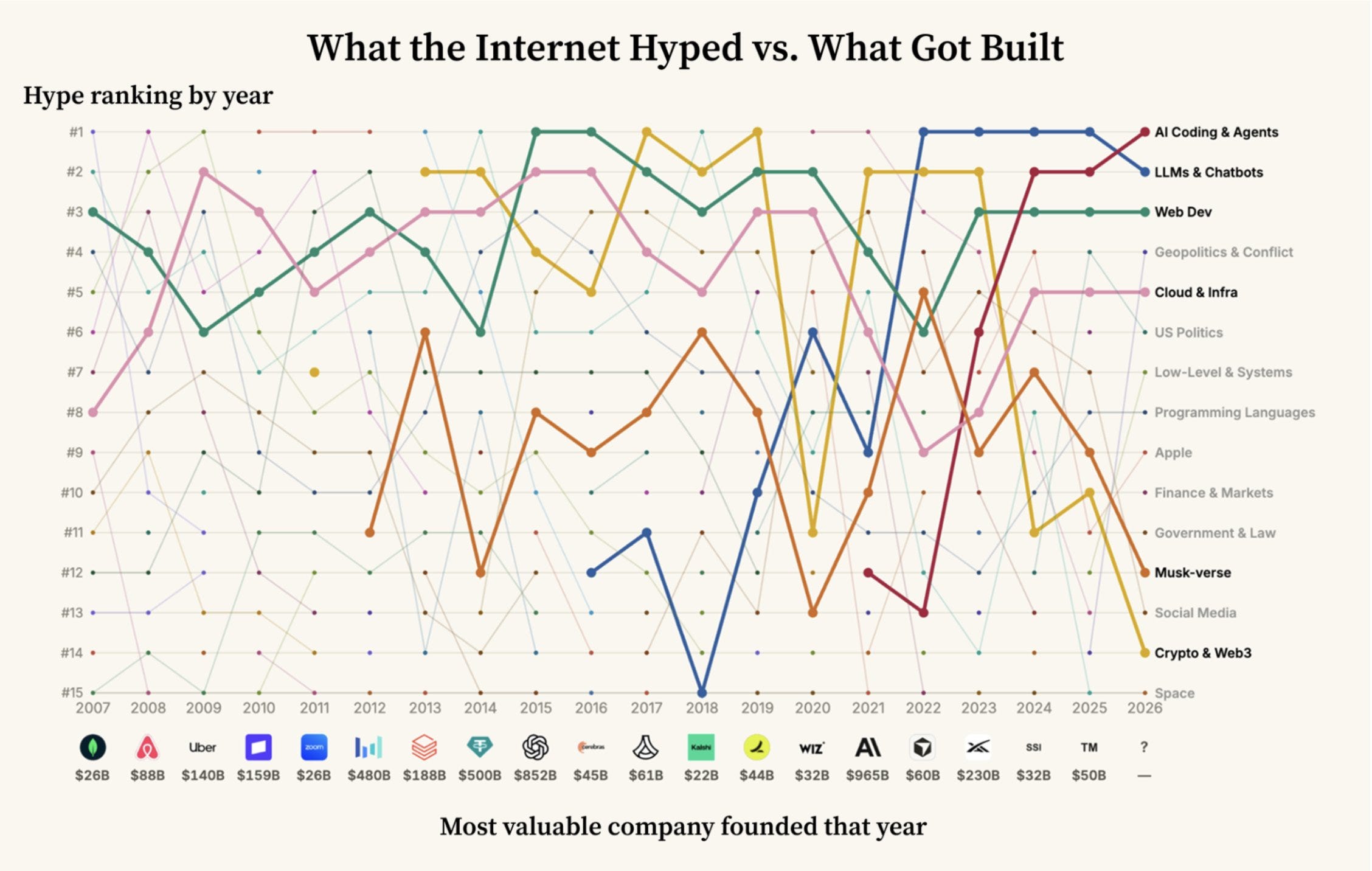
If you don’t immediately recognise the logos, it is a little tricky to interpret, but even to pick out some well known companies: Airbnb, Uber, Stripe, Kalshi and ChatGPT - none of them are the hyped trend of that year, but have in common that they went after industries that weren’t seen as ‘tech’ - so car hire, accommodation rental, gambling (in the form of prediction markets), banking.
This is similar to how many predict that some of the growth in AI will be in creating tools and services for businesses largely outside of the world of tech - so say laundromats, or hairdressing salons. You could argue much of the TV production process could fit into this camp too (how many productions are running on excel spreadsheets??). One to ponder…
Konstantine made the following observations:
The top company founded in a given year is rarely related to the hype of that period. Airbnb was founded in 2008, when the top topic was Google. Uber arrived in 2009, while the conversation revolved around low-level programming. Anthropic came in 2021, while the internet was consumed by crypto. Chasing hype rarely leads to enduring outcomes. The top companies of recent years have yet to be decided.
New trends announce themselves five to six years early. LLMs first cracked the top 15 in 2016 and took until 2022 to hit #1….“New” trends don’t appear out of nowhere, and internet subcommunities are often the first to know where the puck is headed.
How to think about this as a TV producer? Well, I think it is about carrying multiple thoughts in your head at once:
Hype doesn’t automatically mean something has staying power
Nor does it mean something is nonsense
What is hyped today might not have longevity in its current form, but might be an indicator of a direction of travel (Quibi and vertical video, most notably)
Applying critical thinking and plausibility to hype is important, especially those which involve consumer behaviours (wearables for example, or the Metaverse)
Certain technologies make it hard for non-engineers and scientists to evaluate their plausibility and longevity (AI is the poster child for this) and so finding trusted non-hype but also non-cynical experts is helpful
All aspects of the TV production process could be open to technology to build efficiencies and save costs.
Back in March, Meta and Google lost a significant court case in Los Angeles, where it was deemed that the product design of their apps was faulty. This was notable as this was the first time this argument was successfully made in a court - so rather than focussing on the content on the platform, instead they were accused of making faulty products, similar to say how a car manufacturer could be held responsible for their seat belts not working.
At the time I noted that there were many other court cases coming down the pipeline, and this week, they were ordered to pay a further $567m in fines in a case in New Mexico, in addition to $375m in fines they’ve already been told to pay in this specific case, bringing it to a total of $942m.
The BBC reported that the judge described Meta as:
…a ‘public nuisance’ akin to air pollution and that it must put the money in a fund aimed at reducing future harms.
…
Judge Biedscheid compared Meta to a factory, with advertising and content as its product and “the psychological harm and sexual exploitation of children to be the pollution that must be abated”.
As well as the fines, the BBC has reported that the judge ordered all sorts of new policies to be enacted by Meta, such as ensuring no user under 18 could be messaged by an adult, removing ‘like’ counts for under 18s, banning push notifications during school hours and over night, plus mandatory usage limits.
Meta has said they will appeal:
“We remain confident in our record of protecting teens online and will continue to defend ourselves against claims that misrepresent the facts.
The key thing to remember here is this isn’t a lone case, there are 1,000s of others stacking up, and it isn’t just one company: other cases include YouTube and Google, Roblox, Discord and more.
And while these cases progress to appeal and through the courts, they indicate a general move in the direction of far more attention and restriction being placed in these companies in a range of aspects, both via courts and governments across the world.
This is one of these strategic shifts to bake into your thinking - not just if you are seeking to make content for kids or teens, but also if product changes such as removing scrolling video become the norm.
Spotify are believed to be introducing a new bit of functionality that allows users to skip ads and sponsorship messages with a click of a button. It is described this way by Pod News:
The tool, called “Skip Ahead”, is available for Premium users in selected markets, and enables them to skip entire ad breaks, intros, sponsorship messages, and even mentions of premium subscriptions.
The announcement has not been well received by some in the podcast quarters, for example:
Others have made the observation that you’ve always been able to skip the ads, yet research suggested only a small percentage (say 10%) actually do so. It would be interesting to understand if this low level of skipping ads is because people are out and about when listening so aren’t controlling their devices in this way, or how easy/hard it is to skip the ads (say having to slide along with your finger or jump 20 seconds ahead) versus this new functionality which appears to be more carefully timed to the start and end of ads and sponsored reads.
For others, they see it as a clarion call for podcasts to improve the quality of their presenter reads - indeed, this LinkedIn post celebrates the infamous host reads by Adam Buxton, who is in a class of his own on this front.
Separately, I did a session back in May with Indielab, and William Miller of Raconteur Studios (producer of When It Hits The Fan podcast) memorably described the podcast economy as ‘evolving like fruitfly’, meaning it is hugely changeable, where advertising and sponsorships once dominated, and now there are other parallel income streams like subscriptions and membership clubs.
Final point - this new product feature from Spotify is a great example of a tech company pivoting, and how that can huge knock ons for those relying on these platforms for income and audiences. For those podcasts with other revenue streams, the impact might be minimal, however for those that are 100% ad funded, then you can see why this might be making them nervous.
Another area I’ve not written about recently is the video podcast market - another one for the list for autumn.
I’ve written previously about how development producer Patrick Carnegy found a rich seam, almost by accident, when he launched an Instagram account of documentaries people should be watching late last year.
It is so exciting to observe what he is building in that classic test and learn approach which I outlined in the post below:
At that time, I called not appreciating test and learn ‘the single biggest mistake’ TV producers can make on YouTube, or anywhere in the direct-to-consumer economy:
For creators (indeed, anyone publishing to the internet), an essential approach is what is called iteration, or test and learn. This is where you create something, publish it, see if it gets any traction, if it does great, do more of that, if it doesn’t, go back and try again. And ideally, this loop is run fairly quickly and frequently, so momentum isn’t lost before finding something that works. The idea is to keep plugging away, trying things out to see if anything flies, and when it does, double down on it.
This is completely different to TV where the show is made and iterated on behind the scenes before being revealed as a finished product to audiences. This approach is great for everyone involved in TV, as audiences and advertisers have high quality expectations and so want a polished finished show. Plus the cost has been covered by the broadcaster so if a show doesn’t work, the producers aren’t out of pocket.
Applying this same approach to YouTube is highly risky, because if the videos don’t work, well that is a lot of money down the pan as they won’t get views and therefore they won’t generate any ad revenue. As well as losing money, this also has the psychological effect that the initiative is viewed as a failure, and therefore it makes it less likely for everyone involved to try again - so the essential iterative cycle dies at this point.
For TV freelancers - or indeed anyone - to succeed on YouTube, committing to the test and learn cycle is vitally important.
It is so helpful to watch a producer build something in real time, and where it isn’t hard to imagine the potential as it grows. This experience is less common than it sounds.
So where is Docs to Watch?
Instagram followers have doubled to 603,000
Launched a website to buy/rent documentaries
Become a distributor for these docs
Launched a newsletter last week.
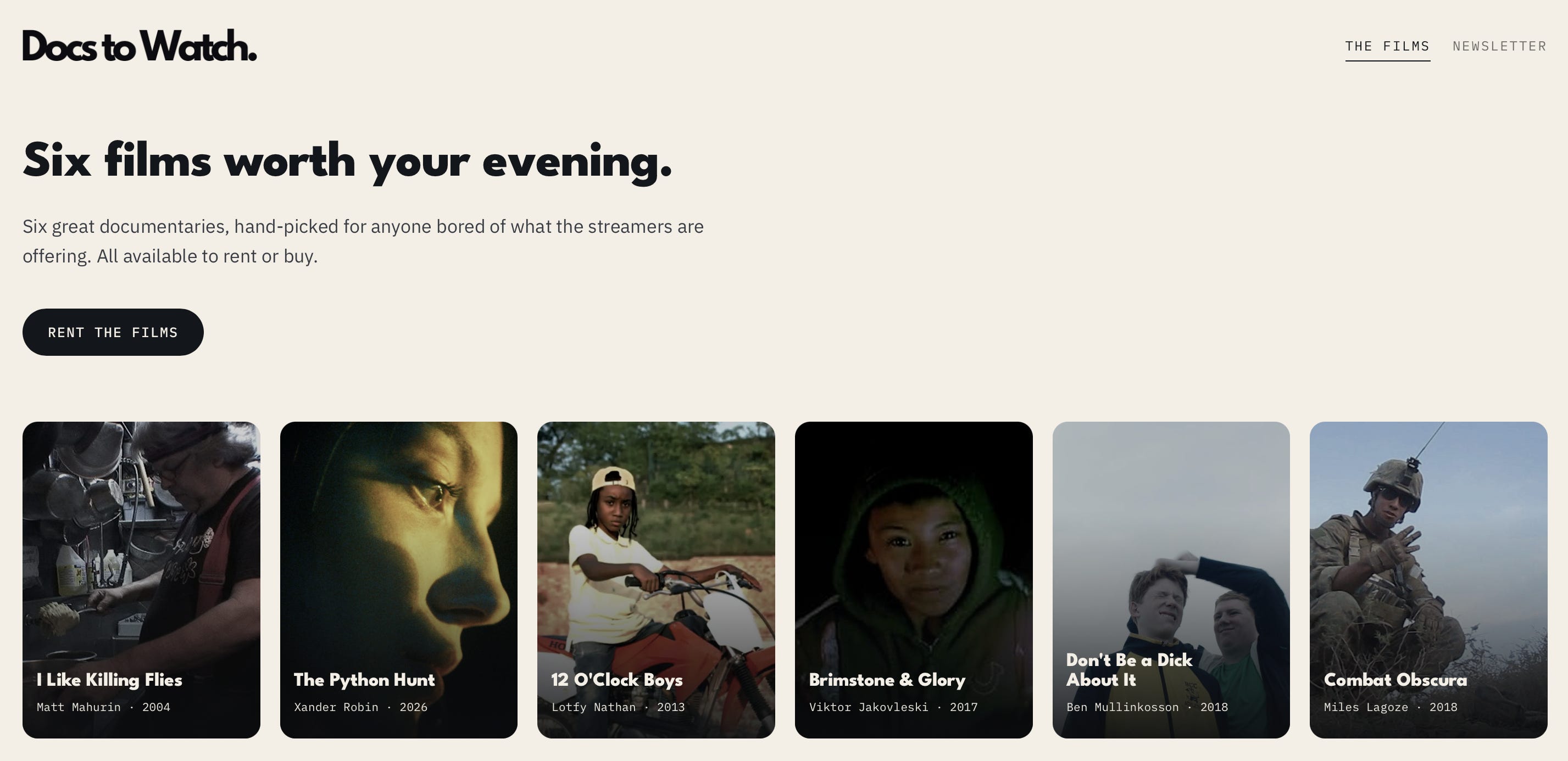
A few quick comments: growing followers on Instagram is notoriously hard - and so the speed of Docs To Watch’s growth is impressive.
In terms of becoming a distributor, he said it was something of an accident, having teamed up with Oscilloscope Laboratories to host six of their films through Vimeo.
Patrick says he got 100 rentals in less than two weeks, going on to say:
…which may not sound like a huge amount for half a million followers, but converting followers to sales from Instagram to Vimeo is a tricky business. As I’ve only posted two of the six documentaries so far, and I’m doing this all with no budget, posting from my bedroom, I’m pretty damn happy to see rentals ticking over every day. It’s a marathon not a sprint.
Patrick has now put a shout out to directors and producers with existing docs, saying he is looking to add more great titles to his rental platform. He said:
If you have a documentary with non-exclusive digital rights available, I'd love to hear about it.
Worth knowing before you get in touch: it has to fit Docs to Watch, and be good calibre. That doesn't mean it has to be big budget or super high production values, or recent. I Like Killing Flies had a tiny budget, came out in 2004, it's amazing, and it's doing well on DTW. They just have to be good docs. I also generally don't do true crime.
There's no advance. It's a 50/50 revenue share on rentals and purchases through Vimeo, and it's non-exclusive, so your film can stay up on any other TVOD platform it already exists on. The aim is always to grow the audience, so hopefully it drives sales and rentals across all platforms, not just Docs to Watch.
If you have a film you think would be a good fit, I'd love to see it. Finished films only, and preferably ones with an existing trailer.
Send it to: hello@docstowatch.com
It will be interesting to see how this rental/DTO distribution business develops, and how the various funnels of newsletter & Instagram work, plus whether Vimeo ends up being the best partner of choice considering there are others in the market (I wrote about some of them previously).
What next? A podcast? A film festival? Brand partnerships? Awards programme? Film financing? Building out a VOD and distribution business?
Either which way, if you are a documentary producer then Docs to Watch should be on your radar as a crucial marketing opportunity for your films.
Thought this sounded like a great idea: Adam Bhala Lough has a newsletter called ‘Almost Greenlit’, where he opens up his pitch graveyard of projects that didn’t get over the line, with the goal of helping other producers and film makers understand how the business works, plus practical lessons about development, packaging and sales.
As he said:
A huge amount of filmmaking happens in the space between “this could be great” and “this is getting made.” That space is full of brilliant ideas, near misses, embarrassing mistakes, impossible timing, weird characters, beautiful failures, and projects that deserved a better fate.
That is the space I know best.
As interesting as this is as a learning experiment, there is also value in opening your vaults and reconsidering all those projects that didn’t quite get away. Where before, there was a narrow funnel you were trying to get through to get a commission, there now is the open internet that might create the opportunities to make that project, albeit in some reconfigured form and revenue model.
The graph below was shared by Lucas Shaw recently, showing Luminate’s research into TV shows production volumes:
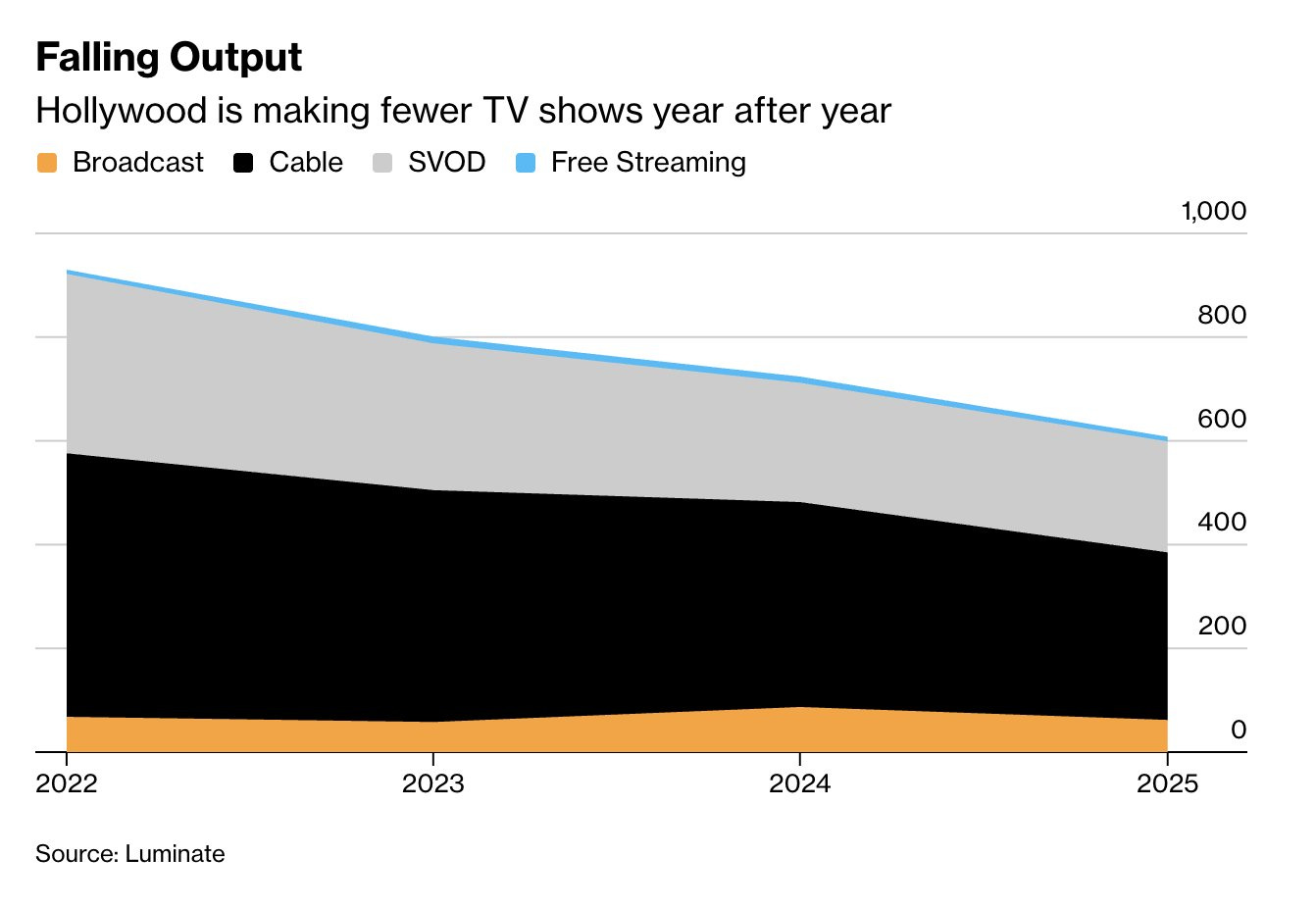
It is worth remembering the previous years, where production volumes ramped up during that phase of the so-called streaming wars. See below, where US produced scripted series went from 288 a year in 2012 to 600 in 2022 - and this excludes genres such as reality, unscripted and documentaries, which had a similar explosion in demand at hte same time (the Luminate graph above appears to be for all genres, not just scripted).
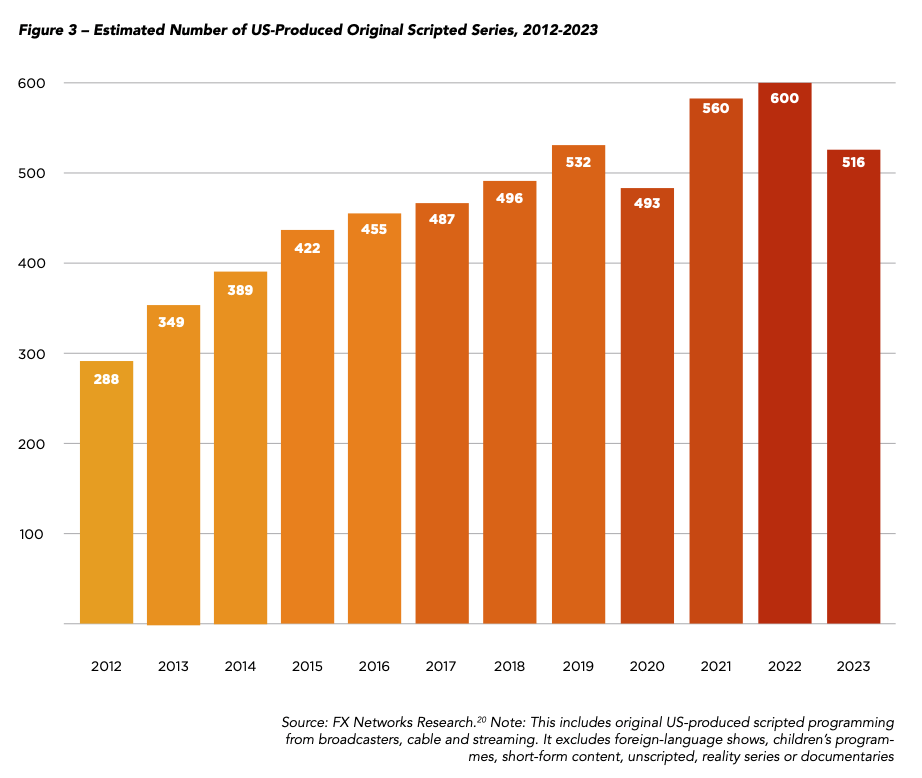
So the graph Lucas Shaw shared from Luminate is yet more evidence of this bubble deflating.
I’m conscious I’ve not written much recently on commissioning and financing volumes, plus tracking the various shifts in production hubs, production incentives and the like, so will add it to my list of things to do in the future.
If you want joyful and uplifting posts from the frontier of indie film and TV producers finding their way in this crazy, internet upended world, then Ted Hope’s Hope for Film does this in bucketloads.
This one by Shane Snow from a month ago about how he and his wife got a kids TV series off the ground.
It includes all sorts of great advice, mainly for scripted producers but especially for those from film who are thinking of making series. In general, it is just such a fun read, it makes me want to watch the show!
One small aside, he references Film Hub as again a place that many are trying and succeeding to distribute their content to various smaller FAST and streaming services. This is a platform and model I haven’t talked about enough, so will do more of it in a piece in the Autumn about the distribution market.
Thanks for reading Business of TV! This post is public so feel free to share it.
Comments
Nothing yet. Say the first thing.
Sign in to join the conversation.