
If you are a single woman beyond the age of 35, you are likely regularly pummeled with expressions of sympathy and speculative horror fiction of what it could mean to die alone (we’re going to bust that myth shortly here, so just stay tuned).
Let’s start by defining “Boston Marriage,” since if you’re one of the 99.9% of people who did not major in feminist literature and theory, you may not be familiar:
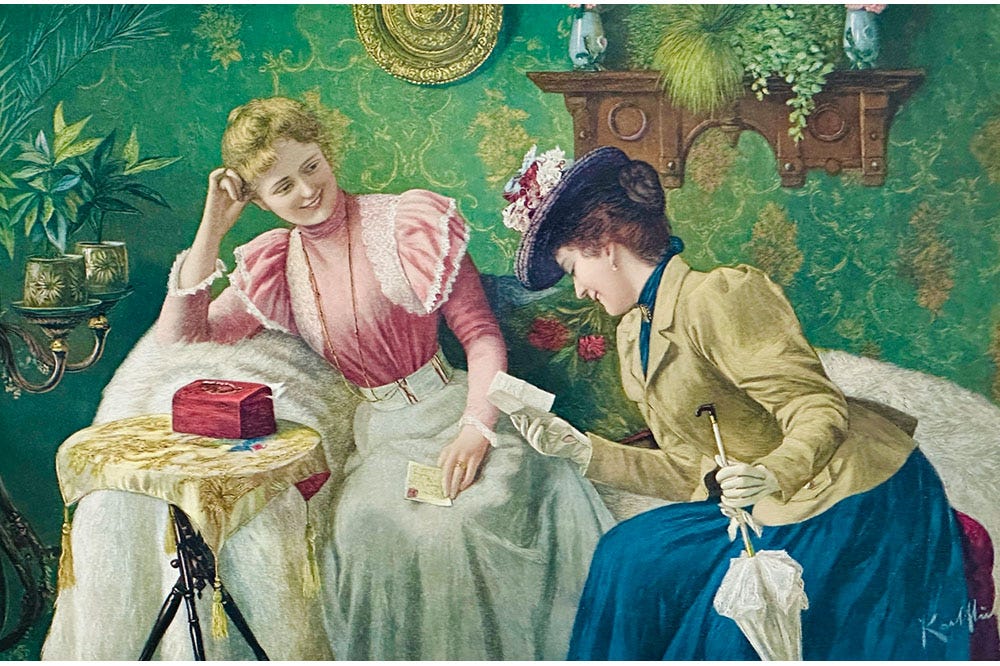
The term refers to a long-term, committed partnership between two women, usually involving shared travel and cohabitation. It emerged as a relationship structure in the 19th century, primarily in literary circles. The inspirations for these pairings were economic, domestic, and emotional, perhaps in equal measure. Whether or not the relationship was sexual or platonic wasn’t the point and wasn’t openly discussed, given the era (it’s most likely that these relationships ran the gamut from friendship to asexual romance to lesbianism).
New England in that time was a place where women were still very much expected to marry and become mothers, but there were also burgeoning intellectual opportunities for women, especially in writing and publishing. Unfortunately, these new professional options did not always provide the economic or domestic infrastructure to adequately support women living independently.
Thus, the Boston marriage was born. Living in partnership provided women emotional companionship, safer travel options, easier entry to intellectual communities, and the ability to share living expenses. You can read more about the details of these “marriages” in this article.
The best thing about the Boston marriage, in my opinion, was its radical creativity and its ability to not only fill gaps but to propel women forward in exciting new ways. Fast-forward to 2026, and we’re seeing a whole new array of options for women. There are many reasons for this:
More women than ever are prioritizing careers and individual goals over marriage and family.
Reproductive freedom is being throttled (in America, at least), which means the risks of partnering with men are higher and therefore less worth it.
Christian Nationalism and efforts toward the reversal of no-fault divorce and household-voting (I can’t believe I just typed that, but here we are) are resulting in many young women opting out of traditional couple/family structures altogether.
A rising Manosphere makes dating heterosexual men somewhere between annoying and downright dangerous, and the gender divide seems to only be growing. A lot of women have decided it’s simply not worth it.
That was a depressing list, I know, but the opportunities these conditions are engendering are exciting and encouraging. Here’s another list, and I offer this one for anyone who wants to entertain new ideas or explore other options:
There are all-women communities popping up across the planet: from the north flats of London to Kenya to rural Texas. Many of them make provisions for interactions and relationships with men, including procreation, but these intentional homelands are for women (and sometimes children) only in terms of who calls the shots and who calls it “home.”
There are emerging movements—many of which are social media driven—that facilitate living near/with friends intentionally, not just incidentally. You can read about the theory of it here, and some concrete possibilities right here.
And it’s not only geographic boundaries that are being stretched. This Washington Post article examines a contemporary lavender marriage and also one comprised of “asexual tradwives.” Here’s an excerpt:
In late 2023, April Lexi Lee told her parents that she was going to marry her childhood best friend.
“They were shocked, but at the same time, not surprised,” Lee, 28, said as she smoked a cigarette outside of her parents’ apartment in Singapore. She was visiting her family while her wife, Renee Wong, 27, was holding down the fort at their home in Los Angeles.
Lee and Wong had been close since they met at age 12. During the pandemic shutdowns, when Wong was in Singapore and Lee was in California, they were spending hours on FaceTime every day.
Then Lee’s TikTok algorithm started delivering her videos about “Boston marriages,” a term from the 19th century for pairs of women who lived together without men. “We didn’t even know it was an option, and then we were like, ‘Wait, this makes so much sense,’” Lee said.
Lee and Wong started cohabitating and sharing finances. Marriage wasn’t on either of their minds until Wong had a health issue that required surgery.
“It became really clear that we are family, but on paper we are nothing,” Lee said. She looked back at the times when they were on separate continents. “I would want to be able to be at the border and say, ‘My wife is in here.’ Not just ‘my best friend.’”
Lee and Wong are both on the asexual spectrum. Lee has been happily celibate for years. Wong, who identifies as “solo poly,” occasionally dates outside their marriage.
There are even lesbian tradwives now, though the term is more “subversive co-opting” of the tradwife movement than adherence to it. I kind of love that.
But here’s the crux of all of this:
There are social scripts, and following them offers some degree of safety and acceptance and comfort: graduate from high school, go to college, marry someone of the opposite gender, buy a house, have babies, raise the family, launch the family, receive grandchildren, and on and on.
But social scripts don’t serve everyone, they don’t work out for everyone, and they change over time; they’re supposed to change over time—that’s productive evolution.
“The world only spins forward” (Tony Kushner, Angels in America). Women are tired of waiting for men to straighten themselves out and become egalitarian, monogamous partners who are capable of functioning as full grown adults.
Rather than being patient or passively waiting, women are beginning to flick at that metaphorically spinning globe, to nudge the spin a little faster, to knock it out of orbit just enough to get people’s attention, to destabilize things in a way that demands attention and requires re-stabilization.
And in many cases, the re-stabilization looks better, whether that means coming home after a hard day to prepare dinner with a bunch of girlfriends or sinking into the couch with your gay husband or just cherishing your own space in a way that’s celebratory rather than conciliatory.
To return to the “You’re gonna die alone!” threat, I’ll leave you with this reel. Thank you for reading ❤️🔥
ps: I wrote this piece to be encouraging, and I hope it accomplishes that. I also realize that many women still want that traditional dream—liberal, progressive women included—and I believe it’s still a valid dream. You can healthily slot yourself and your partner into a heteronormative division of labor if that’s what works best for you and as long as no one is being diminished or disempowered (just yesterday I said to my partner, “Please stop trying to help me in the kitchen. This is my domain. The dogs and the car are your domain, and we need to both stick with what we’re good at.” I was kind of joking but also not really. I crack a lot of jokes about being a “fake tradwife,” but what I really mean by that is that I prefer to perform traditionally-female forms of labor while maintaining my commitment to feminism and political progressivism. I think it’s a possible thing to do).
Okay, sorry, enough from me. Please discuss . . . . . . . ❤️
No posts
Comments
Nothing yet. Say the first thing.
Sign in to join the conversation.