
Folks, we have to talk.
This week, CB Insights released its periodic analysis of the Top Reasons for startup failure. They analyzed 395 startups that shut down since 2023, looking for the reasons the startups shut down.
The number one reason?
They ran out of capital.
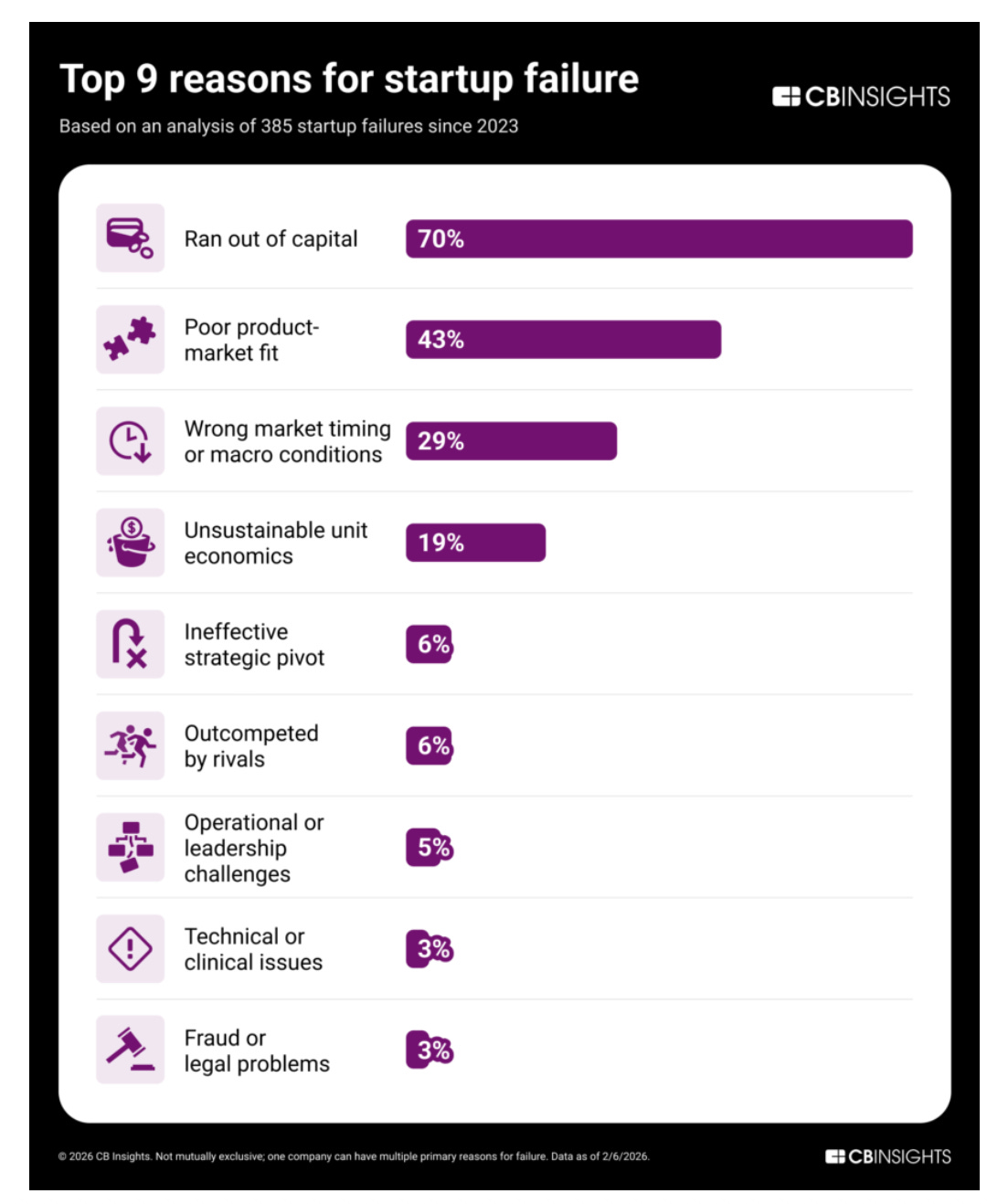
Seems intuitive, right? But once you let it sink in, you realize, “Well, yeah, you ran out of capital. If you still had capital, you would still be in business.”
Running out of capital is the symptom. It’s not the root cause.
It’s kind of like a coroner saying the cause of death is that the person’s heart stopped beating. Technically, true. But why did the heart stop beating? That’s the real question.
For founders, saying your startup failed because you ran out of capital ignores the root cause.
You ran out of money because you didn’t achieve a business goal.
But telling yourself that it was because you ran out of money? You’re just lying to yourself.
CB Insights comes to a similar conclusion, but is more polite than I am:
The more telling causes — poor product-market fit (43%), bad timing (29%), and unsustainable unit economics (19%) — reveal why the capital dried up in the first place.
— CB Insights
The three root causes they call out:
Poor product-market fit: This is always an issue. They even highlight that 20+ post-Series B companies failed to find it! You have to know your market and customers.
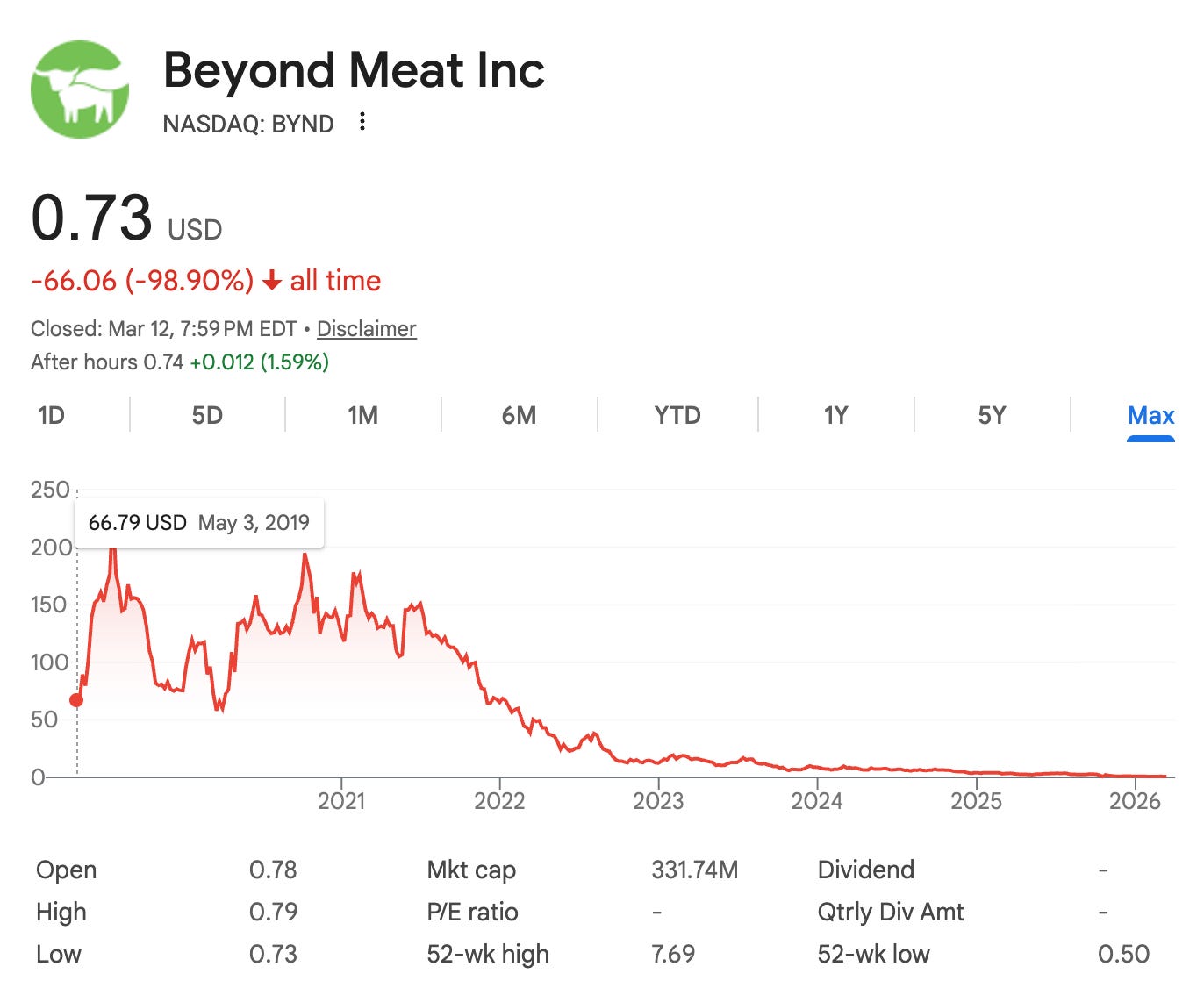
Bad timing: This could be several things. The examples CB Insights cites include alternative protein companies, which are a market that is really struggling. Is it bad timing, or is it a failure to reach price parity with traditional proteins? Timing is often a code word for 'we couldn't get the costs down fast enough to shift the market.
Beyond Meat is a case in point, where costs have remained stubbornly high, stalling widespread adoption, and leading to a cratering in their stock price:
Unsustainable unit economics. Becoming profitable is critical for long-term success. You can only live on venture capital funding for so long. Very few companies can replicate the Amazon model. Most end up like Movie Pass.
For deep tech founders, you have to build the model and stress test every assumption about your unit economics. Customers need to save money, create more revenue, or do both. This is a challenge for many climate tech companies competing against decades-old technology that has benefited from extensive learning and cost compression.
I credit CB Insights for pushing their analysis to the next level. But I wonder why they even list running out of capital as an option.
I am not a psychologist, and the literature on failure is extensive, so I can only share a few personal reflections.
The Cognitive Triangle
In cognitive behavioral therapy, there is a concept of the cognitive triangle. Thoughts, feelings, and behaviors are interrelated.

The dynamic interactions are powerful in how you navigate the world day to day. They also have a role to play in learning from failure.
As a toddler, after you pinch your finger in a door, you learn quickly not to stick your fingers in a door jamb. The brain is saying, “We stuck our fingers in the door and got hurt. Let’s not do that again.”
If our brains told us instead, “Our fingers got pinched because mommy shut the door on our fingers,” we would learn a very different lesson. This might be, “We should yell at mommy every time we are near a door to not shut it on us.”
Dig deep for the root cause
Just like the toddler blaming mommy, we can tell ourselves, “We had to shut down because we ran out of money.” But what lesson can we take away from that? It might make us feel better, since it puts the cause outside our control, but we miss the chance to avoid the core mistake that led to the shutdown.
There are lots of ways to get to the root cause. One of the simplest is Five Whys. Ask why at least five times to reveal the deep causes of an event.
Why did we fail? Because we ran out of money.
Why did we run out of money? Because we couldn’t raise more money from investors?
Why couldn’t we raise more money? Because we didn’t hit our revenue targets?
Why didn’t we hit our revenue targets? Because our customers weren’t happy with our product, they didn’t renew the contracts.
Why wasn’t the customer happy with the product? Because we only delivered half of the cost savings in their back-office operations that we had originally promised.
It is much more productive to acknowledge, “We really misread what our customers really cared about. We should have done more customer discovery early on.” Only when you do this can you increase your chances of success in your next startup.
Take that long, hard look in the mirror and be honest with yourself.
The focus on money can be corrosive to founder success, manifesting in many ways:
Validation Gap: Founders are trying to raise money with limited customer validation.
Pitch Deck Tunnel Vision: Founders focus so much on the pitch deck that they forget to focus on the product.
Penny-wise, pound-foolish: Founders are monitoring every penny spent but are not asking whether that spending is delivering on the milestones.
The constant fear of not raising money or running out of money can distract you from focusing on finding a repeatable business. Remember, that’s the real goal.
Agree or disagree?
Should CB Insights even include this as an option in their survey?
When have you lost sight of the real purpose of your startup in the pursuit of funding?
Would love to discuss this more with other founders.
Comments
Nothing yet. Say the first thing.
Sign in to join the conversation.