
Deep tech founders, you can take a sigh of relief.

On Tuesday, the Senate unanimously passed S. 3971, the Small Business Innovation and Economic Security Act. After months of arguing and negotiating, it looks like the Small Business Innovation Research (SBIR) and Small Business Technology Transfer (STTR) programs will be reauthorized.
I cannot overstate how critical these programs are for the deep tech startup community. I know personally that without the SBIR program, BlueDot Photonics would have never existed.
But this wasn’t just a simple reauthorization; there were some notable changes to the programs that every founder needs to know. Let’s dive in to learn what’s changed and what you should be doing as a result.
The Act will extend the SBIR/STTR program through the end of fiscal year 2031. That’s a six-year extension. Given the proposed changes, this is a practical amount of time to assess their impact.
But it also means we could see this reauthorization tangle play out all over again in 5.5 years. Fingers crossed that doesn’t happen.
The extension also clarifies one of the most concerning questions from the authorization lapse: will agencies have to spend all of FY 26 funding by the end of September?
No. The bill will allow unused FY 26 funds to carry over into FY 27.
The biggest changes are all about vetting small businesses for security risks for both SBIR and STTR awards.
Agencies are now required to “evaluate whether a small business concern presents a security risk for any reason” through the standard due diligence process, disclosures the companies make, and coordination with the intelligence community. The head of the agency then has discretion not to make an award using a simpler set of criteria.
Things that can warrant denial:
Owners or individuals with connections to foreign talent recruitment programs;
Affiliated businesses located in China or other foreign countries of concern;
Owners or individuals with affiliation with a research institute in China or a foreign country of concern;
(NEW) Connections to any individuals on the following watch lists: UFLPA, Chinese Military-Industrial Complex, Section 889, DoD Chinese Military Companies, Military End User List, Commerce Entity List, FCC Equipment List, CBP Withhold Release Orders;
(NEW) Security risk identified through classified sources;
Any security risk that the Agency determines warrants denial.
Similar language was present in the prior law, but this adds a level of specificity not present in the prior law (watch lists) and grants the agency broader discretion.
Fortunately, the new bill requires agencies to notify businesses about the denial and the basis for it. Businesses can apply in future cycles (after addressing the security concerns).
The bill then expands what risks the due diligence process should interrogate. Additions include:
Foreign affiliations of covered individuals, owners, or other key personnel;
Investment relationships with an individual or entity in a foreign country of concern;
Technology licensing agreements or joint ventures with an individual or entity in a foreign country of concern;
Business relationships with an individual or entity in a foreign country of concern.
Imagine getting an award of $30,000,000.
Historically, the SBIR program didn’t have the capacity to do this. Phase I awards ranged from $100k to $ 315k, and Phase II awards had a cap of $2M.
This is a considerable investment in early-stage R&D, but it has its limits, especially for scale-up development.
The reauthorization Act seeks to address this issue by allowing agencies to award up to $30M to small business concerns called the Strategic Breakthrough Allocation (SB-Allocation).
Before you get too excited, there are a couple of caveats:
It’s optional: Agency directors have the option to allocate up to 0.5% of their R&D budget to the SB-Allocation. It isn’t mandated, so we will see what agencies decide to use the allocation.
It’s not as much money as you might think: The NSF spends about $174,000,000 on SBIR/STTR projects every year, which should be 3.65% of their annual R&D budget. If you do the math, their SB-Allocation would only be $24,000,000. A solid 15% increase in total funds available, but the NSF will not be issuing multiple $30M awards. Instead, we might see smaller awards to augment the traditional Phase II funding.
Cost match required: Awardees must provide a 1:1 cash match for an SB-Allocation award. Fortunately, this can come from either new private capital or new government funding; the only prohibition is that you can’t use other SBIR/STTR funds.
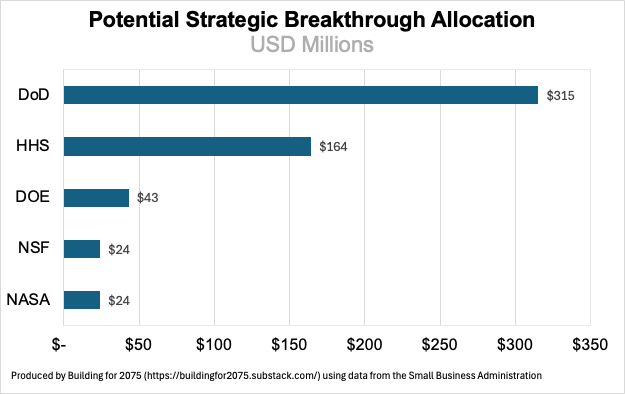
The Strategic Breakthrough Allocation allows agencies to allocate up to 0.5% of their R&D budgets to SBIR/STTR projects whose acceleration is strategically important to the US. These estimates are based on SBIR/STTR budgets from the Small Business Administration circa March 2026.
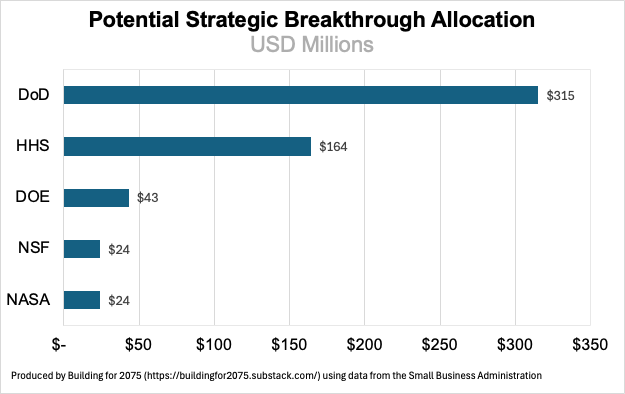
The reality: this program will be much more impactful for DoD/DoW awardees. The DoD/DoW spends $2.3 billion on SBIR projects every year. Now, they have an additional $315 million to award to Phase II recipients.
Agencies that do participate will select projects for SB-Allocation funding if they meet the following criteria:
National Security Impact: Potential of the small business concern to advance the national security capabilities of the United States;
Novelty: Potential of the small business concern to provide new technologies or processes, or new applications of existing technologies, that will enable new alternatives to existing programs;
Federal Government Demand: Whether a customer in a Federal agency has expressed an intent to purchase and integrate technology from the small business concern into its operations;
Undercapitalized: Whether a particular technology area is undercapitalized by private investment.
These criteria are ideal for DoD/DoW projects, so it will be interesting to see if other agencies take advantage of the program.
Another nice feature of this new SB-Allocation funding is the focus on a streamlined process; agencies must complete contract awards within 90 days of receiving a proposal from a business.
Another change requires agency heads to set limits on the number of applications businesses can submit. This was a major point of contention during negotiations, as Sen. Ernst sought to shut down “SBIR mills,” i.e., companies that repeatedly secure SBIR awards, partly because of their aggressive application strategy.
The heads of agencies can set the limits:
On a fiscal year basis;
On a solicitation basis;
On a topic basis.
Agencies can request a waiver for these limits, but there are notable restrictions in place to prevent abuse.
Technical and Business Assistance (TABA) remains, with the funding levels unchanged ($6,500 for Phase I, $50,000 for Phase II).
The bill gives businesses more control over who they work with and expands the uses to which they can put TABA funds. The bill removes language that allowed agencies to pre-select eligible vendors. Businesses now pick who they want to work with to carry out eligible uses of funds. This includes paying their own staff.
And there are new eligible uses:
Cybersecurity assistance
Intellectual property protections
Screening for potential foreign involvement in technology development or commercialization activities
In addition, the changes to TABA include expanding access to I-Corps programs. Agencies are now required to offer participation in an I-Corps program. And TABA funds can be used by the business to pay for this participation.
Phase III of SBIR/STTR awards has always been a bit murky. As defined by the law, Phase III is broad, encompassing commercial development, additional research, and federal procurement of the technology.
The spirit is to encourage successful Phase II projects to secure additional non-SBIR funding from federal agencies for either further development or procurement. And what’s great for the small business is that these Phase III awards can be sole-sourced without further justification.
So, what’s new?
The bill requires agencies to train procurement and acquisition employees on the details of Phase III. This should help increase the number of Phase III awards made.
It also empowers the Administrator of the Small Business Administration to advocate for the Phase III program and update policies appropriately.
Finally, it also compels agencies to adopt “simplified and standardized procedures and model contracts for Phase I, Phase II, and Phase III SBIR awards,” and for agencies to clarify what small businesses are “expected to provide as part of market research or as part of a proposal by those small business concerns to establish eligibility for Phase III awards.’
Overall, small tweaks, but ones that should help make Phase III a more likely outcome for more awardees.
The bill expands the data collection requirements for agencies to help gauge the effectiveness of the SBIR and STTR programs, e.g., tracking Phase II and Phase II awards more comprehensively.
The bill gives the DOE and NASA the ability to provide direct Phase II awards (previously limited to NIH, DoD/DoW, and the Dept of Education).
Whew. That was a lot. So, let’s boil it down to a few takeaways:
 Program extension through 2031. 2) Increased scrutiny on security risks/foreign influence. 3) New $30M Strategic Breakthrough funding. 4) TABA expansion for all agencies including cybersecurity. 5) Efforts to make Phase III procurement more effective. 6) Expansion of "Direct to Phase II" for STTR, DOE, and NASA. 7) New limits on proposal submissions to curb "SBIR mills." 8) I-Corps participation available for all awardees.")
What are your thoughts?
Do the new security requirements worry you?
How do you think agencies will deploy the strategic breakthrough allocation? Do you think the 1:1 match is a fair requirement? Is this actually going to help early-stage startups?
Do you think the new limits to stop SBIR mills are fair?
We should start seeing new solicitations appear from agencies once this bill is signed into law, so now’s a good time to update your notifications from grants.gov.
The SBIR/STTR rules just changed. Are you ready?
Gliding Ant Ventures is here to help. Our SBIR Academy program is designed to help you prepare a competitive Phase I application using an 8-week structure. Our role: your co-pilot, helping you stay on track and giving you a fresh perspective.
Let’s make sure you meet all of the new requirements. Apply for the SBIR Academy today.
Comments
Nothing yet. Say the first thing.
Sign in to join the conversation.