
People with PhDs make the best entrepreneurs.
This, I believe.
Am I biased? Probably.
I have a PhD. My business partner, Virginia, has a PhD. I founded a solar startup with another PhD.
But there is data to back it up.
In 2023, 35 billionaires in the US had PhDs. And the founders of unicorn companies are 6x more likely to hold a PhD compared with the population at large.
But unfortunately, PhD participation in startup formation fell by 38% between 1997 and 2023. The reasons for this decline are unclear.
But it should be seen as an existential crisis for society. The only way we can continue accelerating innovation across society is by increasing the participation of PhDs in startups. The problems are getting bigger and more complex — mitigating and adapting to climate change, transitioning to an electricity-driven economy, feeding another 2 billion people — and will require expertise and rigor to solve them. PhDs have the expertise and skills to tease apart these problems into solvable chunks, and startups are more nimble and can move faster than existing corporations.
So, today I’ll share the reasons why I believe PhDs can be excellent entrepreneurs and the biggest thing that derails them.
Then, over the next few weeks, we’ll dig into why their participation is declining and ways to reverse the trend. This is a core part of our goal here at Building for 2075 and Gliding Ant Ventures, which we have shared previously:
When I was in my PhD, I never saw myself as an entrepreneur. I was a scientist, a chemist to be precise. An expert in chemistry. Not a deep tech founder.
It wasn’t until I went into the business world and eventually became an entrepreneur that I realized how similar PhDs and entrepreneurs are.
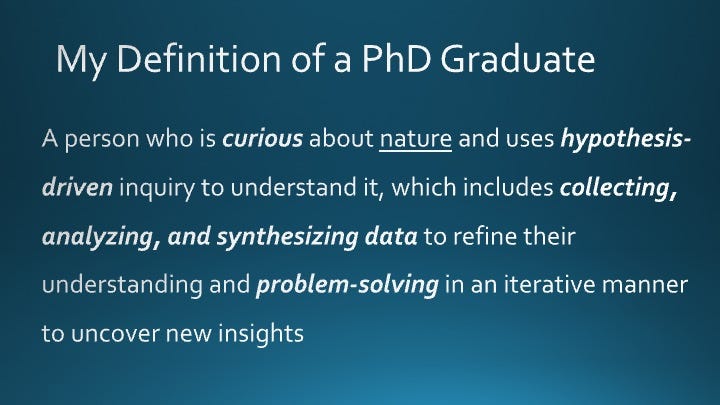
Here is my definition of a PhD graduate:
And here is my definition of an entrepreneur:
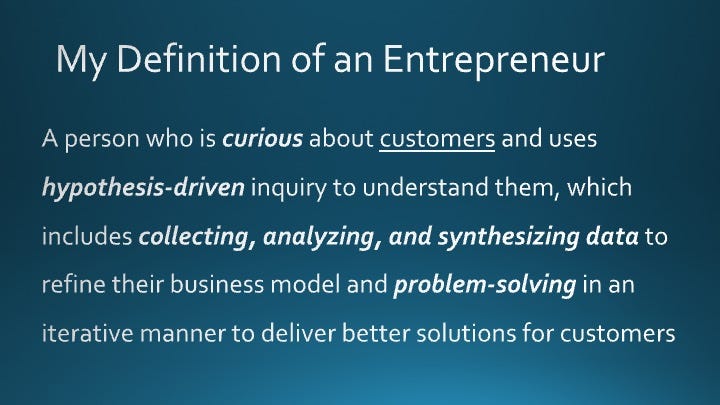
As you can see, the only fundamental difference between a PhD and an entrepreneur is the specific problem they are trying to solve.
The PhD wants to discover a repeatable, consistent truth about the universe.
The entrepreneur wants to discover a repeatable, consistent business model to serve their customers.
The similarity between the two is uncanny.
Throughout my career, I have been continually surprised by how helpful my PhD training has been in the business world. As a management consultant, product manager, and deep tech founder, I was able to adapt what I learned in the research lab to the business setting.
Naturally, if the core goals of PhDs and entrepreneurs are similar, the two groups should have similar skillsets, and they do:
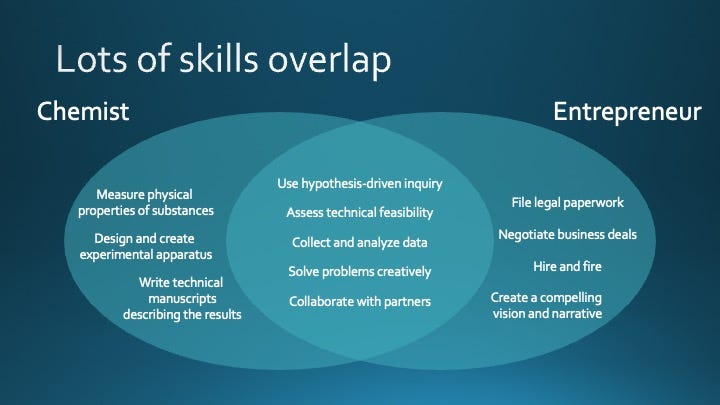
The core skill set of both PhDs and entrepreneurs focuses on answering questions through inquiry and data collection.
The effective application of hypothesis-driven inquiry separates great founders from mediocre ones.
How does this skill translate from the lab to the startup?
During my PhD, I developed a molecule that could reversibly bind carbon dioxide. I developed a hypothesis that I could tune the binding strength by changing the external environment. I designed a series of empirical and computational experiments to test my hypothesis, eventually confirming my intuition.
When I was the CEO of BlueDot Photonics, I hypothesized that we could coat solar cells with our new optically active materials. I then created an interview guide and conducted a series of interviews with industry veterans to test this hypothesis. Through the interviews, I learned that coating the cells would be a manufacturing nightmare, and we would need to pivot.
Different questions, same basic method: come up with a hypothesis, design an experiment, collect and analyze data, and interpret the results.
This is just one example, but over and over again, I have found myself and other PhD founders tapping into the skills they first developed during their PhD.
Of course, no one can do it alone, so it’s important to build the right team for your venture:
If you have a PhD, you know what I mean when I talk about grit and determination.
When I was working on my PhD, I had to measure the volume of a very small amount of carbon monoxide produced by a reaction that was central to my thesis. I tried dozens of different experiments and techniques over months of work. It was one failure after another. But I wouldn’t accept the failure. I kept reading articles and asking questions. Eventually, I found a molecule to use as a trap for my product, and the final piece of the project fell into place.
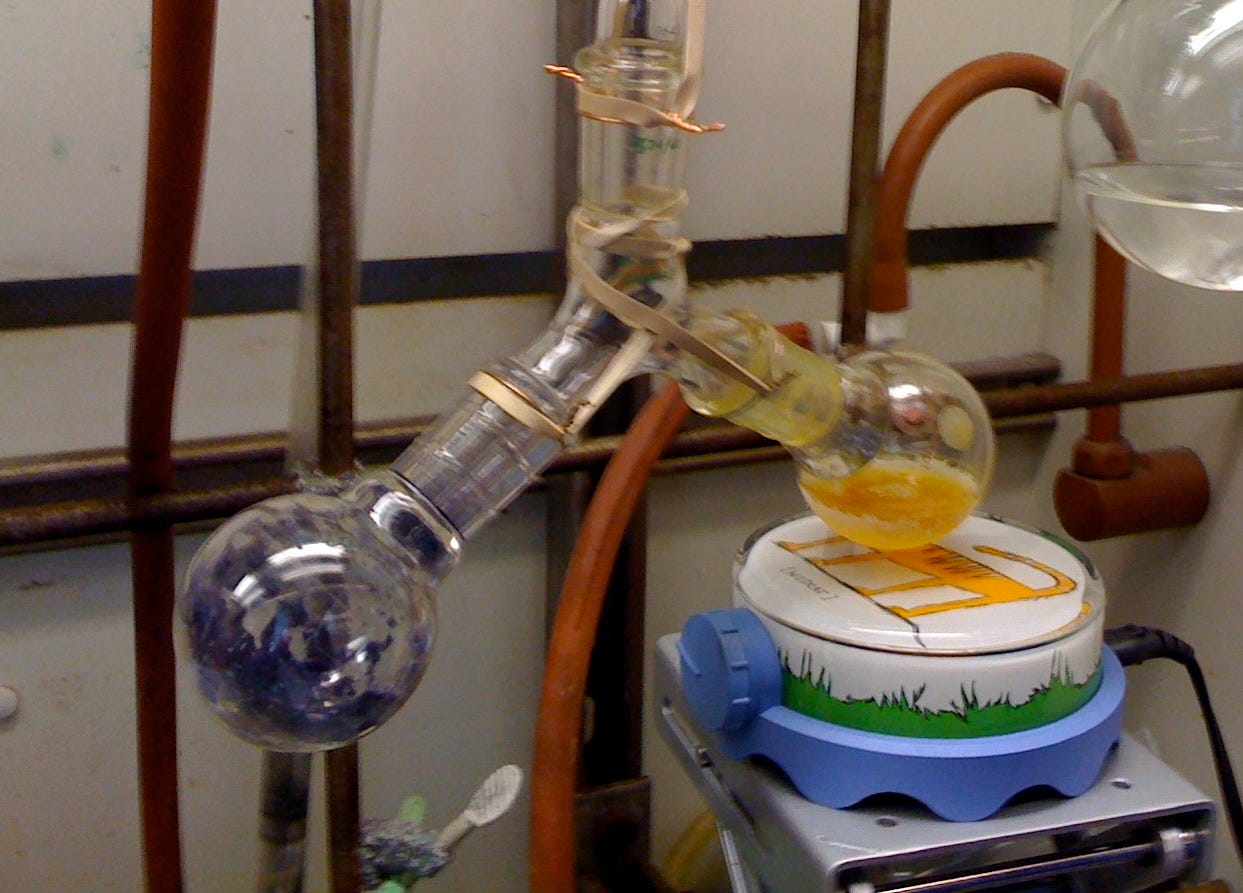
It’s moments like these that prepared me for the grind of my startup, BlueDot Photonics. In early 2020, we had secured our first grant from the DOE and were pitching to investors. Then, in March, we were locked out of our labs, and investors froze all investment activities as COVID-19 spread. I had to renegotiate our contract with the DOE, secure working capital for our research activities, pay legal fees to secure our IP, and secure private investment to grow the team. As daunting and stressful as this was, I was able to lean on the mental grit I developed while chasing CO in the lab.
A PhD thesis is a mental and emotional marathon. There can be months of frustration when instruments break or experiments fail repeatedly. There is often no external validation or motivation to keep going; it’s up to the individual to put their head down and grind through the struggle.
This is the same struggle every entrepreneur faces at one time or another. A PhD has a leg up on other founders because they have experienced this frustration firsthand.
If it is so obvious why PhDs can make great deep tech entrepreneurs, why don’t more pursue it, and why aren’t they winning at even higher rates?
A few aspects of entrepreneurship deter PhDs from following this path: seeking the most elegant rather than the most practical solution, making decisions quickly with incomplete data, being OK with an 80% answer, and needing to self-promote.
But the biggest challenge area for PhDs that can derail their entrepreneurial dreams is storytelling.
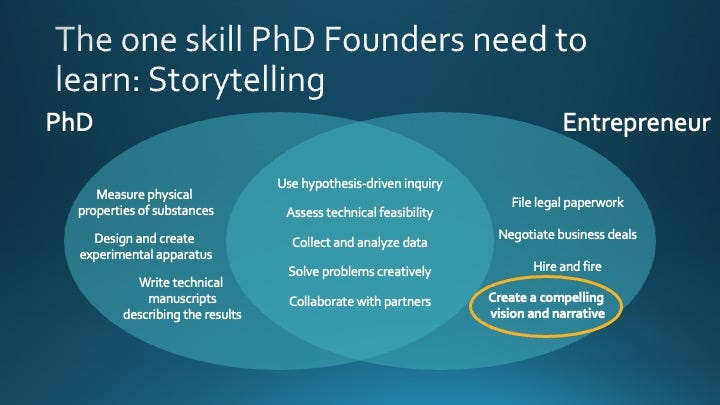
And I was no different. I thought I was a pretty good communicator by the end of the PhD. But I didn’t realize that I had been trained to only communicate in one way — as a careful, methodical scientist.
When I was in my first year at McKinsey & Co., I had to unlearn almost everything I had learned about communication in my PhD. Get rid of the jargon. Use fewer words. Don’t bury the lede. Make sure you can tell the client the story in 30 seconds while walking down the hall to the next meeting. It was trial by fire for me.
Scientific communication is almost the complete opposite of the communication style required for entrepreneurship.
Scientists typically tell stories as a series of steps: first I did this, then I did this, and then I did this, and at that point I realized I had learned this. This is classic inductive reasoning.
And it’s intentionally dry. Emotions should be left at the door. Facts should carry the day.
Entrepreneurs flip the script, talking about their vision first and then explaining why they believe it is real. Classic deductive reasoning.
And it’s critical to invoke feelings, emotions, and passions. We’re talking about people, and people are messy.
Time and time again, this is where I have seen PhDs stumble on their entrepreneurial journey.
Their pitch decks are too heavy on tech and jargon, fail to address the customer, and, to be frank, they’re boring. I’ve covered the pitfalls of coming across as a scientist when you pitch here:
Fortunately, these are skills that can be learned, and those PhDs who commit to practicing and soliciting feedback from others can quickly overcome this deficiency.
By the time I was making my first pitches, I had refined my communication style. An investor at the Cascadia Cleantech Accelerator came up to me after my final pitch and asked, “How many other startups have you had?” I answered that this was my first one, and her eyes widened. “We should talk,” she said, handing me her card. Clearly, I had told a good story.
I wish that someone had told me earlier that my PhD was preparing me not just for scientific research, but a whole swath of careers, including entrepreneurship. The underlying skills — hypothesis-driven inquiry, problem-solving, collaboration with partners, and perseverance through challenging situations — were all there. But it wasn’t until I was outside the lab, looking back on my career, that I appreciated this.
The PhD-to-entrepreneur journey isn’t easy. It takes an open mind, hard work, and practice. But the gap between a scientist and an entrepreneur is narrower than it looks from inside the lab. Most of what you need, you’ve already built.
Over the coming weeks, I’ll be exploring this topic further — helping PhDs who are curious about entrepreneurship learn what it takes, how to harness their skills, and how to find team members to complement them.
If you are a PhD student interested in becoming an entrepreneur or have recently started your journey, I’d love to hear from you. Subscribe and leave a comment, and I’ll set up a 30-minute meeting to talk through your situation and what could come next in your career.
Comments
Nothing yet. Say the first thing.
Sign in to join the conversation.