
“Can I get a show of hands? How many solution providers are here?”
I was sitting in the audience of a panel session at Carbon Unbound, a carbon removal conference held in Vancouver, BC, last month. Thomas Goetz from Air Canada had asked the question from the stage. The discussion focused on decarbonizing the airline and shipping industries.
I looked around. With surprising timidity, about half the hands in the audience of 150 people raised.
“OK, great. That’s what I thought. How many policy makers are in the audience?” he asked.
I craned my neck left and right. I saw a single hand.
“Exactly,” Thomas concluded.
Most deep-tech founders believe they are competing with other startups. In reality, they often compete with outdated regulations designed for a different century.
Policy and regulation play a critical role in determining which products thrive and which die. Unfortunately, most founders and investors take a passive approach to policy and regulation.
The story above highlighted to me how large the disconnect can be between entrepreneurs and policymakers, both conceptually and physically.
This post examines how founders and investors can mitigate risk in this critical component of any startup strategy.

Before going out and talking with legislators or other policymakers, make sure you know what you want or need. Ask yourself: What new policy or policy change could provide a tailwind for your business?
Is it a faster permitting process for a pilot plant?
Is it an update to a 30-year-old safety standard that doesn’t account for your new chemistry?
Is it a new source of funding for a key gap in the funding pipeline?
Be specific. Big sweeping policy changes take years of education and discussion. But small changes can happen within a year if you talk to the right people.
Brainstorm with your team, investors, and advisors about what actions would be most beneficial for your startup. Talk with your competitors as well to find points of mutual agreement.
Make your ask clear and actionable.
Even if you don’t have a specific ask or dedicated lobbying effort, it makes sense to connect with the representatives and legislative staff where you operate. These people are very well-connected. And part of their job is to make sure their district is well-taken care of.
How to do this?
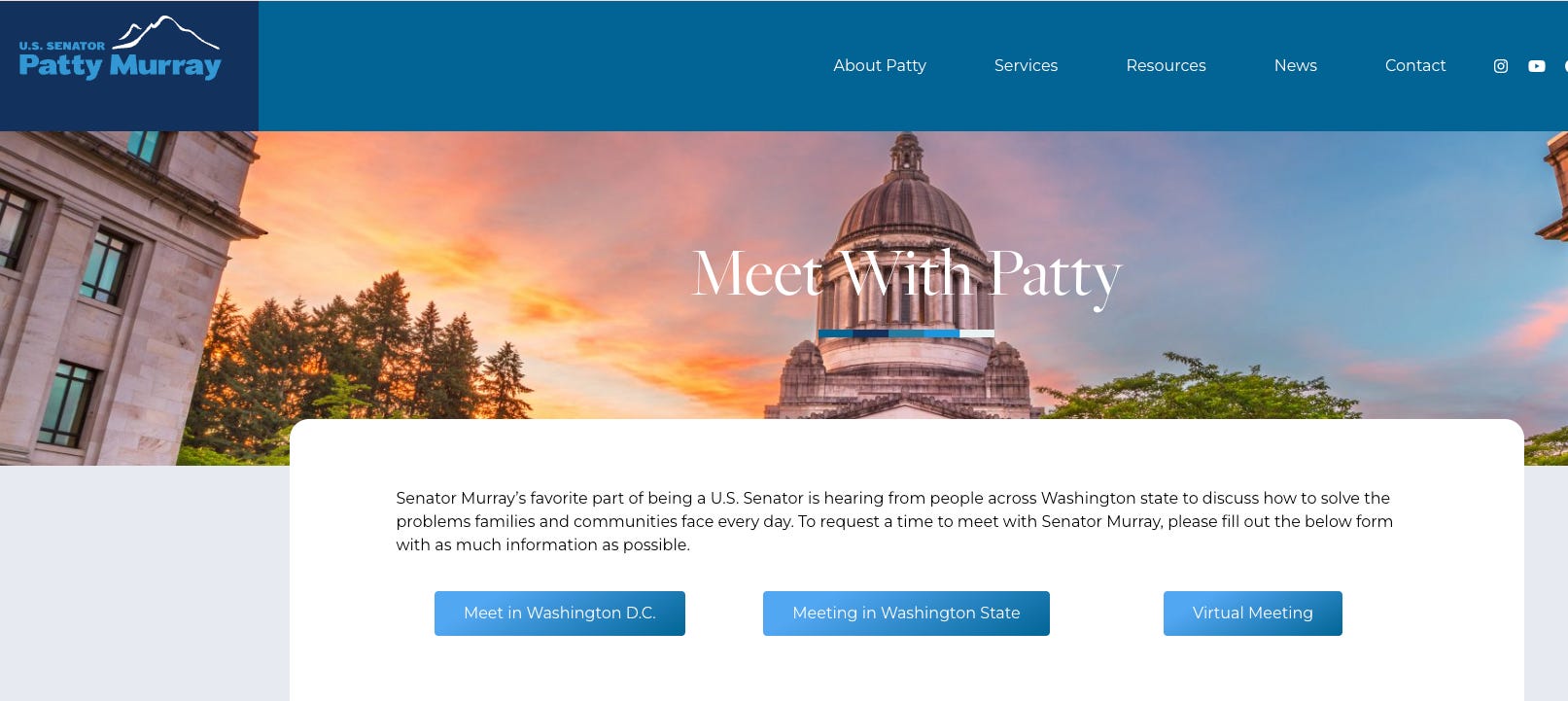
Start at your rep’s website. Many offer ways to meet and connect with the rep and their staff.
Email introducing your company and asking for time to share your concerns and needs as a small business owner. This is an easy way to get on the office's radar.
Try to connect with your rep’s local office. Staff here can often be a great resource for making connections and getting questions answered.
Attend meetings and town halls. Meetings focused on economic development are a great place to find reps and staff. Leave them your contact info, make sure to get their info, and follow up with an email afterward.
The 24-year-old staffer whom you will probably meet with can be your best friend. They are the ones who draft the language that makes into the bills and rules that are turned into law. Treat them well, make it easy for them to advocate for you, and good things will happen.
There are many trade groups that advocate for entire industries at various levels of government. These groups can be effective at raising awareness of your industry’s needs and can be more influential than your voice alone. You can join these groups often for a modest fee (some have free membership), and they provide legislative updates and occasionally ask for your voice to support or oppose legislation.
At BlueDot, we were part of a perovskite-specific group called US-MAP. This was a consortium of academics, national labs, and corporate partners who would engage the DOE and Congressional Offices to educate about and advocate for perovskite technology. I also participated in the Clean Energy Business Network (CEBN), which lobbies for support of clean energy businesses across the US.
Virginia was a founding member of the North American Coalition for Insect Agriculture (NACIA). NACIA’s role is to educate and raise awareness and acceptance of insects as a way to upcycle nutrients back into the food chain. It had dozens of members ranging from Fortune 500 companies to pre-seed startups.
Virginia and I were also board members of the Cleantech Alliance in the Pacific Northwest, an organization that promotes the benefits and potential of cleantech to drive the region's economic development.
Plus, these organizations are also great places to network and make connections that can help grow your startup.
I’m shocked that more VCs don’t require their startups to pay for professional lobbyists.
Some of you may frown on the idea of lobbying. But in most cases, lobbying is simply educating. Legislators are busy people, with thousands or millions of constituents. They aren’t deep tech experts. They can’t help you if they don’t know you or what you do. Lobbying is the process of closing that gap.
Let me share with you a story about how lobbying works in practice:
When I was at BlueDot, Joel Jean from Swift Solar reached out one day. Joel had just closed a funding round, and he was using part of the funds to work with Boundary Stone Partners to advocate for funding to support scale-up R&D for perovskite solar technology.
This was a key gap in the funding pipeline for new solar technologies. Joel’s a smart guy, and he knew that his voice alone wouldn’t carry as much weight as having several startups make the ask. So, he was building a coalition of other perovskite startups.
This was a brilliant move by Joel and his investors. The lobbyist Steve would schedule calls with Congressional staffers and then invite CEOs like me to attend, and share our stories. We met with staff from the offices of Senators Cantwell and Murray because BlueDot was in Washington State. I also met with folks from California since there were several startups based there.
The focus was on educating people about the technology's potential and how it would improve economic growth, energy security, and job creation across the US.
After a few months of discussions, language was included in the appropriations bill authorizing the DOE to dedicate tens of millions of dollars for solar technology scale-up R&D.
Think about that. For tens of thousands of dollars, educating congressional staff members about this exciting new technology led to tens of millions of dollars in non-dilutive funding. There are very few actions a startup founder can take that offer such a high return on investment.
If you have a clear, actionable ask, consider allocating funds for lobbying in your Series Seed or Series A round. If you are a venture capitalist, consider requiring your startups to set aside a portion of invested capital for lobbying. And encourage other startups in your industry to do the same. Then, pool your resources to work with a firm like Boundary Stone Partners to advocate for the policies and regulations you need.
If you don’t advocate for yourself and your industry, who will?
So, what’s your policy strategy? I challenge every founder to take an hour this week to brainstorm three policy changes that could help accelerate your business’s growth. Then, go to one of your representatives' websites, find their energy or technology staffer, send them a one-paragraph introduction, and ask for 15 minutes to discuss your top policy priority. I’ve added a template in the next section to help you get started.
And if you have stories about policy and lobbying, please share them in the comments. Examples of where effective lobbying and education resulted in positive change for your startup? Stories of policy changes derailing your startup? Share your stories in the comments so others can learn from your expertise and experience.
Here are simple email outreach and policy-briefing templates to help you take the first step in implementing your policy strategy.
Subject: Meeting Request: [Startup Name] / [Relevant Topic, e.g., Updates to Safety Regulation for Energy Storage]
Hi [Staffer Name],
I’m the CEO of [Startup Name], a startup based in [District], building [one-sentence tech description, e.g., “long-duration energy storage systems designed to stabilize the grid and lower energy costs.”]. We’ve recently run into a regulatory hurdle regarding [Issue] that is slowing our ability to deploy pilot projects with customers.
I’ve attached a one-pager on our work and the issue at hand. Do you have 15 minutes next week for a brief intro call so I can learn more about the Representative’s priorities in this space?
Cheers,
[Name]
[Company Website]
Instructions for founders: Keep this to a single page or slide, including your company logo. Use high-quality, compelling visuals of your tech whenever possible. The goal is to make the staffer’s job easy when they have to explain your company to their boss.
[Company Name] – [Brief Title of the Issue, e.g., Modernizing Safety Standards for Advanced Battery Tech]
Our Mission (State clearly what your startup does and the major problem you are solving.)
Example: “We are building long-duration energy storage systems designed to stabilize the grid and lower energy costs for [District/State] residents.”
The Regulatory Barrier (Define the outdated regulation or policy gap that is holding you back.)
Example: “Current safety regulations (Standard XYZ) were written for 20th-century technologies and do not account for the unique safety profiles of [New Tech]. This is creating an 18-month delay for pilot projects that have already secured private funding.”
Economic & Local Impact (State the impact on the policymaker’s district.)
Job Creation: “We currently employ [Number] engineers and technicians in [City/District] and plan to double that by 2027.”
Private Investment: “We have successfully raised $[Amount] in venture capital to scale our operations here.”
Strategic Leadership: “[District/State] has the opportunity to be the national hub for [Industry] if the regulatory environment keeps pace with innovation.”
The “Ask” (Actionable Request) (What do you want the staffer to do? Be specific.)
Example 1: “We ask for your support for recently introduced legislation [Bill Number] to update safety regulations for new technologies, including long-duration energy storage like ours.”
Example 2: “We request an introductory meeting with [Representative] to share our perspective on how [Regulation X] impacts local innovation.”
Contact Information
Primary Contact: [Founder/CEO Name]
Email: [Email Address]
Website: [Company Link]
Comments
Nothing yet. Say the first thing.
Sign in to join the conversation.