
Founders spend hours on their market size slide. Most investors look at it for maybe 3 seconds.
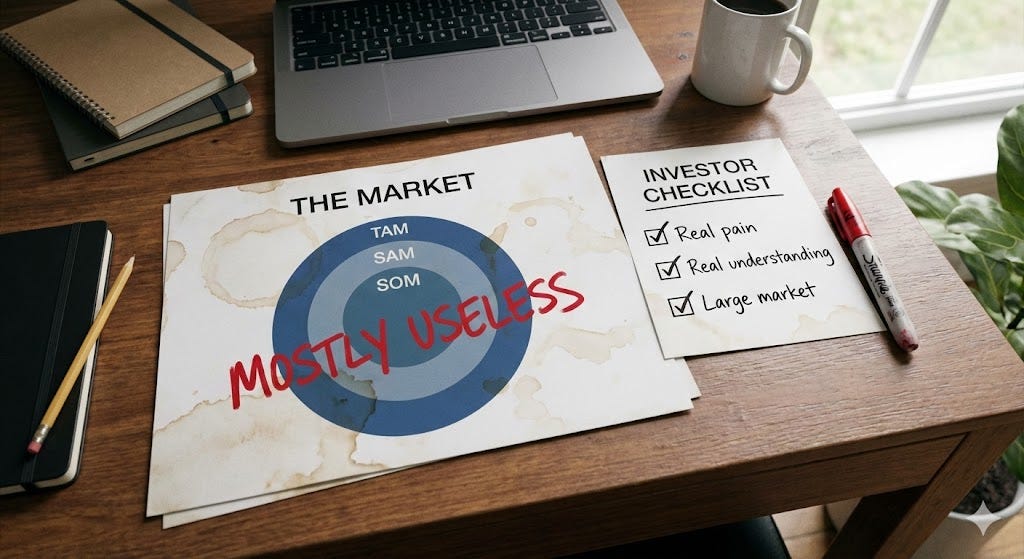
It’s a classic in a pitch deck: concentric circles labeled TAM (total addressable market), SAM (serviceable available market), and SOM (serviceable obtainable market), sometimes including LAM (launch addressable market). These circles are often decorated with dollar figures in the billions.
And the slide is mostly worthless. This isn’t a hot take; several folks have called it pointless or useless.
It’s not that the market size isn’t important. During the earliest stages of a startup, the market is second only to the quality of the Team in most investors’ evaluations. But it’s about more than market size. Investors need to believe the startup will break into the market and grow rapidly.
Investors need to believe the startup will break into the market and grow rapidly.
All too often, I see founders get fixated on showcasing a large market size, forgetting to show why now is the right time to enter, why the customer pain point is large enough to drive sales, and who their initial customers will be.
Next to having the wrong team to execute the strategy (which we talked about here), not demonstrating deep market understanding is the biggest mistake founders make. They haven’t spent enough time speaking with and understanding customers to gain unique insights. Instead, they rely on market reports, personal anecdotes, or, more recently, AI-generated summaries as validation. (And these poorly researched ‘market reports’ are notoriously inaccurate, often by orders of magnitude.)
This lack of understanding is a major red flag for investors, often more so than a small market size.
Founders need to get out of the building, talk to LOTS of customers, study competitors and alternative technologies, and then quickly demonstrate this knowledge to investors if they want to secure investment.
In our Investor Red Flag Assessment, we ask founders 18 questions to see if they are a good fit for venture capital.
Today, I’ll talk about the three market questions investors care about that show if a founder has done the necessary groundwork to truly understand the market.
Let’s dive in.
Some people call this the pain metric. How much are people currently paying someone else to solve this problem? Or how much lost productivity or revenue is the problem causing? The greater the pain, the more likely a customer is to pay for a new solution. Reed Hastings highlighted this nicely:

Let’s look at an example from the solar industry. Circa 2019, smaller solar panel manufacturers were stuck. The industry had just completed a decade-long technical transition to high-efficiency mono-PERC cell technology, pushing panel efficiency to about 22%. Unfortunately, further efficiency gains would require significant capex for new production tools. At the same time, solar panel gross margins were often below 10%. Only the largest companies would have access to the capital needed to make the next technological leap; small players faced an existential threat. These smaller companies were looking for new technology that could extend the life of their existing production systems and boost their gross margins. This is the pain point BlueDot targeted with our drop-in-ready quantum-cutting technology. Our solution was an order of magnitude more efficient in terms of capex than the alternatives. By correctly identifying this pain point, we successfully engaged several CTOs at solar panel manufacturers about joint testing and material development, which helped investors see the market potential for our startup.
Venture capitalists need to see the customer’s pain; otherwise, they won’t invest.
Identifying an existing pain point is a best practice, but venture capitalists also invest in category-defining products. However, I would argue that even category-defining products start by solving an existing problem. The iPhone recognized that people were spending a large amount of time just checking email and doing quick Google searches on their laptops. Why not have that functionality in your pocket? SpaceX recognized that they could reach space for a fraction of NASA’s cost, and people were struggling with low-speed internet in large swaths of the world because of the expense of fiber cable build-out. In almost all cases, the customer is either paying someone for a solution or suffering a loss.
Venture capitalists need to see the customer's pain; otherwise, they won’t invest.
So, how should a founder confirm the pain point is real? There is only one proven way to do this – the founder needs to talk to the customer.
Startup founders need to know their customers better than they know themselves. This deep understanding cannot possibly come through reading websites and market reports. As Steve Blank recognized years ago, founders need to “get out of the building” and meet and talk with customers.

Repeatedly, I meet founders who can’t articulate who their customer is. They haven’t gone out and met them. They are building their company on unproven assumptions, a recipe for failure.
Unfortunately, customer discovery is often the hardest challenge a first-time founder will face. But there is no replacement for deep conversations with your customer.
For a B2B business, conduct at least 50 interviews with potential customers and relevant stakeholders. This must happen before starting on the pitch deck! I’m not going to lie; this will be one of the most challenging things a founder needs to do. B2B customers are hard to reach. Find in-person meeting places, such as trade shows, conferences, and industry networking events. Also, look for people who are already engaging with the community, e.g., those who are prolific on LinkedIn or writing opinion pieces for trade publications. At BlueDot, I attended Solar Power International and Intersolar and spoke with hundreds of people in the solar industry. It proved invaluable even though I had to pay for the trips out of my own savings.
For B2C startups, you need to have over 200 interviews with your launch customer. And get specific! For example, a startup may be selling an app for diagnosing ear infections. It would be tempting to say that the customer is any parent in the US. But what’s better is getting specific. The launch customer could be primary caregivers aged 35-45 with children under five who live in the top 50 US cities by income. Then, go to where these customers congregate. For the ear infection example, this could include pediatric clinics, playgrounds, or parenting support groups. You might also look at online parent forums for active contributors.
I would never invest in a startup that couldn’t show me the receipts of their customer discovery efforts.
Then, keep detailed notes of these conversations. Best practice is to have two people attend the interviews: one asks questions, and the other takes notes. Having two people listen to the interviewee and observe their body language is super important. And ask whether you can use an AI transcriber, which will provide the details for later reference. I would never invest in a startup that couldn’t show me the receipts of their customer discovery efforts.
Big markets are where startups need to focus to attract venture capital. We say $500M, but this is the bare minimum for the total market size. Realistically, the market size needs to be closer to $10B to really attract a venture capital fund’s interest.
Why? It all comes down to how venture capital funds make money. This is probably its own post, but let’s walk through some back-of-the-envelope math to illustrate the point.
Funds earn money by generating outsized returns for their limited partners (LPs). Funds receive only a percentage of the returns on an investment, called carried interest (aka “carry”). The typical fee is 20%.
This means that the ratio of invested capital to the startup’s exit valuation is a key driver of fund returns. For example, let’s consider two startups with $100M in invested capital. Company A sells for $200M. Company B sells for $1B. The LPs get their $100M of invested capital back in both cases. The venture fund could earn up to $20M for Company A and up to $180M for Company B.1
Clearly, the fund would prefer investing in Company B! That’s why many venture funds invest only in companies that can reach exit valuations in the billions (i.e., unicorns).
What does it take for a startup to reach unicorn status? The company must grow rapidly, ideally reaching over $100M in ARR within five years (sometimes referred to as T2D3), and future investors must be confident that continued growth is possible.
These criteria are easiest to meet when a startup targets a vast market. $100M in sales in a $10B market is a 1% market share. $100M in the $1B market is a 10% market share. The first scenario is much easier, and there’s still room for future growth. This makes it easier to justify a billion-dollar valuation.
There are a few exceptions to this market sizing threshold:
Fast-growing markets – Nascent markets that are growing rapidly can be interesting to venture funds. If a market is growing at 20% per year, it will be hard for incumbent players to grow that quickly, leaving room for new startups. This belief has underpinned lots of investment in climate tech over the past couple of decades. The existing markets were small but growing fast, making it attractive for investment.
Category-defining products – Sometimes, the market for a new product doesn’t exist. For example, virtual reality technology is not universal today; it is, at best, a niche. However, a startup that develops a VR product that attracts mainstream customers could suddenly find itself with near-infinite demand. Obviously, these are riskier investments, so it is up to the founder to demonstrate that their product is truly game-changing.
Strategic investors or specialized funds – Strategic investors (e.g., corporate VCs) or specialized funds (e.g., carbon impact funds) will look past a small market if they believe the startup has additional intangible value. This could be a strategic fit for a corporate VC, or it could be the potential societal impact for an impact investor.
When a startup has a market red flag, founders can take a few actions to either validate their current target market and its size or pivot to a more exciting market.
Here are a few ideas for founders:
Double down on customer discovery – A founder will need to dig deep and keep looking for customers with a real problem and who are willing to pay someone to solve it. Until you have the customer and problem well-defined, there is little chance of raising venture capital. Founders need to block at least 10 hours per week for customer discovery until they hit their interview target and validate their market. This is way more important than building the MVP.
Reevaluate the technology roadmap – Founders should look not just at today’s product but also at future products that can address a deeper market. If a founder can put together a credible path to serve a larger market over time, it can give the investors confidence to invest. Founders should have a multi-stage roadmap ready to explain to investors how they envision their product’s reach expanding over time.
Hard pivot – This is a classic situation in which founders could pivot. What other markets can the startup apply its core competencies to? What other business models could capture more value? Founders need to identify the three distinctive competencies of their startup and brainstorm 10 alternative markets they could enter. Prioritizing these markets by customer pain and market size is a great way to order things.
Look for alternative financing strategies – Venture capital isn’t for everyone. What would a non-venture capital growth strategy look like? Founders should consider bootstrapping, debt financing, and grant funding to achieve their growth goals. Also, look to friends and family for seed capital. If you are entering a small market, look for non-dilutive grants (e.g., SBIR), investment from strategic partners, or bootstrapping by securing revenue from customer contracts for services or custom development (this is the best way to fund your business!).
To summarize:
Market Understanding Trumps Market Size: Investors prioritize founders who deeply understand their market, customer pain points, and timing—not just those who can quote a large total addressable market.
Customer Discovery is Essential: Successful deep tech startups validate their product-market fit through extensive, real-world customer interviews and insights, not just secondary research or AI-generated summaries.
Big Markets Attract Capital, but Exceptions Exist: While a market size of $500M–$10B+ is often necessary to attract venture capital, fast-growing or category-defining markets can also be compelling, non-traditional venture funds could be an option, and alternative growth strategies may be appropriate for some deep tech ventures.
Some of this is out of the founder’s control, but lots of it really depends on the founder’s ability to dive into the market and customer research.
So, if you are a founder, which of these three questions is the hardest for you to answer ‘yes’ to right now? What are you going to do to go from ‘no’ to ‘yes’? I would love to hear your thoughts in the comments.
Also, we are recruiting founders for a video series we are working on that focuses on building a deeptech pitch deck. If you want some free pitch coaching, reach out and let’s talk.
This post is part of a series on Investor Red Flags. Next up: the Business Model.
Subscribe now to make sure you don’t miss it. Thanks for reading!
Obviously, Company B would return some value to common stockholders, so the carry for LPs would be smaller. But this example illustrates the massive upside for funds that invest in billion-dollar exits.
Comments
Nothing yet. Say the first thing.
Sign in to join the conversation.