

Every time a deep tech founder opens their mouth in front of an investor, they are being judged. The investor is trying to decide if you are building a business or conducting a really expensive science project. Once they decide you're doing the latter, it’s game over. No money for you.
We’ve been talking about Red Flags for Venture Capital Funds for early-stage deep tech startups over the last few weeks. We covered the importance of the team. We talked about how understanding the market is more important than the market's size.
This week, we continue going through the 18 questions from our Red Flag Assessment and turn to the business model.
How do you make money? It is surprising how often founders forget this key piece of the puzzle. But it happens all the time. Most of the time, founders seem to think great tech should speak for itself. But investors don’t really care about the tech if it can’t generate enough revenue to turn a profit.
So, founders, you have to convince them that you can make money. Lots of money.
Hmmm…how to do that? How can you show an investor you can get customers to pay lots of money for your product?
You could spend a lot of time putting a lot of marketing and sales buzzwords onto a slide.
OR, hear me out on this…
You could get customers to pay you for your product!
Showing you have paying customers is the best way to convince an investor that you have a real business, not just a science project.
Having a paying customer is the gold standard for demonstrating a successful business model. And right now, investors are reluctant to let that standard slip when making investment decisions. Especially for climate tech companies.
In today’s post, we’ll look at the three questions you, as a founder, need to answer convincingly to give investors confidence about your ability to make money.
We talked last week about the importance of understanding the customer’s pain. But understanding is only half the battle. If you want to be a successful startup entrepreneur, you need to have a solution to eliminate their pain. You need to be their aspirin.
In startup speak, this is known as your value proposition. How much value are you delivering to the customer? It can be in the form of cost savings. It can be in the form of productivity improvement. It can be in the form of social status. Whatever it is, it has to be clearly valued by the customer.
For investors, it also has to be quantifiable. Saying you've reduced a customer's cost isn’t enough. How much are you reducing costs? 5% or 50%? How much are you improving productivity? 10% or 200%? If you don’t know how to quantify the value proposition, it is going to be very hard for an investor to back you.
How should deep tech startups show their value? Software startups rely on customer acquisition costs and lifetime value, but deep tech startups should depend on a technoeconomic analysis (TEA). The best way to think about a TEA is that it turns physical assumptions about a technology into dollars and cents. A TEA is often an Excel model that includes the cost of each input to the product, a calculator that determines the unit costs to produce the product at various scales, and, finally, the value the product delivers to the customer. This lets you, the founder, and the investor see if your technology is economically viable under different assumptions.
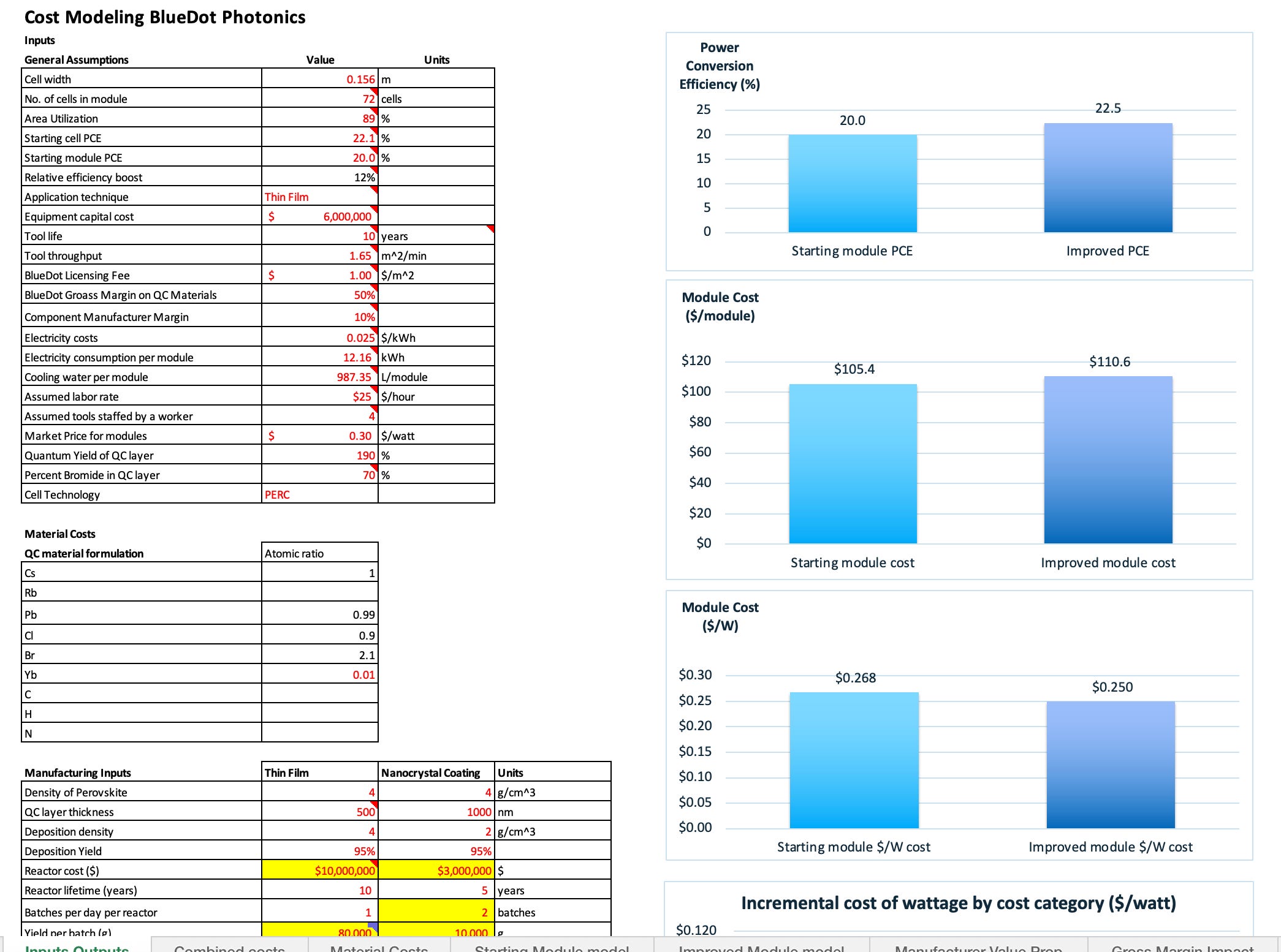
The power of the TEA lies in identifying the major drivers of your product's cost and value. Each assumption can be interrogated. It clarifies what you, as the founder, need to deliver in your product for it to be competitive.
In some cases, a TEA might be overkill. But you still need to show the investor you have a quantified value proposition that resonates with your target customer.
If you don’t have a clear value proposition, do this now:
Validate your value proposition with customers - What price is a customer paying right now to solve their problem? What criteria do they have for switching suppliers or using new technology? Making sure that you can deliver on their requirements is key.
Create a TEA model - There isn’t a good replacement for a TEA. So, sit down and make it. It doesn’t have to be super complex. You can make it more detailed over time. The most important thing is that you make your assumptions and calculations clear for an investor.
Let’s say you’ve done your homework and have a clear, compelling value proposition. What’s next?
Well, you still need to figure out how to get your product into customers' hands. You need to know how to build customer awareness. You need to find a way to get the customer to agree to pay you for the product. And you need to deliver the product to the customer.
This is often referred to as the go-to-market strategy. For early-stage deep tech companies, this may not seem relevant; in most cases, you don’t even know if the product will work. However, if the investor believes you can build the product, they also need to believe you can sell it. Again, the goal is to make money, not just create a cool prototype.
You have to show the investor that you know how to make money.
If you don’t have a go-to-market strategy nailed down, do this now:
Ask your potential customers about where they get their market info - Figuring out where your customers are looking for information is key to a successful marketing strategy. What conferences do they attend? What industry news outlets do they read?
Find companies you can use as examples - If it ain’t broke, don’t fix it. If another startup in your sector has been successful, what was their go-to-market strategy? Can you replicate it? Investors like to see precedent for go-to-market strategies.
Engage a strategic advisor - If you don’t have an industry advisor with sales and marketing experience, find one. They are often the best people to help you shape your go-to-market strategy since they understand the way the sector operates.

Alright, you’ve convinced the investor that your go-to-market strategy is sound. Deal closed?
Not quite. At this stage, the value proposition and go-to-market are just ideas. How do you know that customers will actually pay for your product if you build it? How much traction do you have with customers? I have no idea where the term traction came from, but VCs love it. Basically, traction is the level of engagement and customer sales you have.
Lack of traction is probably the single biggest reason why investors say no to a founder.
If you don’t have sufficient traction, you’ll probably end up hearing something like this:
We love what you are working on. Come back when you have more traction.
You are just too early for us.
Let’s talk when you have at least $100k in customer revenue.
At some point, it will feel like you are banging your head against a brick wall. And honestly, you might be.
Right now, the bar is high for startups to demonstrate traction. Especially for deep tech startups. There are a couple of reasons this is happening:
Investors need liquidity events - Startup exits are stalling across sectors. The IPO market was quiet for several years, and M&A was stagnant. This means that the limited partners in many funds haven’t gotten back capital to reinvest in new companies. This trend hits climate tech companies especially hard, which have seen their fortunes change dramatically with the election of the Trump administration.
AI is warping the market - The highest cost for venture investing is the opportunity cost. If I invest in Company A, I can’t invest in Company B. This means that every startup is competing against every other startup for limited capital. Right now, AI startups are the hottest ticket, leaving little capital for other sectors.
The upshot of these two trends is that investors are incredibly reluctant to invest in startups without customer sales or a firm commitment from potential customers. What this means for you is that you can’t compete on hype or potential.
You have to compete on indisputable economics and strong customer validation.
If you are a startup without strong customer traction, do this now:
Double down on customer discovery - If there are potential customers that you haven’t talked to yet, make it a priority to contact them. Casting a wide net is key at the earliest stages. Most potential customers are going to be pragmatic, happy to follow once others have taken the risk on your product. Finding the visionaries who see what you see in the product and technology is critical.
Ask for LOIs or MOUs from your existing customer contacts - Lots of founders I talk to seem to think it’s unseemly or annoying to ask their customers for LOIs or MOUs. But, if you can’t ask them for an LOI, how are you going to ask them to buy the product from you? They might say no, sure. But that can be very telling.
Ask about previous startup experiences - Most potential customers are afraid to say something they’ll regret later. So, asking them what it would take for them to pay for your product is often a fool’s errand. Instead of asking directly what they need to see, ask about previous examples where they worked with a startup. How did the engagement begin? What did the startup demonstrate that built conviction within the customer’s organization? Who had to sign off on the deal? Use this previous experience to inform your customer engagement plan.
Trouble coming up with the right words to ask a customer for an LOI? Try this to get started:
Hi [Name],
Thanks again for spending time with the [Company Name] team over the last few months.
We are moving into our next phase of development and are prioritizing partners who are serious about deploying our solution once it's ready.
Would you be willing to sign a non-binding LOI stating an intent to test our prototype once we hit our technical specs?
This would be incredibly helpful for us to accelerate our development timeline and secure the necessary financing to build the product you need.
If a signed LOI isn't possible at this stage, could you let me know exactly what specific technical milestones or data points you would need to see from us to consider one?
Best,
[Founder Name]
Don’t let your life’s work remain a science project.
Unfortunately, deep tech founders often believe that tech will speak for itself. But that’s a fatal assumption, especially in today’s market. You have to show that your new tech can be turned into an investable business by:
Quantifying and validating your value proposition - Don’t simply claim you’re better; prove it. Validate your proposition with customers. Show indisputable value potential with a thorough technoeconomic analysis.
Stress test your go-to-market early and often - Having a great product is only half the battle. You have to get it into your customer's hands. Find out how customers buy, where they look for information, and who they trust. Use a combination of customer interviews and strategic advisors.
Get traction! - Cast your net wide for visionary customers who will pay now. If you can’t find them, secure LOIs or MOUs tied to specific milestones.
Remember, you aren’t selling a technology. You are selling a business that delivers high returns to investors. Show them the money, and they’ll provide you with the fuel to build it.
If you are a deep tech founder just getting started, take our Red Flag Assessment, 18 yes-no questions that will tell you if you are a good fit for venture capital. You can take the assessment on our website:
Do you know a deep tech founder who should read this post? Please share it with them! This post is public and free to share.
Comments
Nothing yet. Say the first thing.
Sign in to join the conversation.