
This article is Part 3 of our 3-part series on the loss of dark matter, know-how, and IP during startups’ wind-downs, inspired by our report “Dark Matter: Harnessing the lost innovation of deep tech wind-downs". Make sure to check out Part 1, “Deep Tech, Dark Matter: An opportunity to solve bigger problems,” and Part 2, “What Happens to IP When a Startup Fails and Why 60% of It Simply Disappears.”
The Takeaway: We can prevent more IP from disappearing when startups shut down by developing AI tools to capture and interpret dark matter; cultivating good practices and hygiene for managing dark matter in startups; improving and standardizing startup wind-downs, including open-sourcing as an option; and creating a non-profit library to curate and preserve rescued IP.

Most startups, especially early-stage ones with small teams, face a key-person risk, whether they know it or not.
You know that person who may not be a founder, but is the linchpin of the R&D team, the person everyone looks to for advice and has an uncanny, intuitive knowledge about everything related to the technology? That’s the key person. The tacit knowledge they have in their brain is invaluable. At BlueDot, Jared and his co-founder were terrified of losing anyone on the team, largely because of this reality.
And not only is it a risk for the startup when it is flush with cash and operational, but it’s also a problem when the company decides to pursue a merger or acquisition, or to wind down. How can you put a value on the know-how in one person’s mind?
As we discussed in Parts 1 and 2 of this series, the deep tech ecosystem is losing valuable informal IP like know-how and tacit knowledge of team members, aka “dark matter,” especially during startup transitions. The current dynamic isn’t just bad for the founders; it also creates a missed opportunity for the next generation of innovators to learn from past mistakes and build on existing work.
What is key person risk?
It’s the risk that losing one key person would threaten the startup’s future viability. Often it is applied to the CEO or the executive team, but for startups with few team members, it can be anyone whose know-how is singular.
What is dark matter?
Dark matter is the informal IP within a deep tech startup’s IP portfolio. It takes many forms — lab notebooks, wiki pages, daily operating notes, facility designs, and the tacit awareness of what does and does not work stored only in employees’ minds. We call this knowledge dark matter because, like its cosmological namesake, it makes up most of a deep tech company’s IP yet is often unseen and overlooked.
What can be done to tackle this problem and rescue the IP from disappearing?
To better understand how startups handle dark matter at wind-down, we researched startup failure. Our research draws on conversations with over 150 people across the innovation ecosystem, including founders, VCs, philanthropists, government programs, and university tech transfer offices. We also surveyed 25 founders and 5 investors who have collectively deployed over $3B in capital. We supplemented this with 20 in-depth interviews, eight founder case studies, and an analysis of CrunchBase and Pitchbook data.1
We don’t claim to have all the answers, but here are four ideas to improve dark matter capture and retention, along with ways founders, investors, philanthropists, and others in the innovation ecosystem can contribute.
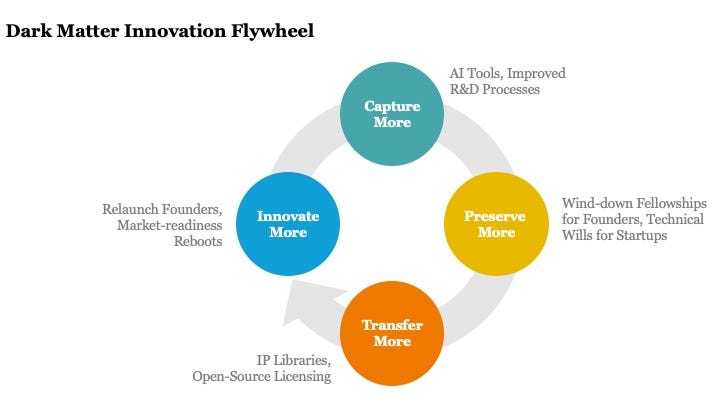
Dark matter leaks out most during transitions, when staff turnover, tech is transferred, or at the end of a venture. AI is an exceptional tool for deriving insights from unstructured data. A properly designed tool could help annotate documented dark matter, serve as a catalog for locating key information, summarize detailed material for new hires, and function as a Q&A interface for deeper extraction of tacit knowledge.
Applications include improved exit interviews, better invention disclosures (especially for universities and corporate spinouts), faster M&A transfer, and the identification of gaps or next steps for derivative inventions. A dark matter tool should handle many file formats for biological, chemical, and engineering data; integrate with specialized software, e.g., genomic or chemical analysis; and prompt the creation of appropriate metadata. These tools should help innovators leverage existing work rather than create more work for them.
In deep tech, you need a clear understanding of why something is broken to solve it. Unfortunately, venture expectations for speed and progress can push founders to “move fast and not write things down,” which results in poor capture of know-how. For knowledge to grow additively, a good foundation is essential.
The best teams commit to a knowledge management system early and build discipline around documentation: writing SOPs, investing in backup systems, using digital rather than physical notebooks, and developing a quarterly process to extract tacit knowledge from employees. Venture investors would do well to add “knowledge management” to their diligence checklists.
Dark matter management is part of the job. By making your know-how actionable for an outsider, you are building enterprise value.
It is intimidating to speak openly about startup failure, especially when there are no apparent benefits. Uncertainty around confidentiality, legal liability, and reputation makes the process unappealing, if not downright scary. As Eleanor Roosevelt advised: “Learn from the mistakes of others. You can’t live long enough to make them all yourself.”
When a deep tech company fails, the obvious question is: was it the tech, the team, or the timing? A standard postmortem would give invaluable context. Non-profits, trade organizations, and special-interest groups could host startup post-mortems and their accompanying data. Catalytic capital will also be needed for more open-sourced endings. A wind-down fellowship that supports a founder while they turn their IP into an actionable open resource would solve the question of who pays for the work. We discussed how this worked for Makani in our previous post.
As counterintuitive as it may seem, entrepreneurs and investors need to agree on what a wind-down looks like before a crisis occurs. Ways to standardize wind-downs should be developed and adopted broadly across deep tech entrepreneurship. One idea is creating a “technical will” during formation or at the first major equity investment. That way, when the end is near, the team can focus on executing against a plan or preferred outcome rather than arguing what should happen to the IP.
What is a “technical will” for a startup?
A “technical will” would be an exhibit that defines what happens to the technology under different circumstances and specifies preferred outcomes for it in the event of a wind-down. It could be adopted in the equity transaction or ratified by the board and shareholders as a separate document.
What does open source mean for deep tech startups?
The concept of open source is commonplace in software development. But its origins can be traced back to deep tech and the US automotive industry in the first half of the 20th century. The Motor Vehicle Manufacturers Association was created for US auto manufacturers to share patents and technology.
This idea of sharing IP and using it to benefit the entire industry is the core of open source we envision. Especially for intellectual property that originated in a startup that is forced to wind down. This should include both formal IP (e.g., patents) and, perhaps more importantly, informal IP.
Venture investors must fulfill their fiduciary responsibility to limited partners by squeezing out any residual value. Creating an alternative to selling the IP, e.g., a tax incentive for donating unmonetized IP, could motivate new behaviors.
A non-profit repository of donated intellectual property could serve as a valuable resource for future innovators. Cascade Climate is one initiative that seeks to open-source the science behind enhanced rock weathering, a key carbon capture and storage technique. Similar entities could preserve more dark matter by assuming the responsibilities and costs of maintaining assets that serve as a public good.
Now you may be thinking, why aren’t these actions happening already? What’s holding us back from making these changes?
And the answer is it’s a classic collective action problem. Although each stakeholder in the ecosystem — researchers, founders, investors, lawyers, philanthropists — loses when informal IP disappears, no single player can fix this alone.
The effective capture and preservation of informal IP requires researchers, founders, investors, philanthropists, and lawyers to work together to create a new operational model for deep tech development.
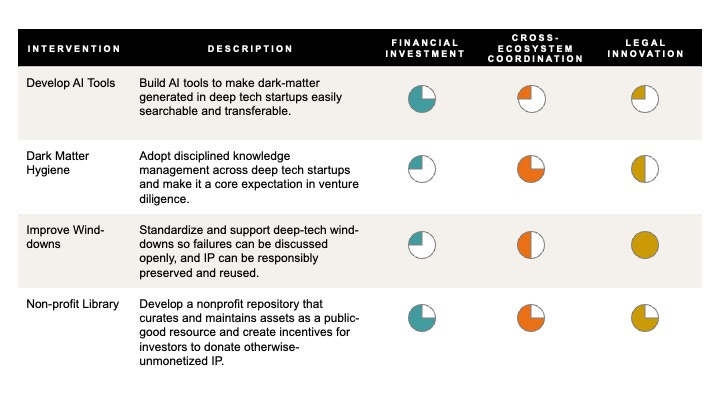
What does this collaboration look like? Each of our four ideas requires varying degrees of financial investment, cross-ecosystem coordination, and legal innovation.
For example, developing AI tools for deep tech innovation processes and dark-matter capture will require substantial financial investment from private investors, philanthropists, or government agencies.
Improving dark matter hygiene requires the concerted, coordinated effort of multiple stakeholders; for example, founders need to learn and share best practices for conducting R&D, and investors need to accept the upfront cost of establishing systems and processes rather than moving quickly.
Improving wind-downs requires rethinking and innovation in legal frameworks and governance for startups, necessitating partnerships among law firms, founders, and investors.
Developing a non-profit library to capture and retain rescued IP requires all three — funders to build and maintain the library (likely philanthropic), founders to design their R&D processes to enable easy sharing, and a legal framework to incentivize data sharing from a formerly for-profit entity.
Gliding Ant is excited to help drive these changes as venture builders. We are exploring ways to structure venture deals to leave open the possibility of open source endings. We are also excited to improve operations and knowledge management in the next generation of deep tech startups. Finally, we want to take care of the most important resource in the startup ecosystem — the founder.
The founder role is one of the toughest careers to pursue, and discussing a failed venture is especially challenging. But a seasoned entrepreneur can avoid lots of the early-stage mistakes that can derail a startup. Why let that person get dejected and leave entrepreneurship? Gliding Ant is ready to provide a connection to founders navigating this transition.
The ideas we propose are the foundation for a new era of deep tech innovation in which knowledge compounds rather than evaporates.
Imagine a future where intelligent tools not only preserve and transfer dark matter but also suggest the next steps in the innovation process. There is a digital twin of the R&D team, and those teams can open time capsules of know-how and easily access what has come before. Industry groups coordinate in open innovation through non-profits that reduce friction in collaboration between public and private research. More tech is commercialized by universities and national labs, and more academic work is informed by commercial advances, creating a better-prepared scientific workforce. Deep tech investors realize better returns with fewer mistakes, faster acceleration, and better exits. Founders can both fail faster and fail forward.
That future can be now, if we seize the opportunity. With the convergence of massive cloud computing resources, large language models for processing unstructured data, and advances in specialized machine learning and predictive algorithms, there is an opportunity to radically rethink how innovation and R&D occur in deep tech.
The challenges facing humanity — mitigating climate change, improving human health, feeding a hungry planet — are too significant for us to waste time repeating mistakes we’ve failed to learn from others.
We’ve shared our ideas, but we would love to hear your ideas. If you’ve wound down your startup, what happened to your IP? What could have rescued it from destruction? Leave your thoughts in the comments, and we’ll connect with you to explore ways we can work together on this challenge.
We believe that preserving dark matter and bringing it into the light is possible. But it will take the work of many to overcome the inertia of today's systems. We are proud to be working on part of the solution.
More notes about our research: We found that public information about startup closures, IP transfers, and informal IP is sparse and unreliable. Hence, the high level of direct interviews and surveys we cited above. Additionally, we analyzed CrunchBase and Pitchbook for trends in deep tech startups. AI search engines were used to surface trends and primary sources. We primarily focused on agtech, biomanufacturing, climate tech, and materials science, and secondarily focused on life sciences, space tech, and artificial intelligence.
Comments
Nothing yet. Say the first thing.
Sign in to join the conversation.