
This article is Part 2 of our 3-part series on the loss of dark matter, know-how, and IP during startups’ wind-downs, inspired by our report “Dark Matter: Harnessing the lost innovation of deep tech wind-downs". You can read Part 1 below or here.
The Takeaway: When a startup fails, formal IP typically sells for less than 2% of invested capital, while informal IP — the tacit knowledge and know-how built over years — is lost entirely in more than 60% of cases.
Do you have “The Box” in your office? Maybe it’s in your garage. If you are a startup founder who’s had to wind-down their company, you probably have The Box somewhere.
For our partner, Jared, the box is in his office. It contains a couple of file folders of important legal documents from his former startup, BlueDot Photonics. There are some “souvenirs” — lab samples and trinkets collected along the way. And there is a hard drive backup of every digital record from the company. It’s the final remains of many years of work.
But you know what’s not in The Box? It’s years of R&D experience and know-how that are fading from his former teammates' memories. The tacit knowledge about what works and what doesn’t, which is never written down. This informal IP is gone forever.
We call this informal IP the “dark matter” of every startup. It’s the unseen yet incredibly valuable combination of know-how, tacit knowledge, unstructured notes, and communications that accumulates over years of work.
Both of us at Gliding Ant have experienced this loss of dark matter firsthand. But we were curious if we were alone. Are other founders transferring IP more effectively? Are there systems available to stem the losses?
To better understand how startups handle dark matter at wind-down, we researched startup failure. Our research draws on conversations with over 150 people across the innovation ecosystem, including founders, VCs, philanthropists, government programs, and university tech transfer offices. We also surveyed 25 founders and 5 investors who have collectively deployed over $3B in capital. We supplemented this with 20 in-depth interviews, eight founder case studies, and analysis of CrunchBase and Pitchbook data.1
Here, we extract key takeaways, starting with our own companies: photovoltaics innovator BlueDot Photonics, co-founded by Jared Silvia, and insect protein pioneer Beta Hatch, founded by Virginia Emery. We also discuss insights from the carbon marketplace startup Nori, the open-ocean aquaculture trailblazer Forever Oceans, the battery storage startup Cuberg, the fusion energy spinout CT Fusion, the asteroid mining company Planetary Resources, and the wind energy moonshot Makani.
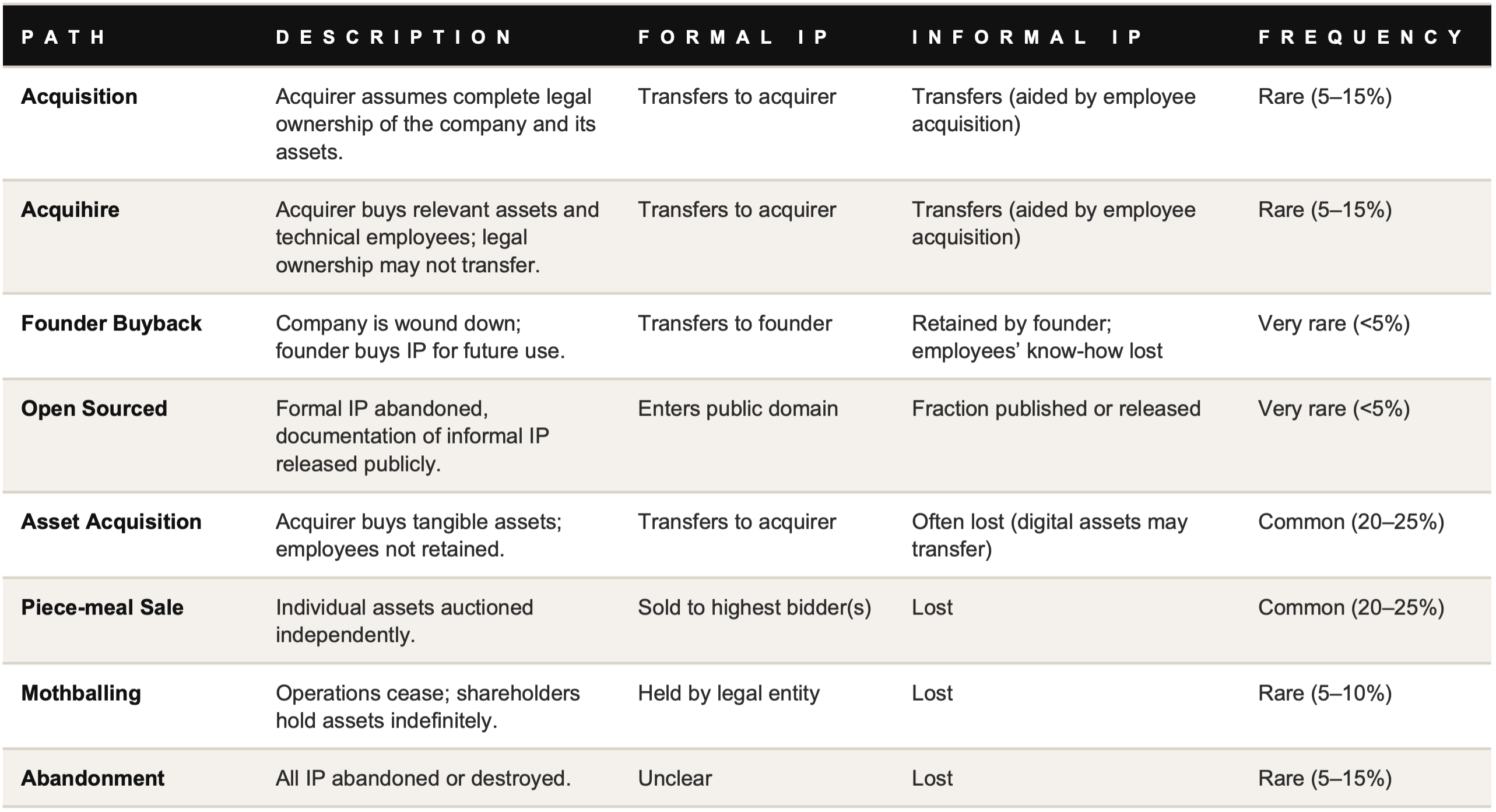
We identified eight typical wind-down paths for startups (see Table). We outline what happens to both formal and informal IP along each path and provide an estimated frequency for each outcome. We have organized the table from the paths where dark matter is preserved most completely to those where it is lost entirely. Our research confirms that informal assets are usually overlooked and sometimes lost entirely during shutdown.
There are many reasons why dark matter is destroyed so frequently. In most cases, the destruction is incidental, a victim of competing priorities and limited resources. In others, the best of intentions results in the slow atrophy of knowledge, preventing any future hope of resurrecting the technology. Here are some of the most common problems that contribute to the destruction of dark matter.
Dark matter is mostly or entirely lost in over 60% of wind-downs.
Even in the best cases, when a founder takes extra steps to preserve it, dark matter is lost. Part of the challenge we saw is that most entrepreneurs don’t know what to expect, so we are sharing our stories to help open the black box.
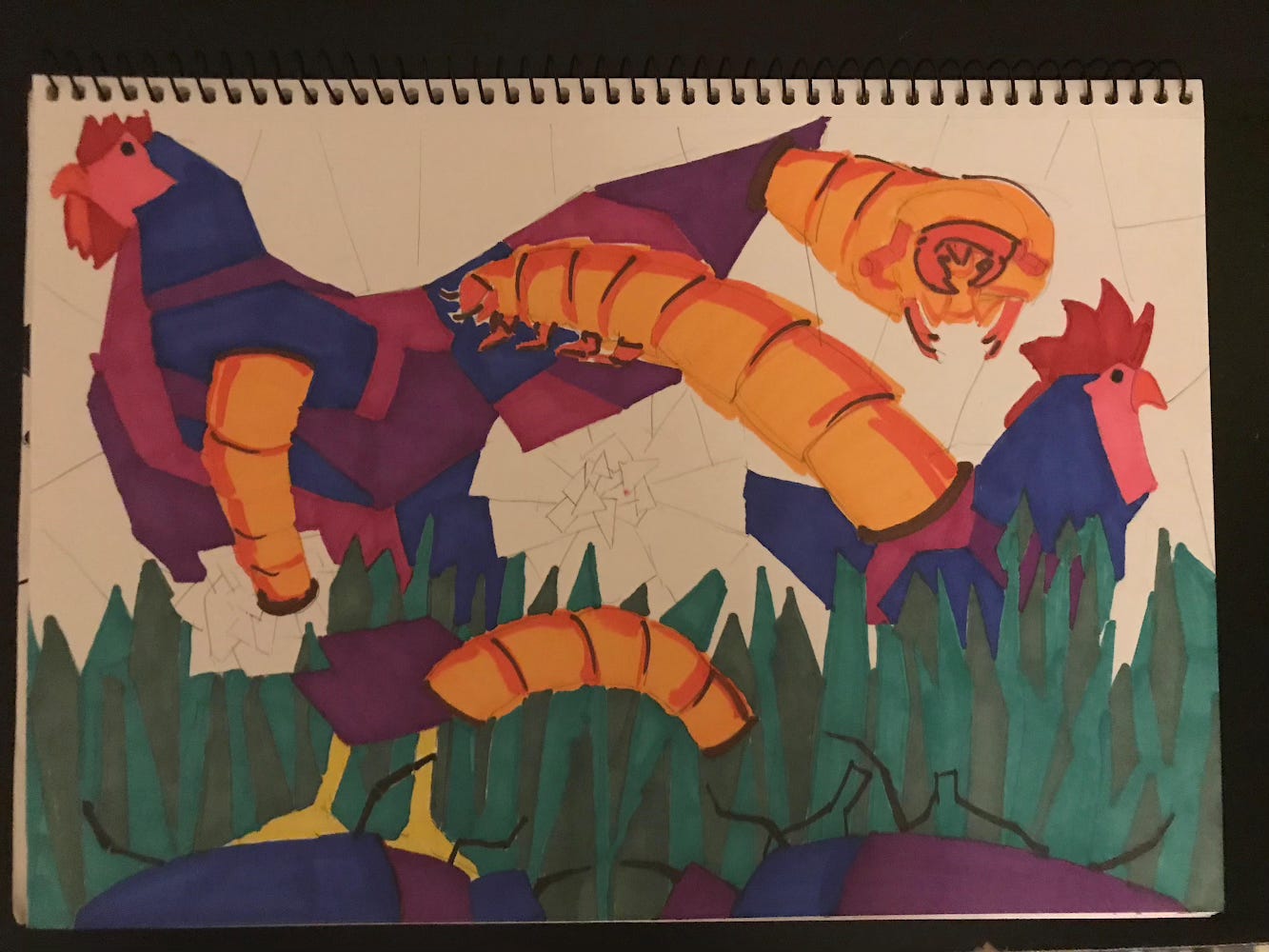
Beta Hatch, founded by Virginia, showcases the challenges in capturing dark matter and transferring it in a wind-down. The company's vision was to establish insects as a new biomanufacturing platform. The innovation efforts spanned multiple disciplines, from robotics and manufacturing automation to DARPA-funded work in genomics and CRISPR. The company was unable to secure Series B financing amid the post-COVID financing slump and closed in 2023. The 4 TB of IP assets were bundled by Virginia and sold by a receiver in an assignment to the benefit of creditors (ABC) process. The acquirer hired Virginia to help with the transfer. The original intent was to preserve enough for a possible reboot, but this seems unlikely due to the loss of genomic and digital dark matter.
Some lessons learned:
Decisions often must be made quickly, especially for perishables or assets that incur maintenance expenses. Live animals and freezer-stored specimens were shipped to competitors and collaborators in the first weeks of the wind-down – the IP transaction took another 4 months to finalize.
Genomic data, with DNA as a common language, was among the easiest to share. By contrast, engineering drawings, facility design considerations, and CRMs and supplier lists were difficult to make actionable, even with meeting notes and email records as context.
Personally identifiable information contaminates many systems, including email, messaging platforms, and personal file systems, restricting sharing.
Wiki systems like Confluence and Notion can be hard to navigate for newcomers. A human interpreter with tacit knowledge is an essential navigator. AI tools are starting to help here, but are still missing the context that a human can provide.
In the rush to wind-down and preserve cash, it is easy for an exit interview to be overlooked or a key computer password to be lost. For example, at Nori, a carbon trading platform company, an expired software subscription led to the loss of significant digital assets. Small mistakes like this are a major source of dark matter leakage.
If you are a founder who has gone through a shutdown, you’ve probably experienced something similar.
Tacit know-how — the undocumented and intuitive knowledge in people's heads — is lost when key team members depart. Acquiring companies acknowledge this by placing a premium on acqui-hires rather than a simple asset acquisition.
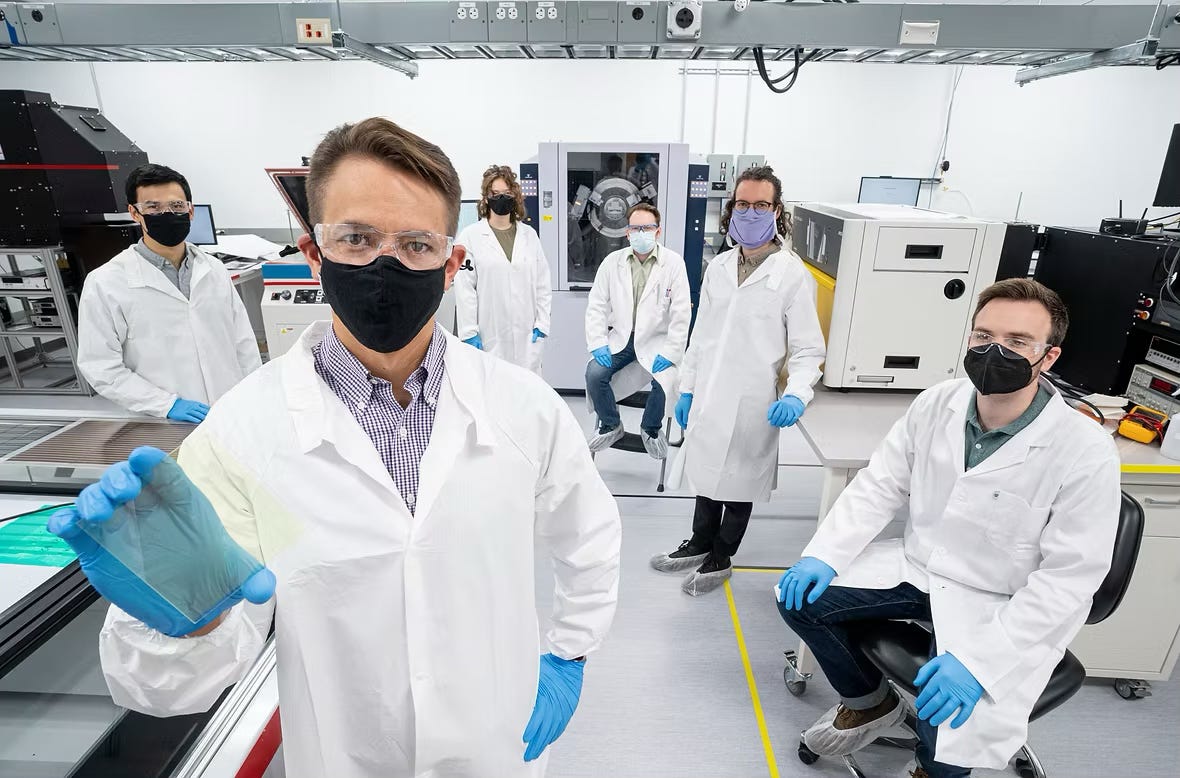
BlueDot Photonics, co-founded by Jared, serves as a notable example. BlueDot Photonics was a materials startup that created optically active thin films to enhance the efficiency of silicon solar panels. Its solar panel boosting technology had shown strong customer validation with multiple Tier 1 panel manufacturers engaged in material transfer agreements. During an attempted pivot, employees were laid off to preserve cash while the company navigated new commercial discussions. However, the product development timeline would take several years and many millions of dollars, so the company opted to pursue an acquisition. A sale was then negotiated with UbiQD of Los Alamos. Unfortunately, valuable knowledge and informal intellectual property from the employees had already been lost, leaving only lab notebooks.
For the most innovative tech, a failure to launch can decouple formal patent IP from hard-won commercialization know-how. For example, CT Fusion was a spin-out from the University of Washington focused on spheromak nuclear fusion technology. After licensing the technology in 2015, the company was unable to secure funding and subsequently ceased operations in 2023. The expertise developed by the 10-person team remains within the ecosystem, with key personnel moving to rival Zap Energy, but the loss of dark matter makes relicensing (and technology iteration) unlikely.
Most founders recognize that their greatest asset is their team, so it makes sense that dark matter can be lost when the team disbands.
The instinct to preserve data is common among deep tech founders, perhaps best exemplified by Suren Sehgal's preservation of rapamycin. Involving the founding team in an IP sale increases the thoroughness of dark matter preservation and the likelihood of a sale or future reboot. However, most startups lack the resources, processes, systems, and financial incentives to transfer dark matter during a wind-down. Timing is particularly important: memories fade, employees leave, and competitive relevance diminishes the longer a transaction takes.
Dark matter has a short shelf life.
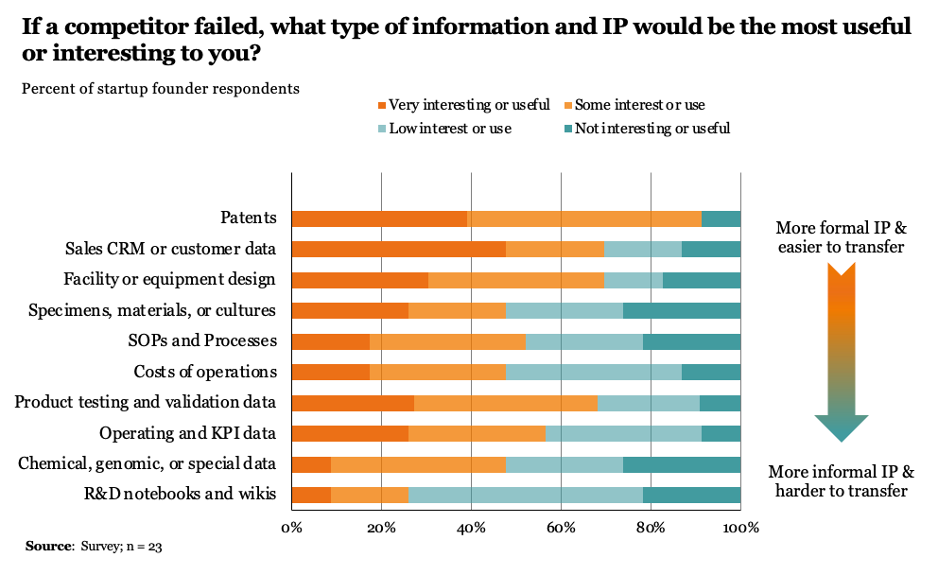
We asked founders to rank their interest in the types of information and IP available from a failed competitor. While sales information and patents ranked predictably at the top, there was also significant interest in the dark matter. However, only about 25% of survey respondents were interested in R&D notebooks and company wikis. Founders felt that, though this material had value and contained much of their company's internal dark matter, the effort required to extract information from these resources was too high.
One of our interviewees transacted dozens of IP acquisitions from distressed companies. In negotiations, the asset price itself was rarely the deciding factor; instead, the cost of incorporating the new technology and making it functional was a significant barrier. If there were high patent costs, burdensome IP license terms, or poorly documented R&D, otherwise valuable IP was passed over.
With the current tools available to digest and analyze these materials, the cost-benefit analysis didn't pay off. New tools are needed to better capture dark matter and make it more actionable.
Technology that is lost in a freezer, sits in a closet, or drains talented people's time serves no one. And yet mothballing is the outcome for roughly a third of startup wind-downs, with 5-15% as a primary outcome and 10-20% of other failure paths ultimately ending up there secondarily.
One reason is the sunk cost fallacy, and the other is a distorted view of IP value, especially acute in first-time founders and emerging managers. Our surveys show that 65% of founders overestimate the value of IP transactions, often by up to 10 times the average actual transaction size. For deep tech founders, this distorted view saps energy and resources from the innovation ecosystem. The tech perfectionist embodied here thinks, 'If I build it, they will come,' and can waste years working on technology that struggles to gain traction or funding. Likewise, investors hang on to the assets despite a low likelihood of a return. As one surveyed investor puts it, “You can just sit on the IP until you find a way to sell it.”
Unfortunately, the value realized in these deals is minuscule. Based on our interviews and surveys, in 60% of wind-downs that found a home for the formal IP, the typical transaction represents less than 2% of the financial value invested in the company. For one of our case studies, total funds invested were approximately $30 million, but after nine years of operation, the IP sold for only 0.1% of that value.
An alternative ending to the 'fractions of pennies on the dollar' asset sale would be for the IP to be made open source. But this is a very rare outcome, happening less than 5% of the time.
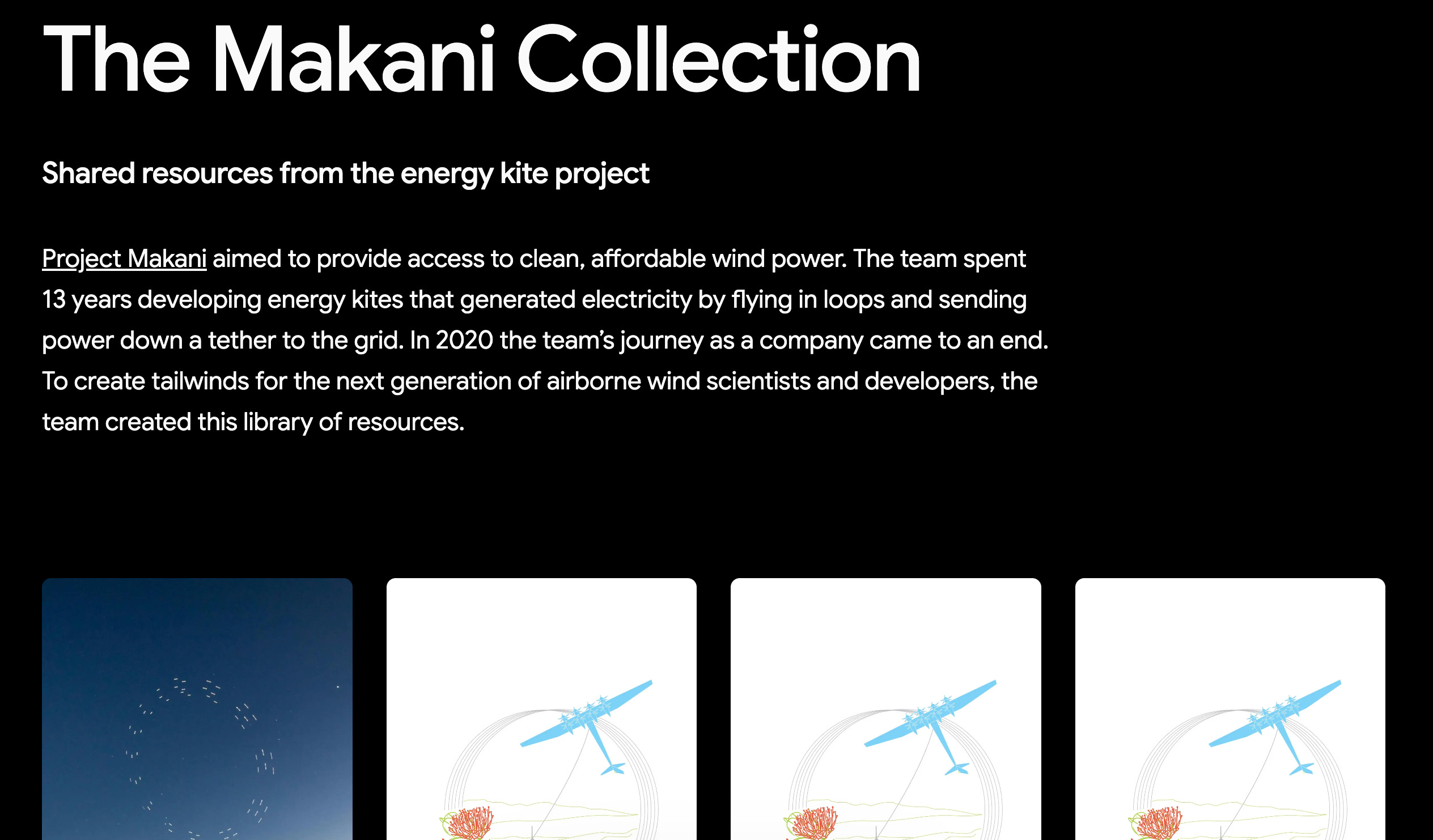
The most comprehensive example we've found is Makani Technologies, an airborne wind energy startup spun out of Alphabet's moonshot factory X that closed in 2020. A patent non-assertion pledge was made for the formal IP, including 127 patents. The 13 years of learning captured as informal IP were posted online. This dark matter includes several hundred pages of reports, flight log datasets, technical videos, and open-source code. The project is now a time capsule, preserved for future innovators. It is too early to definitively measure the impact of this open-source gift, but with over 1,200 stars and over 100 forks, the GitHub repository is remarkably well-engaged.
Sometimes, open sourcing is a secondary outcome. The asteroid mining company Planetary Resources negotiated an acquisition deal with ConsenSys, expecting ConsenSys to continue its satellite development work. However, with the deal taking almost a year to execute, staff atrophied, and the original budget allocation shrank. The IP ended up being mothballed. Fortunately, the tech remains alive through a secondary transition to open source, with a non-assertion pledge on the IP negotiated by a technical co-founder.
The few examples we found share a few things in common: simple ownership structures and deep pockets were coupled with an open-source ethos at founding; passionate technologists remained engaged in the wind-down process and beyond; and the technology was promising, but the business model was well ahead of its time.
To make open sourcing a more common outcome, we need to develop standard practices for how to do it and how to incorporate it into startups' governance structures. Founders and investors will both need to be engaged and understand how it can be a preferable alternative to abandonment.
Many of the innovators we interviewed expressed frustration at wanting to share their know-how but having no clear paths to do so.
For Planetary Resources, the second chance of open sourcing has been complicated for their satellite technology. As export-controlled material, much of the IP cannot be shared openly. However, non-assertion has allowed former employees to use their work products in new roles, in stark contrast to the uncertainty many technical teams face after leaving a failed company.
At Forever Oceans, an open-ocean aquaculture pioneer, former employees expressed uncertainty about IP ownership and how best to share lessons learned with other operators. Indeed, remaining confidentiality confusion can limit the mobility and efficacy of subject matter experts who remain in the field.
You may ask yourself, why isn’t there a library that can serve as a repository for IP when there is no acquirer? Ultimately, it’s a cost issue. Over time, the IP asset's value erodes, but storage or maintenance costs remain constant or rise. It is rarely clear who would welcome, benefit from, and be able to maintain the cost of preserving donated IP. As a result, destruction is often the easiest and, hence, the most common outcome.
IP that took years to develop can be destroyed with a few clicks of the mouse.
As you can probably see by now, many of these problems share common root causes: uncertainty, misaligned incentives, and technical challenges. But we believe that now is the time to tackle these challenges head-on.
We highlight six problems here, but it’s possible there are others we haven’t uncovered. If you have gone through a startup wind-down and seen the destruction of dark matter, we would love to hear from you. What happened to the dark matter before, during, and after the shutdown? Where is it now? Why wasn’t a better transfer possible?
By understanding all possible ways dark matter can be destroyed, we hope to build startups that avoid these problems. Although the problems we highlight are complex, there is no reason to think they are insurmountable.
In part three of this series, we will share our ideas for how to save this precious asset from destruction and accelerate future innovation in the process.
More notes about our process for this white paper: We found that public information about startup closures, IP transfers, and informal IP is sparse and unreliable. Hence, the high level of direct interviews and surveys we cited above. Additionally, we analyzed CrunchBase and Pitchbook for trends in deep tech startups. AI search engines were used to surface trends and primary sources. We primarily focused on agtech, biomanufacturing, climate tech, and materials science, and secondarily focused on life sciences, space tech, and artificial intelligence.
Comments
Nothing yet. Say the first thing.
Sign in to join the conversation.