
This article is part of a series about PhD founders and the entrepreneurial challenges they face. Make sure to check out our earlier posts: The Questions Every PhD Founder Should Answer Before Starting a Company and Why PhDs Make Great Entrepreneurs (And What Holds Them Back).
The Takeaway: PhD founders often struggle with three major mistakes when launching a startup: technospeak, analysis paralysis, and naive business assumptions. These can derail your entrepreneurial dreams, but with the right support team, hard work, and practice, they can be overcome.

“You PhDs…you love your words,” the McKinsey partner said with a smile.
I furrowed my brow, uncertain what that meant. We were in the middle of reviewing a slide deck for an upcoming presentation with the strategy team at a major fertilizer company. A slide I had created was up on the team room screen.
“It’s your bullet points over on the right-hand side. They’re bullet points. Not paragraphs,” he continued.
I was still confused as I looked at the text box he was referring to. They weren’t paragraphs. They were hardly sentences!
“It’s OK. You’ll learn,” he said as he started reworking all of my bullet points. “The content is great, but that’s way too many words. PhDs always struggle with it.”
The feedback stung because I had reworked those bullet points at least a dozen times! He should have seen the first draft…those were paragraphs.
But nowadays? The partner’s words echo in my mind every time I see a PowerPoint slide created by a first-time PhD-turned-entrepreneur, and I’m forced to give the same feedback I was once given.
As I have said before, I think that PhDs can make great entrepreneurs. But it’s not a given. While your PhD training brings many strengths to a startup, it also introduces potential liabilities that can lead to mistakes as you start building. Technospeak, analysis paralysis, and naivety about business — these are the habits that will follow you out of the lab, and the ones you will need to work hardest at to overcome.
And these habits can be the reason you don’t get investment. I was recently speaking with another venture builder and investor at the Flywheel Investment Conference, and he told me, point blank:
I will never invest in a PhD founder. They’re too slow.
- Angel Investor
In my earlier post, I discussed how the lack of storytelling is the biggest challenge a PhD will face when transitioning to entrepreneurship. But it’s not the only issue. Today, I want to break down the major mistakes I’ve seen in PhD founders and the possible remedies.
After five years of thinking about incredibly complex ideas and communicating subtle nuance to other experts in your field, you have become very good at speaking in what I will call technospeak. This is the jargon-filled language you have used day to day without even knowing you are using it. Terms like “Fermi levels” and “nonradiative decay pathways” flow out of your mouth without even thinking about it.
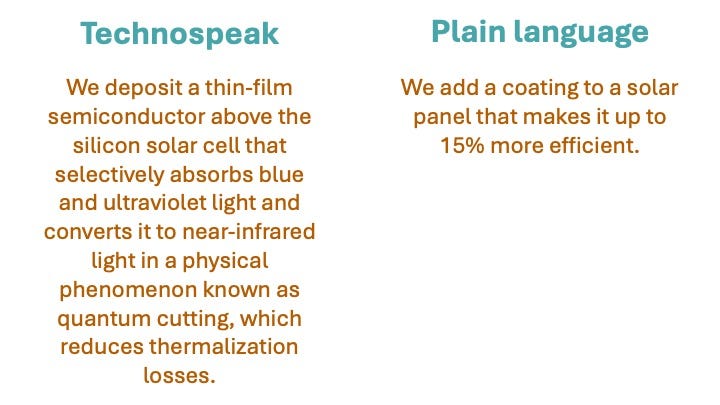
Unfortunately, this technical dialect you honed over years is now a huge liability as the CEO of a startup. I’ve written about how one of the red flags investors look for when evaluating a deep tech startup is whether it’s a science project or a business. When you pitch to investors and start describing your technology using technical terms and jargon, you immediately put yourself, rightly or wrongly, in the science project column.
How can you avoid using technospeak and jargon when pitching?
Write out what you want to say - Never read your pitch, but write it out and edit it a few times before you start practicing. This will help you see the jargon and technospeak and remove it.
Record and listen to yourself - When you practice your pitch, you can’t really hear yourself in real time. Recording yourself and listening can help you identify where you slip into technospeak.
Pitch to your family - If your mom or dad don’t understand what you are talking about, there is no way an investor will. Use your friends and family to help find where you are losing the audience.
Leverage AI as a training tool - Recording your transcript and sharing it with an AI agent for feedback can be a great way to refine your pitch. Make sure you craft your prompt and instructions to give the agent the right persona so you get the feedback you want. There are also a growing number of apps that claim to be effective pitch coaches, but be wary of relying on them too much.
Get a pitch coach - A great coach can make a world of difference for your pitch. My firm Gliding Ant Ventures has helped many founders refine their pitch, and folks like Dana Sather Robinson at Pitch4Impact are great resources if you are really struggling.
Practice, practice, practice - Practice makes progress. You wouldn’t run a marathon without training for months, so why do you think you can suddenly wow investors without practicing? You can’t, so don’t try.
Finding this useful? Pass it on to a PhD founder you know.
PhDs Are Trained to Be Methodical, Startups Aren’t. Science and engineering PhDs typically involve projects spanning 4-7 years. Markets can be transformed in three years. Speed is of paramount importance for startups, and many PhDs have no experience moving fast. What was considered good progress in one week in the academic lab is glacial in the startup environment.
Aside from the communication issues we have discussed, this is probably the biggest complaint I hear from other investors about PhD founders. That investor I mentioned earlier who won’t invest in PhDs? This was his primary complaint. There is too much analysis, too much research, and too much desire for the perfect solution rather than a good-enough one.
How can you learn to move faster and make quicker decisions in the startup CEO role?
Find good mentors and advisers who can push you - Getting advice and feedback from experienced entrepreneurs is one of the best ways to develop the skills and intuition for making decisions quickly and effectively.
Set aggressive objectives and milestones - Without clear SMART goals, it’s easy to fall back into the academic habits you’ve developed. With them, it’s easier to identify when you are wasting your time.
Join a founder mastermind or peer group - Hearing other entrepreneurs share their problems can give you a broader perspective and help you develop the quick problem-solving skills you need.
Hire an experienced CEO - In some cases, you might not be a good fit for the CEO role. That’s OK. Your job as founder is to build a successful business, and part of that is building the right team.
At a recent pitch competition I was attending, a PhD founder was in the middle of the Q&A when they were asked about their sales strategy. Their go-to-market had been missing from the deck, so it was a natural question for the investor to ask.
The founder quickly responded that they had already secured one customer (the customer was not secured; the LOI wasn’t signed yet) and, given that success, they didn’t think they would need dedicated salespeople. The investor was skeptical to say the least.
This is an example of something that happens far too often to PhD founders. They rely on untested business assumptions while developing their strategy. This can manifest itself in many ways, e.g., underdeveloped go-to-market strategies, unvalidated financial models, or unclear exit options.
After 10+ years of post-secondary education in a technical field, it’s not surprising if you aren’t familiar with sales and marketing or profit and loss statements. But you are trying to build a company, so it’s on you to close this gap. If you don’t, you don’t stand a chance.
How to learn the business fundamentals required for startup success?
Read a book - There are lots of great books on being a startup founder. One of my favorites with lots of references is Dave Parker’s Trajectory: Startup. Although not deep tech specific, it’s a fun read that is very practical.
Join an accelerator - I’ve talked about how accelerators can be a mixed bag, but I generally recommend new founders attend at least one highly rated accelerator to make sure they have covered the business basics. If you are looking for deep tech specific accelerators worth your time, check out Deep Tech Dirt.
Get feedback on your assumptions before you start pitching - As mentioned before, mentors and peer support groups are great resources for getting feedback. Leverage those support networks here as well.
Find a fractional CFO/COO or business cofounder - Ultimately, the fastest way to close this gap might be to add a new team member. It comes with risks, but if you need to move fast, this is the best option.
There are lots of things stacked against you as you make the move from PhD to founder. But none of these obstacles are insurmountable. Most of them just require dedication to learn new skills. You already learned how to probe the edge of human knowledge; learning to be an entrepreneur isn’t any harder.
I eventually learned how to make McKinsey-style PowerPoint slides, and before I knew it, clients couldn’t tell I didn’t have an MBA.
But what do you think? What flaws did I miss that founders should be aware of?
If you’re a PhD-turned-founder who is struggling with the transition and looking for help, I’d be happy to connect. Subscribe to this newsletter and leave a comment, and I’ll reach out to set up a 30-minute call.
And if you enjoyed this article, please Like and Restack it. Thanks.
Jared Silvia, PhD, has worked in the energy and materials sector for over 15 years, as a consultant at McKinsey & Company, Director of Product Management and Marketing at Doosan GridTech, and CEO and Co-founder of BlueDot Photonics. He is now a Partner at Gliding Ant Ventures, where he co-builds climate tech, deep tech, and frontier tech companies with technical founders from science and engineering backgrounds.
Comments
Nothing yet. Say the first thing.
Sign in to join the conversation.