
Raising Testosterone without TRT - Behavioral and Psychosocial NO-GO’s.
It seems like everyone and his endocrinologist has advice for raising Testosterone (T) levels these days. And there has been a great deal of teeth-gnashing about plummeting levels of T in the male population.
Seth Capehart did a video suggesting several nonpharmacological ways to increase T. It’s a good video. You can view that video here (note-Skip the Blowtorch) :
Decrease belly fat. Belly fat aromatizes testosterone into estrogen. That’s a big problem. He suggests reasonable steps there.
Eat real food
Focus on Protein
Eliminate processed sugar
Do aerobic and strength training
Sleep better. Most T is produced when you sleep so
Wake up at the same time daily to set your circadian clock
Sleep in a cold dark and quiet place
No screen on hour before bed. (This probably has more to do with mental arousal than blue light exposure)
Eat right. You need cholesterol in your diet.
Capehart makes pretty reasonable suggestions here for eggs, salmon, beef and olive oil
Do Man Things
Challenge
Competition
Hard lifts
Cold Showers
Spend time outdoors
Sunlight exposure
The outdoors is good for your mental health
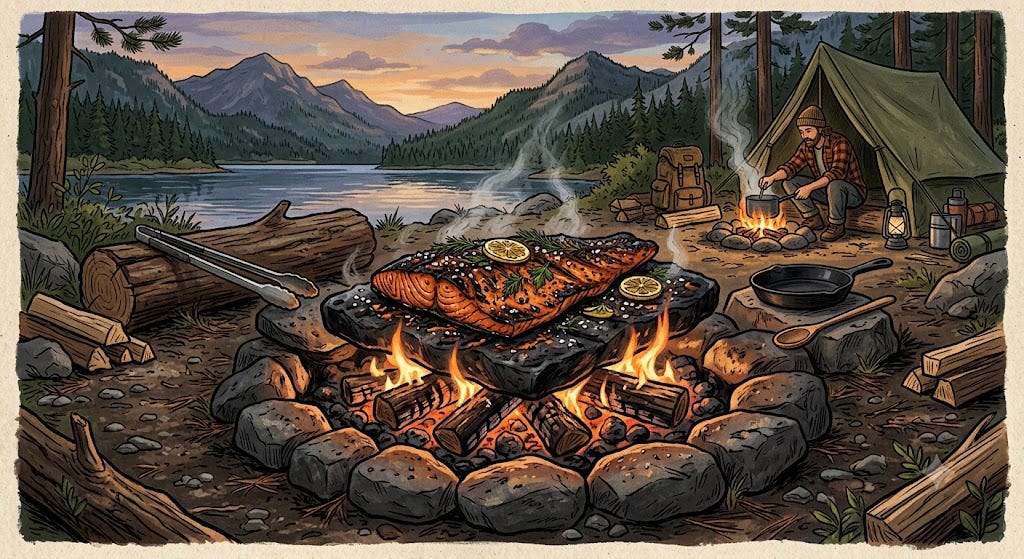
So, eating small amounts of salmon that you cook over heavy rocks that won in competition and then carried to your campsite right before you sleep … you’re covered.
Don’t consume alcohol heavily, especially chronically. A review by Smith, Lopresti and Fairchild (2023) in the Expert Review of Endocrinological Metabolism found that
Low to moderate alcohol levels boosted T. The bad news. The body suspended the breakdown of T because it was busy trying to stop you from dying because you consumed a toxin (alcohol).
High volume alcohol led to decreases in Serum T levels. After you drink a lot, your HPA axis gets out of kilter and that along with oxidative stress and inflammation significantly reduce T levels.
Smith concludes “When alcohol is consumed in excess, particularly chronically, it negatively affects testosterone production in men”
Don’t be submissive. This is not an invitation to start watching Andrew Tate videos and be a jagoff.
Maner, Miller, Schmidt and Eckel (2008) in Psychological Science write that
Socially Anxious men demonstrated decreases in T levels (saliva) after rigged competitions.
Terburg, Syal, Rosenberger, Heany, Stein and VanHonk (2016) in Psychoneuroendocrinology (37 Scrabble Points for that word) write that administration of sublingual testosterone eradicated behavioral signs of submission in social anxiety. Subjects did not look away from subliminal images of angry faces. Because both studies looked at
Testosterone is important for health and well being.
Trying to optimize testosterone is probably counterproductive. Optimization-Anxiety ironically is a chronic stress that will reduce T levels, and especially so if you are unsuccessful at optimizing it.
But do reasonable things
Eat right
Lose excess weight and especially belly fat
Sleep better
Exercise
Expose yourself to challenges
Spend more time outdoors
If you use alcohol at all, use it sparingly and 1-2 times a week. Maybe 1.
In general be mindful of submissiveness, hopelessness, defeatism. When you can reality check this and feel better, do so.
But if you can benefit from mental health support to deal with anxiety or particularly social anxiety ( as well as alcohol addictions), seek that support.
please help support my blog by taking one or more of these actions
“Like the Post”
If this issue interested you please consider sharing it with someone. It’s one of the ways I can grow my blog
Maner, J. K., Miller, S. L., Schmidt, N. B., & Eckel, L. A. (2008). Submitting to defeat: Social anxiety, dominance threat, and decrements in testosterone. Psychological Science, 19(8), 764–768. https://doi.org/10.1111/j.1467-9280.2008.02154.x
Smith, S. J., Lopresti, A. L., & Fairchild, T. J. (2023). The effects of alcohol consumption on testosterone in men: A systematic review. Expert Review of Endocrinology & Metabolism, 18(2), 187–196. https://doi.org/10.1080/17446651.2023.2183842
Terburg, D., Syal, S., Rosenberger, L. A., Heany, S., Stein, D. J., & van Honk, J. (2016). Acute effects of sublingual testosterone on social anxiety and submissive behavior. Psychoneuroendocrinology, 65, 30–38. https://doi.org/10.1016/j.psyneuen.2015.12.008
Capehart, S. (2023). How to naturally increase testosterone without TRT [Video]. YouTube. https://youtu.ly/l3L3M9sQMrc
No posts
Comments
Nothing yet. Say the first thing.
Sign in to join the conversation.