
Focusing to Think and Learn: How a Kodak Viewfinder Changed my Life.

When you look at anything, special cells in your optical cortex pick out the edges… the contours and then fill in what is inside. The picture above looks like a forest scene until you look more closely and begin to see the contours and outlines of a person. (You can look up the article I’ve referenced below from Science Daily for a more technical explanation.)
It’s inefficient to sit down and expect your brain/mind to be able to focus when you have just had a double helping of high stimulation from the internet, or a stressful conversation. You need a period of quiet before and after your episode of focused concentration. It’s analogous to dynamic stretching and cooling down before and after an intense 5K run. If you sit down to read, or study, or learn, or create or meditate and your mind was just previously wading in the cesspool of angertainment on Facebook or Youtube, then even as you intend to focus, your mind flicks back to that stupid, stupid quote and what you would like to say to that dimwit. You know who I’m talking about.
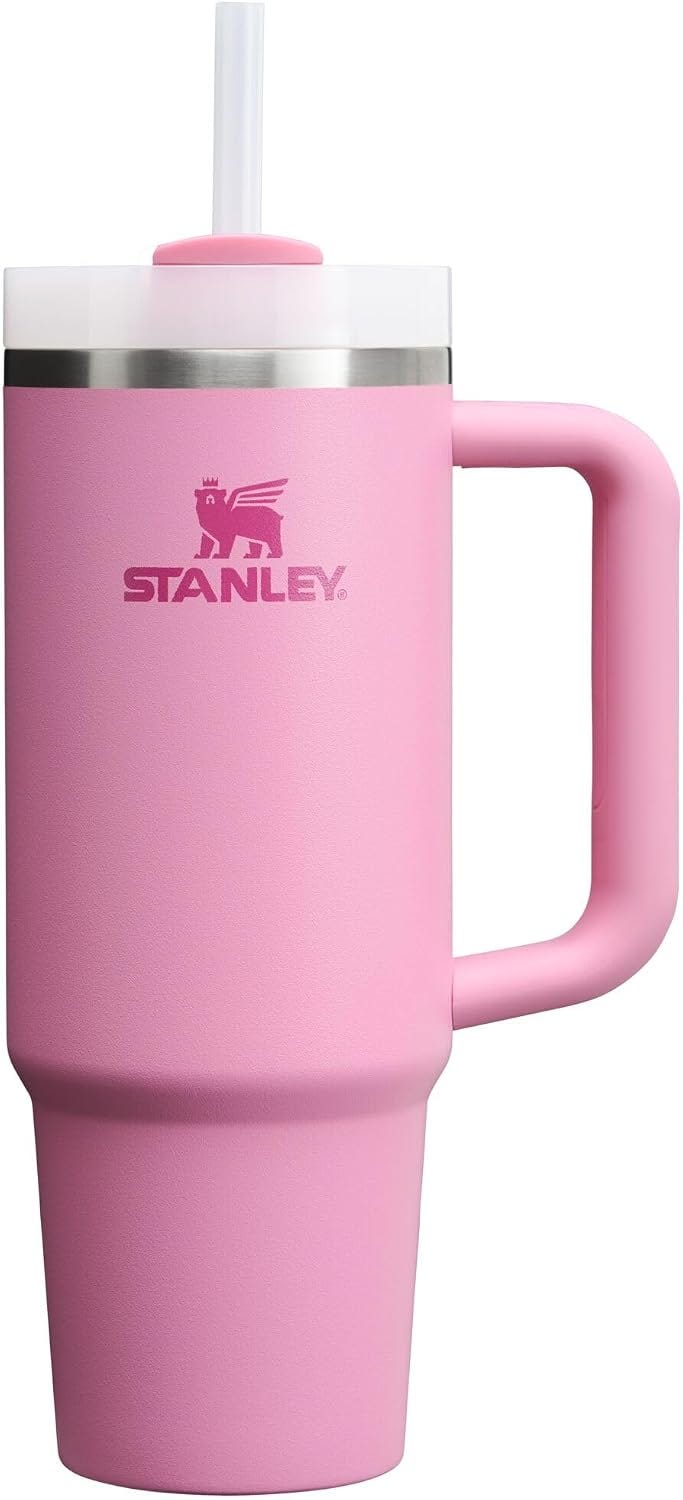
This is what Leroy (2009) referred to as attention residue. According to Leroy, “people need to stop thinking about one task in order to fully transition their attention and perform well on another. Yet, results indicate it is difficult for people to transition their attention away from an unfinished task and their subsequent task performance suffers.” It’s like the aftertaste of that cherry soda on the straw of your big-ass Stanley mug… Hard to rinse away.
Andrew Huberman during his 2026 conversation with Chris Williamson credits James Clear with the idea that what you think about and what you choose has a lot to do with not only what you are currently thinking but also what you thought in the past hours or even days. It is crucial to set the stage correctly in order to make the most of your Deep Work time.
What Distracts You?
James Clear suggests that what we have been thinking or exposed to during the past hours and days affects what we are currently thinking.
During the time you read this blog, did you think about
other blogs you just read?
Email you wrote or read?
Social media posts?
Were you distracted by other titles and blogs you want to read next or right now?
Before Deep Work, limit exposure to intense or stimulating information or entertainment.
During Deep Work, limit your sensory environment.
Use noise canceling earphones or a white noise generator
Get rid of as many visual distractions as you can from your workspace.
Temporal Orienting refers to providing START and STOP cues for the work session. It lets you know that you are
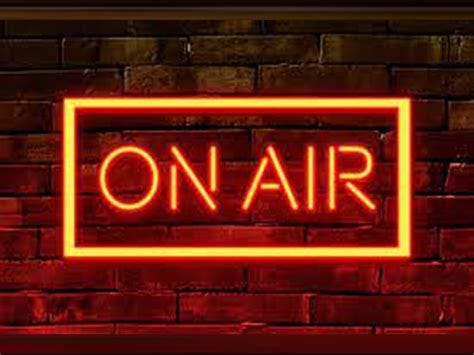
Create some kind of cue to yourself that you are in a Deep Work session. Train yourself to work as long as the signal is on. It can be as simple as the timer I use
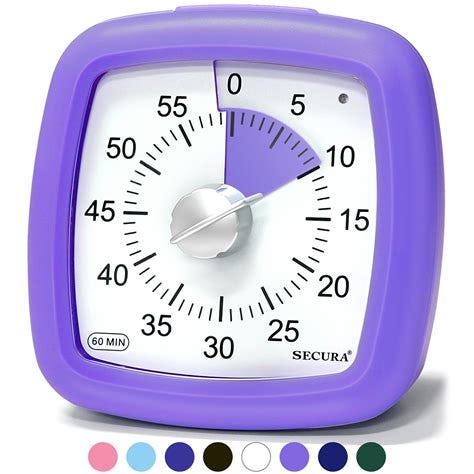
I have slightly adapted this START-ACT-STOP system into the following.
C – Cue (Cued Start)
L – Locate (Orient to Project)
O – Occupied Focus (Focus)
S – Summary Trail (Summarize & Leave Breadcrumbs)
E – Exit Signal (Terminate)
With the CUE, I start working.
In the first minute, I orient myself to my task by looking at my notes about what I need to do and quickly conceptualizing what my task is. This is LOCATE
The bulk of the time is spent on OCCUPIED FOCUS
In the final minute, I summarize where I am and leave a note specifying where to pick up. I try to write this note in a way that a stranger would understand because I might pick the work up immediately or after a long delay. “Finish note on CJ” probably won’t be intelligible.
The EXIT SIGNAL tells me it is time to stop and change focus.
Huberman says the type and quality of rest is essential. He recommends “boring rest.” Breathe, walk, close your eyes, have a drink of water. Just not all at the same time. Don’t open email or check TikTok if you intend to return to work. This gets whole sections of your mind working and unfortunately working at cross purposes to your goals.
During Deep Work, there is nothing more important than intense uninterrupted focus. Interruptions come in two basic forms. There are internal interruptions caused by thoughts, feelings and physical sensations arising in the body such as hunger. And there are external interruptions caused by noise, odors and, because we are primarily visual animals, visual cues.
It is extremely important to narrow your visual field of attention. Part of this is simply by eliminating the obvious distractions. Don’t have eye-catching photo displays or televisions or screens nearby. Don’t have your phone flashing notifications. Be careful even of sitting in front of a window if the scene in front of you is busy and distracting.
But part of this is also visual training. You can train yourself to focus your gaze on what you want to concentrate on. The better you become at noticing when your gaze wanders off and correcting this, the better you will become at elongating your concentration span and improving your attention.
What you focus on becomes the focal point of your attention. Let me expand on this. I like photography. When you look at a scene, your eyes can take in approximately a 180-220 degree wide field of vision. When you look through a camera’s viewfinder, the field is substantially narrowed to perhaps 45 degrees. When you look through the viewfinder, you focus on what is in the viewfinder. This is a helpful analogy for learning to focus your attention elsewhere.
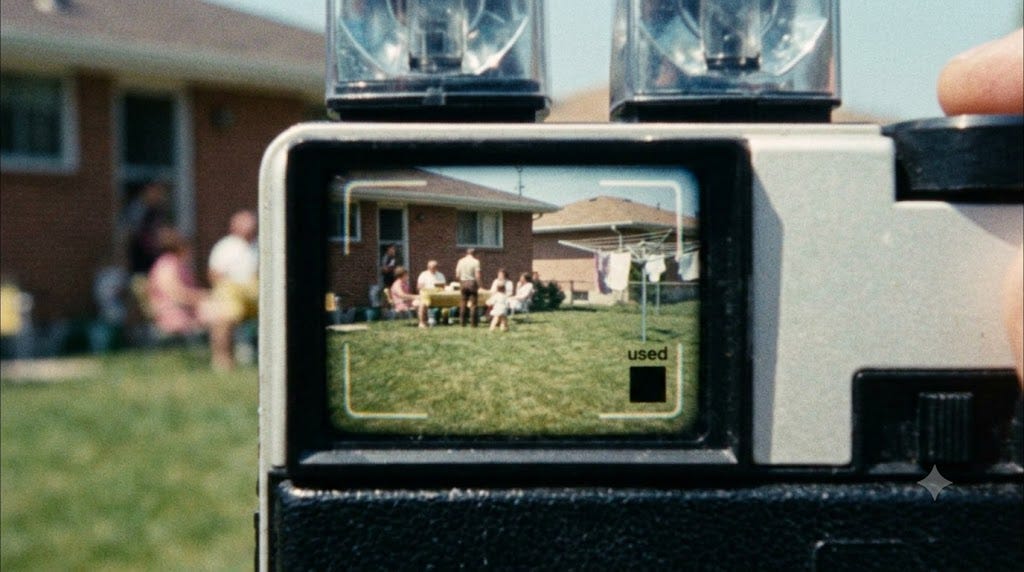
One exercise to help you appreciate focus of attention is what I call the “Instant Instamatic Index Card”. It’s pretty simple. Take a 3 X 5 index card and cut out a box about ½ inch wide. Draw a black frame around the box to cut down glare. Then see what the world looks like when you put it up to your eye.
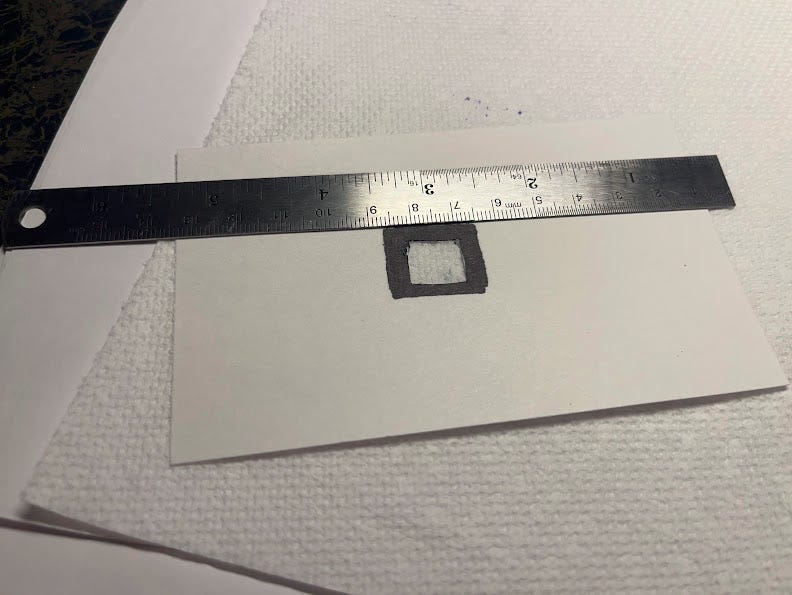
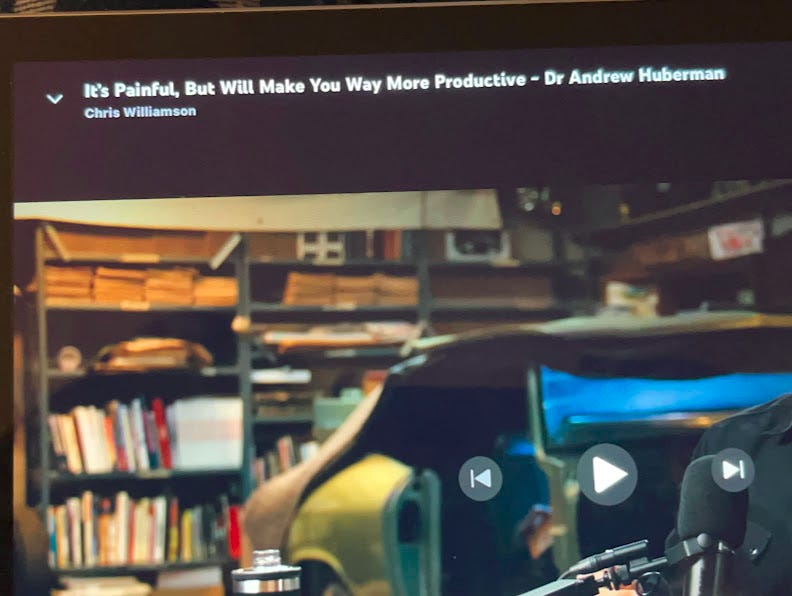
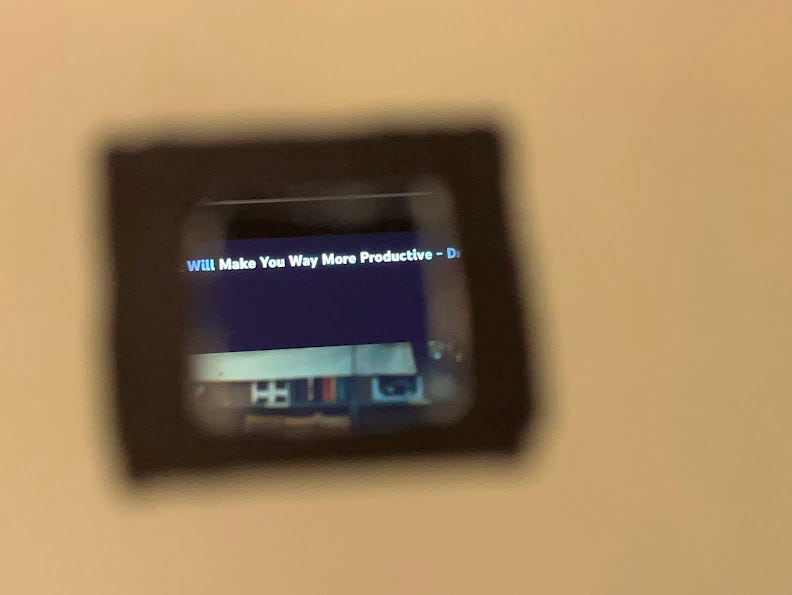
Suddenly, your field of vision is drastically narrowed. You focus on what is in the frame.
It can be interesting looking at a YouTube video or even Television through that frame. You instantly concentrate more. What is in focus becomes more salient.
Of course you can’t walk around with an index card in front of your face, but you can take that main idea with you. Your focus and specifically your visual focus is important. So,
Look at people talking to you
Look at the television when it is on.
Don’t look at your phone when you want to talk to someone.
45-55% of viewers report “Always” or “Almost Always” having a second screen (their phone) on when watching their TV. Don’t be one of those people.
If you want to remember what is happening during the baseball game, then look at the baseball game, not the running Pierogies

One of the tips Huberman provides for increased focus is to put a red dot on what you want to focus on and make sure your focus is on that.

When it comes to learning, output is more important than input. People can repeatedly read a book and even feel familiar with the book but still be unable to independently recall the names of the main characters or understand anything about the themes of the book. This is why students can read and highlight and re-read their text and then fail a test. Learning requires operating on the information in your head in order to create a new mental map.
Once you have read or studied or thought about something, do something with it. It’s not enough to just take notes. The information must be actively synthesized and organized.
What can you do with the information you have been exposed to? It all depends on the information and you. But you can
Draw something
Rehearse an action, dance, operation
Summarize it into an essay
Teach someone about it
Create a model or a prototype
Practice a conversation in that foreign language
And once you create that product… PUT IT OUT THERE!
This remains one of my motivations for this blog. It’s not enough for me to read things. I want to synthesize that reading into an essay.
But it’s not enough to create an essay and store it in the digital purgatory of my hard drive. Publish it. Make it real. Let other people see and comment and complement or criticize your work.
When possible, solicit feedback on your work from a mentor or associate. But also, let that work out into the wild and see who responds.
The world has a way of reality testing and correcting our excesses and misperceptions, especially if we distribute it to a wide enough audience. Distribution only in your “echo chamber” or only to your AI Bot tends to just amplify your message back to you.
In the classic paper by Dunlosky, self-testing is one of the strongest methods of ensuring learning. Self-testing helps us retain information, assess what we know well and poorly, and motivates us to learn at a deeper level. When you use a well-constructed test, you are able to accurately see your strengths and weaknesses. But even the most rudimentary self test is better than none.
Without looking at the text/video
What was it about?
What are three important points I would tell somebody about this book/movie/presentation?
Who was the presenter and why are they credible or not?
What is the next question based on this video/text?
Dunlosky also talks about spaced repetition. To remember something, you need to periodically review it. How often? It depends on how long you want to remember the information.
A common practical rule of thumb for spaced repetition (based on memory research and the 10%–20% rule of target retention) follows this progression:
To remember for a day: Review 1 to 2 hours after first learning it (or once before sleep).
To remember for a week: Review 1 day later (and once mid-week).
To remember for a month: Review 1 week later.
To remember for a year: Review 1 month later (and again every 2–3 months).
To remember long-term (multi-year): Review every 6 months to 1 year.
Finally, Dunlosky talks about the importance of providing less and less structure so that you need to provide a more well-developed response independently. For instance, you can begin by self-quizzing:
The first five presidents were
W_______
A_______
J_______
Ma______
Mo______
And fade the prompt to: name the first five presidents of the United States.
Cal Newport, in his Podcast Deep Questions tackles the question about Learning Hard Things. Newport emphasizes the importance of getting better by having deliberate appropriate next steps. This involves knowing how to make the next step of learning or performance that little bit harder so that it challenges you but still stays in the Goldilocks Zone of difficulty. Not so easy that you are not challenged, but no so hard that you consistently fail and don’t learn or experience reinforcement.
Newport emphasizes getting guidance from an expert and this can be a teacher, mentor, coach or a formal coach.
Finally, it’s easy to assume that we learn hard things and do Deep Work because we want to wade in the cesspool of hustle culture. Do more. Get better. Optimize yourself. Wrong.
After you are done with Deep Work. After you are finished with reviewing and writing your note about what the next step is, do one last habit recommended by Cal Newport.
We all need a life.
In the words of the great Cindi Lauper “Girls Just Want to Have Fun.” So go have fun.
Fun is the background that makes everything else possible and meaningful.
So go have it.
To learn and focus optimally, sandwich Deep Work between quiet periods.
Use Temporal Orienting to signal the onset and end of Deep Work
Output >> Input. Create something to make your learning sticky.
Reality Check - Put your work out there and get feedback. Make it real.
Test yourself - It’s the best way to learn and know you have learned.
Spaced Repetition and Fading the Prompt. To retain your learning, review at increasingly longer intervals and with fewer and less structured prompts.
Level up - Learning new skills involves deliberate selection of appropriate “next harder steps”
Have a good life. It’s not all about work
References
Coull, J. T., & Nobre, A. C. (1998). Where and when to pay attention: The neural systems for directing attention to spatial locations and to time intervals as revealed by both PET and fMRI. Journal of Neuroscience, 18(18), 7426–7435. https://doi.org/10.1523/JNEUROSCI.18-18-07426.1998
Dunlosky, J., Rawson, K. A., Marsh, E. J., Nathan, M. J., & Willingham, D. T. (2013). Improving students’ learning with effective learning techniques: Promising directions from cognitive and educational psychology. Psychological Science in the Public Interest, 14(1), 4–58. https://doi.org/10.1177/1529100612453266
Huberman, A. (Host). (2022, September 5). Focus toolkit: Tools to improve your focus & concentration (No. 88) [Audio podcast episode]. In Huberman Lab. Scicomm Media. https://www.hubermanlab.com/episode/focus-toolkit-tools-to-improve-your-focus-and-concentration
Leroy, S. (2009). Why is it so hard to do my work? The challenge of attention residue when switching between work tasks. Organizational Behavior and Human Decision Processes, 109(2), 168–181. https://doi.org/10.1016/j.obhdp.2009.04.002
Newport, C. (Host). (2024, January 1). Ep. 281: Learning hard things (No. 281) [Audio podcast episode]. In Deep Questions with Cal Newport. The Deep Life. https://www.thedeeplife.com/podcasts/episodes/ep-281-learning-hard-things/
University of California - Berkeley. (2007, August 22). The brain doesn’t like visual gaps and fills them in. ScienceDaily. https://www.sciencedaily.com/releases/2007/08/070820135833.htm
Williamson, C. (Host). (2026, January 2). It’s painful, but will make you way more productive - Dr Andrew Huberman [Video]. YouTube.
No posts
Comments
Nothing yet. Say the first thing.
Sign in to join the conversation.